

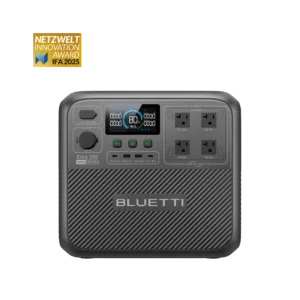
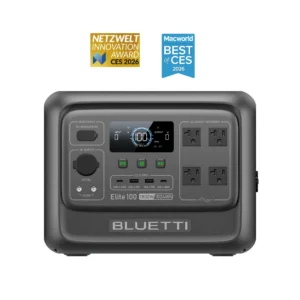
The defining question for a full-time off-grid station is not how big the battery is — it is how much sun actually gets in. A unit that fills slowly is a unit that runs dry. Two large-battery contenders looked nearly identical on paper; what independent testing found in the field split them decisively.
The DELTA Pro 3 is the only large-battery unit here whose solar intake in the field roughly matches what the label promises. Independent testing measured approximately 1,650W through the High-PV port and another 1,150W through the Low-PV port — close to the 2,600W ceiling, and a result no competing unit in the eligible set came close to replicating. That difference is the case: a cabin cycling its battery every day on the sun cannot afford a 50% gap between the rated and the real.
The evidence for full-time off-grid use is not theoretical. One owner documented daily use for over a year, and the unit’s review explicitly names the off-grid cabin or remote-property owner as a core buyer. Real runtimes carrying a fridge, furnace, and tankless water heater measured 20–22 hours; a refrigerator alone stretched to 28 hours. Noise at idle and under light loads measured around 30dB — described by the long-term tester as effectively silent overnight, reaching 55–56dB only when pushing sustained loads near 4kW. At $2,099 the 4,096Wh base is expandable to 12kWh on a single unit. (The marketed 48kWh figure is a three-unit system incorporating gasoline Smart Generators — not a pure-battery number, and the review FAQ flags it as such.) Native 120V and 240V from one box is a useful forward compatibility if the cabin ever adds a 240V load.
Plan the motor-start headroom on the measured surge figure, not the rated one: independent testing confirmed the unit holds around 5,100W for roughly a minute before shutting down as loads approach 6,000W. Size accordingly.
Two things to wire into how you use it. First, the two solar ports do not share a voltage window — High-PV is 30–150V and Low-PV is 11–60V — so the array needs to be planned per port, and owners consistently flag the initial wiring as fiddly. Do not series-wire the bifacial panels into three-panel strings into the High-PV port: three panels in series rides the 150V ceiling exactly, and cold-morning open-circuit voltage rise will push past it. Second, and more significant: firmware faults and app dependency make this unit unreliable for unattended critical loads. A long-term tester logged three unexpected resets in five weeks. The review’s off-grid endorsement carries the assumption that you are on site to notice and recover from a lockup. If your off-grid setup runs unattended life-critical equipment — well pump, medical device, anything that cannot wait — no station on this page is the right answer; that is dedicated-UPS territory.
Panel pairing — EcoFlow 125W Bifacial Modular Solar Panel ($169/panel, sold in 250W and 500W kits): This is the permanent-install panel. Rigid tempered glass, aluminum frame, 5-year warranty, and a 30-year/90% output rating — built to live outside, which the foldable alternatives are not. The EcoFlow 400W foldable’s own review warns its polymer surface degrades within 12–24 months of continuous sun exposure. At 50V Voc per panel on XT60, the system is parallel-native by design: the published specification is optimized for parallel wiring up to 8 panels per set, which puts them comfortably inside the High-PV port’s 30–150V window without any series math. Real output runs at or above the label — a 500W four-panel kit measured 525–537W feeding a DELTA Pro 3 — and EcoFlow rates three 500W kits to refill the unit in 3–4 hours. One required habit regardless of panel type: anchor the kickstand legs with sandbags or stakes. The 9.26-lb panels tip in wind, and tempered glass behaves like glass.
Skip it if: your cabin runs unattended for days at a time with critical loads — firmware resets are a documented reality, and for a permanently staffed cabin with heavy continuous draw, the Apex 300’s standby efficiency and cold-weather tolerance make it the stronger choice.
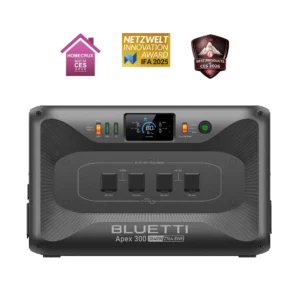
paired with 2× Bluetti PV350
The cold-climate or efficiency-conscious cabin, particularly one on a tighter budget, has a genuine alternative here. The Apex 300’s review measured standby draw at 18–24.7W, compared to the DELTA Pro 3’s measured 49W — a meaningful gap for a unit that is always on, though the review is clear this advantage applies to standby, not to whole-day operation at light continuous loads where 240V pass-through draws more. One owner ran it at −15°C without pre-warming; a cabin running lights and internet reportedly stretched 5–7 days per charge; and the platform expands to 19,353.6Wh on one head unit. At $1,699 it undercuts the pick by $400, and it offers simultaneous 120V/240V split-phase from a single box.
The reason it is not the pick is exactly the axis that matters most for this use case. Its 2,400W solar rating collapses against a 60V-per-port MPPT ceiling: independent testers measured around 790W per port in cold conditions and never reached the claimed 1,200W per port. A 60–150V dead zone in its MPPT architecture — the base unit’s controller stops at 60V and the SolarX 4K accessory begins at 150V — strands standard series-wired panel arrays, the most common permanent-install configuration. The base unit also ships with no USB or DC ports; those require the separately sold Hub D1, and there is no solar or turbo-charge cable in the box.
Panel pairing for the Apex 300: two Bluetti PV350 panels ($599 each), one per port. The PV350’s 46.5V Voc sits cleanly inside the 60V ceiling — the configuration that avoids the dead-zone trap entirely. Two panels deliver a measured 560–660W real in good sun. IP65 splash-only: bring them in for rain, and confirm the Voc sticker reads 46.5V on arrival — a lower-voltage regional ‘PV350D’ variant exists and underperforms on some MPPTs.
The value case for a 120V-only cabin: 3,072Wh, real measured solar intake around 1,900W combined (its 165V high-PV input accepts standard panels in series), roughly 2,760Wh usable at the wall, and quiet operation at 35dB under moderate load. Three documented patterns keep it off the podium for full-time remote duty: the proprietary AC charging cable is a single point of failure with no off-the-shelf substitute; solar panels cannot remain connected overnight without extra battery drain; and there are no remote notifications — the review characterizes it as not a set-and-forget system for unattended use.
A homestead well pump, workshop, or central AC system does not negotiate with 120V. Native split-phase 240V is the hard requirement here, and it eliminates the majority of the portable power catalog before the solar question even comes up.
The 5000 Plus wins this segment on the one axis where the spec-sheet leader failed the measurement test. The EcoFlow DELTA Pro Ultra carries a 5,600W rated solar input — higher than the 5000 Plus’s 4,000W — but independent testing found real-world peaks of 3–3.7kW on the high-voltage port and 1–1.2kW on the low, with hot climates throttling it further to 500–1,000W when the battery temperature hits 113°F. The review’s conclusion was direct: the buyer running primarily on solar for off-grid autonomy is the one this unit disappoints, and documented owners in exactly that situation have moved on from it. The 5000 Plus’s review verified 3,600–3,900W of actual intake from four 500W panels, filling the battery in 1.9 hours. Stronger solar intake, lower price ($2,899 against the DPU’s $4,099), and a review that names ‘off-grid or solar-primary owner with a real panel array’ as a core buyer profile.
The output credentials are also there for homestead loads. Testing confirmed clean power to the full 7,200W rated output (2.2–2.6% THD), and the unit ran a 2,400W well pump and dual RV air conditioners without complaint. The one architectural quirk — AC charging disables 240V output — does not touch a solar-primary deployment, because DC and solar input leave 240V fully available. This unit is happiest in exactly the configuration this segment demands.
One voltage planning note: the High-PV port requires a minimum 135V in operation — sized on operating voltage, not open-circuit. The SolarSaga 500X runs a maximum power voltage of 41.7V per panel, which means three panels in series (125.1V operating) sit under the floor; four in series (166.8V) is the working minimum. The review’s ‘roughly five panels’ guidance is consistent with this math and points in the same direction: size the array on ~40V operating voltage per panel, not the sticker. The panel supports up to 600V system voltage, so there is room to grow.
Two operational notes before you site it. The unit is rated IP20 — indoors only; run solar cables through the wall and keep it out of humidity, as the fans pull in whatever air is around them. The app is the weak link (Wi-Fi drops, scheduling bugs reported), but physical-button operation is solid and does not depend on it.
Keep surge expectations grounded in the measured figures: testing found the unit sustained around 8,000W for roughly 30 seconds and 9,500W for about 20 seconds, but could not start a 10,000W-surge air conditioner unaided. A soft-start module on central AC is the right call.
Panel pairing — Jackery SolarSaga 500X ($799/panel): This is the panel behind the verified 3.6–3.9kW intake figure, and the one Jackery bundles with this station. Its own review verdict is ‘skip unless’ — the unless being an owner of a large Jackery station who will tilt-mount it. Laid flat, it delivers around 250W; tilted 20–30° on a fence, pole, or stand it reaches approximately 400W, with Jackery confirming 70–80% of the 500W rating as the realistic ceiling. Specs: 48.5V Voc, 41.7V Vmp, IP68, 22.05 lbs, 5-year warranty. Wire four or more in series to clear the 135V High-PV floor at operating voltage, mount them tilted, and size the array on the 70–80% figure.
Skip it if: AC charging is part of your energy mix — it disables 240V output on the 5000 Plus, which means any grid or generator AC-charge session takes the big loads offline. For a site that needs 240V available at all times, the E10’s passive architecture and persistent 240V output make it the sounder choice.
paired with Anker SOLIX PS400 strings
The homestead whose defining load is a hard-starting motor — a large well pump, a 5-ton central AC system — has a purpose-built alternative. The E10 is the only unit on this page validated to start a 6.15kW central-AC inrush (155 LRA, confirmed running a full 5-ton system with two or more batteries), the only outdoor-rated unit here (NEMA 4 / IP66), fully passively cooled and therefore silent, with a 9,000W solar input ceiling across two MPPTs (30–450V) and expansion to 92kWh. Its tri-fuel Smart Generator integration auto-starts on a state-of-charge threshold — a genuinely useful feature when there is no grid behind you. (Cannot ship to California.)
The reason it does not lead: its high-wattage solar intake is unverified in the field. The only solar data point in the review is approximately 400W under overcast from eight panels in series — the 9,000W ceiling is the most capable rating in this comparison on paper and the least demonstrated at scale. That uncertainty, combined with a $4,299 starting price, app-only interface (no built-in display), and a form factor built for permanent installation rather than redeployment, puts it behind the verified 5000 Plus for the segment as written.
Panel pairing for the E10: Anker SOLIX PS400 panels ($699.99 each) on native MC4. At 57.6V Voc, strings of four reach approximately 230V — comfortably inside the 30–450V MPPT windows. Cap any single string at seven panels: eight in series puts open-circuit voltage at 460.8V, over the 450V ceiling. Plan on 275–345W real per panel in good conditions, per the PS400’s own review. The snap-button stand mechanism is a documented failure point with no reliable owner workaround — plan for a fixed external support structure from day one and treat each panel as a permanent array placement. The E10’s 9kW ceiling is engineered for rigid roof arrays; the PS400 is the in-catalog path to that potential.
The hybrid-energy answer for a homestead that supplements solar with a generator. Its review confirms off-grid cabin viability on a solar-plus-generator pattern, and the 11–165V MPPT range — the most-cited upgrade over the original F3800 — accepts standard third-party panels in series: series-wired 48V panels measured 830W where the same array in parallel made 623W, with real-world intake reported at 1,400–2,200W in non-ideal conditions. The 240V generator bypass charges while powering 240V loads at around 3,300W single-unit. A smaller battery (3,840Wh) and a 136.7-lb frame keep it behind the 5000 Plus when solar is primary, but for a homestead that already plans to run a generator on heavy cloudy stretches, it is a credible and less expensive path.
A weekend or seasonal retreat asks something different from a power station than a full-time cabin does. The unit spends more time sitting than running, gets hauled in a truck bed rather than bolted to a wall, and needs to refill in an afternoon of sun rather than across a whole day. At this size — the 2kWh class — the spec sheets cluster tightly enough that the interesting differences are all in the second-order numbers.
The Elite 200 V2 wins on the axes that set real weekend runtime. Independent bench testing measured 96% AC inverter efficiency and roughly 9.5–10W idle with the inverter on — the review called both the best its testers had seen at this size — and that is why owners consistently report 22–30 hours on a full-size fridge and why a weekend of fridge, lights, and cooking routinely ends with charge to spare. Efficiency at the inverter and idle at light loads are exactly what separate a 2kWh unit that feels capacious from one that just barely makes it through a weekend.
The 6,000+ cycle LFP chemistry is double several class rivals’ cycle ratings, and it suits the retreat ownership pattern well: the unit deep-cycles hard for two or three days, then sits idle for weeks or months. Storage guidance is a recharge to 40–60% every 3–6 months. Turbo charging (80% in roughly an hour) means a grid stop on the drive out fills it fast. At $799 it is the cheapest path to 2kWh on this page.
There are two limits to plan around. The 60V solar input ceiling rules out series-wiring standard residential panels — owners see roughly 600–800W real in parallel configurations. The pairing below is chosen specifically to stay inside that ceiling without series math. And the unit does not expand: what you buy is the permanent capacity ceiling. If the retreat is quietly becoming a full cabin, that fixed ceiling is the thing to know before buying.
Before you trust it with a cycling fridge: disable the default ECO mode (it can cut AC outlets during a fridge’s between-cycle idle) and run a calibration cycle so the state-of-charge gauge reads true. The display reports VA rather than watts, so it over-states some loads until you calibrate your expectations against actual consumption.
Panel pairing — Bluetti PV350 ($599): On Bluetti’s official compatibility list for the Elite 200 V2, and at 46.5V Voc it is the single high-voltage panel the 60V ceiling demands — one cable, no series wiring, no math. Real output runs 280–330W in good sun, with better-than-class shade behavior per the review. Two panels in parallel approach the 1,000W input ceiling. IP65 splash-only: deploy and retrieve for rain, and confirm the 46.5V Voc sticker on arrival — a lower-voltage regional variant exists.
Skip it if: the retreat is fixed in scope and you will never use more than 2kWh — at $600 less and noticeably lighter, the Elite 200 V2 is the right match for a weekend that stays a weekend. If the plan includes a window AC unit, note that the Elite 200 V2’s surge is Power Lifting only and will not start a compressor — the 2000 Plus’s 3,000W inverter is the better platform for that load.
paired with Jackery SolarSaga 200W (or 500X)
The retreat that is already becoming a cabin should buy this instead. The review’s whole verdict is essentially ‘buy it only if you will grow into it’ — and the buyer who will is real in this segment: 2kWh today, scaling to 12kWh on one unit and 24kWh across two, with each expansion pack adding its own solar inputs. A documented owner lived off-grid for a year and a half post-wildfire on six panels, a 2000 Plus, and one expansion battery. The 3,000W inverter bench-sustained clean sine power, out-muscling everything else in this class. At $1,399 it is $600 more than the pick and 8 lbs heavier — the review says clearly not to pay the premium for headroom you will never touch.
Solar caveats to know before buying: the 60V/12A-per-port input limits panel options; an F7 error appears if panels stay connected overnight (use a disconnect switch or timer between sessions); and a documented cluster of solar-input-port failures means testing solar charging thoroughly in the return window is not optional — that port is this segment’s lifeline. For the fixed-scope weekender, the Elite 200 V2 is the better match; for the retreater who is quietly planning a cabin, the 2000 Plus is the right long game.
Panel pairing for the 2000 Plus: the SolarSaga 200W ($379) is the rare portable that hits its rating — 198–200W measured in aligned sun — and two of them delivered a verified 393–430W into this exact station. 22V Voc fits the port windows natively. Scaling up, one SolarSaga 500X per port (tilt-mounted) is a confirmed compatible path.
The solo off-grid build runs on a simple equation: if real solar intake roughly matches battery size, the pack refills in a good hour of sun and effectively never goes dry during daylight. Two units in this class clear that bar — one costs $200 less and weighs less, the other grows with the build.
At $399 and 25 lbs, the Elite 100 V2 is the cheapest and lightest unit on this entire page — and its solar intake is verified, not aspirational. Bench testing unlocked the full 1,000W at 48–60V panel configurations, and the review calls it one of the fastest-charging solar stations its testers had seen at this size. Usable capacity holds around 86% at the wall over AC, higher on DC. For attended light-load solo use, the weaknesses that exist do not reach this buyer.
Run the fridge and router on the 12V DC port instead of through the inverter: standby drain on DC measures roughly 140Wh per day, against roughly 262Wh per day with the inverter active — the discipline of switching the inverter off overnight is the single most effective habit for stretching this pack. Owners have confirmed the 12V/10A port starts diesel heaters across dozens of cold-weather starts; verify your specific heater’s startup current against the 10A rating before relying on it.
Two setup steps before you trust it in the field. First, enable high-current PV mode in the app — it ships off, and one owner went from 123W to 260W with a single toggle. Second, disable the default ECO mode before connecting a cycling fridge; a documented sump-pump shutoff traces directly to that default. Take an hour on arrival, run both steps, and the unit behaves as advertised.
One reliability note that is worth knowing before you buy: a recurring early-failure cluster exists — DOA units and deaths within the first 1–6 months appear in the owner record. Bluetti honors the 5-year warranty, but test the unit hard on arrival and keep a fallback plan for anything critical during the break-in period.
Panel pairing — Bluetti PV350 ($599): On the official Elite 100 V2 compatibility list, and its 46.5V Voc is the one-panel answer to the ‘wire at 48V or above’ requirement — one cable, no series math, roughly 280–330W real output, refilling the 1,024Wh pack in approximately 3–4 hours of usable sun. IP65 splash-only; confirm the 46.5V variant on arrival.
Skip it if: the build will grow or your primary load is a compressor fridge or freezer — the DELTA 3 Plus’s expandability and documented motor-start ability make it the better foundation. The Elite 100 V2 is the answer for a fixed, light-load solo setup where the price and weight savings are real money and real carry weight.
paired with EcoFlow NextGen 220W Bifacial
The starter who knows the build will grow, or whose fridge is a compressor unit, should look here instead. It matches the 1,000W solar input across two independent 500W MPPT ports (11–60V each), expands to 5kWh with broad cross-generation battery compatibility, and an AC recharge in a measured 55 minutes is the fastest in this class. Critically, the DELTA 3 family started a 1,275W window AC that the Elite 100 V2 refused — that motor-start gap is documented in the Elite’s own review, and if a compressor freezer or window unit is on the load list, this is the unit to buy.
The reason it is not the pick: $200 more, and its loudest flaw lands squarely on this segment. Idle draw with the inverter on measures roughly 32–40W — roughly three to four times the Elite’s — a real tax on a 1kWh pack at light loads. It is manageable with the discipline of killing outputs overnight, but manageable is not the same as free. Measured surge also falls short of the rated figure at approximately 2,600W, and sustained loads above 1,500W trigger thermal derating.
Panel pairing for the DELTA 3 Plus: the EcoFlow NextGen 220W Bifacial ($299) is the bundle partner for this station and hits its rating — 180–210W front-side in good sun, up to 240W in cool air, with the rear side contributing 15–25% over reflective ground. 21.5V Voc: two panels in series per port (43V) fits the 11–60V window. The review’s one rule for this panel: tempered glass cracks under repeated folding. Deploy it at the hut and leave it, which is exactly this segment’s pattern.
The largest battery in the class at 1,264Wh, an honest 2,000W inverter bench-sustained to 2,136W, and expansion to 5,056Wh. It trails on the solar axis that defines this segment: 800W rated input measures roughly 550W real, and the proprietary DC8020 connector requires an MC4 adapter for third-party panels. A solid ecosystem pick; not the fast-solar one.