

The honest finding for this whole tier: expanding a sub-1kWh station rarely makes economic sense. On the smallest units the add-on battery often costs as much as a second whole station or a step-up unit outright, and published reviews say so repeatedly. Treat this segment’s pick as the best compact station that also offers a genuine runtime-extension path — if expansion is your primary goal, the entry all-rounder in the next segment is the better starting point.
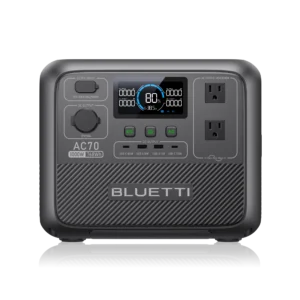
The AC70P wins on two things that matter most for a compact station used as backup: it recharges to 80% in about 45 minutes — the fastest in this tier, confirmed by independent testing — and it idles at roughly 6W with the inverter on, which is genuinely efficient enough to leave plugged in without watching the meter.
Before you buy it as an expandable, read the architecture carefully. The marketed ‘expandable to ~4,000Wh’ is Power Bank Mode: a compatible battery connects via cable and recharges the AC70P’s internal pack. It extends runtime, but it does not turn the unit into a continuous parallel power source. That’s a meaningful distinction if you were imagining a system that grows seamlessly — what you’re actually buying is a bigger fuel tank, not a bigger engine.
There’s one firm boundary on the backup side. The ~20ms switchover degrades when the unit sits at full charge — exactly the state a standby backup unit spends most of its life in. An owner running a Plex server saw a power blip on roughly 20% of outages. Fridges, TVs, routers, pellet stoves: fine. A server, NAS, or anything that reboots on a brief dropout: wrong tool.
Skip it if: you need the backup to be invisible to sensitive electronics — look at the EcoFlow RIVER 3 Plus for its sub-10ms switchover, or step up to the DELTA 3 Plus if you want genuine capacity growth alongside clean backup behavior.
The RIVER 3 Plus holds one genuine advantage over the pick: its sub-10ms switchover is the best in this tier and actually qualifies as UPS behavior for sensitive loads. At 10.4 lb and $269 it’s also the lightest and cheapest path into the segment. But the expansion case — the reason it belongs in this guide at all — is the part the review explicitly warns against: the economics collapse, and you’re better served buying a second unit or stepping up to a larger station than purchasing the expansion battery. Compound that with a documented firmware bug that cuts AC at 100% state-of-charge during solar charging (EcoFlow has declined to fix it) and a recurring chemical-smell complaint driving returns, and the RIVER 3 Plus earns the runner-up slot on its UPS behavior alone. Buy it over the AC70P if sensitive-load protection is the priority and you have no real expansion ambitions.
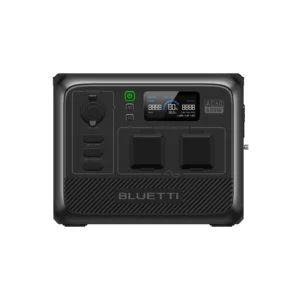
The AC60P is a smaller, pricier sibling to the AC70P — 504Wh, 600W rated output, 20.06 lb, $749 — that also expands. Without a full published review in the set it stays a conditional mention rather than a scored pick; consider it if the AC70P’s 864Wh is more than you need and the smaller footprint matters.
Most people searching for an expandable power station end up wanting this: something one person can carry, around 1kWh, that can grow into a multi-day essentials bank when the need arises — without a separate purchase decision later. The field here is legitimate and competitive.
The DELTA 3 Plus doesn’t win on any single spectacular number — it wins because it leads the tier on nearly every axis at once. It’s the lightest expandable here. It recharges in under an hour. Its dual 1,000W solar input is double what the base DELTA 3 accepts, which is the figure that matters most for off-grid replenishment when wall power isn’t available. And it matches the field’s 5kWh expansion ceiling, reached by adding one large DP3-series battery.
The software platform is a real differentiator too. Time-of-Use scheduling, usage graphs, and a working API set it apart from the DELTA 3 1500, which fits the same shell but runs the older DELTA 2 software — no scheduling, no graphs, no API. If you want the full feature stack, the Plus is the one.
Two things to know before committing. EcoFlow’s inverter can cut sensitive loads earlier than you’d expect — the base DELTA 3 review documented a 3D printer shutting off around 375W continuous draw, and the behavior carries to the Plus. And idle draw runs 17–18W, which is worth knowing if the unit will sit on standby for long stretches. Neither is a dealbreaker for the all-rounder use case; both are worth the awareness.
If you’ll recharge almost exclusively from the wall and rarely need solar, the base DELTA 3 at $519 expands to the same 5,000Wh with a single 500W solar input. The Plus justifies its $80 premium the moment solar becomes your primary recharge source.
Skip it if: you regularly run a microwave, induction burner, or other high-draw appliance — the Jackery Explorer 1000 Plus‘s confirmed 2,000W inverter handles surge loads the 1,800W class trips on.
The one place the Explorer 1000 Plus beats the DELTA 3 Plus is the inverter. Independent bench testing confirmed sustained output above 2,100W with brief surges to 2,500W — it swallows the compressor kicks and appliance surges that a 1,800W inverter trips on. At the same $599 price and with a larger 1,264Wh base capacity, it’s also the better value-per-watt-hour in the tier at $0.474/Wh. Buy it over the pick if you need to run a microwave or power tools.
It’s demoted from the top spot for the all-rounder role for three reasons: it’s roughly 4 lb heavier, its expansion battery costs well over twice the base unit price (making the 5,056Wh ceiling expensive to actually reach), and its EPS auto-shutoff below about 10W draw is a real risk if you plan to run a low-draw CPAP overnight as backup — test that specific load before relying on it.
The DELTA 3 1500 offers the most watt-hours per dollar in the tier at $599 for 1,536Wh, expanding to 5,500Wh. The catch is the software: it runs the older DELTA 2 platform — no Time-of-Use scheduling, no usage graphs, no working API, no combined AC-plus-solar charging — and its cycle rating (3,000 to 70%) is meaningfully worse than the 4,000-to-80% figure its siblings carry. It’s a capable dumb box for the capacity-first buyer who will never miss the smart features. Everyone else should buy the DELTA 3 Plus instead.
At $429.99 and 28.4 lb, the Gen 1 C1000 is lighter and cheaper than anything else here. Its ceiling, though, is just 2,112Wh — one expansion battery, and you’re done. Fine if a modest top-up is all you want; not the right foundation if you’re building toward a multi-day bank. One important note: the Gen 2 C1000 is sealed and cannot expand at all. Confirm the generation before buying.
The 2kWh class is legitimately crowded. Several units pass the expandability test, several have impressive ceilings on paper, and at least one has a review veto that settles the question before the scoring starts. The real differentiator is which unit gives you a competent base, a meaningful and economical growth path, and clean backup behavior — all three at once.
The C2000 Gen 2 is the lightest unit in this tier, the cheapest, and the one with the cleanest backup behavior. Idle draw sits between 9 and 18W — the lowest in the class — the 10ms UPS switchover is genuine, and the recharge is fast. For the buyer who wants fridge-and-essentials coverage now with the option to double the bank later, those three things together make a strong case.
The 4,096Wh ceiling is the right-sized answer for most essentials-backup buyers. Real fridge runtime lands at 14 to 22 hours — roughly half the figure some marketing implies, worth knowing when you’re sizing for a multi-day outage. Two settings to configure before you rely on it: the output-memory switch is off by default, so after a power loss the unit won’t resume its ‘on’ state until you enable that setting; and the TT-30 outlet is capped at 20A, so plan accordingly for any RV hookup.
Skip it if: you need a ceiling beyond 4kWh or a true 3,000W output for heavy appliances — the EcoFlow DELTA 3 Max Plus scales to 10kWh and delivers genuine 3,000W, and it’s the right pick for that specific requirement.
The DELTA 3 Max Plus scales to 10,000Wh and delivers a genuine 3,000W continuous output — the two axes where the C2000 Gen 2 runs out of room. It’s also the quietest unit in its class and carries a 30A Anderson DC port that makes it a real centerpiece for RV and van DC systems. If your eventual ambition is a deeper bank or you’re running high-draw appliances regularly, it belongs at the top of your list.
It’s demoted from the pick slot on the base-unit axes: standby drain runs 22–25W, which adds up quietly over multi-day outages; it auto-shuts off when AC draw falls below about 15W, which is a genuine trap for a router-only or low-draw overnight setup; and EPS behavior (not true online UPS) means owners have reported NAS and desktop reboots through the transition. One naming note worth repeating: the non-Plus ‘DELTA 3 Max‘ is sealed and cannot expand — make sure you’re buying the Plus.
At 61.5 lb and $1,399, the Explorer 2000 Plus is the heaviest and priciest unit here — but it carries the deepest expansion ceiling in the class at 24,000Wh, and its 3,000W inverter is the real thing. The pick if your long-term ambition is whole-home-scale backup starting from a portable base.
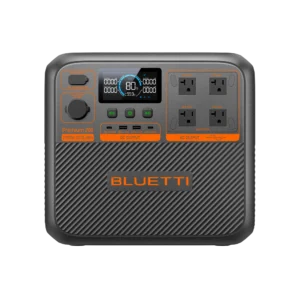
The Premium 200 V2 is the longevity pick: 6,000 cycles to 80%, which works out to roughly 17 years of daily use, and a genuinely silent 15–16 dB under light loads. Its B300 expansion path grows the bank roughly four times. It’s demoted for a thin DC side — single 12V/10A port, no TT-30 outlet — and a higher $1,499 price than the pick. The right choice for the buyer who prioritizes longevity and acoustic quietness over economy and port variety.
On clearance at $849, the DELTA 2 Max offers strong value and rare dual-MPPT solar. It’s the wrong choice for set-and-forget critical backup: a documented pattern of firmware updates silently resetting the AC-output defaults — including overriding the ‘never turn off’ setting — and a weak warranty-service record mean it needs a human in the loop. Use it only with a manual transfer switch and someone present to verify the output after any firmware event.
This is where the expandable category reaches its logical conclusion: units wired to a transfer switch, built out over time, expected to carry the whole house or a large off-grid load. Home-battery-class units are legitimate competitors here. Two honest caveats apply across the entire tier: solar ratings are systematically optimistic at this scale (plan around real measured input, not the spec sheet), and single-unit expansion ceilings differ meaningfully from the multi-unit marketing numbers — both are noted per unit below.
Among true-240V expandables, the DELTA Pro 3 is the lightest native split-phase chassis in the class — and for a unit you may eventually need to move as your setup evolves, that matters more than it sounds. It’s self-installable by any licensed electrician, carries a genuine 10ms UPS, and the $/Wh is competitive for the tier.
Two numbers to keep straight before sizing it. The single-unit battery ceiling is 12kWh — that’s the figure to use when planning one tower. The 48kWh headline in the marketing is a three-unit-plus-gas-generator number, not a single-stack ceiling. On surge, always use the measured figure: independent testing confirmed approximately 5,100W held for roughly a minute, with shutdown occurring near 6,000W. The 8,000W rated surge is not a planning number.
There are hard limits that matter for unattended installation. The DELTA Pro 3 cannot output 120V and 240V simultaneously — it’s one or the other. Pass-through is throttled to 1,800W. And known firmware faults make it a poor choice for critical loads that run unattended; it performs best with a human in the loop during extended operation. Size loads against the measured figures, not the label.
Skip it if: you need to output 120V and 240V at the same time — the Anker SOLIX F3800 is the only unit here that does both simultaneously, or step up to the DELTA Pro Ultra for the deepest single-system ceiling.
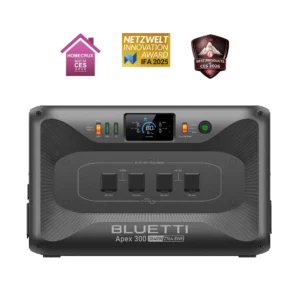
The Apex 300 is the lightest entry into single-box split-phase at 83.78 lb, and its a-la-carte scaling — up to approximately 19.3kWh from one head unit, or roughly 58kWh across three units via the Hub A1 — is the most flexible expansion architecture in the tier. Standby efficiency is class-leading. For the buyer who wants the lightest split-phase chassis and maximum modular flexibility, it belongs at the top of the list.
Its real acquisition cost is higher than the sticker. The base unit ships without USB or DC ports (the Hub D1 is a separate purchase), without a solar PV cable, and without the L14-50P turbo cable. One unit’s 240V is also capped at 16A — 30A service requires two units, 50A requires three. Solar badly underdelivers in practice: measured input runs roughly 790–1,100W against the 2,400W rated spec, and arrays in the 60–150V range hit a dead zone. There is also a critical distinction on the standby figure that is easy to miss: the widely cited 18–24.7W idle is standby-only. Under 240V mode with light continuous loads, the unit draws three to four times the consumed power via a pass-through that cycles the battery — Bluetti confirms this is intentional behavior. Don’t carry the standby figure into inverter-on operation or you’ll missize the efficiency math.
The F3800 is the only unit on this page that outputs 120V and 240V simultaneously, and at $1,799 it’s the cheapest way into 240V-capable backup here — expanding to 26.88kWh. The reason it doesn’t hold the runner-up slot: its 240V output disables during 120V AC charging, which means you cannot generator-recharge and run 240V loads at the same time. For a backup system built around solar or grid-only recharge, that limit may never matter. For a generator-recharge setup, it’s a genuine constraint. Real solar input runs around 1,200W against the 2,400W spec.
The DELTA Pro Ultra carries the deepest plug-and-play whole-home ceiling here — expanding to approximately 90kWh — and it does it with genuine online UPS behavior (measured switchover near 4ms), IP54 weather resistance, and a quieter acoustic profile than most units at this scale. At 181.8 lb, 6,144Wh base, and $4,099, it’s the right pick for the buyer who wants the maximum modular ceiling and plans to recharge from grid or generator. Plan solar input conservatively: real measured input runs roughly 3–3.7kW against the 5,600W rated spec. High-inrush motors are a mismatch — the surge envelope has limits that cost it some heavy-equipment scenarios.
The Explorer 5000 Plus carries the strongest single-unit inverter in the tier at 7,200W rated and a deep 60kWh ceiling, with native 120/240V output and 4,000W solar. Independent testing measured surge output near 9,500W for roughly 20 seconds (against the 14,400W rated figure). The tradeoffs are significant: it’s effectively a permanent fixture with wheels, rated IP20 for indoor use only, and requires a Jackery Smart Transfer Switch plus an electrician for the 240V hookup. The 50A port is rated for 30A current. Right for the buyer who needs the deepest inverter headroom; wrong for anyone who expects to relocate it.