

A whole-home solar generator has to do two things at once: keep 240V appliances running through a multi-day outage and refill itself with enough solar to stay useful day after day. The second requirement is where most systems in this class fail. Every flagship unit advertises a big solar throat — 5.6kW, 9kW, 10kW — but very few of those ratings hold up to measured intake. The system that wins this segment is the only one whose solar side is verified at scale.
The station is proven at this job. Owners running a 5,000W dryer, central AC, and a well pump simultaneously across multi-day tests reported no load-shedding, and independent testing measured the system at a quiet 43dB under full 12kW draw — understated for the class. The two 5,000W MPPT ports measured above 99% efficiency, and a full two-battery stack delivered 22.6kWh usable on whole-home loads in discharge testing — about 92% of nameplate, or roughly 11,300Wh per 12.3kWh battery at this regime.
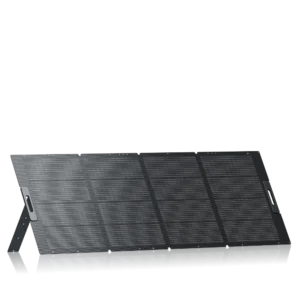
The solar side is the differentiator. The EcoFlow 125W Bifacial Modular panels are the only catalog option whose real-world output is independently verified: 500W sets measured at 525–556W in good sun. They’re also the only panel architecture here suited to a semi-permanent home array — rigid TOPCon bifacial construction with tempered glass and aluminum frame, IP68, with a 30-year/90% lifespan rating. The portable 400W foldable option isn’t a substitute: independent testing documents its polymer surface degrading within one to two years of permanent outdoor exposure. Two or three 500W bifacial sets give this system a real 1–1.5kW midday intake rate, putting roughly 6–9kWh back into the bank on a good sun day.
One limit demands honesty from any solar-generator framing: the largest panel building block in this catalog is 125W, so a complete catalog-panel system recharges at a 1–1.5kW daytime rate — enough to cover an essentials-heavy load, not a 30kWh-per-day summer-AC household. Owners in hot climates have calculated that roughly 6kW of solar paired with 12kWh of storage can’t keep up with Texas summer AC. Saturating the station’s 10kW solar input means roof-scale panels sourced outside this catalog.
There are two ownership risks to size up before committing. Full 12kW output requires two battery modules — a single-battery stack caps around 6,000–7,200W — and the inverter trips if one 240V leg carries more than roughly 6,500W, even when total draw is under 12kW; phase loads need to be balanced. The more serious concern is support: EcoFlow uses a return-first replacement policy, owner reports of dead inverters exist, and the Smart Home Panel’s relays are non-serviceable — a relay failure can lock a house off grid power entirely. For standby backup this is tolerable; as a sole off-grid power source it’s a genuine risk.
Skip it if: your primary goal is verified multi-day whole-home solar cycling with a modest budget — the Explorer 5000 Plus system below comes closer to genuine daily cycling at a fraction of the price, and is the better fit if 5kWh of base storage is enough to start.
The station carries a 7,200W split-phase inverter that ran dual RV air conditioners, a 2,400W well pump, and full kitchen loads in testing, with a <20ms switchover in standalone mode (true 0ms in Online mode via the Smart Transfer Switch accessory) and a measured AC recharge of about 1.7 hours. At 30dB rated and 35–40dB measured below 3,000W, it's quiet for a split-phase unit.
The panel side is where this system earns its runner-up place. Four SolarSaga 500X panels — the lightest 500W folding panel in the class at 22 lbs — delivered 3,600–3,900W of real input in clear conditions during comparative testing, refilling the base 5kWh station in under two hours. That’s the closest thing in this catalog to a solar generator that genuinely cycles daily at whole-home scale. One architecture note: the station’s high-PV input requires a minimum 135V, which means three or more 500X panels in series. Plan this array as a set; it’s not designed to be built one panel at a time.
It stays runner-up for three reasons: the base 5,040Wh pack isn’t multi-day whole-home energy without expansion batteries, the 14,400W surge claim fell short in testing (a 10,000W-surge central AC needs a soft-start), and the unit is IP20 indoor-only — panels live outside, the station lives inside, cables run through a window. One quirk actually favors the solar-generator use case: AC charging disables 240V output, but solar input does not, so the panels are the recharge path that keeps 240V loads running during a refill.
Two systems that didn’t make the picks, and why:
The EcoFlow DELTA Pro Ultra fails as a solar generator on its solar side: real-world intake measured at 3–3.7kW on the high-voltage input and 1–1.2kW on the low-voltage side against its 5.6kW rating, with solar throttling to 500–1,000W when the battery hits 113°F. For a solar-first buyer, its own published review sends them to the Ultra X instead.
The Anker SOLIX E10 is a credible installed whole-home appliance — passively cooled, NEMA 4 outdoor-rated, with turbo to 10kW — but its solar side is field-unverified: the only measured figure from testing is roughly 400W under overcast with eight panels, a real build runs well into five figures, and its sales and support layer carries a documented failure cluster. In a segment decided by verified solar, unverified solar costs it the pick. A buyer who specifically needs an outdoor pad installation should weigh it anyway — it’s the only outdoor-rated installed option in this catalog — but should do so knowing the solar throughput is spec, not evidence.
The wired-in essentials buyer has an electrician wiring a transfer switch for fridge, freezer, lights, and comms — plus a 240V load like a well pump — and needs the solar side of the system to make a multi-day outage livable without a gas generator running in the driveway. On paper, the Anker SOLIX F3800 anchors the segment’s best system: the lowest $/Wh of any 240V unit here, solid hardware, and a strong short-outage record. Two things veto it as a solar generator, and those two things are exactly what this buyer is counting on.
It’s the one system in this price band where both halves survive testing. The station delivers native split-phase from a single rolling box — owners have run well pumps, furnaces, central AC, and 240V welders on it — and the solar ports deliver close to their ratings: roughly 1,650W measured on the High-PV port, roughly 1,150W on the Low-PV port. The EcoFlow 125W Bifacial Modular panels pair directly with this station, and independent testing measured 525–537W per 500W set feeding a DELTA Pro 3 specifically. They stow flat between storms, matching the deploy-when-the-grid-drops pattern of a home backup system.
Two to three 500W sets give the system a real 1,000–1,500W daytime recharge rate, comfortably inside the 2,600W ceiling, putting roughly 5–7kWh back per good sun day against a roughly 3.8kWh usable tank — genuine daily-cycling territory. Independent discharge testing measured about 3,810Wh usable on 120V (about 3,880Wh on 240V) at outage loads, or roughly 93% of nameplate. Owners running real outages reported 20–22 hours on a fridge, furnace, and tankless water heater, and 28 hours on a refrigerator alone.
One wiring note: the two solar ports use non-overlapping voltage ranges, so an array gets split between them or committed to one. It’s fiddly but manageable, and the watts arrive — which is the thing that matters.
There is one hard limit that is not negotiable. A long-term tester running this station for five weeks logged three firmware-fault resets with no push notification on shutoff. Their explicit conclusion: do not rely on this unit where nobody is present to reset it. If the scenario is a CPAP or oxygen concentrator running while the house is empty, this is the wrong system. Two other limits to plan around: pass-through charging throttles output to roughly 1,800W while grid-connected, and the unit cannot output 120V and 240V simultaneously.
Skip it if: the system will run unattended critical medical loads — go to the Bluetti Apex 300 runner-up below, which carries a true 0ms UPS and a different firmware history, or step up to the Segment 1 systems for that duty cycle.
The Apex 300 ($1,699) does one thing no other single unit in the catalog does: it outputs 120V and 240V split-phase simultaneously from one box while charging from a wall outlet, with a true 0ms UPS. That combination — along with the lowest entry weight of any 240V station here at 83.78 lbs — makes it the right call when the unattended-critical-load scenario is real.
The Bluetti PV350 ($599 each) is the strongest real-output story among the catalog’s foldable panels: 280–330W measured in good sun, and it beat a 400W glass array in shaded conditions in testing. Its 46.5V Voc sits correctly inside the Apex 300’s 60V MPPT window, and it’s on the station’s official compatibility list. One model trap to avoid: a regional ‘PV350D’ variant exists with a near-identical name but a roughly 27–33V Voc that won’t work in this system. Confirm the spec sticker reads 46.5V before buying.
It stays runner-up because the solar side has a real ceiling: the 60V MPPT window caps actual intake around 790–1,100W per port, and the base station ships without solar cables or DC ports — this solar generator is assembled, not unboxed. With two PV350s the system banks roughly 550–650W at midday. Right for the staged-budget installer who’s adding panels over time; wrong for anyone expecting a complete kit. At $0.61/Wh the station costs more per stored watt-hour than the pick, and the base 2,764.8Wh nameplate is the smallest of the 240V options here.
The Anker SOLIX F3800, and why it isn’t here:
The F3800 ($1,799, 3,840Wh, 6,000W split-phase) is the lowest $/Wh of any 240V station in this catalog at $0.47/Wh, and its hardware is genuinely solid — its published review endorses it for short, hours-to-a-day outages with a deliberate recharge plan. Two things disqualify it as the engine of a solar generator for this buyer. First, the 60V/25A input ceiling makes its 2,400W solar rating unreachable with standard panels; an Anker 400W panel measured 280W in clear Texas sun, and realistic intake caps around 1,200W. Second, plugging wall or generator power into the AC input disables the 240V output and three of six 120V outlets — a 240V freezer or well pump stops every time the battery refills. For a buyer whose plan is solar-powered multi-day coverage, the charging architecture is the documented failure. It would be a fine pick on a non-solar short-outage backup page; the flipping factor here is solar replenishment.
For a household with no 240V loads on the backup list, the 3kWh-class 120V stations are almost identical on storage and output — 3,072–3,584Wh of capacity, 3,600W across the board. What separates systems is how much solar each one can actually absorb per day. The ratings spread 2,400W down to 1,000W, and independent testing confirms or shrinks each number. That difference, played out over a multi-day outage, is the difference between a system that cycles daily and one that’s draining on a clock.
It carries the biggest verified solar throat in the 120V class. The 2,400W dual-MPPT rating holds up: independent testing puts realistic intake around 1,900W on real-world arrays — more actual solar than the rivals’ ratings. Two station properties compound that for daily cycling: measured idle draw of roughly 20–35W, which is far below what the competition idles at, so overnight standby doesn’t eat the day’s harvest; and full 3,600W pass-through charging, so it powers loads while it refills.
Two PS400 panels ($699.99 each) give the system a real 550–690W midday rate — about 3–4kWh banked per good sun day against a roughly 2.7kWh usable tank. That’s a system that genuinely cycles. Independent testing measured roughly 2,760Wh usable at the wall at low-to-moderate discharge (~2,650Wh under heavier draw), about 90% of nameplate. Owners running a fridge, lights, and WiFi covered a full day per charge; a 400–600W partial-home load ran 13.5 hours.
For occasional outage use the PS400 is the right panel — its 57.6V Voc sits inside the station’s 60V low-voltage window, and owner testing logged a 421W peak. Plan around 275–345W real per panel in good conditions. One setup note: the snap-button stand legs are a known weak point, so anchor the panel against wind. If one person will be setting and breaking the system down solo every day, the PS400’s own independent review recommends two PS200s instead — the 400W unit is heavy for a solo daily handler.
Two limits that don’t touch the essentials-backup core job but are worth knowing: this is a native 120V station, and the four standard outlets cap at 2,400W combined. The AC charging cable and high-voltage solar adapter are proprietary — keep a spare of each.
Skip it if: indoor quiet matters more than maximum daily harvest, or if you want Smart Output Priority load-shedding and pre-storm pre-charge — the EcoFlow DELTA 3 Ultra Plus runner-up below trades solar ceiling for quieter operation and more automation.
The DELTA 3 Ultra Plus ($1,449) is the quietest station in this class at typical loads — rated at or below 25dB below 600W — and at 74.3 lbs with wheels and a telescoping handle, it’s the lightest of the high-output options. Self-Powered Mode and Storm Guard let the app pre-charge the battery ahead of a forecast storm, and the 10ms UPS is faster than the F3000’s 20ms.
One 500W EcoFlow 125W Bifacial Modular set pairs natively via XT60 and delivers at or above its rating — roughly 500W real from one set, with the station’s 1,600W ceiling leaving room for two more. A transfer-switch owner running seven essential circuits estimated roughly 2.5 days of battery-only runtime on their load; independent discharge testing measured about 2,690Wh usable, roughly 88% of nameplate.
It concedes the segment’s deciding factor: half the F3000’s solar ceiling, MPPT efficiency measured near 80% rather than the 90%+ a solar-first setup wants, and a real 19–30W idle draw if left on continuously. If the daily harvest is what you’re optimizing, this isn’t the system. It’s a legitimate sideways pick for the buyer who prizes indoor quiet over maximum solar throughput.
Two systems that didn’t make the picks, and why:
The Jackery HomePower 3600 Plus ($1,699) is a capable 120V outage station — the easiest to move in its capacity class, and it cold-charges down to −4°F. Its solar ceiling is the problem: 1,000W on a 3.6kWh pack, with a 60V limit that forces parallel-only arrays and MPPT efficiency measured at roughly 25% waste as heat. For a solar-powered multi-day system, it’s undersized on the intake side. A portability- or cold-climate-first buyer has a real case for it; the flipping factor here is solar throughput.
The Jackery HomePower 3000 ($1,299) is quieter still and a solid closet unit, but a 1,000W solar ceiling with no expansion path puts a hard ceiling on any solar-sustained system.
At this tier, storage, price, solar ceiling, and recharge speed all trade against each other across three closely matched stations. The fridge-runtime lead, the idle efficiency advantage, and the recharge-speed combination settle it — and the evidence here is unambiguous.
The station carries the only flat Strong Buy on this page, and the case is the combination that defines a small solar generator done right. At $0.39/Wh it’s the cheapest stored energy of any pick here. Idle draw measured at 9W with AC off and roughly 18W active — days of standby instead of hours, which means a single panel’s daily harvest isn’t bled away overnight. The 10ms UPS is verified; CPAP and router setups ride through the switchover without a blink. And the 58-minute combined AC-plus-solar recharge turns a power window into a short top-up — solar input is prioritized automatically when both sources are active.
One PS400 panel ($699.99) nearly saturates the 800W solar input at real-world output — 275–345W in good sun, with a 421W owner-measured peak. That’s roughly 1.5–2kWh banked per good sun day against the roughly 2kWh usable tank: a self-refilling system for outages that stretch past a day. Its 57.6V Voc sits inside the station’s 60V window. The same solo-handler caution applies here as in the 120V segment: if one person breaks down the panel every day, two PS200s are the more practical choice per the panel’s own independent review.
Real fridge runtime sits at 14–22 hours per charge with normal door use — plan around that range, not the 32-hour marketing figure, which is a closed-door lab number. CPAP users logged roughly 21% battery per 6-hour night with humidifier on, which translates to four nights before a refill is needed.
Before leaving the station set up unattended for fridge backup: enable the buried ‘Output Port Memory Switch’ first, or a unit that drains completely won’t restart its outlets when grid power returns. The default 1,800W fast-charge will trip a loaded 15A circuit — lower input watts in the app before plugging into a shared circuit. Neither is a dealbreaker, both are set-and-forget traps if you don’t know about them.
Skip it if: your loads or ambitions are likely to push past 2,400W, or if expansion beyond 4kWh is in the plan — the EcoFlow DELTA 3 Max Plus runner-up below carries a true 3,000W inverter, a 10kWh expansion runway, and smart load-shedding for the buyer who expects to grow into the system.
The DELTA 3 Max Plus ($1,099) is $299 more on the station, and the money buys specific things: a true 3,000W inverter that didn’t trip until roughly 3,600–3,750W in testing, a 1,000W dual-port solar ceiling versus 800W, a 10kWh expansion path, and Smart Output Priority load-shedding. At or below 25dB at 600W, it’s the quietest option in this class.
One EcoFlow 125W Bifacial Modular 500W set ($169/panel) connects natively via XT60 and delivers at or above its rating — about 500W real, filling half the 1,000W ceiling with one set. Independent discharge testing measured roughly 91–93% of nameplate at a 2kW load (~1,870–1,900Wh usable). A review owner ran a router, workstation, and tablet over ten hours with margin, and a refrigerator for five hours with plenty remaining.
Two cautions keep it second at this tier. The built-in UPS behaves like an EPS and has rebooted NAS units and desktops during switchover — put sensitive electronics on a small downstream UPS if they’re in the circuit. And 22–25W standby drain plus an auto-shutoff below roughly 15W load are real traps for set-and-forget router backup: the station may cut power to a low-draw router overnight even when the battery has capacity remaining.
One system that didn’t make the picks, and why:
The EcoFlow DELTA 3 Plus ($699, 1,024Wh) has the best solar-to-storage ratio at this tier — 1,000W of dual-port input on a 1kWh pack, refillable in roughly an hour of strong sun — and an 8ms-measured UPS. Its own published review forks hard against this buyer: 32–40W idle drain and broken Time-of-Use scheduling make it a poor always-on home unit, and 1,024Wh runs a fridge for roughly three hours. The review’s own verdict is to buy it for mobile use, not home standby. It’s a strong pick for a camping or road-trip solar generator page; the flipping factors here are storage-per-outage and idle behavior on standby.