
When you purchase through links on our site, we may earn an affiliate commission. Learn more.
A thousand watt-hours is the sweet spot in portable power for a reason: it’s the smallest size that runs a full-size fridge, a CPAP, or a mixed campsite for real hours, yet still fits in one hand for the trip to the car. The problem is that ‘best 1000Wh power station’ is five different questions depending on who’s asking. A van camper and a home-UPS buyer look at the same eight units and want opposite things — one optimizes for how fast the box refills at a café stop, the other for how quietly it idles in a closet for weeks without cutting power to the router.
No single unit wins every situation. The picks below are organized by use case, not by a global ranking that would mislead three of the five buyers it pretends to serve. Find your situation in the router below, then read that segment — the pick, the real-world numbers at your actual load, and the honest catch that would send you somewhere else.

The unit that lives in a truck bed or a van earns its keep on two things you feel every single trip: how heavy it is when you haul it out, and how fast it refills between adventures. Capacity is nearly identical across the band, so it doesn’t decide anything here. Weight and recharge speed do — with fan noise as a tiebreaker, because you sleep next to it.
The Gen 2 is the lightest unit in the 1kWh band at 24.9 lbs — a figure independent testing confirmed when testers called it the first unit in this class they could lift one-handed without thinking about it. That matters every time it moves.
What clinches it is the recharge speed. Independent testing measured a full 0–100% in 46–47 minutes in UltraFast mode, beating Anker’s own 49-minute claim. Dead-to-full is a coffee break. For a buyer who tops up at a café or a campground hookup, that’s the whole argument — you spend less time waiting and more time using it.
The bedside case: below 200 W the unit runs under 20 dB, which is about as close to silent as this class gets. A 12V cooler humming away at 80 watts won’t wake you. One timing note — during UltraFast charging the fans climb to around 42 dB, so charge it in the afternoon, not at the foot of your sleeping bag.
There are two things to handle before you leave civilization. First: SurgePad cannot be disabled, which means high-inrush devices — a table saw, some microwaves — may stall on startup. Camp loads don’t trigger it, but power tools do. Second: complete the Bluetooth app pairing at home. If the app hasn’t paired before you go off-grid, the outlets may not turn on — a genuinely inconvenient discovery at a dark campsite. Do it once, at home, and it’s not an issue.
The solar ceiling is 600 W, but reaching it requires 29–60 V panels. Common 12–28 V folding panels will top out near 200 W, so pair accordingly if solar matters to you here.
Skip it if: you want the absolute lightest box and your heaviest load stays under 1500 W — the Jackery Explorer 1000 v2 is 23.8 lbs and edges it on weight alone.
The Jackery is the single lightest unit in the band at 23.8 lbs — a meaningful pound lighter than the Gen 2 — and at measured charging noise below 22 dB it’s nearly as quiet. Its flat, stackable top is purpose-built for a packed vehicle. What keeps it in second place is a 1500 W output ceiling and a 20 ms switchover, both fine for a mobile camper who’s present and running moderate loads. If the lightest possible box is your priority and you stay under 1500 W, this is your pick over the Gen 2.
When the panel is your only refill, the solar input ceiling is the most important number on the spec sheet — but it’s the second question you have to ask. The first question is whether that ceiling is actually accessible, or whether it’s sitting behind a default setting that nobody told you to change.
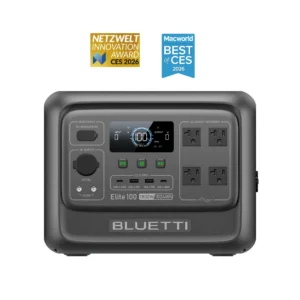
Independent bench testing measured 869–910 Wh of usable energy at off-grid mixed loads — strong delivery across the range. But the headline is the solar front-end: a 1000 W input ceiling, double what the AC180, DELTA 3 Classic, and base DELTA 3 offer, and the single most decisive advantage for a buyer whose only charger is the sky. In ideal sun with the right panel, a roughly one-hour refill is realistic.
At $399 it’s also the cheapest unit in the band, which means the solar leader and the value leader are the same box.
The setup step you cannot skip. Out of the box, the Elite 100 V2’s high-current PV mode is disabled. Independent testing documents that without enabling it in the app, the unit is capped near 130 W of solar intake — you have bought the best solar front-end in the class and wired it shut. Enable the mode in the app before you leave. The full ceiling also requires a panel in the 48 V or 60 V range; at 24 V you’ll pull around 460 W, at 12 V around 230 W. Wire into the high-voltage band and toggle the mode, and it delivers. Skip either step and it doesn’t.
ECO mode is on by default and will cut the AC outlets at very low draws — relevant if you leave a light or a small fan running unattended. For an active solar day camp this is a minor nuisance, not a dealbreaker; for a buyer who wants to set it and walk away, this is the wrong unit (see the always-on UPS segment instead).
There is also a documented early-failure cluster in owner reports — less consequential for an attended, mobile buyer who can troubleshoot on the spot than for an unattended-backup application, but worth knowing before you commit. Test it at home before a long trip.
Pairing the Elite 100 V2 with a panel
To actually hit the Elite’s solar ceiling, panel choice matters. The Bluetti PV350 is the clean match: its open-circuit voltage of 46.5 V sits inside the Elite’s 12–60 V window and lands squarely in the 48 V band that unlocks high-current PV mode. Even on a cold morning, voltage stays safely under the 60 V ceiling. At roughly 300 W of real output in strong sun across around five peak-sun-hours, one PV350 can harvest approximately 1,500 Wh in a good solar day — enough to refill the 1,024 Wh station from empty in roughly 3.5–4 hours of strong sun. Enable high-current PV mode first, or that math collapses to a fraction of it.
If you’d rather carry two lighter panels, two Bluetti SP200L units wired in series (combined open-circuit voltage around 49 V — within the window, under the ceiling; combined short-circuit current around 10.2 A — under the 20 A limit) deliver roughly 400 W rated, around 260 W real. That’s the right choice only if two lighter panels beat one 30.6 lb panel for your trip; the PV350 delivers more actual power.
Note: two PV350s in parallel would push short-circuit current to roughly 21.6 A, just over the 20 A input limit. Two in series would hit around 93 V open-circuit, well over the 60 V ceiling. One PV350 is the pairing; do not stack a second one.
Skip it if: you plan to add a second battery later or want dual independent solar ports for flexible panel mixing — the EcoFlow DELTA 3 Plus matches the 1000 W ceiling, splits it across two 500 W inputs, and expands to 5 kWh, at $200 more.
The DELTA 3 Plus matches the Elite’s 1000 W solar ceiling but routes it through two independent 500 W ports — useful for mixing panels of different sizes or orientations, with around 400 W real intake per port in testing. It’s also expandable to 5 kWh, which is the flipping condition: if you expect to outgrow 1 kWh on longer trips, the Plus’s expandability is worth its $200 premium over the Elite.
Independent bench testing put the Classic’s usable output at 940 Wh from 1024 Wh — 91.7% inverter efficiency, the highest in the band. But the number that wins this segment is 13 watts: the Classic’s idle draw, the lowest of any unit here, and the figure that determines how long it survives sitting plugged in on standby. Our DELTA 3 Classic review calls continuous standby UPS duty ‘the Classic’s strongest case’ — a verdict grounded in that idle figure and a real, confirmed 10 ms switchover that keeps routers, NAS units, and computers alive through a drop without a reboot.
Before you trust it, change one setting: out of the box, a 2-hour inactivity timer will shut the unit off under light or intermittent loads. Go into the app and set auto-shutoff to ‘never.’ That one step is the difference between a reliable UPS and a box that silently turns itself off at 2 a.m. Also: the Classic blocks AC pass-through once fully depleted, so size your reserve — don’t let it discharge completely if the grid goes out for hours.
One reliability pattern to know if your use evolves: owner reports and testing document a BMS MOSFET failure mode under high-cycle, daily-outage use — the kind of stress a unit gets in a neighborhood with chronic power cuts, not the occasional grid blip this segment actually sees. For everyday standby duty, this is not a realistic concern. If your grid is unreliable enough that the unit cycles daily, the base DELTA 3 (runner-up below) is the more durable route.
Skip it if: your NAS needs graceful automated shutdown signaling (USB-HID/NUT) — only the DELTA 3 Plus supports that protocol, at the cost of a 32–40 W idle.
The base DELTA 3 matches the Classic on switchover speed and inverter efficiency (owner-reported 90.7%), but idles around 17.6 W versus the Classic’s 13 W — a meaningful gap when the unit runs continuously. It earns runner-up status by keeping two things the Classic drops: expandability to 5 kWh and a 12V car port. If your standby duty might grow into daily cycling — chronic outages, not just occasional blips — the Classic’s high-cycle BMS concern argues for the base model, and the expansion headroom gives you room to grow the bank. The idle penalty is the price.
One gap that applies to both: neither the Classic nor the base DELTA 3 supports USB-HID/NUT signaling for graceful NAS auto-shutdown. If your NAS needs that, the DELTA 3 Plus is the only unit here with it — accepting its 32–40 W idle as the cost of that capability.
Running a CPAP through the night is a low-load problem — around 30–40 watts — and at that draw, inverter idle is often larger than the device itself. But the spec math is secondary to the question that actually decides a medical pick: if this unit fails at 2 a.m., what happens? Reliability and support weigh above every other axis here.
Below 200 watts, this unit runs under 20 dB — effectively silent at the bedside. A CPAP at 30–40 watts sits far under that threshold, which means no fan noise disturbing therapy. That bedside quietness, combined with a 10 ms switchover that bridges a grid drop without interrupting airflow, forms the core of the case here.
The runtime advantage is in how you connect it. Running the CPAP over DC or USB-C bypasses the inverter entirely, and independent testing puts that route at up to roughly four nights of CPAP runtime — the inverter idle that eats into AC runtime simply doesn’t exist on the DC side. On AC the runtime is shorter but still comfortable for an extended outage.
The medical support consideration deserves a direct statement. On pure low-load AC efficiency, the EcoFlow DELTA 3 Classic‘s 13 W idle would look best on paper — and it is the runner-up here. But extended testing of the EcoFlow platform explicitly flags that for a primary-dependency medical device, EcoFlow’s support process, which lacks a US phone line and runs slow on warranty cases, ‘matters more than the specs.’ Anker’s support path is imperfect but offers a faster Amazon return route, and for a device someone’s health depends on, that reliability weighting tips the pick to the Anker even though the Classic leads on one efficiency metric.
Three things to handle before the first night of use. Pair the unit via Bluetooth before relying on it away from a power source — unpaired, the outlets may not activate. Plan to run the CPAP over DC or USB-C to hit the longer runtime figures. And test the unit on day one: a small number of owners received units measuring around 53% of rated capacity on arrival, likely isolated defects, but a medical buyer needs to know before the first night away from the grid. Keep a fallback power path — that’s true of any unit in this band, not just this one.
Skip it if: you have an independent fallback power path and want to maximize AC runtime on a single charge — the DELTA 3 Classic’s 13 W idle delivers a reported 30-plus hours at a 30 W CPAP load on AC, the longest stated figure in the band.
At a 30-watt CPAP load, the Classic’s 13 W idle — the lowest in the band — translates directly into the longest AC runtime: over 30 hours on a single charge, per the review record. On raw overnight math it leads every unit here. It’s the runner-up rather than the pick only because of the reliability and support weighting for a life-safety device; if you maintain an independent fallback and are comfortable with EcoFlow’s warranty process, the Classic’s AC runtime advantage makes it a legitimate choice.
Value at this tier isn’t just about the lowest sticker price — it’s about what you get per usable watt-hour, and whether the cheap unit has a catch that makes it a false economy. Here, the cheapest unit also happens to lead on solar input. That’s the whole story.
At $399 and $0.39 per watt-hour, the Elite 100 V2 is the cheapest unit in the band by a meaningful margin — and the savings don’t come at the cost of a stripped-down spec sheet. Independent testing measured around 880 Wh of usable energy at the wall, and the unit carries the band’s highest solar input ceiling at 1000 W and a 3600 W surge rating. You pay the least and still get the most capable solar front-end. For attended use — camping, occasional backup, a solar day camp — that’s a clean value win on more than one axis.
One pricing note worth knowing: the $399 reflects an aggressive current street price rather than a traditional list price. The value ranking is genuine at that number, but if the price climbs back toward $500 or above, the gap over the runner-up narrows significantly and the comparison is worth revisiting.
The caveats that matter for this buyer are both manageable with attention. ECO mode is on by default and can cut the AC outlets at very low draws — turn it off in the app for camping or backup use. There is a documented early-failure cluster in owner reports; test the unit at home before a trip, and keep receipts. Used attended, neither of these is a reason to walk away from the best value in the band.
Skip it if: you want a unit you can grow into a larger bank — the Anker SOLIX C1000 Gen 1 expands to 2112 Wh and adds a more confidence-inspiring build, at $429.99.
The Gen 1 comes in at $0.407 per watt-hour — second-lowest in the band — and adds two things the Elite lacks: expandability to 2112 Wh (the Gen 2 dropped this feature) and build quality that survived a drop test in independent testing, with owner-reported efficiency of 85–92% at the wall. It loses the top value spot on raw price and solar input, but if you want a value unit with room to grow, this is the cleaner long-term buy.
Picks on this page come from deciding what the use case actually rewards — then judging each unit by how it behaves under those conditions, not by how it reads on a spec sheet. The criteria that matter shift with the job, so a unit that’s decisive in one segment can be disqualified in the next by a single behavior. Where two contenders cleared the same bar, documented performance under real load settled the pick, not a comparison of rated numbers.
A 1kWh power station’s nameplate capacity tells you almost nothing useful. Every unit in this band is rated near 1024 Wh, every one outputs pure sine wave, and several share the same lithium iron phosphate chemistry. What the spec sheet hides is what actually decides a purchase: how much of that capacity arrives at a real-world load rather than evaporating in inverter idle, how the unit behaves when no one is watching, how quickly solar panels can refill it, and whether its default settings quietly cut power to whatever is plugged in.
We weighed usable energy at the loads each buyer actually runs — not at the nameplate figure, which requires a perfect load and no conversion losses. For a CPAP buyer, that means judging efficiency at 30–40 watts where inverter idle dominates the math. For a solar buyer, it means asking not just what the input ceiling is rated at, but whether the full ceiling is accessible by default or locked behind a setup step. For an always-on UPS buyer, idle draw matters more than burst capacity — a unit that pulls 32 watts sitting there burns through its own charge in days, not weeks.
Reliability patterns and default behaviors, documented in extended-use owner reports and independent testing, were the deciding factors in several segments — particularly where multiple units looked identical on specs. In those cases the unit whose behavior under real conditions was actually confirmed won over the unit that merely published a favorable number. Units with documented unattended failure modes were removed from consideration for any segment where the buyer steps away from the machine.
Two units from adjacent capacity bands were audited and set aside on size grounds: one sits roughly 16 percent below the 1kWh floor, the other roughly 23 percent above it. Each belongs to a different tier’s roundup. The Bluetti AC180 cleared every eligibility check but wins no segment in this field — its weight costs it the portability decision, its solar ceiling costs it the off-grid decision, its switchover speed costs it the electronics-UPS decision, and its price-per-watt-hour costs it the value decision. It is a capable unit that happens to face stronger competition on every axis this group of buyers cares about.
The picks above answer “which one for my situation.” This table answers “show me everything, I’ll decide.” It lays every unit out on the same axes used to make the calls — measured behavior, not nameplate specs — so a reader whose priorities cross segments can weigh the tradeoffs directly instead of trusting our segmentation.
| Unit | Capacity (Wh) | Rated Output (W) | Surge (W) | Weight (lbs) | AC Recharge | Solar Input (W) | UPS Switchover | MSRP | $/Wh | Buy |
|---|---|---|---|---|---|---|---|---|---|---|
| Anker SOLIX C1000 Gen 2 | 1024 | 2000 | 3000 | 24.9 | ~47 min (UltraFast) | 600 | 10 ms | $500 | $0.488 | Check price |
| Jackery Explorer 1000 v2 | 1070 | 1500 | 3000 | 23.8 | ~95 min (~60 min Emergency) | 400 | 20 ms | $499 | $0.466 | Check price |
| Bluetti Elite 100 V2 | 1024 | 1800 | 3600 | 25 | ~1.17 h (80% in ~45 min) | 1000 | 10 ms | $399 | $0.39 | Check price |
| EcoFlow DELTA 3 Plus | 1024 | 1800 | ~2600 measured | 27.6 | ~55 min | 1000 (2× 500 W) | 10 ms | $599 | $0.585 | Check price |
| EcoFlow DELTA 3 Classic | 1024 | 1800 | 3600 | 27.3 | ~1.0 h (45 min to 80%) | 500 | 10 ms | $449 | $0.438 | Check price |
| EcoFlow DELTA 3 (base) | 1024 | 1800 | 3600 | 27.6 | ~56 min | 500 | 10 ms | $519 | $0.507 | Check price |
| Anker SOLIX C1000 Gen 1 | 1056 | 1800 | 2400 | 28.44 | — | 600 | 20 ms | $429.99 | $0.407 | Check price |
— = not independently verified for this guide
The questions here are the ones that don’t belong to any single pick — the cross-cutting concerns that come up regardless of which unit a reader lands on. We pulled them out of the individual segments so each answer lives in one place, addressed against the same standard of evidence used throughout the page.
The two segments share an axis — bedside quietness — but the reasons it wins each are actually different. In camping, the Gen 2 wins on weight and recharge speed: it’s the lightest fully-capable unit in the band and refills in under 50 minutes. In the CPAP segment, weight and speed matter less than reliability and silence at a 30–40 W load. The Gen 2 runs under 20 dB below 200 watts, and its support path — while not perfect — is faster and more accessible than EcoFlow’s for a buyer whose health depends on the device. Two different questions, answered by two overlapping strengths.
ECO mode. Out of the box, the Elite 100 V2‘s AC outlets will cut off at low draws — a default setting documented in owner reports and tied to at least one case where a sump pump lost power during an outage because the unit decided the load was too light to justify staying on. For a solar camper or a value buyer who’s present and attentive, ECO mode is a minor nuisance you turn off once. For a unit plugged in under a desk keeping a router alive at 30 watts, it’s a disqualifying default. The unattended buyer never finds out until the equipment is already offline.
The Classic idles at 13 watts; the base DELTA 3 idles around 17.6 watts. For a unit that runs continuously, that gap adds up. The Classic also posts slightly higher inverter efficiency — 91.7% versus around 90.7% — so the rare discharge delivers a bit more. The base DELTA 3 earns runner-up status because it keeps expandability to 5 kWh and a 12V car port that the Classic drops, and because its architecture is a better fit for buyers whose standby duty might grow into daily cycling — the Classic has a documented BMS concern under high-cycle conditions that doesn’t apply to occasional-outage use but matters if the grid is unreliable enough to cycle the unit every day. There is also a third option in the DELTA 3 family worth naming: if your NAS requires graceful auto-shutdown signaling via USB-HID or NUT protocol, neither the Classic nor the base supports it — only the DELTA 3 Plus does, at the cost of a much higher 32–40 W idle draw.
It matters a lot, and you almost certainly should. Running the CPAP over DC or USB-C on the Anker SOLIX C1000 Gen 2 bypasses the inverter entirely — the roughly 13–20 watts the inverter would otherwise consume just sitting there simply disappear from the equation. Independent testing on the Gen 2 puts that route at up to roughly four nights of CPAP runtime. On AC, the inverter’s idle draw taxes every hour of use, which shortens runtime meaningfully at a 30–40 W CPAP load. Check your CPAP’s DC input spec and whether your unit accepts the right connector; many travel CPAPs support 12V or USB-C input. The cable is usually a small purchase that pays back quickly in runtime.
The AC180 is a capable unit — around 90% usable AC efficiency, roughly an hour to recharge on turbo, and a durable build. The problem is that it faces a stronger competitor on every axis this group of buyers weights. At 35.3 lbs it’s the heaviest unit in the band, which costs it the camping segment. Its 500 W solar ceiling costs it the off-grid segment. Its 20 ms switchover is enough for a CPAP but not reliably fast enough for desktop electronics, which costs it the UPS segment. And at $0.607 per watt-hour it’s the highest-priced unit in the band, which costs it the value segment. None of those are fabricated weaknesses — they’re just what the competition looks like in this particular field.
The voltage window is what matters most, and it varies enough between units to matter in practice. The Bluetti Elite 100 V2 accepts 12–60 V and up to 20 A — but its full 1000 W ceiling only unlocks after you enable high-current PV mode in the app, and only at panel voltages in the 48–60 V range. At 24 V you’ll pull around 460 W; at 12 V, around 230 W. Common folding panels in the 12–28 V range will not fill this unit’s input. The EcoFlow DELTA 3 Plus splits its 1000 W across two independent 500 W ports, which gives more flexibility for mixing panels but requires checking each port’s voltage tolerance separately. The Anker SOLIX C1000 Gen 2 accepts 29–60 V for its 600 W input — the high floor means many lightweight folding panels in the 12–28 V range will cap it near 200 W. Check your panel’s open-circuit voltage against the station’s input window before buying, not after.
If you came here looking for one unit to carry to campsites and top up at a café stop, the Anker SOLIX C1000 Gen 2 is the default — lightest capable unit in the band, dead-to-full in under 50 minutes, and quiet enough to leave running at the bedside. The Jackery Explorer 1000 v2 is a real alternative if raw weight is the priority and your loads stay under 1500 W.
For solar-first use, the Bluetti Elite 100 V2‘s 1000 W input ceiling is decisive — and at $399 it’s also the best value in the band. Just enable high-current PV mode in the app and pair it with a panel in the 48 V range, or you won’t see what you paid for. The EcoFlow DELTA 3 Plus matches the solar ceiling and adds expandability for buyers who expect to grow the system.
The always-on UPS segment is where the default assumptions break hardest. Five units tie on switchover speed; what separates them is idle draw and whether the default settings will quietly abandon your equipment at 2 a.m. The EcoFlow DELTA 3 Classic wins it on 13 W idle and confirmed standby behavior — change the auto-shutoff to ‘never’ before you trust it. The base DELTA 3 is the right call if daily cycling is a realistic scenario or if you want room to expand the bank.
The CPAP pick is also the Gen 2 — silent at therapy loads, long on DC runtime, and backed by a support path that matters when the device is medically necessary. The EcoFlow DELTA 3 Classic is the runner-up on raw AC efficiency, and a legitimate choice if you maintain an independent fallback.
One pattern runs through this whole field: the spec sheet will tell you a unit can do something, and the default settings will quietly prevent it. Every pick above comes with one setup step — enable PV mode, disable auto-shutoff, complete Bluetooth pairing — and in every case the step is the difference between the unit working as advertised and failing at the worst possible moment.