

The default 2 kWh shopper — no single overriding constraint, just wants the most capable all-around box near $800 — lands here. Three units in this tier cluster within fifty dollars and thirty watt-hours of each other, so price alone never decides it. The tiebreak is the combination of things that matter over months of use: idle draw, carry weight, a real expansion path, and the weight of accumulated owner and testing evidence.
The C2000 Gen 2 wins this segment because it is the only unit in the tier that genuinely beats its competitors on every axis at once — and the only one to earn a ‘Strong Buy’ verdict from a thorough review, which calls it a unit that ‘wins its bracket cleanly.’ That verdict isn’t handed out lightly in this class, and it reflects something the specs confirm: this box does everything the all-round buyer actually cares about better or equal to cheaper rivals, without demanding a premium.
The most consequential edge is idle draw. It sits at 9 watts with AC output off and around 18 watts with it on — independent bench testing confirmed both figures. Against competitors drawing 22–45 watts at idle, that gap compounds into days of additional standby time on a full charge. For a buyer who stores the unit between trips or leaves it plugged in during a slow outage night, the difference between 9 watts and 45 watts is the difference between weeks of readiness and a dead battery when it matters.
Recharge speed is the other practical edge. A full AC cycle runs about 88 minutes, dropping to 58 minutes when solar is added — which means a generator run or a short grid window is enough to top it off, not a half-day commitment. At 41.7 lb it is the lightest expandable unit in the band, and one BP2000 battery doubles it to 4096 Wh — an actual growth path that none of the cheaper sealed rivals offer at all.
The one real catch: expansion tops out at 4096 Wh. That is enough for most extended outage scenarios, but if the plan is to build toward a cabin or whole-home system, this ceiling becomes a wall. The Jackery Explorer 2000 Plus in the Expandable segment reaches 24 kWh and is built for that kind of growth from the start.
Skip it if: you are building toward a serious off-grid or whole-home system — the 4 kWh expansion ceiling will run out before your ambitions do; go straight to the Expandable segment instead.
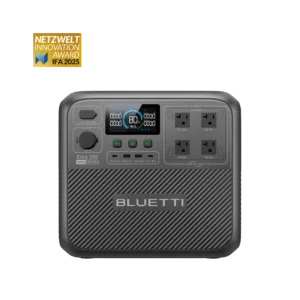
The Elite 200 V2 comes within one dollar of the C2000 Gen 2 at $799 and beats it on two genuinely important axes: inverter efficiency and longevity. Independent bench testing measured 96% AC efficiency — the best in the band — and the 6000-cycle rating (roughly 17 years at daily use) is approximately double several competitors’. Those numbers mean real runtime for the fridge and a battery that outlasts the gear it powers.
It loses Best Overall on weight — 53.4 lb is 11.7 lb heavier than the Anker — and on architecture: there is no expansion path. For a buyer who will never move the unit more than across a room and has no interest in adding capacity later, the Elite 200 V2 is the closer call than the gap makes it sound. The full case for it as a backup station is in the Home Backup segment.
At $749 and $0.366/Wh, the DELTA 3 Max is the cheapest usable energy in this band — a real distinction if budget is the only constraint. Owner reports confirm its UPS mode held through repeated grid events without rebooting a server over a full year, and it runs quietly enough for an apartment where generator noise is a problem.
It earns only a mention, not the win, for a combination of reasons: no expansion path, a single MPPT capped at 500 W solar, no published cycle life, and a naming trap worth knowing about — this is not the DELTA 2 Max‘s true successor; that role belongs to the Max Plus, a different and more capable machine. The DELTA 3 Max is the value floor of this tier, not the all-rounder.
Every pound matters when you are loading a car alone at 6 a.m., hauling the unit up apartment stairs, or moving it room to room during an outage. In this tier, the weight spread runs from 39.5 lb to 67.2 lb for essentially the same 2000 Wh — which means the heaviest option makes carrying feel like moving furniture while the lightest is a firm but manageable lift. For this buyer, weight is the whole game until the gap closes enough for other things to break the tie.
The Explorer 2000 v2 is the lightest 2 kWh station available — 39.5 lb, cube-shaped with a folding handle, and compact enough to fit where wheeled or taller units will not. That weight advantage is not marginal; it is 2.2 lb lighter than the next-lightest option and more than 20 lb lighter than the heaviest unit in this guide. For a buyer who moves the unit regularly, that difference is felt on every single trip.
The output holds up under real loads: independent testing sustained 2200 W without fault, running a 2100 W coffee maker and heat gun combination, and a 1600 W air fryer. Recharge is full in under two hours, fast enough to top off over lunch. The standby retention figure — 95% after 12 months — is the best in this band, which matters for a unit that sits in a car or closet between camping seasons.
Two limits are worth knowing before you load it up. The solar ceiling is 400 W, the lowest among the picks in this guide. For a buyer whose plan is to solar-recharge at camp rather than find shore power, that ceiling constrains how quickly the unit recovers — budget accordingly for panel sizing. More importantly, the UPS auto-switchover has a documented reliability issue: owner reports describe it failing to engage, and this is widely acknowledged as a known limitation. The Explorer 2000 v2 is a very capable portable station; it is not a reliable set-and-forget backup for critical home loads. If the fridge or medical gear needs that guarantee, the Home Backup segment is the right place to look.
Skip it if: your primary use is home backup with critical loads — the UPS auto-switchover has a documented failure-to-engage pattern; the Bluetti Elite 200 V2 in the Home Backup segment is the right call instead.
At 41.7 lb the C2000 Gen 2 is only 2.2 lb heavier than the Jackery — a difference most buyers will find irrelevant by the second carry. What the Anker adds for that weight is meaningful: double the solar input (800 W vs 400 W), a real expansion path to 4096 Wh, faster recharge, lower idle draw, and a TT-30 RV outlet. For a buyer who will ever charge from panels or add capacity later, the weight difference stops mattering quickly. The pure-pounds buyer takes the Jackery; anyone with solar plans or growth in mind should seriously reconsider.
Backup power for a fridge, a router, and possibly a CPAP or medical device demands something most spec sheets do not honestly advertise: a UPS that actually works when the grid drops, stays working through a long outage, and does not drain itself dead between events. On paper, two other units in this guide look like obvious choices — one expandable with dual solar, one with a fast recharge and high output. The lived evidence vetoes both for this specific role, and the pick is decided by which unit’s UPS claims hold up under the kind of scrutiny this job demands.
The Elite 200 V2 is the most thoroughly validated UPS in this tier. A review examining its practical performance calls it the most ‘decisively validated practical claim’ in the band — enterprise home labs bridged repeated grid drops with no reboots, an owner running it as standby power for an MS patient’s treadmill (where an unexpected stop is a fall risk) confirmed it, and oxygen-concentrator backup has been documented. That depth of evidence, across load types that include sensitive electronics and medical-adjacent gear, is what puts it ahead of units with more impressive spec sheets but shakier records.
The efficiency advantage is not decoration. At 96% AC inverter efficiency — the highest bench-measured figure in this class — the fridge actually runs the long end of the range: owner reports land at 22 to 30 hours per charge on a standard refrigerator. At roughly 10 watts idle, the unit can sit inverter-on for days without meaningfully depleting. That combination of efficient conversion and low standby draw is exactly what a backup station needs to be useful over a multi-night event.
One setup step is not optional: ECO mode ships enabled from the factory and will cut a very-low-wattage load — a router on its own, a low-draw lamp. Disable it once before relying on the unit for always-on gear, and it stays disabled. The switchover time of approximately 15 ms (corroborated by review coverage, though the product page omits the specification) is fast enough that sensitive electronics, including computers and networking gear, do not notice a grid transition.
Skip it if: you need more than two days of runtime and cannot recharge between outage nights — the Anker SOLIX C2000 Gen 2 runner-up is expandable to 4096 Wh and adds a second battery overnight; or if you are building toward whole-home backup, jump to the Expandable segment entirely.
The C2000 Gen 2 earns its runner-up slot here primarily on expandability — a multi-day outage that outlasts a single 2048 Wh charge can be covered by adding a BP2000 battery. Its 10 ms UPS switchover is review-confirmed seamless on computers, routers, 3D printers, and a CPAP (one owner logged a 6-hour night at 21% remaining). The 9 W idle means it can sit on standby for an extended period without the kind of self-discharge that disqualifies other options in this role.
The one thing to do before trusting it unattended with a fridge: find and enable the ‘Output Port Memory Switch’ in the app settings. Without it, the unit defaults to AC output off after a power loss, which means the fridge restarts without the station coming back on automatically. It is a one-time change, but it is genuinely buried and easy to miss.
Several units that appear competitive on paper were ruled out for this segment specifically. The EcoFlow DELTA 2 Max — expandable, dual MPPT solar, attractive price — has a documented pattern of firmware updates silently resetting AC output to off, random dropouts under its ‘never turn off’ mode, and at least one vaccine-storage loss and a sump-pump near-miss in owner accounts. It is a capable unit in other contexts; for set-and-forget critical backup, its reliability record disqualifies it. The EcoFlow DELTA 3 Max Plus loses here despite its strong showing in the High-Output segment: its EPS-style switchover reboots sensitive electronics, and a 22–25 W standby draw combined with an auto-shutoff below about 15 W can drop a router-only setup entirely. The Anker SOLIX F2000 has a documented standby self-discharge pattern — drained from full to zero over three to four months of storage — which is the exact failure mode for a backup unit kept ready for an outage. The Jackery Explorer 2000 v2 wins on weight, but its UPS auto-switchover has a known engagement failure that makes it unreliable in this role.
Running a microwave, a window AC, or a circular saw from a 2 kWh station requires a unit that genuinely holds 3000 W under a sustained load — not one that lists it as a peak figure and sheds to something lower the moment a real appliance plugs in. Two units in this band are rated at 3000 W; one of them actually delivers it.
The DELTA 3 Max Plus wins this segment because independent testing held it at 3000 W across a full discharge without a trip — and it did not fault until the draw reached approximately 3600 to 3750 W. That tested headroom above its rated output is what matters for motor loads, which pull hard on startup before settling: a window AC, a power saw, a router table will all throw an inrush spike on startup, and the unit has genuine room above its rated output to absorb it without shutting down.
The 6000 W surge figure on the marketing materials is not a number to plan against. Testing shows the real trip point is in the 3600–3750 W range; the bigger number is not what the unit delivers to a real load. Size your heaviest appliance against the tested figure, not the spec sheet.
Everything else about this unit works in its favor for the high-draw buyer. Noise is mid-20s dB at light load and low-40s near 3000 W — quiet enough to run inside a living space or on a job site without the kind of fan noise that makes sustained use miserable. The 30 A Anderson DC port feeds a 12 V fuse panel or DC loads directly, which is unusual in this class. At 48.7 lb and $1099, it is 12.8 lb lighter and $300 cheaper than the only other 3000 W-rated unit in this band.
One limitation to carry: this unit’s EPS-style switchover reboots sensitive electronics, and its standby draw of 22–25 W combined with an auto-shutoff behavior below about 15 W makes it a poor choice for unattended home backup. It wins specifically on output; the Home Backup segment covers why it does not win there.
Skip it if: you need a reliable set-and-forget home backup UPS — the EPS reboot behavior and standby auto-shutoff make it the wrong tool for that job; the Bluetti Elite 200 V2 in the Home Backup segment is the right answer.
The Explorer 2000 Plus is also rated at 3000 W, and comparative testing confirmed it held 3000 W for 15 minutes and sustained 2329 W over a long discharge — and it powered a 12,500 BTU window AC for about 1.2 hours at full draw, which is the kind of real-world result that validates a rated output figure. It also has the highest solar input in the band at 1400 W and an expansion path to 24 kWh, which is why it wins the Expandable segment.
Where it falls short of the pick: the 6000 W surge figure on the box is a two-unit parallel number — single-unit tested surge is approximately 3275 W, noticeably less than the DELTA 3 Max Plus’s tested headroom. It is also 12.8 lb heavier and $300 more. For a buyer who needs raw output headroom and plans to keep it as a single unit, the EcoFlow is the stronger choice; for a buyer who also wants to grow the system and prioritizes solar recharge, the Jackery is the closer call.
Some buyers know from the start that a single 2 kWh station is not the end state — it is the beginning of a system. A cabin that needs three days of autonomy, an RV build that will add panels and batteries over time, a home that wants to grow from essentials to whole-circuit coverage: these buyers are not buying a box, they are buying an architecture. The ceiling on that architecture is what this segment turns on.
The Explorer 2000 Plus has the largest expansion ceiling in this band — by a significant margin. A single unit can grow to 12 kWh; two units in parallel reach 24 kWh. The next-closest competitor tops out at 10 kWh. For a buyer whose plan is to add capacity over time, that gap between 10 kWh and 24 kWh is the difference between a capable backup system and one large enough to cover most of a home’s essential circuits through a multi-day event.
The review of this unit centers on exactly that use case — its thesis is that the Explorer 2000 Plus is built for the buyer with a longer-term plan, and the most consistent reason owners report for choosing it over cheaper alternatives is the ability to grow rather than replace. The expansion batteries also cost meaningfully less per watt-hour than the base unit, so the system gets more efficient to build as it grows. The 30 A RV outlet pairs with a manual transfer switch for essential-circuit home backup that scales as batteries are added. And at 1400 W solar input — the highest in this band — a larger battery stack can actually be refilled off-grid at a meaningful rate.
There are two real catches to carry into the purchase. For unattended home backup, a firmware bug creates a silent battery drain after roughly a week of continuous EPS mode — if the plan is set-and-forget critical backup, the Bluetti Elite 200 V2 in the Home Backup segment is the right choice for that function; the Explorer 2000 Plus earns its win specifically on the expansion axis. And owners have reported solar port failures and a 1440 W bypass cap in extended use — worth knowing before the system scales.
Skip it if: you need a reliable set-and-forget home UPS — the EPS firmware drain issue makes it the wrong foundation for that role; use the Explorer 2000 Plus for what it is built for, and handle critical backup separately.
The DELTA 3 Max Plus reaches 10 kWh — the second-largest expansion ceiling in the band — at $300 less and 12.8 lb lighter than the pick. It is quieter, has a cleaner single-unit surge figure, and handles high-draw loads better than any other expandable option in this tier. For a buyer whose plan is ‘one or two extra batteries, not a whole system,’ that combination of lower price, lower weight, and genuine 3000 W output makes it the stronger value.
The gap that costs it the win is the expansion ceiling itself: 10 kWh versus 24 kWh is a real constraint for a buyer with serious growth ambitions. There is also a practical friction point — dual-battery expansion on the EcoFlow requires a separately sold adapter, whereas the Jackery’s native expansion path adds no extra hardware step. For the buyer who knows the ceiling of their system will land below 10 kWh, the EcoFlow is the closer call on almost every other dimension.
The C2000 Gen 2 earns a mention here for buyers whose growth plan is modest — one extra battery, not a system build. At $800, it is the lightest and cheapest entry into an expandable 2 kWh station in this band, and adding a single BP2000 brings it to 4096 Wh. That is a meaningful upgrade for extended outages or longer camping trips. The ceiling is the constraint: at 4 kWh maximum, it is the right answer for ‘just one more battery’ and the wrong answer for anyone thinking further ahead than that.