
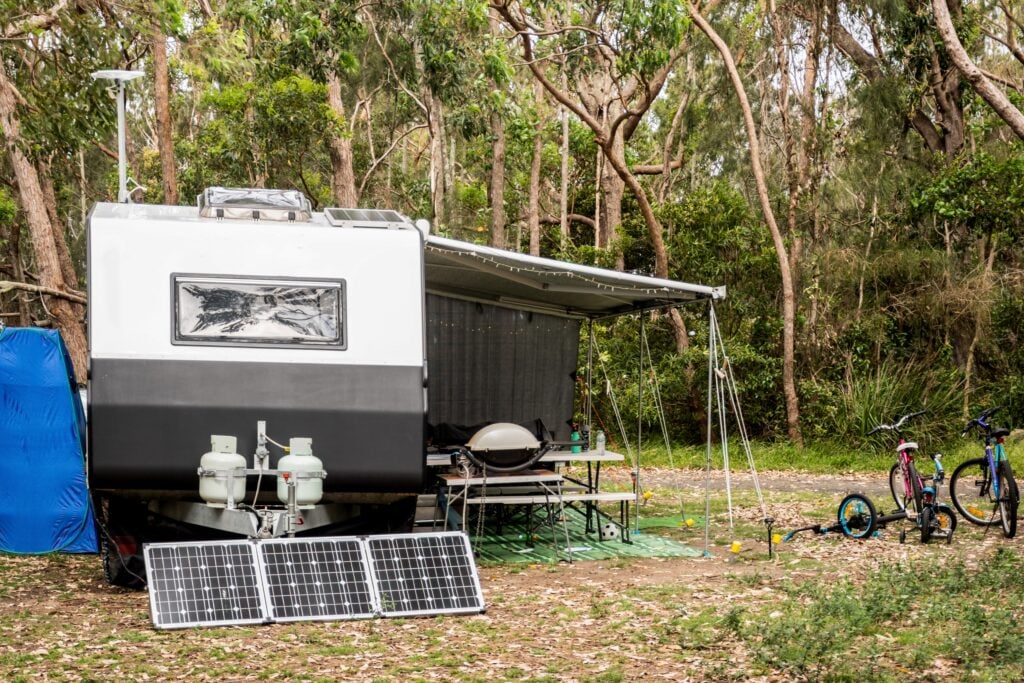
The whole kit has to travel by hand, the panel has to recharge it over a day at camp or through a short outage, and the loads are small enough that the way you route power matters as much as how much you have. That last point — port selection — is where this segment’s decision actually lives.
Two stations were effectively eliminated before the kit comparison began. The EcoFlow RIVER 3 Plus — which actually leads the solar spec in this tier — carries an EcoFlow-acknowledged firmware bug: AC output shuts off whenever the panel tops the battery to 100%, and the unit fails to wake to solar input at daybreak. A solar generator that drops its load every time the sun finishes its job fails the one job a solar generator has to do. The Anker SOLIX C300 fails differently: its 100 W input ceiling cuts any 200 W-class panel to half its harvest at the port — you buy a 200 W panel and the station accepts 100 W. That leaves the Elite 30 V2.
The station’s 200 W input matches the SP200L’s class exactly, so nothing is throttled. What the panel actually delivers — independent testing puts the planning figure at ~130 W in clear sun, with peaks of 160–186 W on a well-aimed panel — is what the station sees. Against a 288 Wh pack, a few good midday hours rebuild the day’s energy budget. The kit carries about 26.7 lbs split across two hands.
Usable capacity at this segment’s light mixed loads lands around 260–274 Wh — roughly 90–95% of nameplate, with ~260 Wh through the AC port and ~274 Wh through DC, per independent bench testing. That gap is the reason DC routing matters here: a CPAP on the 12 V DC port delivers dramatically longer runtime than the same machine on AC, because DC bypasses the inverter’s idle draw (11–19 W) that dominates tiny loads. Owner reports confirm the field picture — a 12 V fridge ran 33 hours off the DC ports, and multi-day van trips ran Starlink, laptops, and fans over DC. The station is quiet at light loads; the fan only becomes audible under sustained heavy draw, and independent testing measured a 44 dB maximum — safe beside a sleeping bag.
The SP200L’s own reviews name intermittent camping and emergency deployment as its designed duty cycle, and its parallel-wired sections degrade proportionally under partial shade rather than collapsing — the right behavior for a panel that spends half its day moving with you.
There are a few things to sort before the kit works. The station ships without a solar cable — budget an XT60 cable plus an MC4-to-XT60 adapter to mate the SP200L. High-current solar mode is app-gated; the station won’t charge below 32°F; and the panel’s carry handle is a documented weak point — test it before trusting 17 lbs to it. One honest uncertainty: the SP200L’s compatible-station list names units from the EB55/AC2A class upward but doesn’t specifically call out the Elite 30 V2. The voltage class matches, so the mating is plausible — but it hasn’t been confirmed by a paired test. Finally, run eco mode with care: AC idle with eco off can drain the pack overnight at near-zero load.
One boundary worth naming plainly: the SP200L is built for intermittent use. Owners running it daily as a primary solar source report output decaying by roughly half within a few months. If this kit will run every single day as your main power source, you’re looking at the Off-Grid Basecamp segment, not this one.
Skip it if: your loads will run daily without breaks — the SP200L degrades under that kind of grind; move to the Off-Grid Basecamp Kit and a panel rated for continuous deployment.
Worth considering only if your loads are strictly small electronics and quiet operation or fast wall charging dominate your priorities: independent testing confirmed 25 dB operation, dual 140 W USB-C ports, scope-verified pure sine output, and a roughly one-hour built-in wall recharge. As a solar kit it’s deliberately limited — the 100 W input makes the panel an expensive trickle charger — so it belongs here only as the wall-charge-first, solar-as-supplement option for someone who plugs in most of the time and wants sun as a backup.
The EcoFlow RIVER 3 Plus ($269) was demoted on a kit-level firmware veto, not on its specs. It actually wins a wired-AC framing — sub-10 ms switchover, roughly one-hour recharge, near-silent — anywhere wall power is the replenishment source. It just can’t be trusted as the solar-fed pick.
A weekend car camper or van-lifer runs a 12 V cooler, charges phones and laptops, boils water occasionally, and expects one or two folding panels to keep the system fed through the day. The question that settles this segment isn’t which station has the bigger solar spec — it’s what one or two real panels actually deliver to either station.
The two finalist stations for this segment — the BLUETTI Elite 100 V2 and the EcoFlow DELTA 3 Plus — both spec 1,000 W solar input on 1,024 Wh LiFePO4 packs with 1,800 W inverters, and both are reviewed as built for this exact buyer. With the one or two folding panels a weekend camper actually carries, both stations are panel-limited, not input-limited. A single 220 W folding panel feeds either at the same ~180–210 W real rate. When the harvest ties at the realistic array size, the station’s headline solar ceiling stops deciding anything — and the kit breaks on price, weight, and setup friction.
The 220W Bifacial is the rare folding panel that independent testing shows meeting its rating: 180–210 W in strong sun, occasionally above 220 W. Its review confirms it mates with non-EcoFlow stations within input specs via a standard MC4 adapter — the cross-brand pairing that makes the kit work. So the decision falls entirely to the station, where the Elite 100 V2 wins three ways at once: it’s $200 cheaper than the DELTA 3 Plus at the same capacity, it’s about 2.6 lbs lighter, and it carries the best value per watt-hour on this page. Independent testing confirms the inverter sustains its full 1,800 W without throttling, and owner reports paint exactly this life — one-handed 25 lb carry, flat stackable top for van storage, induction cooktops, kettles, 12 V fridges, and diesel heaters all running without complaint.
Usable capacity at this segment’s mixed moderate loads runs around 870–910 Wh — independent bench testing measured 869 Wh through DC and 880 Wh from the wall, with about 910 Wh under a 1.2 kW load. Run the cooler on the DC port to bypass the inverter idle; this regime sits at the high end of the efficiency curve.
One setup step before you get a good day of solar: the Elite 100 V2’s high-current PV mode ships turned off. Enable it in the app or solar input caps near 130 W — this is the single most common ‘broken panel’ false alarm in owner reports. With it on, a single 220 W panel in a 12–24 V single-panel arrangement works fine; add a second panel in series (~42–52 V) and you start pushing toward the 1,000 W ceiling, with testers calling it one of the fastest solar chargers at this capacity. An MC4 adapter is needed for the cross-brand mate, and charging fans hit 46–47 dB — charge by day, not next to the tent.
One reliability note: independent testing found a real early-failure pattern in the Elite 100 V2, typically surfacing in the first one to six months and consistently replaced under the five-year warranty. It’s friction, not a veto, for an attended camping kit where you’re there to notice and return it — but it’s worth knowing.
For a softer-bodied single-panel alternative, the SP200L ($349, ~130 W real output) trades output for handling tolerance if the bifacial’s tempered glass makes you nervous. The 220W Bifacial’s 12-month panel warranty is short, and its reviews show a crack pattern that hits frequent folders — handle the glass accordingly.
Skip it if: you’re committing to two panels from day one and want zero wiring thought — the DELTA 3 Plus runner-up kit is built for exactly that.
The pick if you’re going in with two panels and want the simplest possible setup: dual independent 500 W ports take one panel each with no series math and no app toggles. Its review confirms lunch-break refills in good sun and a 7,100-mile field trip running fridge, Starlink, and laptops. It also carries the fastest AC recharge in this class, measured at about 55 minutes. The cost is real — $200 more at the same capacity — and its idle draw runs 32–40 W, which its own review flags as a drain for always-on setups; cycled campers who charge and discharge don’t feel it the same way.
The Jackery Explorer 1000 v2 was demoted on a kit-level compatibility problem: its proprietary DC8020 solar connector regularly rejects third-party panels and adapters — discovered by owners after the return window closes, according to its review — which means the solar half of the kit only reliably exists with Jackery’s own panels at roughly double third-party pricing on a 400 W input ceiling. The station itself is competitive on portability, but a solar generator whose panel options are connector-locked loses the kit comparison. The Anker SOLIX C1000 ran into a different problem in the same direction: review-measured MPPT current limits fed only about 110 W from a 200 W-class panel, and the MC4 adapter is sometimes missing from the box.
When sun is the only fuel for days at a time, what decides the kit is how much of it you can actually capture. Three 3 kWh stations compete here, and their specs look close — but the Reviews separate their real intake ceilings dramatically once a multi-panel array is involved.
The BLUETTI Elite 300‘s measured solar tops out at 1,000–1,100 W against its 60 V input ceiling. Series arrays overload that ceiling — one owner nearly returned the unit over panel incompatibility — and exceeding it risks MPPT damage. For a solar-primary system with a multi-panel array, that ceiling is the whole problem. The Elite 300 wins a different framing entirely: van and RV shore-power setups that don’t lean on solar, where its compact body, native TT-30 port, best-in-record usable efficiency, and 6,000-cycle cells are the deciding factors. Here, it loses on the one axis that defines the segment.
The F3000’s dual MPPT inputs measured roughly 1,900 W combined from real-world panel setups — about 50–90% more daily harvest than the rivals’ ceilings can deliver at this array scale. That margin decides the segment on its own.
The station validates exactly this duty: table saws, miter saws, and a hammer drill across multi-day farm construction are in its review record; a sustained real 3,600 W from the TT-30R held for 15 or more minutes without shutdown; overload measured around 5,300 W (plan around that figure, not the 7,200 W spec); idle sits at 20–35 W; and fan noise at moderate loads is around 35 dB. Full-rate passthrough means a generator can top the kit during cloudy stretches while loads keep running without a swap.
The PS400 is the matching array half. Its review names this exact deployment as its best application — set-once off-grid and basecamp use, not daily solo carry. Owners have run multi-panel PS400 arrays as daily-cycling solar inputs, and two units carried a household through a three-week post-hurricane outage. Independent six-panel comparison testing ranked its build quality at the top of the field. IP67 has held through heavy rain and harsh daily exposure in the record. Two panels deliver roughly 550–690 W to the station in good sun; four approach the measured ~1,900 W ceiling.
Usable capacity at this segment’s sustained mid and high AC loads runs around 2,650–2,760 Wh — independent testing measured approximately 2,760 Wh at the wall under low discharge and ~2,650 Wh in a heavier bench run. One thing worth knowing: efficiency actually drops at trickle loads (around 81% delivered at 200 W), so this kit is least efficient at light duty. It belongs at a working basecamp, not a quiet reading camp.
Before deploying: the high-voltage solar input uses a proprietary MC4 adapter — carry spares for a remote site. The AC charging cable is a proprietary twist-lock with no off-the-shelf substitute; same advice. Don’t leave the panels plugged in overnight, as there’s a measured drain. No remote notifications on the station — this is a managed system, and someone needs to be checking it. One honest uncertainty: the F3000’s MPPT voltage windows aren’t published. The PS400’s 57.6 V open-circuit voltage fits the sibling F3800‘s input class, but verify the window before series-wiring pairs.
The PS400 also comes with a hard duty-cycle limit its own review states plainly: it’s the wrong panel for a solo user who deploys and stows it every day. The review explicitly recommends a pair of PS200s for that pattern. This segment’s set-on-arrival, leave-it-working setup is the PS400’s working side of that fork. If your basecamp means chasing sun across a site alone every day, the two-panel lighter route is the right call.
Skip it if: you need the best automation and smart energy management over the highest raw harvest — the EcoFlow DELTA 3 Ultra Plus runner-up kit runs Self-Powered Mode, Storm Guard pre-charging, and modular rigid panels that outperformed folding panels in cloudy conditions.
The automation-first alternative for the buyer who wants the system managing itself. The station’s review names the solar-first off-grid buyer as a core profile — Self-Powered Mode runs the system within configurable charge/discharge bounds with generator fallback, Storm Guard pre-charges ahead of weather. Four modular rigid panels measured 525–537 W per 500 W four-pack into this station class and outperformed folding panels as clouds thickened; they deploy one at a time to match the day’s conditions. The station runs at or under 25 dB under 600 W, weighs 74.3 lbs on a mature wheel system, and its MPPT measured near 80% efficiency. The solar ceiling is lower than the F3000 kit’s by a margin that matters at full array scale — but for a buyer who values intelligence over raw harvest, it’s the right trade.
A home backup system waits quietly, then powers essential circuits through a multi-day outage on whatever the panel array can harvest, topped up by a generator when needed. The station has to output 240 V, accept panels without adapter headaches, and be honest about what it can sustain over days of attended household use.
Four stations were in contention for this segment. The original Anker SOLIX F3800 was eliminated outright: standard panels measure roughly half its rated solar input against its 60 V/25 A ceiling, and recharging from a generator over its AC input disables the 240 V output — exactly the failure a multi-day outage system exists to prevent. The F3800 Plus was built to fix both of those problems, and it did; the original survives only for a wall-recharged short-outage buyer who doesn’t need solar at scale.
Among the three remaining contenders, no single axis dominates cleanly. The DELTA Pro 3’s two PV ports measured at spec in independent testing — approximately 1,650 W on one port and 1,150 W on the other. The F3800 Plus’s wider single MPPT window (11–165 V) accepts standard series-wired panels without the voltage-window juggling the DP3’s non-overlapping ports require; its review calls this its most meaningful upgrade over the original, and real-world testing in non-ideal winter and mixed-array conditions measured 1,400–2,200 W. Those two results were taken under different conditions and can’t be ranked against each other — the solar comparison is treated as rough parity with different shapes: the DP3 maximizes verified intake, the F3800 Plus minimizes array friction. The tiebreak falls to price, base capacity, and what the record has actually tested as a system.
The DELTA Pro 3 wins all three. It’s $400 cheaper than the F3800 Plus. It carries the largest base battery in the group — 4,096 Wh. And it’s the only station-plus-panel combination the record has measured together: a 500 W four-pack of the 125W Bifacial Modular panels delivered 525–537 W into a DELTA Pro 3, with peaks reaching 556 W. One owner runs a ten-panel array across two DELTA Pro 3 units for disaster readiness, covering fridge, freezer, and critical loads — the precise deployment this segment describes. Review-confirmed runtimes anchor the outage math: 20–22 hours on fridge, furnace, and tankless water heater; 28 hours on a refrigerator alone. The station runs at about 30 dB at overnight loads. It expands to 12 kWh on one unit, and its review describes the realistic rhythm this system runs — battery power overnight, the panel array (plus an hour or two of generator) doing daytime bulk recharge.
Usable capacity at sustained household loads runs around 3,810 Wh on 120 V and 3,880 Wh on 240 V, per independent testing — roughly 93–95% of nameplate at these draw levels.
The panel half is a good match for this deployment pattern. At 9.26 lbs per panel and IP68, the 125W Bifacial Modular panels deploy and stow cleanly for a system that doesn’t run permanently mounted hardware. The rear bifacial bonus is real over snow or white surfaces; over grass, independent testing measured it at roughly 52% of its rated rear spec — minimal under most installations.
Wire mapping matters before install: the station outputs 120 V or 240 V, but not both at the same time — map your circuits before calling the electrician. A transfer switch, interlock, or Smart Home Panel is required for whole-home tie-in. Pass-through charging throttles output to roughly 1,800 W, so don’t lean on it as a pass-through for surging appliances, and generator recharge is a swap, not a parallel operation. The two PV input ports use non-overlapping voltage windows (30–150 V and 11–60 V) — split the array deliberately between them. Anchor the panel kickstand legs; tip-and-crack is the recurring failure in the field record. Treat the glass as glass.
One firm boundary from the station’s own review: this system is not for unattended life-critical loads. A long-term tester logged three firmware-fault resets in five weeks, with no push notification. Attended household outage duty — the pattern this segment describes — tolerates that reality. A CPAP or oxygen concentrator running in an empty house does not.
Skip it if: a 240 V generator is central to your outage plan, or you’re wiring a larger standard-panel array — the F3800 Plus runner-up system charges from a 240 V generator while simultaneously powering 240 V loads, and its wide-window MPPT makes series-wired third-party panels straightforward.
The pick if a 240 V generator is part of your outage plan, or if you’re wiring a larger array of standard panels and want to skip the voltage-window math. Its review confirms both upgrades over the original: it charges from a 240 V generator while simultaneously powering 240 V loads — independent testing confirmed roughly 6,000 W out while roughly 6,000 W in — and the 11–165 V MPPT window accepts standard third-party panels in series, where series-wired 48 V panels produced 830 W against the same array’s 623 W in parallel. The 6,000 W inverter is real and sustained, with around 52–54 dB fan noise even at full draw. A firmware update moved idle consumption from worst-tested to best-tested in one independent reviewer’s pool — update before first use. The PS400 is the reviewed array match for this deployment: its own review names the home emergency-backup owner pairing with an F3800-class station, two units carried a household through a three-week post-hurricane outage, and its 57.6 V open-circuit voltage series-wires cleanly inside the 165 V window (two per string at roughly 115 V).
Plan the system honestly: solo-unit generator charging caps near 3,300 W (the 6,000 W headline requires expansion batteries); sub-20 ms switchover exists only on three specific 120 V outlets during 120 V wall charging; 240 V generator input disables the 120 V outlets while charging; 120 V wall charging can’t coexist with 240 V output; the solar connectors are proprietary on the station side (panel MC4 ends are unaffected); 136.7 lbs makes this a semi-permanent installation; and a credible flag exists on post-2025 Anker SOLIX support staffing.
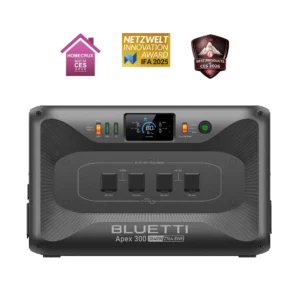
Worth naming for the buyer whose top priority is stretching a tighter budget across a split-phase system, or who expects long standby intervals between outages and wants the lowest idle draw in the group. The Apex 300 runs 18–24.7 W on standby against roughly 49 W for the DELTA Pro 3 — a real difference for a system that mostly waits. Simultaneous 120 V and 240 V split-phase output from one box is available while charging, and an expandable ceiling of roughly 19.3 kWh on one head unit makes it a credible infrastructure backbone at $400–800 less than the picks. The PV350 panel’s review names the Apex 300 in its compatible-station list, its 46.5 V open-circuit voltage fits the 60 V MPPT window, and independent testing measured 280–330 W real output — the strongest reviewed panel that fits that window. The pairing is review-endorsed, not bench-tested as a system.
It steps back from the picks on solar: measured input runs 790–1,100 W per port against the rated 1,200 W, the built-in MPPT has a 60 V ceiling, and the SolarX 4K accessory that extends the window starts at 150 V — leaving a genuine 60–150 V dead zone that limits array flexibility. The single-unit 240 V ceiling is 16 A. No wheels, no USB or DC ports out of the box, no solar cables included — this is infrastructure hardware, designed to be wired in. If the budget fits and the low standby draw and simultaneous split-phase output matter to your installation, it earns serious consideration; if raw solar harvest or a wider panel array is central to your plan, the picks do that job more completely.