

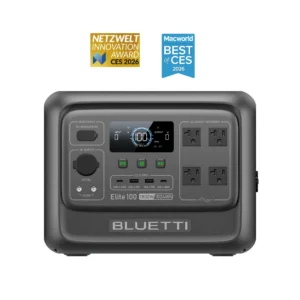
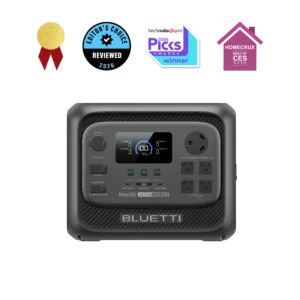
Your situation has one defining constraint: you carry the unit in and out, rely on a portable panel to top it up between drives, and sleep near it. On those three axes — portability, solar replenishment, and nighttime noise — the spec sheets in this class are nearly useless. Five units arrive with 1,024–1,070Wh, 1,500–2,000W output, and weights between 24 and 28 pounds. The Reviews are what separate them.
Van lifers and overlanders are not an afterthought in the Elite 100 V2’s design — they are, per its review, ‘the heart of the unit’s appeal.’ The flat top stacks cleanly in a van cargo bay. Ports face front so they’re accessible when the box is buried in gear. At 25 pounds it moves in one hand. Those are the physical facts; the electrical ones are just as pointed.
The solar ceiling is the decisive number for this buyer. Independent testing confirms 1,000W of intake — a 1:1 ratio of solar to capacity that nothing else in this class touches, and at the right price: $399 is the cheapest unit in the set, and the best value per watt-hour on the page. On replenishment from a panel, no unit in this tier competes.
Two conditions shape how that 1,000W actually arrives. At a 12V panel config you see roughly 230W; at 24V, around 460W. Full rate needs panels wired to 48–60V and the high-current PV mode enabled in the app. Plan your panel config before you buy, not after. For alternator charging, pairing via Charger 1 or Charger 2 is the path the review names for ‘effectively unlimited off-grid power while driving’ — the car-charge cable is not in the box.
Sleeping nearby: independent testing measured 28–32 dB up to around 500W — quiet enough that you will not notice it. Fans only hit 46–47 dB under wall charging or heavy discharge, so the habit to build is charging in daylight and letting the overnight DC loads run quiet.
Two things to know before you commit. Owner reports document a recurring early-failure cluster — DOA units and unprompted deaths in the first one to six months. The five-year warranty is honored, but getting a replacement involves real return logistics friction. And the surge headline does not extend to reactive motor loads: this unit will not start a window-AC compressor despite the 3,600W surge rating. If either of those is a dealbreaker, the runner-up is the path forward.
Skip it if: your replenishment is mostly wall outlets and quiet doesn’t matter — consider the Anker SOLIX C1000 Gen 2 instead (see below); or if early-reliability risk is unacceptable given you’re months from a shipping address, the EcoFlow DELTA 3 Plus trades cost for a cleaner reliability record.
The DELTA 3 Plus earns its place here on one axis the Elite 100 V2 cannot answer: growth. The XT150 expansion port accepts DELTA 3, DELTA 2, DELTA 2 Max, and DELTA Pro 3 batteries, so you are not locked into 1,024Wh if your needs change. Dual independent 500W solar ports plus a native 800W alternator charger (hardwired, not portable between vehicles) give it a replenishment architecture that matches the Elite 100 V2 on solar ceiling and beats it on alternator. Its review documents a 7,100-mile trip running fridge, Starlink Mini, and laptops continuously.
The tradeoffs are real and both land on this segment. The inverter idle sits around 32–40W with AC output active — roughly double the class norm — which quietly taxes a fridge running through the AC ports. And the fan runs near-constantly above 600W, audible in a quiet van interior; if you sleep light, that matters. At $599 it costs $200 more than the pick for a reliability record that is solid but unconfirmed at this segment’s specific mid-load regime. The expandability path is the reason to choose it; if you know your build will grow, that path has real value.

The lightest 1 kWh unit in independent testing — under 25 pounds — with a bench-verified 46–47 minute full recharge and near-silent operation below 200W. Its review’s first-named owner profile is van lifers, and for an outlet-primary driver it is an excellent option at $500. The reason it doesn’t place higher: its 600W solar ceiling requires panels wired to 29–60V. Typical portable panels running 11–28V cap near 200W even with three in parallel, which effectively rules it out for the panel-reliant buyer this segment is built around. If your replenishment is mostly campsite outlets or plug-in charging with solar as a supplement, this is worth a close look.
Full-time van life puts an electrical system through something closer to commercial cycling than recreational use — the station charges and discharges every day, the DC loads never fully stop, and the thing you most cannot afford is a unit that quietly degrades, misbehaves under firmware updates, or fails a port six months into a cross-country build. This is the segment where the spec sheet is most dangerous, because the unit that should win on paper — the EcoFlow DELTA 2 Max — matches the pick almost line for line in specs and costs $250 less.
The Reviews decide it. The DELTA 2 Max carries a documented pattern of capacity falling below 80% within one to two years of regular cycling, traced in at least one credible account to BMS cell-group imbalance. Firmware updates have been observed silently resetting output settings. Its 12V port has a documented failure pattern. And its warranty-service record is, per the review, the most damaging thing about it. For a buyer who will cycle this unit daily for months or years, that record is not a caveat — it is a disqualification. The pick’s review is clean exactly where the DELTA 2 Max’s is stained.
The DC integration story is where the Max Plus genuinely separates itself for a wired van build. The 30A Anderson DC port is not a cigarette-lighter socket — it feeds a DC fuse panel or runs 12V fridges, pumps, and fans directly, avoiding the efficiency loss of converting to AC and back. That architecture is exactly what a full-timer wires, and the review calls out RV and van DC users as the configuration ‘where the Max Plus genuinely shines.’
It is also the quietest unit in the 2 kWh class by independent testing: mid-20s dB at light loads, 33–34 dB at 1,200W. On a 24/7 build where you sleep next to the machine, that gap matters more than the spec sheet suggests.
The output envelope holds where it counts. True 3,000W continuous is confirmed across a full bench discharge, with no trip until around 3,600–3,750W. A kettle or a brief induction burst sits comfortably inside that envelope. Dual 1,000W solar input covers the replenishment requirement, and the expansion port takes the system toward roughly 10 kWh if the build grows.
A few operational notes before you wire it in. With AC output active, the unit draws 22–25W at idle — a real number when it is on overnight. Low-draw AC loads below about 15W will trigger the auto-shutoff; run those on DC, which this segment does anyway. The EPS-style switchover is not a precision UPS for sensitive electronics, but that is irrelevant to a van build. Dual-battery expansion requires a separately sold adapter.
Skip it if: you want to spend less and are willing to give up the Anderson DC port and the upper solar ceiling — the Anker SOLIX C2000 Gen 2 at $800 is the compact, quiet alternative that makes that trade.
The case for the C2000 Gen 2 is efficiency, compactness, and price. Independent testing confirms a 9W idle with AC output off — around 18W with it on — the best standby figure in the 2 kWh class. At 41.7 pounds it is the lightest unit here. Owner reports from van-based mobile studios describe running laptops, drones, cameras, a fridge, and lights simultaneously. And at $800 it is $299 less than the pick, with the same best-in-class $/Wh figure as the Elite 100 V2.
Where it concedes: no fuse-panel-grade DC output to match the 30A Anderson port, and an 800W solar ceiling versus the Max Plus’s dual 1,000W. Two setup steps matter before you trust it for unattended fridge duty: enable the Output Port Memory Switch so the unit restarts correctly after a power event, and dial down the default 1,800W AC input if you are on a shared 15A circuit. Neither is a dealbreaker — both are documented, and both are simple. If DC integration via a fuse panel is not your architecture, this is a serious contender at a real price difference.
Park the van for two weeks, point the roof panels at whatever sun the sky provides, and ask the electrical system to keep a 12V fridge cold, a diesel heater alive on startup, and a laptop charged through stretches of overcast. No alternator to lean on. Every watt that disappears into conversion loss or idle drain is a watt you cannot get back until the clouds part.
That constraint collapses the comparison to one axis: how much of the stored energy actually reaches the load at low continuous DC draw. The answer varies enormously across units that look identical on the box, and the gap is what decides this segment.
The review’s one-liner lands exactly on this buyer: ‘The Compact 3kWh to Buy for RV and Van Life.’ The reason is the port suite. The Elite 300 is the only unit in its tier with a native TT-30 RV outlet alongside a 12V/30A XT90 DC port — independently bench-confirmed to hold 30A sustained — that runs diesel heaters (which spike well above the usual 10A limit), fridges, and multiple DC loads directly, without the efficiency loss of inverting to AC and back.
The efficiency story is what clinches it. Independent testing measured 93–95% usable capacity on DC discharge, with an idle draw below 4 watts — figures one reviewer described as the best usable percentage across every unit they had tested. For a buyer running 80–150W continuously for weeks, that sub-4W idle is the difference between a unit that lasts and one that quietly drinks itself dry. The competition in this class idles at 19–35W with outputs active; one owner who measured his unit’s standby losses found only about 2 kWh of practical energy remaining after idle drain, and returned it.
The physical package matters in a van bay: the Elite 300 is 20–30% smaller than its 3 kWh rivals and roughly 26 pounds lighter than the heaviest alternative. Van storage rations footprint, not just carry weight, and this is the most compact 3 kWh box in the class. Long-term cycling durability is rated at 6,000 cycles to 80% — above the 4,000-cycle standard — with a five-year warranty behind it.
There are real constraints to plan around. The 2,400W output ceiling is the lowest in this tier; it hard-stops around 2,450–2,800W sustained, and the surge rating applies to resistive loads only — it will not handle a reactive startup beyond that window. For a DC-first build that ceiling never comes up; for an all-electric rig it is a dealbreaker (the DELTA 3 Ultra Plus is the answer there). Solar planning: expect 1,000–1,100W of real-world input under the 60V input ceiling, which forces panels into parallel wiring — check your array’s open-circuit voltage before wiring. The turbo charging fan hits 50–53 dB; charge in daylight. No solar cable or car cable in the box. And the Elite 300 is not expandable — buy for the capacity you need now.
Skip it if: you expect your build to grow beyond 3 kWh and want a path to expand without replacing the base unit — the EcoFlow DELTA 3 Max Plus can reach roughly 10 kWh via its expansion port, and its 30A Anderson port and 4–9W DC idle make it a credible boondocking alternative at 2 kWh to start.
The DELTA 3 Max Plus picks up one buyer the Elite 300 genuinely cannot serve: the boondocker who wants a growth path. Expansion to roughly 10 kWh is available through its expansion port — that is another route to boondock autonomy that does not require replacing the base unit. Its 30A Anderson DC port covers the DC integration requirement, and a 4–9W DC idle is competitive with everything in the class except the Elite 300 itself.
Where it concedes is exactly the segment’s deciding axis: 2,048 Wh versus 3,014 Wh is a full extra cloudy day of fridge-and-heater runtime before you touch any expansion spend, and the Elite 300’s measured 93–95% usable percentage at low DC loads exceeds what the Max Plus offers at this regime. If you start at 2 kWh intending to expand, the Max Plus is a sound plan. If you want the most autonomy per dollar on day one, the Elite 300 wins. (For full-timers who drive daily and rely on alternator top-ups, the verdict flips — see the Full-Time Daily Driver section.)
No-propane van builds converge on a single hard requirement: the inverter has to hold its rated output when multiple big loads run simultaneously. An induction burner drawing 1,800W, a kettle adding 1,500W, and a compressor starting on top of that — that stack, at that moment, is the whole test. Units in this class all advertise 3,600W. Not all of them deliver it when it counts.
The power delivery case is straightforward because independent testing made it straightforward: the Ultra Plus sustained 3,600W for a five-minute max-load test without flinching, and handled RV air-conditioner loads in trip testing. The 30A TT-30 outlet delivers the full 3,600W. On the axis that actually decides this segment, there is no ambiguity.
Sleeping near it is not the compromise it sounds. Below 600W the Ultra Plus runs at or below 25 dB — one long-term reviewer called it the quietest unit across many they had tested. Overnight loads in this build — fridge, fans, electronics — live well under 600W. The fan only climbs to 60 dB at maximum sustained output, which is while you are cooking, not sleeping.
At 1,600W, the solar intake is the highest on this page except for the F3000, and Self-Powered Mode lets the unit prioritize solar input between configurable bounds. Expansion is possible toward roughly 11 kWh in a two-battery configuration, though the adapter needed is sold separately and has been noted as scarce. At 74 pounds, this is a roll-don’t-carry unit — the wheels handle parking-lot terrain but struggle on gravel and sand.
Four operational habits make a difference here. The unit draws 19–30W with outputs active at idle — turn outputs off when the van is parked and nothing needs power. The MPPT solar efficiency measured around 80% in testing, so size the array with that loss built in. The X-Boost load extension works on resistive loads only. And the Bluetti Elite 300, which is the right answer for a DC-first boondocking build, hard-stops at 2,450–2,800W sustained — exactly the moment this segment needs more; those are different tools for different jobs.
Skip it if: the 19–30W idle draw concerns you because you park for long stretches without solar — the Anker SOLIX F3000 has a similar idle under load but a bigger solar array to compensate, or consider whether the Long-Stay Boondocker section’s pick better fits your actual use pattern.
The F3000 matches the Ultra Plus on true 3,600W output — independently confirmed sustained for 15-plus minutes from the TT-30R, with a surge threshold around 5,300W in testing and a documented RV air-conditioner start ‘where lesser units fail.’ On the decisive axis, it is a genuine equal.
Its two advantages over the pick are solar intake and expansion ceiling. At 2,400W spec (around 1,900W measured real-world), it takes in more solar than anything else on this page. The BP3000 platform expands toward roughly 24 kWh. For a solar-heavy all-electric build where you want maximum panel throughput, those are real advantages.
The tradeoffs are real too. The four standard AC outlets share a 2,400W combined cap — full 3,600W lives on the 30A TT-30 only, so your induction burner needs to live on that port. An AC idle around 35W is higher than the Ultra Plus. At 91.5 pounds it is a horizontal-footprint unit, not just heavy. And the proprietary AC charge cable and solar connectors represent a single point of failure on a road trip — if that cable goes missing or fails, wall-charging the unit requires waiting for a replacement to ship.