When you purchase through links on our site, we may earn an affiliate commission. Learn more.

Bluetti Elite 300vsElite 400 (2026)

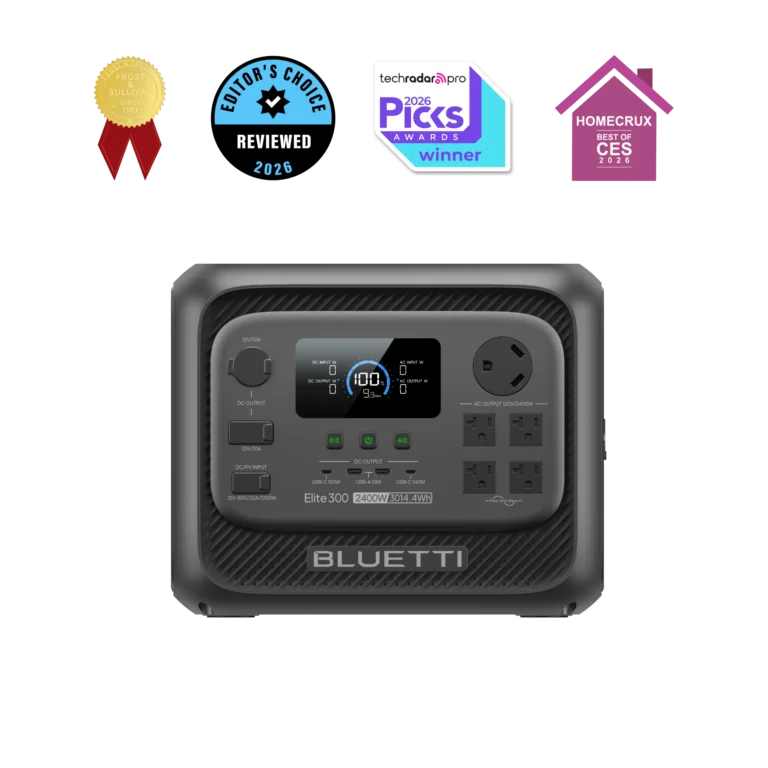
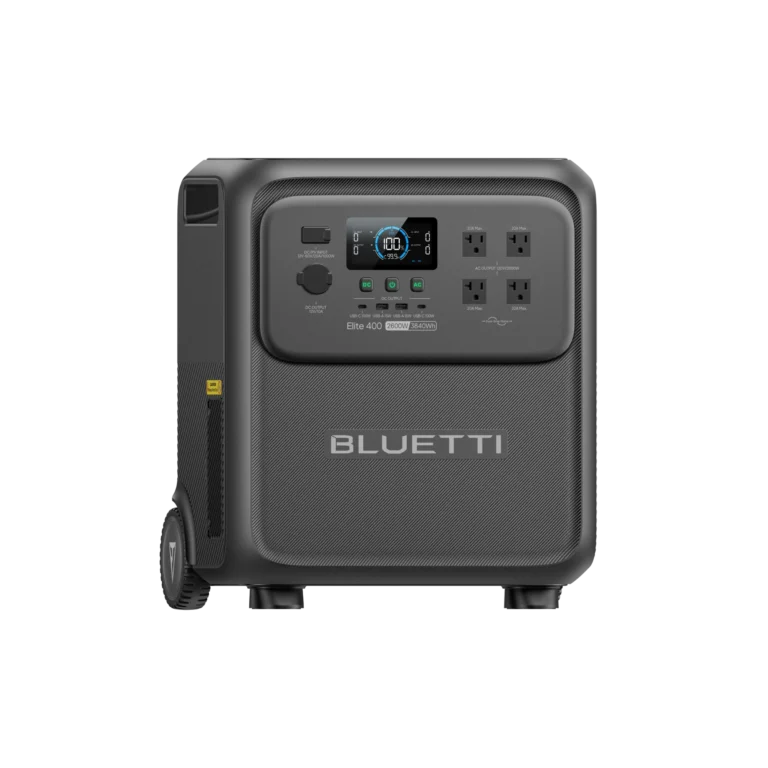
Two siblings in Bluetti’s Elite line, one tier apart, with the larger unit carrying the lower price. The Elite 400 lists at $1,299 with 3,840Wh against the Elite 300’s $1,649 and 3,014Wh. This isn’t a spend-more-get-more ladder—it’s a question of whether you’re paying the 300’s premium for its RV/van port suite and single-person carry weight. Outside those two things, the bigger, cheaper 400 is the default. Both are 120V-only, sealed, non-expandable, and support neither 240V split-phase nor a transfer panel.

Bluetti Elite 300
$1,649 ($0.547/Wh)
Check price
Prices and availability change frequently
Bluetti Elite 400
$1,299 ($0.338/Wh)
Check price
Prices and availability change frequently
Spec Bluetti Elite 300 Bluetti Elite 400
Capacity 3,014.4Wh 3,840Wh
Output (rated / surge) 2,400W / 4,800W* 2,600W / 5,200W†
Weight 57.98 lb 85.98 lb (wheeled)
Chemistry LiFePO₄ LiFePO₄
AC recharge time 1.7 hr‡ 2.5 hr (2h27m measured)
Solar input 1,200W (real ~1,000–1,100W) 1,000W§
Ports 11 (incl. TT-30, 12V/30A XT90 DC, 140W USB-C) 9 (no TT-30, no high-amp DC)
Price $1,649 ($0.547/Wh) $1,299 ($0.338/Wh)

*Resistive-only surge via Power Lifting mode (drops voltage to ~93V). †5,200W startup transient; 3,900W resistive Power Lifting. ‡1.7 hr requires 1,800W/20A circuit; ~2h44m on standard 15A outlet. §1,000W rated but real-world input limited by 20A/60V controller ceiling. Blanks indicate our research did not record the figure, not that the feature is absent.

RV or van shore power

$1,649 ($0.547/Wh)
Check price
  • You’re wiring a 3kWh station into a van bay or RV, feeding it from an alternator while driving and panels when parked, running a mix of 12V loads (fridge, diesel heater, pumps) plus occasional AC appliances.
  • The Elite 300 is the only Elite station with a native TT-30 RV outlet—our review names this as the deciding factor van and RV owners cite. Its 12V/30A XT90 DC port runs diesel heaters (which spike past the usual 10A limit) and 12V fridges directly, skipping the wasteful DC-to-AC-to-DC conversion. Independent testing confirmed the XT90 holds 31.1A before overload.
  • At 58 lb and a compact footprint it fits a van bay where bulkier 3kWh rivals won’t. Charger 2 tops it off the alternator while driving. Delivers approximately 2,790–2,860Wh usable capacity at a DC-dominant mobile load—DC-port loads bypass the inverter so the idle tax largely disappears.
  • The Elite 400 lacks the TT-30 entirely and has no high-amp 12V DC port—its DC output is a single 120W cigarette socket. At 86 lb it’s positioned as a home, tailgating, or truck-bed unit, not a van install. It stores more energy but can’t present that energy to an RV the way this buyer needs.

Multi-day home essentials backup

$1,299 ($0.338/Wh)
Check price

Hand-carried duty: stairs, truck bed, site-to-site

$1,649 ($0.547/Wh)
Check price
  • You physically lift this unit—up basement stairs, into a pickup bed, between jobsites, into a third-floor apartment with no elevator. The defining constraint is vertical movement the wheels can’t help with.
  • At 57.98 lb it’s a genuine one-person lift—and the most compact 3kWh portable in its class, ~20–30% smaller than competing units. Delivers approximately 2,760–2,873Wh usable capacity at mid-high AC load (tools, appliances).
  • The 2,400W inverter covers tools and appliances, and testers pulled 4,800W briefly off a table-saw startup. LiFePO₄ rated for 6,000 cycles to 80% (above the 4,000-cycle class norm) plus a 5-year warranty—buy-once durability for a unit that takes knocks.
  • Honest output ceiling: it hard-stops above ~2,450–2,800W sustained and a bandsaw drawing past ~26A defeated it, so match it to your specific high-draw tool.
  • The Elite 400 actually has better hardware for the work itself—more usable energy, a marginally stronger 2,600W inverter, a higher 5,200W surge—and its wheels and telescoping handle solve horizontal movement completely. But Bluetti itself recommends three people to lift it, and an owner flagged the handle’s strength pulling 86 lb up stairs. Roll it across a flat garage and it wins; carry it up stairs and it can’t.

Bedside medical or quiet overnight (CPAP)

$1,299 ($0.338/Wh)
Check price
  • The unit runs a CPAP or other low-draw device overnight, or simply sits in a room where someone sleeps. Both units are pure-sine, both are UPS-capable with confirmed handoffs, and both store vastly more than a CPAP’s ~320Wh overnight need—so the spec sheet doesn’t decide this.
  • The Elite 400’s 15ms UPS switchover is under the threshold a CPAP needs to ride through a grid drop without interruption, and our review frames it as a strong CPAP backup. The wheels let you move it bedside without a lift. Actionable setting: disable ECO mode for medical-device UPS—the default low-load shutoff can cut an intermittent draw, and our review calls this out specifically.
  • The Elite 300 is demoted on documented fan noise: our review measured ~50–53dB under load or Turbo charging, one tester saying he wouldn’t want it running near him while sleeping, and that it’s not silent even in low-load mode.
  • The honest limit on the 400 pick: our review is silent on a measured noise level—the spec sheet omits the dB row, and the only sleeping-related mention is a UL 2743 label that applies industry-wide to any battery over 1kWh, not a noise finding. The deciding factor here is the 300’s documented fan, not any confirmation that the 400 is quiet. If overnight silence is the single most important thing, neither unit is confirmed quiet, and that gap should weigh on the decision.

True of both units — Both units share configuration caveats for low-load medical use: disable ECO mode to prevent the default low-load shutoff from cutting an intermittent draw. Our reviews call this out specifically for CPAP and similar medical devices. Both units’ surge figures carry conditions—the 300’s 4,800W is resistive-only via Power Lifting mode (drops output voltage to ~93V, unsuitable for sensitive electronics); the 400’s 5,200W is a startup-transient peak, with its 3,900W Power Lifting likewise resistive-only. Real continuous output ceilings are softer than the surge numbers suggest.

Common questions

The bottom line

Under the canonical price the Elite 400 is the default: more usable capacity (approximately 3,576Wh at a ~1,500W AC load vs the 300’s approximately 2,760–2,873Wh at the same load), lower cost per watt-hour ($0.338 vs $0.547), class-leading idle drain, and wheels—the better-value large battery for a buyer who keeps it at home and rolls it where the outage hurts, including bedside for a CPAP (though our review does not confirm quietness). You pay the Elite 300‘s $350 premium for exactly two things, and you should only pay it if you need them: the RV/van port suite (the only Elite with TT-30 and 12V/30A DC) and the 57.98-lb single-person carry weight for stairs, truck beds, and tight installs. Both stop at the same wall—120V, no expansion, no whole-home—so if that’s your real need, neither is your unit.