

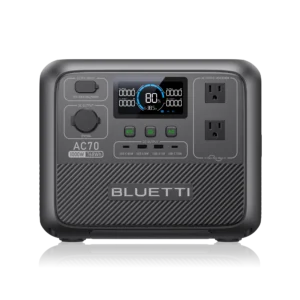

For a van or small trailer off hookups for a couple of nights, the question isn’t how big the tank is — it’s how fast it refills relative to how much you can carry. You’re running a 12V cooler, LED lights, a roof fan, a laptop, phones, and maybe a CPAP overnight. You’re lifting the unit in and out of the rig. You’re topping up from a roof panel or the running 12V system between stops. A sealed 1.5kWh anchor is the wrong answer; a fast-charging, one-hand-portable unit with a high solar ceiling is the whole game.
The AC70’s 500W solar ceiling on a 768 Wh platform is the real differentiator here. A single 200W panel delivers a measured 185–195W, and two panels refill it in roughly two hours — our AC70 review calls this ‘a real differentiator’ and ‘one of the fastest-charging solar stations in its class.’ That ratio of solar intake to tank size is what matters when you’re chasing sun between camps rather than sitting on a 400Ah lithium bank.
At 22.5 lbs it sits at the upper edge of genuine one-hand carry, and that matters when you’re loading and unloading daily. Our AC70 review names campers, van lifers, and RV travelers as its natural home and cites owners logging five years of continuous RV duty — which is the kind of real-world evidence that matters more than a spec sheet for a unit you’ll cycle this hard. LiFePO4 chemistry rated to 3,000-plus cycles to 80% means the chemistry is matched to the use case: partial-state-of-charge cycling and long storage between seasons are exactly what LFP handles better than NMC.
At this segment’s mixed load — 12V cooler running off the DC port (which bypasses inverter idle entirely), plus lights and devices at roughly 150–250W aggregate — usable delivery runs around 650–700 Wh. That’s the number to size your nights against, not the nameplate. The CPAP picture is also covered: a clean pure-sine inverter means medical devices run cleanly, and independent testing shows 7.5–8.5 hours of CPAP-with-humidifier runtime on a single charge — more than enough for a night off the grid.
Two things to know before you leave the driveway. First, there’s a documented early-ownership cluster of DC-port faults (E065 errors) and dead screens — register the unit and run it through its paces before your first trip; warranty service is responsive. Second, in Standard charging mode it pulls a 400–500W minimum from an AC source, which will trip a small vehicle inverter. In the rig, charge from the 12V port or solar, not a 400W truck inverter.
Skip it if: you want a full day of 12V-fridge runtime on a single charge rather than an overnighter — step up to the runner-up below, which carries more than 300 Wh extra and a 1,000W solar ceiling for the same price per watt-hour.
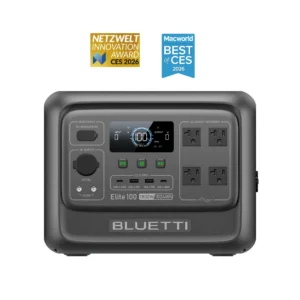
The boondocker who wants a genuine full day of 12V-fridge runtime rather than an overnight shifts here. At 1,024 Wh and 25 lbs it’s still one-hand portable, and its 1,000W solar input — nearly double the AC70’s — means a full refill in roughly an hour of ideal sun. Independent bench testing measured 869 Wh usable via DC and 880 Wh via AC at this segment’s load conditions. Two things to sort out before committing: the 1,000W solar throughput only unlocks at 48V or 60V panel configurations — a standard 24V panel pulls just 460W — so you’ll need to build your array around that voltage. And it is not expandable, which matters if your load ever grows. For a weekend trip where you’re comfortable speccing the right panel voltage, it’s a compelling step up; for a first-time setup where simplicity wins, the AC70’s solar ceiling is more forgiving.
Living in the rig changes the math completely. The battery gets cycled hard every day for months — not a weekend here and there — and the load is residential-style: a full fridge, Starlink, a laptop, occasional induction cooking. The unit that wins here isn’t necessarily the biggest or the fastest; it’s the one designed to be added to as your needs grow and durable enough to sustain daily use for years without degrading.
The DELTA 3 Plus wins this segment on one axis that sealed competitors simply can’t match: it grows. Expansion to roughly 5,000 Wh via DELTA 3-series batteries means a full-timer whose loads evolve — or who starts conservative and discovers they need more — isn’t forced to sell and restart. Our DELTA 3 Plus review calls this ‘broad expansion-battery compatibility’ and the cleanest portability-to-capability trade in EcoFlow’s portable line. A sealed 1kWh box with better specs today is the wrong buy for someone living in their rig.
The chemistry backs up the use case. LiFePO4 rated to 4,000 cycles to 80% is roughly a decade of daily use — the best cycle life in EcoFlow’s portable line. The 5-year warranty signals the same confidence. For a full-timer who can’t afford to replace a depleted cell bank in year three, both matter.
Two charge paths feed the daily-cycling lifestyle. Dual independent 500W MPPT ports mean two separate solar arrays can charge simultaneously without sharing throughput — bench testing confirmed a full AC charge in roughly 55 minutes, and independent solar testing shows a refill during a lunch break in good sun. The 12V car port and 8ms UPS handle DC accessories and seamless transitions when the source changes.
There are two catches that matter only for a specific kind of buyer. Phantom idle draw runs 32–40W — real enough to drain a parked unit over days. And the Time-of-Use scheduling is unreliable. Both of these bite an always-on, set-and-forget installation. A full-timer who is present and actively cycling the unit daily is on the right side of both: the idle draw is irrelevant when you’re running loads, and manual charging discipline replaces the scheduler. Also worth knowing: independent surge testing peaked around 2,600W versus the 3,600W spec, and sustained draws approaching the unit’s limits can trigger a thermal cooldown — not a factor for fridge, Starlink, and laptop loads, but worth noting if you’re planning to run sustained high-output devices.
Skip it if: your version of ‘extended off-grid’ means more base capacity now rather than the lightest expandable 1kWh — the runner-up carries 2,048 Wh out of the box and costs less per watt-hour, at the trade-off of more weight and a single slower solar path.
If the priority is more capacity in the base unit rather than the lightest expandable platform, the C2000 Gen 2 steps in: 2,048 Wh, expandable to 4,096 Wh, 4,000-cycle LFP, and a ‘Strong Buy’ from our review. It’s heavier at 41.7 lbs, and its 800W solar input on a single path is slower than the DELTA 3 Plus’s dual 1,000W — which is why the full-timer chasing sun from a big array and wanting the lightest daily-carry unit goes with the DELTA 3 Plus. The C2000 is the pick when you want the bigger tank first and will add panels later.
A travel trailer or fifth wheel mostly on hookups has a different failure mode than a boondocker: the load isn’t continuous and light, it’s intermittent and heavy. A residential fridge cycling on and off, a 1,500W microwave, a coffee maker — these are spikes on top of a ~300W baseline, and the wrong unit trips out mid-brew or can’t restart the compressor. Add the detail that many RV parks run TT-30R pedestals, and the picture becomes clear: you need sustained output that actually holds, an outlet that speaks the language, and enough capacity to cover the occasional night off-grid.
The C2000 Gen 2 clears the real kitchen-load bar — not just on paper. Our review confirmed air fryers at roughly 1,420W, microwaves peaking at 1,600W, and a kettle that drew 2,162W, all without tripping, with brief surge capacity measured near 6,000W for compressor startups. A 2,400W sustained rating that independent testing confirms is a different thing from a 2,400W claim that throttles under load.
The RV outlet is not a footnote. The C2000 Gen 2 has a TT-30R plug built in — the only pick on this page that speaks the RV pedestal natively. One honest caveat from the review: the inverter caps it at 20A (2,400W), not the full 30A service the plug shape implies, so size your loads accordingly. Still, running your shore-power connection straight from the station to the trailer’s inlet is clean and simple, and no other unit here makes that connection as directly.
At roughly 14–22 hours of real full-size-fridge runtime at a normal ~300W continuous draw — measured, not the advertised 32-hour figure, which holds only under controlled lab conditions — this is a genuine overnight-off-grid unit. It roughly doubles with the BP2000 expansion battery when you need more. LFP chemistry at 4,000 cycles and a 5-year warranty close the argument for a rig that might cycle this daily.
Two app settings are worth changing before you rely on it. Fast charging at its default settings trips a loaded 15A circuit, so dial it back if you’re plugged into a typical campground outlet. And AC output won’t auto-restart after a full drain by default — enable that in the app if you want automatic recovery after a deep discharge.
Skip it if: you want to chase solar off-grid rather than plug into a pedestal — the DELTA 3 Plus in Segment 2 is the better sun-chaser, with dual independent MPPT ports and lighter carry weight at the expense of base capacity.
Same 2,048 Wh and 2,400W output class, four charge paths including a 12V car input, and slightly better measured usable capacity. Demoted on the two axes this segment weighs: it is not expandable — the review calls it ‘the defining limitation of this SKU’ — and its solar input was cut to a single 500W MPPT, which the review flags as ‘a real capability cut’ for buyers who want an off-grid option. For a comfortable trailer that may grow or occasionally chase sun, the C2000’s expandability and native RV outlet make it the sounder choice at lower cost per watt-hour.
A large trailer or fifth wheel running a rooftop air conditioner through a pedestal outage is not a scaled-up version of the camping use case — it’s a different category. The loads are heavier (a 13.5–15k BTU compressor can pull 1,500–3,800W on startup), the form factor is a wire-in fixture rather than a grab-and-go, and the one behavior that decides the whole question is rarely even listed in a spec sheet: can the unit recharge from a generator while still powering the rig? Most can’t. The pick is the one that can.
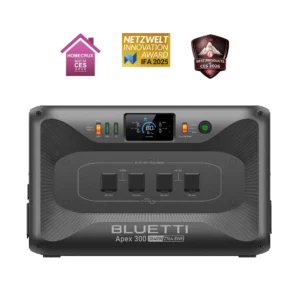
The Apex 300 runs rooftop A/C — not as a theoretical claim, but as a confirmed test result. A tester reported sustaining 3,800W for five minutes with no thermal shutdown and running two 15,000 BTU RV air conditioners plus a heater simultaneously at that draw. That’s the hardware clearing this segment’s defining load, and it’s the kind of real-world evidence that spec sheets don’t provide.
But the load capacity isn’t what separates it from the competition. Three units can hit the surge and 240V bar on paper. What separates the Apex 300 is the one behavior the other two fail: it outputs 120V and 240V split-phase simultaneously while charging from a 120V wall outlet — which means a generator can top it up while the A/C keeps running. Our Apex 300 review puts it plainly: almost nothing else in this class does that. The EcoFlow DELTA Pro 3 throttles total output to roughly 1,800W when charging from grid power, which means ‘an AC compressor startup above 2,000W causes shutoff’ — and one RV owner had to engineer a workaround to avoid tripping the limit. The Anker SOLIX F3800‘s architectural problem is stated even more directly: ‘240V output disables during 120V AC charging,’ and RV owners on 50A service hit the same wall. Both are capable machines in other contexts. For this specific job, both fail the same test the Apex 300 passes.
Independent testing confirms roughly 2,400 Wh (~87%) usable at the wall per base module under heavy AC loading. Expansion via B300K batteries grows the platform to roughly 19.3 kWh from one head unit — genuine multi-day coverage for an extended boondock or a prolonged outage. The 0ms UPS switchover means nothing downstream notices when the pedestal drops.
Three things to plan around. This is stationary infrastructure: 84 lbs, no wheels, a two-person lift — buy it to hardwire to a transfer switch, not to move between sites. The base unit ships without USB, 12V, or DC ports and without a solar or turbo cable; budget for accessories separately. And the 2,400W solar rating overstates real-world throughput significantly — independent testing measured roughly 1,000–1,100W per port, and there’s a dead zone between 60V and 150V array voltage. Plan solar around Bluetti’s low-voltage panel lineup or the SolarX 4K rather than generic high-voltage strings.
Skip it if: you want the 240V capability in a rolling, self-contained unit rather than hardwired infrastructure — the runner-up below covers that job, as long as you accept that generator-recharge-while-running-A/C won’t work.
The pick for a buyer who wants 240V output on wheels rather than hardwired, or who needs more base capacity at the start (4,096 Wh, $0.51/Wh). It runs central A/C and 240V loads from one rolling unit. The reason it isn’t the pick for this segment is also the reason it might be right for a different buyer: if you’re never in a situation where the A/C needs to run while the generator is charging the station, the pass-through limitation never bites you. It also can’t output 120V and 240V simultaneously, and the 12V car socket is absent.
Hard budget, light-to-moderate loads — a fridge, lights, devices, a microwave burst — no interest in paying for output headroom or solar performance you won’t use. The deciding number is cost per watt-hour on the bare unit. But an RV buyer has one hard requirement the cheapest box can quietly fail: a 12V DC port for accessories and, ideally, room to grow. Without those, cheap-per-watt stops being a value and becomes a limitation.
At $0.39/Wh the C2000 Gen 2 is the cheapest watt-hour among the units that actually qualify for RV use — and it doesn’t make any sacrifices to get there. TT-30R RV outlet, 12V output, expandability to 4,096 Wh, 4,000-cycle LFP, 2,400W sustained output, a ‘Strong Buy’ from our review. This is not a stripped budget unit; it’s a full-featured 2kWh station that happens to be priced aggressively.
The unit that appears cheaper by raw $/Wh — the EcoFlow DELTA 3 Max at $0.37/Wh — fails the RV port gate for this buyer: no expansion path and solar input halved to a single 500W MPPT. For a small rig that won’t grow and never goes off-grid, that might be acceptable; for anyone who wants to add capacity later or actually use solar, the C2000’s extra two cents per watt-hour is not a premium — it’s the cost of a complete setup.
At roughly 14–22 hours of full-size-fridge runtime at ~300W, this segment’s lighter loads leave even more headroom. The app-setting notes from Segment 3 apply here too: set fast charging to a lower draw on campground circuits, and enable auto-restart after full drain if you need unattended recovery.
Skip it if: you’re running a small rig and portability matters more than raw capacity — the Bluetti AC70 below is lighter, faster to recharge from solar, and confirmed for RV duty, though it costs roughly twice as much per watt-hour.
For a small-budget rig that doesn’t need 2kWh, the AC70 at $599 earns a mention here — not as a value pick, but as the right answer when lighter weight and faster solar recharge matter more than cost per watt-hour. At $0.78/Wh it costs roughly twice as much per watt-hour as the C2000, so it wins on portability and solar-per-size, not on raw value. The full case is in Segment 1.
The EcoFlow DELTA 3 Classic is worth naming for anyone who finds it. It has the best raw $/Wh in the 1kWh class and seamless UPS, but an RV buyer hits its limits quickly: no 12V car port and no expansion port. The review is explicit that both of those cut against van-life and RV use directly. Cheap per watt, but not a complete RV solution.