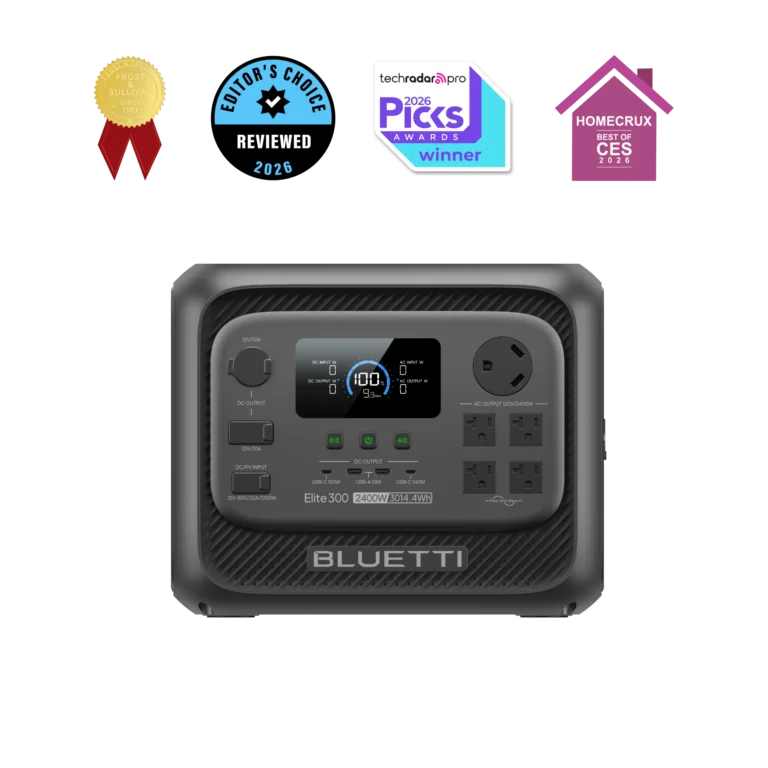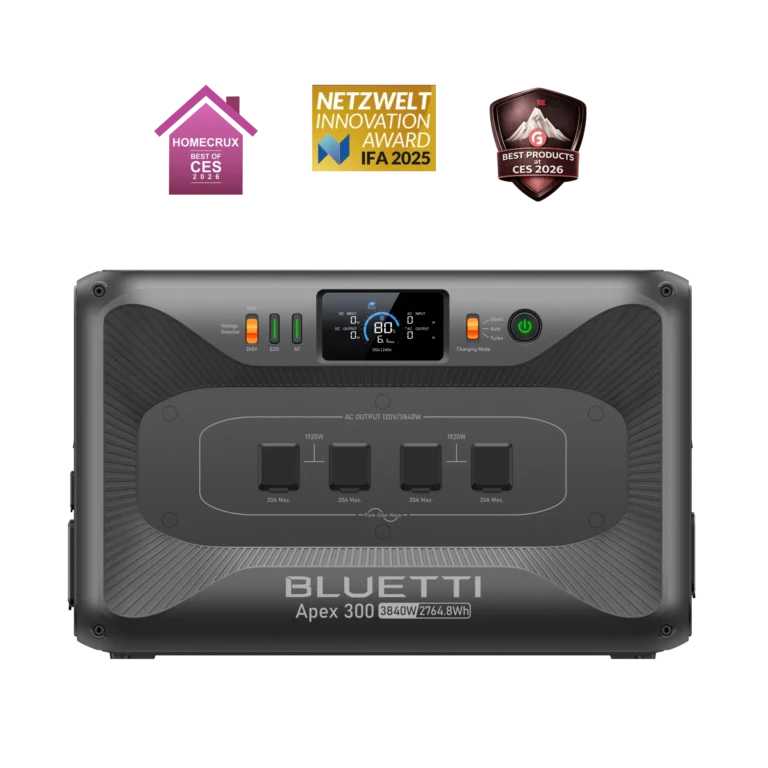
The Bluetti Elite 300 and Bluetti Apex 300 sit $50 apart at street price—$1,649 and $1,699—both Bluetti, both LiFePO4, both around 3,000Wh, both with an RV outlet. They are not neighbors. The Elite 300 is a portable power station you carry and plug devices into. The Apex 300 is stationary split-phase home infrastructure you wire to a transfer switch and expand over time. Almost every decision below is made by which of those two things you need, not by comparing outputs on matched loads.
| Spec | Bluetti Elite 300 | Bluetti Apex 300 |
|---|---|---|
| Capacity | 3,014.4Wh | 2,764.8Wh base |
| Expandable | No | Yes, to 19,353.6Wh on one unit |
| Rated output | 2,400W | 3,840W |
| Surge | 4,800W* | 7,680W* |
| Weight | 57.98 lb | 83.78 lb |
| Chemistry | LiFePO4 | LiFePO4 |
| AC recharge | 1.7 hr† | 1.08 hr‡ |
| Solar input | 1,200W rated | 2,400W rated |
| AC outlets | 11 total, incl. TT-30 | 6 total, incl. NEMA 14-50R + TT-30R |
| USB/DC ports | 140W + 100W USB-C, USB-A, 12V/30A DC, car socket | None on base unit |
| Split-phase | No (120V only) | Yes (120V/240V) |
| UPS switchover | ~8–9ms | 0ms§ |
| Price | $1,649 | $1,699 |
| Price per Wh (base) | $0.547 | $0.615 |
*Surge figures are resistive loads only (heaters, kettles), not motors or compressors. †Elite 1.7 hr requires a 1,800W/20A circuit; on a standard 15A outlet approximately 2h44m. ‡Apex 1.08 hr requires the optional L14-50P turbo cable sold separately; on the included 15A cable approximately 2.5 hr. §Apex 0ms UPS requires 240V output, grid via the 15A input, and loads on the two left outlets; other configurations measure ≤20ms. Blank cells indicate our research did not record a figure, not that the feature is absent.
Do not pick between these on price—at $50 apart, price is not the question. Pick on category. The Apex 300 wins if you are wiring in split-phase backup, need 240V or heavy continuous wattage (the segment where it sustains 3,840W rated against the Elite 2,400W ceiling), or want a battery bank you grow over time—accept that it is an 84-lb stationary install with a base unit that needs accessories (a Hub D1 for any USB, a turbo cable for fast charging) to reach its potential. The Elite 300 wins if you want a finished, carry-anywhere 120V unit with ports built in (the segment where it delivers roughly 360–470Wh more usable energy from its base battery and costs less per Wh), and a lighter body—accept that it stops at approximately 2,400W, never does 240V, and never grows past 3,014Wh. They overlap on a TT-30R outlet and a Bluetti badge, and almost nowhere else. The Apex takes the stationary split-phase and high-output roles; the Elite takes the plug-and-play light backup and carry-and-go roles. Decide which job you are hiring it for, and the choice makes itself.