When you purchase through links on our site, we may earn an affiliate commission. Learn more.

Bluetti Apex 300vsAnker SOLIX F3800 (2026)

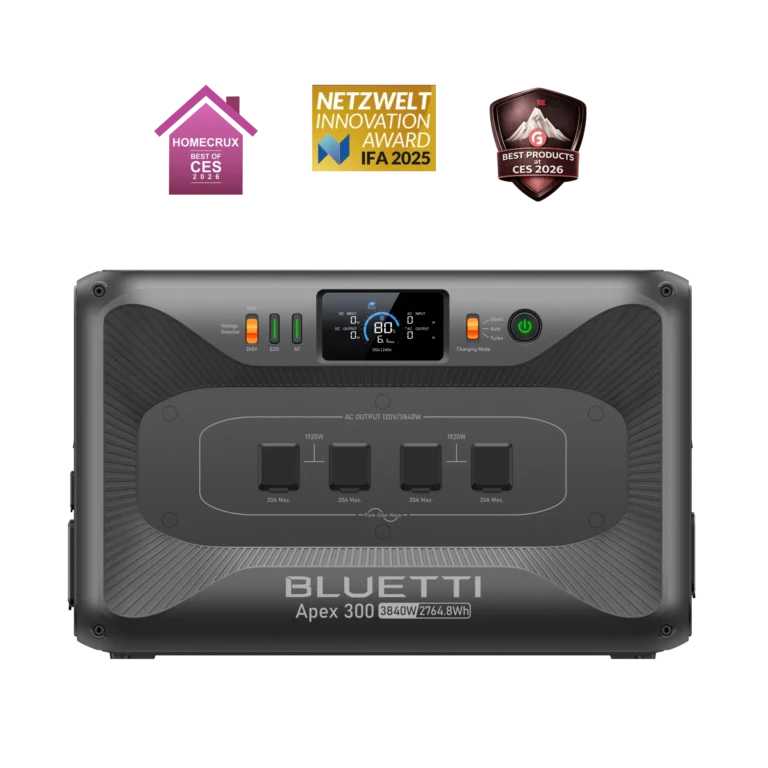
The Anker SOLIX F3800 and Bluetti Apex 300 sit $100 apart ($1,799 vs $1,699) and compete for the same home-backup and off-grid buyer despite landing in adjacent product classes. The F3800 is the bigger hammer — 39% more battery, 56% more inverter, complete out of the box. The Apex 300 is the smarter wiring — the only one of the two that keeps 240V output running while it recharges from a generator or grid. Which one wins depends entirely on whether your outage scenario ever requires powering loads and recharging at the same time.

Check price
Prices and availability change frequently
Check price
Prices and availability change frequently
Spec Bluetti Apex 300 Anker SOLIX F3800
Price $1,699 $1,799
$/Wh $0.61 $0.47
Capacity 2,764.8 Wh (LiFePO4) 3,840 Wh (LiFePO4)
Rated output 3,840W continuous, 120V/240V split-phase (240V limited to 16A single-unit) 6,000W continuous, 120V/240V
Surge 7,680W Power Lifting*
Weight 83.78 lbs, no wheels 130+ lbs, wheels and telescoping handle
AC recharge time ~2.3–2.5 hrs with included 15A cable; ~1.1 hrs with optional NEMA L14-50P turbo cable (sold separately) ~2.5 hrs at ~1,700–1,800W wall draw
Solar input 2,400W rated (dual 60V MPPT); independent tests measured ~790–1,100W real-world ceiling** 2,400W rated; independent tests measured ~1,200W real-world ceiling with standard panels**
Ports 6 AC out (4× NEMA 5-20R, 1× TT-30R, 1× 14-50R) + P050A; zero USB, zero 12V/DC on base unit (Hub D1 required) 6 AC outlets incl. NEMA 14-50 + L14-30, 3× 100W USB-C
Expandable to 19,353.6 Wh on one head unit (6× B300K); ~58 kWh / 11.52 kW across three units via Hub A1 26,880 Wh single-unit (6× BP3800); 53.8 kWh requires a second F3800 via Double Power Hub
UPS 0ms switchover (conditional: requires 240V output mode, grid via 15A input, loads on two left NEMA outlets; all other configs ≤20ms) capable; switchover time not published; seamless with Home Power Panel accessory per owner reports
Warranty 5 yr 5 yr

*Power Lifting is resistive loads only (kettles, heaters); explicitly not for motors or compressors per the manual. **Solar input ratings reflect independent real-world testing, which measured lower ceilings than the published specs; the Apex 300 has a 60–150V array dead zone (built-in MPPT stops at 60V, SolarX 4K starts at 150V). Blank cells indicate figures not recorded in our research, not that the feature is absent.

Short outages with heavy 240V loads

  • Who it’s for: Outages at your address are measured in hours to a day or two. Your transfer-switch circuits include real 240V draw — a well pump, electric dryer, big kitchen loads — and you recharge from the wall between events, not during them.
  • What decides it: When the loads are heavy and the outage is short, the only questions that matter are how much the inverter can carry and how long the battery holds it. The F3800 simply carries more: 6,000W continuous against the Apex 300’s 3,840W. On the 240V side specifically, the gap is wider than the headline — a single Apex 300 delivers 240V at only 16A (~3,840W), while owners ran 250V electric dryers, well pumps, MIG welders, and whole houses minus HVAC off the F3800’s single-box output. It also starts with 39% more battery (3,840 vs 2,764.8 Wh). Our review confirms the hardware delivers in exactly this scenario: owners rode out Helene and Florida hurricanes covering fridge, freezer, lights, and internet, and a single unit covers 6–24 hours of essential circuits. Quietness is confirmed too — 50–60 dB even at ~3,200W kitchen loads, the rare unit you forget is running.
  • Runner-up — Apex 300: If your 240V loads are light (a furnace circuit, not a dryer) and 16A suffices, it does the essentials job at $100 less. Our review confirms it holds full rated load (testers sustained 3,800W for five minutes without thermal shutdown; one ran two 15,000 BTU RV air conditioners plus a heater). Its usable capacity is the better-documented of the two: ~2,400 Wh delivered at the wall (~87% of nameplate) in independent testing. But it cannot match the F3800’s headroom, and 7,680W surge cannot be counted for motor starts — Power Lifting is resistive-only by the manual.

Multi-day outages: recharging while the loads stay up

  • Who it’s for: Hurricane-belt or rural-grid buyers whose outages run days, with a gas generator (or flaky grid) as the recharge source. The defining requirement: the unit must accept charge while continuing to power circuits — especially 240V circuits like a well pump or freezer.
  • What decides it: On paper these two look closer in this segment than in any other — both expandable, both LiFePO4, both 240V. Our reviews break the tie, hard, on an architectural fact no spec sheet shows. The F3800’s review identifies one flaw as the single most-cited architectural failure: plugging a charge source into its 120V AC input disables the 240V output entirely, plus three of its six 120V outlets. In a multi-day outage, your freezer or well pump on 240V stops every time the generator runs a recharge cycle. The documented workaround — feeding DC through the solar port from a 48V server-rack battery or an EG4 chargeverter — adds cost and complexity the product page never mentions.
  • Why the Apex 300 wins: Our review confirms the opposite behavior as its headline feature: dual internal inverters deliver simultaneous 120V and 240V split-phase while the unit charges from a 120V wall input — the thing almost nothing else in its class does from one box. Add Grid Self-Adaption Mode for unstable generator input, black-start capability from solar when fully depleted, and owner deployments wired to transfer switches covering well pump, furnace, fridge, and bedrooms, and this is the unit built for the long-outage cadence. Expansion is a-la-carte to 19.3 kWh on one head unit if days of autonomy are the goal.
  • Catch: A single unit’s 240V is 16A, so heavy simultaneous 240V loads need a second unit. In 240V mode under light continuous loads, technical owners measured it drawing 3–4× the consumed power from the grid via its pass-through design (Bluetti confirmed intentional) — relevant if you keep small loads on it between outages.
  • F3800 in this segment: The F3800 Plus exists specifically to fix this (240V pass-through charging) at a higher price — but the Plus is a different product at $2,499 and outside this comparison.

Off-grid cabin, cold climate, standing reserve

  • Who it’s for: Remote property or off-grid cabin, solar plus a backup generator, the unit lives there year-round — including winters — and may sit in reserve between uses.
  • What decides it: Spec sheets near-tie again — identical 2,400W solar ratings (both limited by real-world testing: Apex measured ~790–1,100W against its 60V ceiling; F3800 ~1,200W cap with standard panels, and 280W measured from a 400W Anker panel), both expandable, both 5-year LiFePO4. Our reviews decide it on cold behavior, standby economics, and remote-deployment risk.
  • Why the Apex 300 wins: Three reasons. First, cold: one owner ran the Apex 300 at −15°C without the pre-warming his previous Bluetti setup required, and our review names cold-weather operation a quiet strength for exactly the off-grid-cabin profile. The F3800’s review reads the other way — BMS throttles AC charging to ~685W below 50°F and refuses charge entirely below 32°F with no internal heater, so a mid-storm outage could leave the unit unable to accept charge until warmed. Second, standing reserve: the Apex 300’s bench-measured 18–24.7W AC-on idle is class-leading; the F3800’s inverter pulls a measured 50–57W in standby — 0.8–1.2 kWh per day evaporating while it waits for an outage. Third, remote-deployment risk: the F3800’s firmware updates require Wi-Fi, and our review documents an off-grid owner losing generator charging to a mandatory update with no human support path. The Apex 300’s app earns praise in our review for fast pairing, over-the-air updates, and time-of-use scheduling.
  • Catch: Plan solar around Bluetti’s low-voltage panels or budget the SolarX 4K — the 60–150V dead zone is real and owners upgrading from the AC300 (12–150V input) lost array flexibility. The Apex 300’s manual also sets a 32°F charging floor — its demonstrated cold advantage is in operation and discharge, not charging. Our review is silent on fan noise under load; for a sleeping-nearby cabin layout, noise is unverified on the winner.
  • F3800 in this segment: Workable per our review only if you have engineered the recharge path, and the cold-charge throttle, idle drain, and Wi-Fi dependency stack against remote deployment.

Out-of-the-carton appliance, best dollars-per-Wh

  • Who it’s for: You want one box that works the day it arrives — USB for phones, AC for everything else, wheels to move it — with no accessory spreadsheet and the best raw value.
  • What decides it: No single spec dominates — this is value plus completeness plus mobility, weighed together. On dollars per Wh it is not close: $0.47 vs $0.61 — 39% more battery for $100 more. On completeness, the F3800 ships functional: three 100W USB-C ports, six AC outlets including both NEMA plugs, wheels and a telescoping handle, charge cable in the box. The Apex 300’s review is blunt that the base unit is not fully functional as purchased — zero USB, zero 12V, no car port (Hub D1 required, and its car/barrel/USB outputs share just 120W), no solar cable, no turbo-charge cable; the low base price comes with a shopping list. There is also a documented design trap: the single expansion port means a Hub D1 and an expansion battery cannot both connect directly — you chain the Hub through a battery you may not have planned to buy; one owner reported it as a return-triggering surprise.
  • Catch: The F3800’s review-side risks for this buyer are arrival-quality (a meaningful DOA and shipping-damage rate, though Anker’s warranty response is a recurring save) and the standby idle drain if it sits on reserve — neither outweighs the value and completeness gap for an unbox-and-use buyer.

RV shore power, 50A rigs

  • Who it’s for: Substituting shore power at the pedestal or boondocking with AC appliances on a 50A rig.
  • What decides it: The built-in NEMA 14-50 plus 6,000W is the whole game — our review confirms owners running it as a 50A shore substitute and powering compressors and tools. A single Apex 300 physically cannot serve 50A (240V/16A; 50A needs three units per our review).
  • Catch: It will not recharge while feeding 50A service — same architecture flaw as the multi-day outage segment, manageable at a campground with planned charge windows, a veto for continuous-hookup living.

RV shore power, 30A rigs that need charge-while-powering

  • Who it’s for: 30A RV service where the unit must power the rig and recharge simultaneously.
  • What decides it: The dedicated TT-30R takes the rig directly, our review confirms the inverter handles AC startup loads competitors stumble on, and — decisively — it keeps powering while plugged into a pedestal or generator.
  • Catch: Larger 12V house loads (slide-outs, leveling) still need a separate house battery; the Hub D1’s DC output will not carry them.
  • F3800 in this segment: 240V output and half the 120V outlets disable during AC-input charging — irrelevant when you recharge between outages, fatal when you recharge during them.
The bottom line

The Anker SOLIX F3800 wins three segments: short outages with heavy 240V loads (because 6,000W and 3,840 Wh beat 3,840W and 2,764.8 Wh when you recharge after), out-of-the-carton value (because $0.47 per Wh, complete ports, and wheels beat $0.61 per Wh with a shopping list), and 50A RV service (because a single unit delivers it and the Apex 300 cannot). The Bluetti Apex 300 wins three segments: multi-day outages (because it recharges while powering 240V loads and the F3800 cannot), off-grid cabin and cold climate (because cold-weather operation, 18–24.7W standby idle, and no Wi-Fi dependency beat cold-charge throttle, 50–57W idle drain, and firmware lockout risk), and 30A RV with charge-while-powering (same recharge-architecture reason). Same hardware throughout; the regime changes whether the F3800’s charge-while-output block ever matters or the Apex 300’s continuity advantage ever activates. The architectural divide is absolute: one enables simultaneous charge and 240V output from a single box, the other disables it. Which product wins depends entirely on whether your outage scenario ever exposes that divide.