When you purchase through links on our site, we may earn an affiliate commission. Learn more.

Anker SOLIX F2600vsEcoFlow DELTA 3 Max Plus

Two 120V power stations at the exact same $1,099 street price — and they are deliberately different machines. The Anker spends its budget on stored energy and a roll-around RV chassis; the EcoFlow spends it on raw output, weight, and a deep expansion path. Neither does 240V, so neither is a whole-home unit. Which one wins comes down entirely to what you plug into it and where it lives.

Anker SOLIX F2600
Check price
Prices and availability change frequently
Check price
Prices and availability change frequently
Spec Anker SOLIX F2600 EcoFlow DELTA 3 Max Plus
Capacity 2560 Wh 2048 Wh
Rated output 2400 W 3000 W
Surge 2800 W honest surge* 6000 W rated / ~3700 W measured trip
Weight 69.7 lbs (wheels + handle) 48.7 lbs (no wheels)
Chemistry LiFePO4 LiFePO4
AC recharge ~78 min to 80% / ~1.7 hr full ~50–64 min to 80% / ~70 min full
Solar recharge ~2 hr to 80% at 1000 W
AC outlets 4× NEMA 5-20 + 1× NEMA TT-30 (30A RV) 4× 20A AC
USB-C 3× 100W 1× 140W + 2× 45W (shared 45W)
USB-A 2× 12W 1× 18W
DC outputs 2× 12V car (120W) 30A Anderson DC (378W) + 10A 12V (126W)
Solar input 1000 W 1000 W
Expansion ceiling 4608 Wh 10,000 Wh
Price $1,099 $1,099
Price per Wh $0.43/Wh $0.54/Wh

*The F2600’s advertised 3600 W SurgePad is a voltage-dropping boost mechanism, not true 3600 W at 120 V; the honest surge to plan around is 2800 W. A blank field means the figure was not recorded in our research, not that the feature is absent.

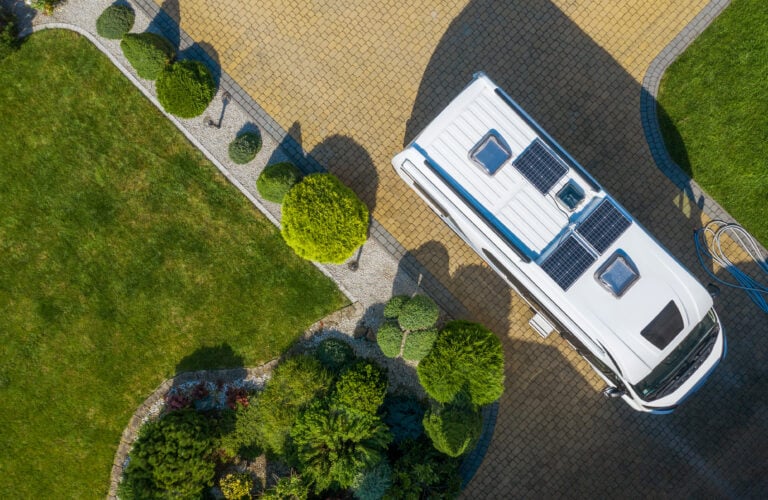
Plug into a 30-amp campground post / your camper's shore inlet

  • You pull into a campground, plug into the 30-amp post or feed your camper’s shore inlet, and want silent overnight power for the fridge, lights, fans, a coffee maker, and devices — without a propane generator. You need a clean shore-power interface and the most overnight energy you can store; output ceiling barely matters because RV hookup loads are modest and continuous.
  • The F2600 has a dedicated NEMA TT-30 outlet — the actual 30-amp RV connector — so it plugs straight into a hookup with no adapter improvisation. Our review confirms owners do exactly this with no drama and run a coffee maker, fridge, lights and TV silently overnight. It also stores 25% more energy than the EcoFlow (2560 vs 2048 Wh), and at this continuous mid load it delivers roughly 2450–2480 Wh usable, against the DELTA’s ~1850–1900 Wh at a comparable AC load. Same regime, ~600 Wh more on the table. And at ~70 lbs it has wheels and a luggage handle — the right answer for moving it around a campsite rather than carrying it.
  • The F2600’s noise spec is null, but our review reports ~45 dB under 1000 W — quiet, though the DELTA is quieter still if a near-silent bedside is the priority. Air conditioning is a short-burst capability on either unit (the F2600 runs a 15K BTU RV AC ~1.5 hr), not an all-nighter — that’s a tier limitation, not a tiebreaker.
  • The DELTA 3 Max Plus is genuinely viable — lighter to lift into a cabinet, quieter, faster to recharge between sites — but it lacks the dedicated TT-30 and gives up ~600 Wh usable per night. It wins this segment only if you value the lighter body over the extra overnight runtime.

Wiring a van or overland rig with a 12V DC system

  • You’re integrating a power station into a van or overland rig that already runs on DC — a 12V fridge, water pump, fans, lights off a fuse panel — and you want to feed that DC load directly and keep weight down. You need a real high-amp DC output so you skip the inverter entirely and low carry weight; running DC-native also sidesteps AC inverter idle losses.
  • The 30A Anderson DC port (378 W total DC) is the reason this unit exists for this buyer — our review calls it the reason to buy this over almost anything in its tier, feeding a DC fuse panel or running 12V fridges, pumps and fans directly without the round-trip inversion penalty. Because those loads run on DC, the inverter idle is bypassed (DC-port idle measured ~4–9 W vs ~22–25 W AC-on), so usable energy here sits near the high-load asymptote rather than the AC figure — and it dodges the standby drain that would otherwise bite an idle build. At 48.7 lbs with no wheels it’s the luggable one that drops into a cabinet; 21 lbs lighter than the Anker matters in a weight-budgeted build.
  • The DELTA’s standby AC drain (~22–25 W) and its low-draw AC auto-shutoff (cuts AC below ~15 W) are real traps — but they’re AC-side behaviors; a DC-native build that runs loads off the Anderson port largely avoids both, which is part of why this configuration suits it.
  • The F2600 has no equivalent high-amp DC output — just 2× 120 W cigarette sockets — which is disqualifying for a DC-native build regardless of its extra capacity.

Essentials home backup and set-and-forget emergency prep

Run power tools, high or spiky loads

  • You run power tools off a truck or around a shop, or your loads spike — microwave plus kettle, a pressure washer, a compressor, motor tools with real startup surge. You need sustained rated output and genuine surge headroom; capacity is secondary to whether the inverter can actually carry the load without tripping.
  • This is the clearest win on the page. The DELTA delivers a true 3000 W continuous — our review held 3000 W through a full discharge and didn’t trip until roughly 3600–3750 W measured — and runs fridges, kettles, microwaves, pressure washers and most power tools (a band saw at 6000 W+ startup starts fine; only the extreme-surge stationary tools like a 7000 W+ table saw or 9000 W+ planer overload it). The F2600 caps at 2400 W and shuts its outputs down about three seconds past it; its advertised 3600 W SurgePad is a voltage-dropping boost trick, not true 3600 W at 120 V — the honest surge to plan around is 2800 W, and a voltage-drop mechanism does not give real inductive motor-start headroom. For high or spiky draw, the Anker simply runs out of inverter before the DELTA breaks a sweat.
  • Bonus: it’s also the quietest in class — mid-20s dB on light loads, only the low 40s near 3000 W — so it stays civil even while working hard.
  • The F2600 is demoted on the output axis — a hard hardware ceiling, not a tuning gap.

Base unit for a growing off-grid stack

  • You want one unit now but intend to expand it into a serious battery bank over time — a cabin, a long boondock, real off-grid endurance. You need the expansion ceiling, not the capacity in the box today. This is the segment that inverts the capacity story from the essentials-backup pick.
  • The DELTA expands to 10,000 Wh, against the F2600’s hard wall of 4608 Wh from a single expansion battery (one BP2600 or one BP2000, and no more — that’s the documented ceiling, not a floor). If the plan is to grow large, the Anker dead-ends at roughly double its base; the EcoFlow has roughly 5× its base to give. Note the asterisk: the DELTA reaches 4 kWh with one battery out of the box, but dual-battery expansion requires a separately sold adapter — so confirm that cost before committing to the deep path.
  • For a buyer who wants the most usable energy in one affordable box and will never expand, the logic flips back to the F2600 — more capacity now at a lower price per watt-hour ($0.43 vs $0.54). The two only diverge on whether more later or more now is the goal.
  • The F2600’s capacity win in the essentials-backup segment is more energy today; its demotion here is less room to grow — same capacity axis, opposite time horizon. That’s why the same pair can flip without contradiction: today’s box favors Anker, the eventual stack favors EcoFlow.

True of both units — Both are 120V-only. Neither has 240V split-phase output, and 2–2.5 kWh is an essentials tier, not a whole-home one. If you need to run a well pump, electric dryer, or whole-home circuits, or sustain electric heat through a multi-day winter outage, both reviews say plainly that you’re in the wrong class — step up to a DELTA Pro 3-class unit with 240V and far more capacity. Forcing either of these into that role disappoints exactly the buyer who needs it most.

The bottom line

At a shared $1,099, this isn’t a which is better — it’s a which problem is yours. Buy the Anker SOLIX F2600 if you want stored energy and a roll-around RV machine: a dedicated 30-amp TT-30 outlet, ~600 Wh more usable per cycle, wheels, the lower price per watt-hour, and dependable set-and-forget standby behavior. Its ceilings are output (2400 W) and expansion (4608 Wh). Buy the EcoFlow DELTA 3 Max Plus if you want power, portability, and a growth path: a true 3000 W with real surge headroom, 21 lbs lighter, the quietest in class, a 30A Anderson DC port for 12V systems, and a 10 kWh ceiling. Its costs are less stored energy today, a higher price per watt-hour, a UPS that reboots sensitive gear, and a standby drain that bites idle, low-draw setups.