

The job here is simple to state and surprisingly hard to fill: keep a large LFP battery charged off the sun, day after day, without a utility connection. That means the solar controller — not the battery — is the decisive spec. And on that dimension, the field clears quickly.
The F3000 posts roughly 1900 watts of real solar throughput — the best of any large unit compared for this guide — driven by a dual-controller design that most competitors don’t match. The number that matters most is the High-PV input’s 165 V ceiling. Nearly every competing unit in this class runs a 60 V MPPT ceiling, which forces single-panel or parallel-only configurations and caps real intake at a fraction of the advertised maximum. The F3000’s tall window is what makes a genuine series string possible: two Anker PS400 panels wired in series reach roughly 115 V open-circuit, sitting comfortably inside that 165 V ceiling — exactly the topology the F3000 was built to accept.
Independent testing confirms the usable capacity lands around 2,650–2,760 Wh under a mixed cabin load (fridge, lights, small electronics) with the inverter running — roughly 86–90% of the 3072 Wh nameplate after conversion losses.
Pair two PS400s in series into the High-PV port and a third into the Low-PV port, and the array delivers roughly 850–950 W real in good sun. Over a 5-hour solar window that’s approximately 4.25–4.75 kWh per day — enough to refill the 3072 Wh pack with headroom to spare, which is the whole point of a solar-primary base. Even the two-panel configuration (~550–650 W, ~2.75–3.25 kWh/day) covers a normal consumption day with margin. The F3000 is also quiet (~35 dB) and idles low (~20–35 W), so the solar you harvest isn’t eaten by the station itself between uses.
Two things to plan around before committing. First, the F3000 uses a proprietary AC cable — keep a spare on hand, because losing it means losing AC charging until one arrives. For a set-and-leave base this is a one-time logistics item, not a recurring problem. Second, the PS400’s snap-button kickstand is fragile — owners and independent reviews both confirm it doesn’t hold reliably. For a fixed installation where panels are aimed once and left, just anchor them to a fixed mount or give them external support from the start; don’t plan around the stand.
One wiring rule that’s not obvious: do not extend the series string past two PS400s on the High-PV port. A third panel in series would push Voc toward ~173 V before accounting for cold-morning voltage rise — above the 165 V ceiling. Additional panels belong on the Low-PV port or in a separate parallel string.
Skip it if: Solar is a supplement rather than your primary fuel — if you’re mostly recharging off AC or a generator, the Bluetti Elite 400‘s larger battery, lower price-per-watt-hour, and quieter idle make it the better buy for that job.
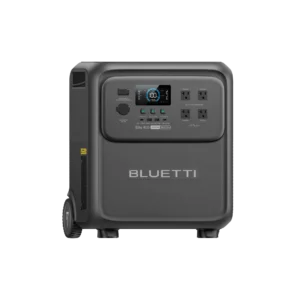
The Elite 400 leads this segment on the two specs that don’t win it: the largest capacity in the field (3840 Wh) and the best price-per-watt-hour ($0.338/Wh). It also idles at roughly 12 W — lowest of any unit compared here — so it holds a charge for days between uses. What it can’t do is push enough solar to stay topped up at a solar-primary base: its 1000 W solar input runs through a 20 A / 60 V controller that independent reviews flag as the unit’s weakest dimension, the ceiling that prevents a real series string. It rolls on wheels and weighs 86 lb. The case for it flips when your setup is AC- or generator-primary and solar is a topper — in that framing, bigger tank and lower cost wins, and the solar controller ceiling doesn’t bite.
Single-unit 240V output is the hard requirement here — two paralleled boxes to make split-phase is not the solution a homeowner wiring a backup panel wants. That requirement leaves two units standing. On raw output numbers the choice looks obvious. It isn’t.
The Apex 300 does something that settles this segment: it can output 240V while simultaneously taking in a 120V charge. In a multi-day outage where you’re running a generator for a few hours to top up between solar harvests, that capability means your essentials stay live the whole time — the generator refuels the Apex while it’s still powering your loads, not after. Add a 0 ms conditional UPS transfer (nothing downstream notices the grid going away) and a standby idle of 18–24.7 W, and the Apex sits cheaply on reserve between solar and generator cycles. Our review of the Apex 300 specifically calls out its cold-weather reliability as a strength — a real consideration for winter outages.
Important: the 18–24.7 W idle is a standby-only figure. Under light 240V loads running through pass-through, real draw runs roughly three to four times higher. Size your runtime estimates from the load itself, not the standby spec. And plan on the usable capacity landing around ~2,400 Wh (roughly 87% of nameplate) at 240V essential loads with the inverter on.
The paired panel system uses two Bluetti PV350s — one per solar port — measured at roughly 280–330 W real each in good sun. Two panels deliver approximately 560–660 W into the Apex over a 5-hour window, or about 2.8–3.3 kWh per day: enough to meaningfully offset daytime draw during an extended outage and bank reserve for the night, rather than just slowing the drain. The PV350 is on Bluetti’s own compatibility list for the Apex 300.
Critical wiring rule: run one PV350 per port, never two in series. A single panel’s 46.5 V Voc fits the Apex’s 12–60 V input window cleanly. Two in series reach ~93 V Voc — squarely inside a 60–150 V dead zone where the Apex won’t charge. This is the one wiring mistake that will leave you with panels in the sun and a battery going nowhere.
The PV350 is IP65, not IP68 — bring panels indoors during sustained rain rather than leaving them out.
Before buying, account for two out-of-box gaps. The Apex 300 ships with no PV charging cable, no turbo cable, and no DC/USB ports — the DC expansion requires the Hub D1 accessory. Add those to your budget before comparing sticker prices. And the single-unit 240V ceiling is 16 A — if you need true 30 A 240V service, that takes two units.
Skip it if: You need to drive a well pump, electric dryer, or any load that wants the full 6000W and a genuine subpanel tie-in — the F3800 handles those loads, and if you’re willing to pause 240V output while the generator recharges it, that scheduling constraint becomes manageable.
The F3800 is the more powerful box: 6000 W rated, 3840 Wh, and the only unit here capable of a true subpanel tie-in without add-ons. It weighs roughly 132 lb (from flat lookup, corroborated by independent coverage noting ‘130+ lb’) and idles at 50–57 W — considerably heavier on standby than the Apex. The flaw that drops it here is documented in reviews: its 240V output shuts off during 120V AC charging. For a multi-day outage where you’re cycling a generator to top up while keeping essentials running, that means choosing one or the other each cycle. For heavier 240V loads — anything that genuinely needs 6000W — and a buyer willing to schedule recharges around load-off windows, the F3800 is the right answer. The disqualifying flaw is a scheduling constraint, not a defect, if the use case fits.
In an RV or van, the spec sheet stops being the full story the moment you try to sleep. Weight affects how the vehicle sits; noise decides whether the unit runs at night; cable standards determine whether you’re hunting for an adapter at a campground. The units that compete here are close enough on paper that none of those things can be dismissed as tie-breakers — they are the decision.
The Ultra Plus is the quietest 3 kWh unit in this comparison — at ≤25 dB under typical RV loads, it runs while you’re asleep without registering. That’s not a small thing when the alternative is 35+ dB next to your head. It’s also 17 lb lighter than the F3000, rolls on wheels with a telescoping handle, pulls a full 3600 W through a standard TT-30 RV connection, and uses standardized connectors throughout — no proprietary cable means no single adapter failure strands you at a campground. It can also expand to 11 kWh if your needs grow, which the competing units in this segment can’t match.
Usable capacity lands at roughly ~2,690 Wh (about 88% of nameplate) under mixed RV loads with the inverter on.
Two NextGen 220W panels in series reach about 43 V Voc — conservative against any standard 60 V floor. One provenance caveat to take seriously: the Ultra Plus’s spec data lists a 1600 W solar maximum but does not state the MPPT input voltage range. The two-panel series configuration is a safe starting point, but confirm the exact voltage window directly with EcoFlow before finalizing your wiring topology. Independent testing puts MPPT efficiency at roughly 80%, which is the basis for the real-output estimates below.
Two NextGen 220W panels deliver roughly 360–420 W real in good sun — about 1.8–2.1 kWh over a 5-hour solar window, solid daily topping for an RV. Three or four panels scale that up to a full daily refill of the 3072 Wh pack. Handle the panels carefully: the bifacial hinge has been noted in reviews to crack under repeated rough folding, so store and deploy with some care.
Skip it if: You’re running a larger roof array and want to maximize raw solar harvest — the F3000 pulls roughly 1900 W real with a 165 V series-capable input that genuinely uses that array headroom, and it’s worth the extra weight and proprietary-cable risk if harvest is the priority.
The F3000 carries the same 3072 Wh capacity and measured ~1900 W real solar — the most of any unit compared for this page — with the 165 V High-PV input that makes a real roof-array series string practical. If your rig runs a serious panel array and maximum daily harvest matters more than noise at night, it out-harvests the Ultra Plus by a meaningful margin. The trade: 91.5 lb against 74.3 lb, ~35 dB against ≤25 dB, and a proprietary AC cable that needs a spare. Same machine with a different question — when the roof fills first, the F3000 wins; when the bed fills first, the Ultra Plus does.
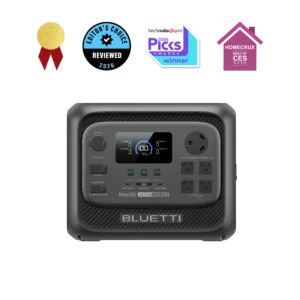
For the tightest van bays where physical footprint is the constraint, the Elite 300 earns a look: at 58 lb it’s the most compact and lightest 3 kWh unit among the options considered here, and it’s the only one with a native 12V/30A DC output for powering van DC loads directly without running the inverter. That direct DC integration is genuinely useful in a wired van build. The catch is noise: at roughly 50–53 dB (a figure from review descriptions, as the spec sheet carries no noise rating), it’s not something you run while sleeping. There’s also no solar or car cable in the box. It’s not expandable, and its solar tops out around 1000–1100 W real at the same 60 V ceiling as the other Bluetti units. The Elite 300 wins the tight-bay, DC-heavy-van framing; anything where quiet operation matters goes to the Ultra Plus.
Every trade-off in this segment comes back to one question: how fast can you refill the pack on a sunny afternoon? Weight and price matter, but a unit that turns daylight into a usable recharge wins clearly — a kit that can’t refill in a day is a kit that runs out on day two.
The DELTA 3 Plus has two independent 500 W solar ports, and that’s the whole argument. Run one NextGen 220W panel into each port and you’re delivering roughly 360–420 W real in good sun — enough to refill the 1024 Wh pack in about 2.5–3 hours of solid afternoon sun. No complicated wiring, no series math, no single-port bottleneck. When the goal is one sunny afternoon back to full, dual independent ports is the architecture that delivers it.
Each panel’s 21.5 V Voc sits well inside the 11–60 V per-port window with plenty of margin. AC charging tops it in roughly 55 minutes if you have a hookup. At 27.6 lb it’s a genuine one-hand carry. The 140 W USB-C port fast-charges laptops and cameras without needing a separate charger. And it can expand to 5 kWh when a weekend trip becomes a week-long expedition.
Independent reviews do document some idle and thermal quirks that affect always-on deployments. For a cycled camping kit — you run it down during the day, solar fills it back up, you repeat — those behaviors are largely irrelevant, and reviews explicitly name camping and overland as the DELTA 3 Plus’s strongest use case.
Two things to handle carefully with the panels: the NextGen 220W’s bifacial hinge can crack under repeated rough folding, so pack and unfold with some intention. Real measured output runs 180–210 W per panel front-side in good sun; two panels together land the kit’s daily recharge math comfortably.
Usable capacity at light camp loads (lights, phone charging, small cooler) lands around 870–910 Wh — roughly 85–89% of the 1024 Wh nameplate with the inverter on.
Skip it if: You’re traveling solo and every pound and dollar counts — the Bluetti Elite 100 V2 is two pounds lighter, $200 cheaper, and brings class-leading 1000 W solar for a 1 kWh unit, plus a solar cable in the box.
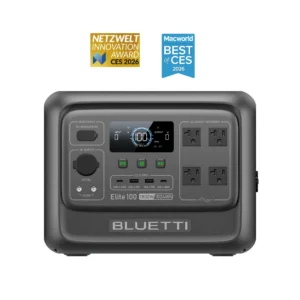
The Elite 100 V2 is the value and minimum-weight option in this segment: 25 lb, $399 MSRP, 1024 Wh, and a 1000 W solar input that leads the 1 kWh class — with a solar cable included. Two catches to know before buying. First, the high-current PV mode is off by default and needs to be enabled manually to unlock the full 1000 W input; it requires 48–60 V panels to work, so check panel compatibility. Second, reviews note an ECO-mode auto-shutoff behavior worth knowing about, and an early-failure cluster in owner reports that earns the ‘value pick’ label rather than the default. It’s not expandable. For a solo traveler who’s weight- and budget-first and doesn’t need the dual-port flexibility or room to grow, it’s a strong choice.
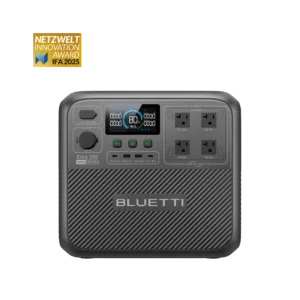
For family or basecamp trips where one carry of double the capacity beats minimum weight, the Elite 200 V2 holds 2073.6 Wh in a 53.4 lb package — still movable by one person — and idles at roughly 10 W with 96% inverter efficiency. It includes a solar cable. The solar tops out around 800 W real at flat-mount in good sun. It runs a fridge for roughly 22–30 hours. It’s not expandable. The case for it is simple: if you need two to three days of family-camp power without a generator, the double capacity is worth the extra carry weight. If you’re going solo and lighter, the DELTA 3 Plus handles the job more efficiently.