
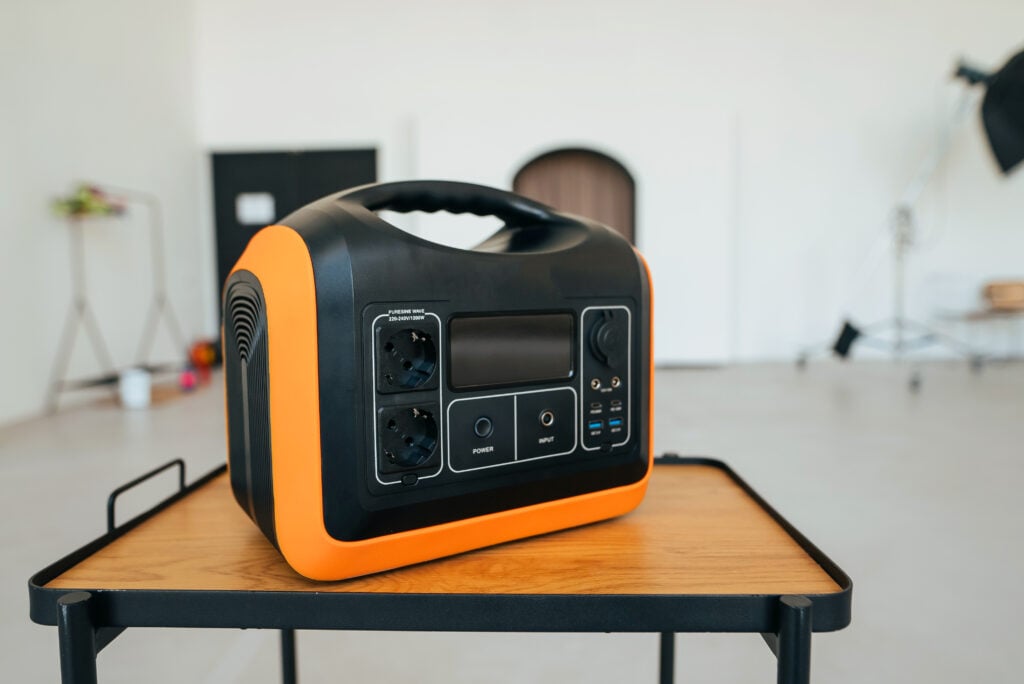
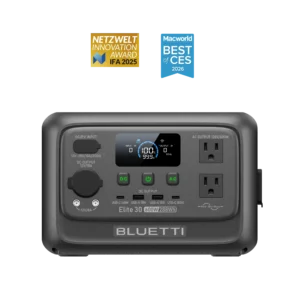

The lightest duty on this page is also the most spec-crowded: four 288 Wh stations land within 2 Wh of each other on capacity, and every one of them will charge a phone. What the spec sheet can’t tell you is which one actually delivers double the AC output for $70 less, charges from dead in under an hour, and runs quietly enough that nobody notices it in a tent. Independent bench testing answers those questions, and at this segment the BLUETTI Elite 30 V2 clears them decisively.
At $199, the Elite 30 V2 delivers 600 W of continuous AC output — double what the same-capacity Jackery and Anker alternatives offer — and independent bench testing confirms it: roughly 260 Wh reaches the AC outlets at steady draws, closer to 274 Wh through the DC ports, and a full wall recharge lands between 51 and 70 minutes on the bench. That recharge window matters on a camping trip where you plug in at the trailhead and leave; it matters even more during a rolling blackout where grid windows are short. Near-silence at light loads is the last piece — this unit doesn’t announce itself.
Two habits worth building before you rely on it. Run eco mode or use the DC ports for the smallest loads: independent testing measured 11–19 W of inverter idle draw with eco off, which is real money out of 288 Wh. And do not attempt to charge it below freezing — the LFP chemistry locks out cold-weather charging, full stop. Neither caveat matters much if you’re cycling the unit on weekend trips; both would matter if you were parking it as a permanent standby, which is not this segment’s job.
One thing the 1,500 W surge rating actually means: it applies to resistive loads — heaters, incandescent bulbs — not to motors or compressors. A window AC will not start on this unit. For the phone-laptop-light-CPAP brief, that’s irrelevant; know it before you try to run anything with a compressor.
Skip it if: weight is your only criterion and you’ll never push past 300 W — the Jackery Explorer 300 v2 is a pound and a third lighter and earns a strong recommendation for pure device-charging duty.
At 8.16 lb it’s the lightest serious station in this class, with 4,000-cycle LFP cells and a published recommendation for exactly this device-charging job. Its 300 W rated output is the ceiling — if you’ll never exceed it, the weight saving is real and the pick swaps. One note: most of its performance figures rest on manufacturer specifications rather than independent bench measurement, so the confidence that backs the Elite 30 V2’s numbers doesn’t carry over equally here.
Same 600 W class, and its sub-10 ms switchover is the best small-UPS execution among compact stations — if your real use is a wired-AC desk or network setup rather than camping, it deserves a look. Two documented issues keep it out of the top spot for this segment: a firmware bug cuts AC output when solar charging tops the battery, which makes it unreliable for solar-fed use, and a recurring chemical smell has driven a pattern of returns.
When the unit travels with you — strapped into a van, hauled to a campsite, sitting on the tailgate while you run a kettle — the calculation shifts from raw energy to energy per dollar, energy per pound, and how fast the sun can put it back. Both finalists here land at exactly 1,024 Wh, 1,800 W continuous, 3,600 W surge, LiFePO4, and a 10 ms UPS. Independent testing confirms both deliver their ratings. The tie breaks on price, weight, and solar ceiling.
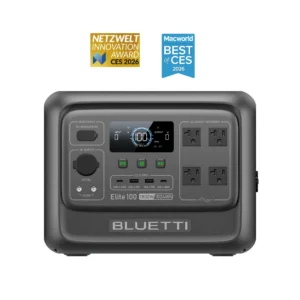
The Elite 100 V2 is the cheapest and lightest unit in this tier, and its 1,000 W solar ceiling — a 1:1 ratio to its own capacity — means a good afternoon of sun comes close to a full recharge. Independent bench testing found 869 Wh on the DC side, 880 Wh at the wall, and about 910 Wh extracted under a 1.2 kW load; run a 12V cooler through the DC port and inverter idle disappears from the equation entirely, so weekend fridge duty sits near that high end. The inverter sustains its full 1,800 W without throttling — confirmed on the bench.
Two limits to respect before loading it up. It will not start reactive motor loads — a 5,000 BTU window AC compressor defeats it even with Power Lifting engaged. And full solar speed requires two things most buyers miss: panel wiring at 48V or above, and enabling the app’s high-current PV mode. Miss either and you’re leaving most of that 1,000 W ceiling on the table.
There is one reliability note worth naming plainly. Owner reports and early field use document a cluster of early failures — dead-on-arrival units and deaths inside the first few months — that Bluetti covers under warranty. For an attended mobile unit where you notice a problem immediately and can act on the warranty, that’s a manageable risk. It is the reason this unit is demoted in the next segment, where nobody’s watching.
Skip it if: you’ll grow the system past 1 kWh, live off an alternator charger, or regularly cook at sustained 1,500 W — the EcoFlow DELTA 3 Plus is the pick for those buyers.
The charging specialist: the fastest verified AC recharge in the class (bench-confirmed at 55 minutes full), dual independent 500 W solar ports, an 800 W alternator path, and a clear expansion road to 5 kWh. Pay the $200 premium over the Elite 100 V2 if you’ll grow the system or spend extended time off the alternator. Two things that don’t bite the mixed mobile regime but do matter in other contexts: a heavy 32–40 W idle draw, and a thermal fan that cycles under sustained loads above 1,500 W and clips usable runtime by roughly 25%. The bench-measured surge held around 2,600 W rather than the 3,600 W headline — plan on the continuous rating for sizing purposes.
On paper, three stations fight for this slot: all 1,024–1,056 Wh, all 1,800 W, all LiFePO4, all between $400 and $450. The spec sheet produces a three-way tie. Independent testing and extended-use reporting break it — because what this buyer actually needs is a box that switches on reliably at 2 a.m., keeps a fridge cold through a 12-hour outage, and doesn’t require a technician to configure.
The DELTA 3 Classic earns this spot by confirming, on the bench and in extended use, exactly what an outage box must do. Independent testing found roughly 940 Wh at the AC outlets — about 91.7% of nameplate, the best efficiency figure in this tier — and the inverter held its full 1,800 W from full charge to empty without degrading. The 10 ms switchover kept Starlink, a NAS, and routers alive through grid drops without a hiccup. At 13 W idle, it sits on standby longer for less cost than anything else in this price range. And when the grid comes back, it recharges to full faster than its rivals here, which matters when outages come in waves.
Before you plug anything into it, do two things. First: set the inactivity auto-shutoff to ‘never.’ The default setting will cut power to a cycling load — a fridge compressor that happens to be off when the timer expires — and that is how food spoils. Second: register the warranty. Neither step takes five minutes, and both matter.
One boundary to weigh honestly: extended testing documents a BMS failure mode under daily deep-cycling — repeated multi-hour discharge cycles every single day. For the US buyer who loses grid power a handful of times a year, that risk is remote. If your grid fails every day, the runner-up or the 2 kWh segment are better fits.
Note: this unit has no 12V car port. If DC output for a cooler or other 12V accessory is part of your plan, the runner-up has it.
Skip it if: you want the option to expand capacity later — the Anker SOLIX C1000 can double its storage with a BP1000 add-on battery, something the Classic can never do.
The expansion argument: add the BP1000 battery and you have 2,112 Wh for roughly the price of the next segment’s units — the only path to that kind of runway in this price tier. Independent testing across three bench runs found about 85–90% of nameplate at household loads, and the 54-minute AC recharge is class-competitive. Two things to know before relying on it for outage duty. The 20 ms switchover is fine for fridges, routers, and CPAPs but reportedly drops desktop computers mid-outage — if that matters, it matters enough. And the 12V DC port auto-shuts after roughly an hour under light loads; running a DC fridge overnight without first disabling several power-save settings is a documented path to a warm cooler. The solar input is rated at 600 W, but real-world delivery runs 20–40% under panel nameplate due to MPPT current-cap behavior — plan the array accordingly.
Demoted here: BLUETTI Elite 100 V2
The Elite 100 V2 wins Segment 2 as a mobile unit but is not the right choice for an unattended outage box. Its default ECO mode has cut AC output during a sump pump’s between-cycle idle — a documented basement flood, despite UPS mode being enabled — and its early-failure pattern argues against trusting it as your only unattended line of defense. With you present on a camping trip, those risks are manageable. With nobody home during a storm, they are not.
Four stations cluster at 2.0–2.1 kWh and 2,200–2,600 W. Specs will not separate them. What separates them is what happens at 3 a.m. when the grid drops and nobody’s home to hit reset.
One unit was removed from consideration early: the Jackery Explorer 2000 v2 has a documented pattern of its automatic switchover failing to engage, leaving protected loads dark until someone manually resets it. For a stationary outage anchor that runs unattended, that is disqualifying regardless of how good its other numbers look. (It remains a strong 2 kWh option for portable, attended use — the failure mode is irrelevant when you’re standing next to it.)
The C2000 Gen 2 is the only unit in this tier whose review lands as an outright strong buy, and the confirmation hits exactly where this segment’s buyer needs it. Idle draw runs 9 W with the AC inverter off and about 18 W with it live — compared to 32–40 W for the EcoFlow 1 kWh siblings, that gap is hours of additional fridge runtime per charge. The 10 ms switchover held through fridges, routers, and CPAPs in testing. And the 80–90 minute measured recharge means a brief generator run tops it up rather than consuming an afternoon.
For fridge runtime specifically: a real full-size fridge with normal door use runs 14–22 hours per charge — that is where owner experience and bench testing converge. The 32-hour marketing figure is a controlled-lab result; don’t plan around it. With the BP2000 expansion battery, double those numbers.
Two setup steps before you trust it unattended. Enable the Output Port Memory Switch so the unit resumes its prior state after a power event rather than waiting for you. Disable Smart AC Output mode. Neither is optional for outage duty, and neither takes long.
One circuit note: on a shared 15A household circuit, keep AC input below roughly 1,500 W to avoid tripping the breaker — the unit will happily try to pull more.
Skip it if: per-charge runtime is everything and you never need to expand — the BLUETTI Elite 200 V2 delivers more hours per charge and a higher cycle rating, at the cost of 12 extra pounds and no expansion path ever.
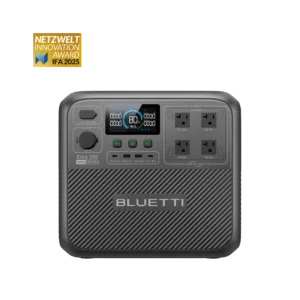
The endurance argument. Bench-measured 96% inverter efficiency and roughly 10 W idle give it 22–30 hours of full-size fridge per charge — the longest in the tier. Its 6,000-cycle rating is also the highest here. Choose it over the C2000 if your need is fixed, you want the most hours between charges, and you’re comfortable knowing you cannot expand it later. Four things to plan around: no expansion battery exists for it, it weighs 53.4 lb, the display reads in VA rather than true watts and over-states consumption roughly 2× on some loads, and the brand-wide ECO-mode default must be disabled before leaving any low-draw load unattended. The 60V solar panel voltage ceiling also means standard residential panels wired in series will not connect — check your array before buying.
This is the segment where the spec sheet misleads most aggressively. More battery and more inverter look better on paper; what decides it in practice is which architectural flaw you can actually plan around — and which one will leave a well pump dark with no warning and no path to recovery until you physically intervene.
The EcoFlow DELTA Pro 3 has the larger battery (4,096 vs 3,840 Wh) and the higher cycle rating. The Anker SOLIX F3800 has 2,000 W more continuous output and costs $300 less. Reviews and extended testing make the call: the F3800’s key limitation is plannable; the DELTA Pro 3’s is not.
For the transfer-switch buyer, the F3800 is one of the easiest single-box 240V recommendations on the market. It runs 120V and 240V simultaneously — the well pump and the kitchen run at the same time, without choosing between them — and 6,000 W continuous is enough headroom that most households never see the ceiling. Owners have ridden named hurricanes on this unit. It runs quietly enough to forget it’s indoors. With one expansion battery, roughly 26 hours of essentials at modest draw becomes realistic based on owner hurricane experience.
The one condition that comes attached to every strong recommendation for this unit: plan the recharge before you buy, not after. Generator recharging suspends 240V output while it runs. Real solar throughput is closer to half the rated 2,400 W with standard panels — the 60V/25A port ceiling is the constraint, not the rating. And below 32°F, charging stops entirely. None of those are dealbreakers for a buyer who plans around them; all of them become problems for a buyer who assumed the rating was the real number.
Three specifications are absent from the published record: surge output, formal UPS switchover time, and exact weight. The figures in the table above come from testing and owner reports, not manufacturer documentation, and carry lower confidence accordingly. The roughly 20 ms switchover is the right number to plan against for fridges and pumps; it is not suitable as a desktop-grade UPS. Round-trip efficiency from the grid measured in the 60–70% range — relevant if you’re calculating generator fuel costs over a multi-day event.
Skip it if: you need a true 10 ms UPS on the 120V side, want UL9540 certification for year-round indoor installation, or prioritize the app experience and the fastest 240V recharge — the EcoFlow DELTA Pro 3 is the answer to all three.
The bigger battery, the faster 240V recharge (bench-measured at 75 minutes versus roughly 2.5 hours), a genuine 10 ms UPS on the 120V side, UL9540 certification, and the better app. Choose it over the F3800 for any of those reasons — they are real advantages. The 2,600 W dual-port solar ceiling, with non-overlapping voltage windows, is the highest real solar intake here, though the port pairing takes some planning. One firmware note that the review documents plainly: logged shutdowns with no notification, requiring physical resets, occurred three times in five weeks of long-term testing. For any critical load that must stay on while nobody is home — a medical device, a freezer full of insulin — that record means this unit is not an appropriate choice, and neither is any portable station at this price tier. Its pass-through mode also throttles output to roughly 1,800 W while grid-connected, so large surge loads can trip it offline in UPS duty. The 0.83-hour AC recharge figure published by the manufacturer is implausible for a standard 15A/120V input and should not be used for planning.
Also worth knowing: Bluetti Apex 300
The staged-system route. A single 84 lb box delivers split-phase 240V simultaneously, and the expansion ceiling reaches roughly 19.3 kWh per head unit. Standby draw measured at 18–25 W is the lowest in this segment. The boundaries: one unit delivers 240V at only 16A — true 30A service requires two units — the base ships with no USB or DC ports and no solar cables, and the 60V solar ceiling repeats the voltage trap that runs through this whole segment. It is the right choice if you are deliberately building a wired-in system in stages rather than buying a finished box today.