

The outage pain here is connectivity, not cold food: the router goes dark, the modem reboots, and anyone working from home or trying to reach family loses the thread. The unit that solves this lives plugged into the wall next to the network stack, invisible until the grid drops — and then it needs to catch that drop without the modem ever noticing, run quietly enough for a bedroom or home office, and hold the kit alive long enough to outlast most outages.
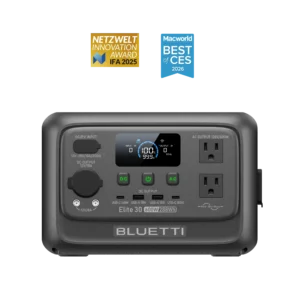
The RIVER 3 Plus is the sub-$300 network UPS this segment is looking for. Its sub-10ms switchover has kept desktops, NAS units, and network stacks running through outages with no reboot — that result holds across both independent testing and owner use. It runs near-silently at router-and-modem loads, owners run it 24/7 in bedrooms without complaint, and the 1-hour wall recharge means a short grid window restores full reserve before the next blip. At a 20–40W network stack, expect roughly 10 hours of runtime — a figure derived from owner-measured results at that specific draw, where the inverter’s own idle consumption is already baked in. One detail that matters for unattended duty: output ports can be configured to remember their state after the battery depletes, so when the grid returns and the unit recharges, everything comes back on by itself. That is not a given across this class.
It also has room to grow. Magnetic stacking expands the system to 858Wh without replacing anything — the only unit in this tier with that path. The 600W AC output leads the three-unit class, though at 20–60W loads that headroom is a bonus rather than the reason to buy it.
There are three things to know before leaving it permanently plugged in. Firmware updates can cut AC output mid-process — schedule them manually during the day, not overnight. A recurring chemical smell on charge and discharge drove some returns; test the unit in the first week and return it if you notice it. And for anyone considering feeding it with solar: a documented firmware bug cuts AC output when solar charging tops the battery to 100%. That bug does not touch wall-plugged UPS duty, which is what this segment runs, but it is a hard veto for unattended solar-fed configurations.
Skip it if: your kit includes anything that plugs into USB-C or USB-A and must stay charged overnight unattended — the runner-up’s USB shutoff issue is the C300‘s problem, not this unit’s, but if your protection needs are purely AC and Anker’s support reputation matters to you, the C300 is the alternative worth considering.
The quietest of the three (a 25dB rating, fan effectively silent in normal use, confirmed in its review) with a firmware-fixed AC auto-restore after full drain and scope-confirmed pure sine output. Owners report roughly 8 hours on a router and modem stack. It loses to the pick on one genuine UPS failure mode: the USB-C output ports auto-shut off after about two hours at low current, which means anything in your kit running on USB — a phone, a mesh node, a small lamp — goes dark silently while you think it’s protected. It also carries no expansion path and half the AC output headroom. Choose it over the pick if everything you protect plugs into AC outlets and you value Anker’s support track record.
The value case of this class at $199, with the fastest wall recharge of the three (51–70 minutes measured) and dual high-wattage USB-C ports. An oscilloscope-confirmed sub-10ms switchover and roughly 10 hours on a router when configured correctly make it a real option — the problem is that ‘configured correctly’ requires actively managing a trade-off between ECO mode (which can shut off under router-class loads) and idle drain (11–19W with ECO off, enough to drain the battery from full to 19% overnight with nothing connected). For set-and-forget wall-plugged duty, that trade-off is a management burden the other two units don’t impose. Buy it only if you’re willing to tune and monitor the configuration; if you want to plug it in and forget it, the pick is the safer choice.
A refrigerator is a harder load than it looks. The compressor cycles on and off, drawing a surge spike every restart, and a power station that reads the idle gap as ‘nothing connected’ and cuts output will fail exactly when the compressor tries to come back. The unit for this job needs genuine surge capacity, confirmed efficiency at mid-range loads, and an inverter that stays on through the whole compressor duty cycle — not just a spec sheet that lists the right numbers.
Independent bench testing measured 940Wh usable at the AC outlets — 91.7% of nameplate, a figure its review calls exceptional for this class — and the inverter held its full 1,800W from full to empty without degrading. At this segment’s cycling-compressor load, that efficiency holds: owners run refrigerators on it as its primary documented use, the 3,600W surge handles compressor restarts cleanly, and the 10ms UPS switchover means the fridge never sees the grid drop. Its review’s own runtime math puts a 60W mini-fridge plus lights and phones at roughly 24 hours — a full-day outage on a single charge.
One setup step is mandatory before you trust it: change the default 2-hour inactivity auto-shutoff to ‘never.’ The unit will read the compressor’s off-cycle as inactivity and shut down mid-outage if you skip this. It takes two minutes in the app, and it’s the difference between a working fridge backup and one that fails quietly. Do it the day the unit arrives.
At 13W standby — the most efficient idle in the 1kWh class — it also costs almost nothing to leave plugged in waiting between outages.
The catches worth knowing: this unit is not expandable. If you think you might want more capacity later, the DELTA 3 Plus (see below) is the growth-path version, and that decision is permanent at purchase. If the battery fully depletes during a long outage, it blocks AC pass-through until it recovers some charge — plan for that if you run a generator. And its review notes an early-failure signal under heavy daily-cycling use; for occasional-outage duty in the US, the review’s own judgment is that it’s the right buy, but register the warranty the day it arrives.
Skip it if: you want the option to add capacity later — buy the DELTA 3 Plus instead; or if recharging speed is your top priority and you run a generator in short bursts, the runner-up’s 47-minute full recharge is the faster path back to a full reserve.
The recharge specialist of the class. Independent testing measured a full refill in 46–47 minutes — the fastest confirmed time here — which changes the math on a long outage: short generator runs or brief grid windows fully restore your reserve instead of leaving it half-full. Its review confirms 8–12+ hours on a cycling fridge, a sub-10ms UPS verified on networking and desktop hardware, and it comes in 2.4 lbs lighter than the pick. It loses the segment on usable energy (independent testing measured 850–907Wh at the AC outlets versus the pick’s 940Wh, at a comparable load) and on price. One hardware note: the SurgePad feature cannot be disabled, and it has stalled some compressor and induction-motor loads. Test your specific refrigerator during the return window before committing.
The right pick for one buyer: the household that wants fridge backup now and knows it will expand the system later. It shares the same 1,024Wh and 1,800W platform as the pick, with a review-measured 8ms switchover and a ~55-minute full AC recharge — and it opens a path to 5kWh across four EcoFlow battery families plus dual 500W solar ports that can refill it in roughly an hour of strong sun. Its own review’s FAQ is direct: for a parked, never-expanded home unit, the Classic is the honest buy. Pay the extra $150 only for the expansion path. Two things to note at this load: idle draw runs roughly 32–40W (versus the Classic’s 13W), and independent testing observed a thermal shutdown under sustained loads above 1,500W — neither affects a cycling fridge, but both matter if you later add heavy continuous loads to the system.
When the load is a CPAP, the stakes change the weighting entirely. Reliability is no longer one factor among several — it is the factor. A unit that works eight times out of nine is not close enough. And the physics of the load are different too: at 30–50 watts draw, a unit’s fixed inverter overhead becomes a large fraction of total consumption, which means the nameplate numbers from fridge-backup tests overstate what you actually get beside the bed. The DC path — bypassing the inverter entirely — can multiply runtime significantly at this regime, and that difference is worth understanding before you buy.
Everything this segment weights, it delivers — and its review carries no reliability asterisk. Connected via DC or USB-C direct (bypassing the inverter), it covers up to four nights of CPAP on a single charge; that figure comes from owner-confirmed use at 30–50W draw, at conditions where the inverter idle tax never enters the equation. The sub-10ms switchover is bench-verified, so a mid-sleep grid drop is invisible to the machine. At loads below 200W it runs under 20 decibels — genuinely sleep-beside-it quiet, confirmed by independent testing, not a marketing claim. Its longevity story is clean: 4,000-cycle LFP chemistry, owners reporting months at 100% standby with no issues, and no early-failure cluster in its review. The 47-minute full recharge means any grid window — even a short one — restores days of margin.
One step that must happen before the first night you need it: complete the initial Bluetooth app pairing at home. Out of the box, the outlets may not turn on without it. This is documented in its review and confirmed by owners. Do it the day the unit arrives, not the night the power goes out.
Skip it if: your CPAP runs a humidifier and heated tube on AC and you want maximum overnight margin — the runner-up’s larger low-load AC runtime gives more headroom for that configuration; or if budget is the primary constraint and your setup is unhumidified, the honorable mention covers two-plus nights at a much lower price.
The capacity-headroom choice. Owners report 30+ hours at a ~30W CPAP draw, and its review calls CPAP backup ‘a genuine night-after-night safety net.’ If your machine runs a humidifier and heated tube on AC — the configuration that pushes draw toward 55W and defeats every sub-300Wh unit on this page — the Classic’s 1kWh tank is the margin that keeps a full night reliably in reach. It cedes the medical win on two fronts: it is louder at the bedside than the pick, and its review notes an early-failure signal under heavy daily cycling that, however unlikely in occasional-outage use, is exactly the kind of asterisk this segment is built to punish. Same mandatory setup step as Segment 2: change the auto-shutoff to ‘never’ before the first night. One honest sizing note: if your device is an oxygen concentrator drawing around 310W rather than a CPAP, this unit gives only 3–3.5 hours — size to your actual machine, not the category label.
The budget medical pick for unhumidified CPAP users. At moderate pressure with humidity, owners measured 25–35% drain per night, giving two to three nights per charge — confirmed through real outages by buyers who purchased it specifically for this purpose. The sub-10ms switchover is the same one that wins Segment 1, and it sits quietly enough for the nightstand. The 286Wh ceiling is the demotion: heated-tube or high-pressure setups can compress that margin below a safe full night, and there is no headroom to be wrong about it. If your setup is unhumidified and low-pressure, it’s a genuine two-night solution at $269. If there is any uncertainty about your machine’s draw, go up to the 1kWh class.
Storm-belt outages that last days are a different planning problem than a one-night fridge backup. The unit needs enough capacity to run fridge, network, lights, and a home office across multiple days; it needs to be physically movable by one person; and it needs to idle efficiently during the hours when nothing much is drawing — because a unit that burns 1kWh per day just keeping its inverter warm is eating its own reserve faster than any load you plug into it.
Its review reads like this segment’s brief. One owner ran it through seven circuits via a manual transfer switch, estimating roughly 2.5 days of battery-only runtime. A renter rode out multiple multi-day storm outages on a fridge, home office, and entertainment loadout. A measured full discharge delivered approximately 2,690Wh usable at realistic mixed loads — about 88% of nameplate, a strong showing at this regime. Independent testing measured ≤25dB below 600W, making it the quietest unit in its class at the loads this segment actually runs. The 10ms switchover carried a real outage without a fan or baby monitor so much as blinking. Storm Guard auto-tops the battery ahead of weather alerts, confirmed working by owners — the kind of feature that matters when you’re trying to start a storm with a full tank.
At 74 lbs with a telescoping handle and wheels, it remains genuinely portable in a way that the runner-up, at 130+ lbs, does not. On a page about portable stations, that distinction is worth naming plainly.
The idle draw — 19–30W — is low for this class, but it still adds up over days. When nothing is actively drawing, switch outputs off; that habit extends runtime meaningfully. At maximum sustained loads the unit climbs to 60dB, so plan placement accordingly for heavy draws even if it’s quiet the rest of the time.
One firm limit: this unit outputs 120V only and cannot be paired for 240V. If a well pump, furnace circuit, or any other 240V load is on your list, this unit physically cannot serve it — that is Segment 5’s territory, and it is a hard boundary, not a soft preference.
Expansion works on paper but with one practical note: a single extra battery works out of the box and takes the system to roughly 6kWh. The two-battery adapter needed to reach 11kWh is hard to source right now — do not build your runtime math around that ceiling until supply normalizes.
One more thing for buyers considering it as a rate-arbitrage or peak-shaving device: it is not that. Its review documents that grid pass-through overrides battery discharge when AC input and load coexist. Buy it for outages.
Skip it if: any load on your list requires 240V — go to Segment 5; or if you need to move it up stairs regularly and 74 lbs is genuinely unworkable, consider whether the runner-up’s additional weight and price make sense for your layout (they won’t for most people, but the output headroom is real).
More battery (3,840Wh), considerably more inverter (6,000W), and the same $0.47/Wh — with hurricane-season owner service documented for real: owners rode out Hurricane Helene running fridge, freezer, fans, lights, and internet. It loses the segment on the tiebreak axes that define portable essentials backup. At 130+ lbs it is a two-person move anywhere but flat ground. Its idle draw runs roughly 50–57W — about 1kWh per day — which punishes the sits-ready-between-storms pattern this segment requires. Real solar input caps near 1,200W with standard panels despite a 2,400W rating (independent testing measured 280W peak from a 400W panel). And it will not charge at all below 32°F, which is a hard winter-storm liability. It wins outright when your load list needs its outputs — specifically when 240V circuits are involved, which is Segment 5’s story.
A well pump is not a load you negotiate with. When the grid goes down and the pressure tank drains, the pump must start — at its full surge draw, on a 240V circuit, repeatedly across however many days the outage lasts. The unit for this job is not just sized to run the load; it needs to be rechargeable while the 240V output stays live, or a multi-day storm becomes a choice between charging the battery and having running water.
Two units on this page output split-phase 120V/240V: the EcoFlow DELTA Pro 3 and the Anker SOLIX F3800. The spec sheet favors the F3800 — more watts, lower price. The way they behave when a generator tops up the battery during an active outage is what decides this segment.
Native split-phase 120V/240V from a single rolling unit — its review names this the advance that ended the two-units-plus-hub era for this class of buyer. Owners run well pumps, furnaces, and central AC off it. Independent testing measured approximately 3,810Wh usable on the 120V inverter and 3,880Wh on 240V — condition-matched figures at mixed whole-house loads. Owner runtimes at this regime: 20–22 hours running fridge, furnace, and a tankless water heater together; 28 hours on a refrigerator alone. Up to 2,600W of solar input and expansion to 12kWh give a multi-day outage a credible replenishment path.
The workflow that wins this segment is confirmed in its review: run a generator for daytime bulk recharge, run silently on battery overnight, repeat — ‘extends that indefinitely,’ in the review’s framing. At overnight loads the unit sits at roughly 30dB, quiet enough for an occupied house. It is UL9540-certified for indoor placement around the clock.
A few things to plan before the storm rather than during it. The unit outputs 120V or 240V — not both simultaneously. Map your transfer-switch topology to that before installation; most multi-circuit setups handle this cleanly, but it needs to be deliberate. Pass-through AC charging throttles total output to around 1,800W, so do not expect full power while grid-connected. Solar wiring requires attention: the two input ports use non-overlapping voltage windows (30–150V and 11–60V), which means the array needs to be planned and wired before you need it — owners flag the wiring as fiddly. Budget for a licensed electrician for the transfer switch or interlock; that is a real separate cost and the one part of this setup that cannot be improvised.
One boundary that is load-bearing for this segment specifically: this is not a unit for unattended life-critical backup. Its review explicitly disqualifies it for that role after logged firmware-fault resets. This segment assumes someone is home and able to monitor the system, and that assumption must hold.
Skip it if: your outages are short enough that you recharge from the wall between events rather than from a generator during them — the runner-up’s 6,000W and simultaneous 120V/240V output give you more flexibility at lower cost for that narrower scenario; or if permanent whole-home coverage without a person managing it is what you actually need, the right product class is a home battery backup system, not a portable station.
The raw-output and price leader of the two, and the right choice for a narrower version of this segment: outages short enough that you recharge from the wall between events rather than from a generator during them. Its 6,000W moves more simultaneous load than the pick. Uniquely on this page, it can run 120V and 240V outputs at the same time — a genuine architectural advantage for households where both types of circuits must stay live simultaneously. Hurricane-season service is well documented, with owners running dryers and whole-house-minus-HVAC loads through documented storm outages.
The veto for the multi-day generator-recharge case is specific and architectural: charging the F3800 via its 120V AC input disables the 240V output and three of its six 120V outlets. In a multi-day outage, the well pump or 240V freezer stops every time a generator recharges the unit. That is the single most-cited failure pattern in its review for this use case, and it is not a firmware fix — it is how the unit is built. Add a sub-50°F charge throttle (no charging at all below 32°F) as a hard winter-storm liability, and realistic solar input near half the rated 2,400W with standard panels, and the F3800 fits a narrower slice of this segment than its spec sheet suggests. Its own review points buyers whose plan includes generator-recharge under 240V load to the newer F3800 Plus, which is not part of this comparison.