

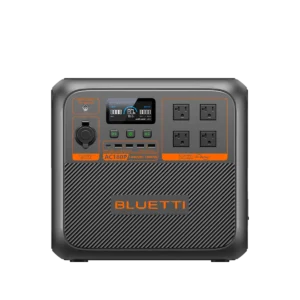

The decisive question for a vehicle kit isn’t how big the tank is — it’s how fast you can refill it with nothing but sunlight. Weight separates the front-runners only loosely (a spread of a few pounds across the class), so the axis that actually matters is realistic solar input and whether the unit refills in a field-usable window. That’s where two units at the top of the class pull away from the rest, and where documented reliability breaks the tie between them.
Plan around 850–900 Wh usable at a mixed 100–300 W field load (fridge, Starlink, laptops across AC and DC ports) — not the nameplate figure.
Its 1,000 W dual-port solar ceiling is the class ceiling, and independent testing confirms it refills ‘during a lunch break in good sun’ — the single most decisive trait when the sun is your only resupply. Most 1 kWh rivals top out at 400–600 W of solar input. Beyond that, the Review documents it sustaining a fridge, Starlink Mini, and laptops across a 7,100-mile trip — direct confirmation of the exact bug-out load, not a lab scenario. LiFePO4 rated to 4,000 cycles to 80% is the strongest cycle life in EcoFlow’s portable line, and the XT150 expansion port means a multi-day scenario can grow capacity instead of leaving you stranded.
There are two real limits worth knowing. The unit idles at roughly 32–40 W — meaningful drain if you leave it connected and forget it. And its Time-of-Use scheduling is documented as broken. Neither of those touches a unit you’re actively cycling and recharging in the field; both would matter if you were using it as a home standby that runs unattended for days. That’s a different segment.
Skip it if: your resupply is a wall outlet or generator rather than solar panels — the Anker SOLIX C1000 Gen 2 is lighter, faster to charge from AC, and holds its charge better on a shelf.
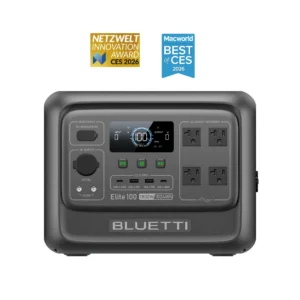
Matches the DELTA 3 Plus’s 1,000 W solar ceiling and is 2.6 lbs lighter for $200 less. If raw carry weight and purchase price lead your list, this is your unit. It steps back for two reasons that weigh heavily on a kit your safety depends on: a recurring cluster of early-failure reports — dead-on-arrival units and unprompted failures within the first six months, warranty-honored but real friction when the unit is your backstop — and meaningful self-discharge that requires periodic recharging in storage. It’s also not expandable. For an attended, actively maintained bug-out it’s excellent kit; the DELTA 3 Plus simply carries less risk and can grow with your needs.
The lightest of the three (24.9 lbs), the fastest AC refill (≈ 47 min), and the best charge-retention story in the class — owners report 100% after months unplugged. It earns a mention here but not a higher placement because its 600 W solar ceiling is hard to reach in practice (≈ 200 W with common 11–28 V panels), so off-grid refill is far slower than the two 1,000 W picks. Choose it over them only when your resupply is a wall outlet or generator. It wins the medical segment — see why there.
Staying put changes everything. The load is the house — fridge, freezer, furnace blower, well pump, comms, lights, select circuits — and the horizon is multi-day. You’re home and present, so you can manage the unit. What you can’t afford is having your 240 V loads drop every time you top up the battery from a generator. That single operational reality — what happens to your devices while the unit is recharging — is what splits the two natural picks in this tier.
Owners report 15–22 hours running a fridge, furnace, and water heater, and 28 hours on a refrigerator alone — roughly 3,810–3,880 Wh usable at whole-house draw depending on port.
The DELTA Pro 3 keeps essentials live while it recharges. Pass-through charging throttles output to about 1,800 W when a generator or grid supply is connected, but your fridge, freezer, comms, and lights stay powered during the daily top-up. For a multi-day grid-down scenario where you’re running the generator for two hours each morning, that continuity is the whole game. Native 120 V/240 V split-phase from one rolling box ties straight into a transfer switch or interlock to cover whole-house circuits, and the unit is expandable to roughly 12 kWh for genuine multi-day autonomy. It runs at about 30 dB under overnight low loads — quiet enough to sleep near.
One reliability caveat deserves a clear statement: the Review’s firmware-fault findings — resets and app dependency — are explicitly scoped as dealbreakers for unattended, life-critical use. That’s the medical segment, not this one. For a present-operator bug-in prepper who can reset a unit and is home to manage it, the Review treats this as a fair trade for everything the DELTA Pro 3 does.
Skip it if: your loads are mostly 120 V and you need the most output headroom money can buy — the Anker SOLIX F3800 delivers 6,000 W continuous and can expand to nearly 27 kWh.
More raw inverter muscle (6,000 W vs 4,000 W), the largest single-unit expansion ceiling of any unit on this page (≈ 26.9 kWh), a cleaner hardware reliability record, and seamless auto-switchover with the Home Power Panel — owners report not noticing the grid drop. It earns its place here and steps back on one specific operational reality: the 240 V output and three of six 120 V outlets go dark whenever the unit is AC-charging. Every generator recharge during a multi-day outage interrupts your 240 V loads. If your critical loads are mostly 120 V and you can tolerate that daily interruption, the F3800 is arguably the more dependable long-haul whole-house box. A note on specs: the F3800’s weight (≈ 130 lbs per review sources), AC recharge time, surge output, and UPS switchover time aren’t independently verified to the same standard as the EcoFlow figures — treat them as lower-confidence planning numbers.
($1,399 · 3,072 Wh · 120 V · 91.5 lbs · exp. ≈ 24 kWh) — the cleanest 120 V essential-loads-on-a-transfer-switch unit: true 3,600 W pass-through so it recharges and runs simultaneously at full speed, low idle drain, the easiest of the large units to move. Not a 240 V solution on its own, but review sources name fridge, lights, router, and CPAP through an outage as its core job. Best pick if 240 V isn’t a requirement.
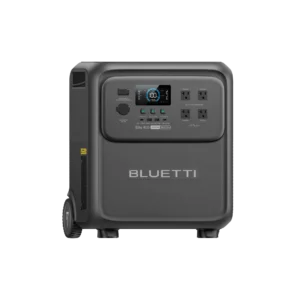
($1,299 · 3,840 Wh · 120 V · 86 lbs · 15 ms UPS) — the most usable capacity per dollar in this tier, roughly 3,576 Wh measured usable at about $0.338/Wh, in a roll-anywhere chassis with class-leading idle draw around 12 W. Ceilinged at 2,600 W continuous, not expandable, and no 240 V — a large 120 V tank, not a whole-panel solution.
Under $500, nothing dominates outright. The pure-sine LiFePO4 units in this range cluster tightly on specs, so the call comes down to what a budget prepper actually needs most: the most usable runtime per dollar — more hours of fridge — against the lowest standby drain and cleanest backup handoff. Two units split those priorities clearly.
Before the picks: the Jackery Explorer 1000 v2 clears the price ceiling at $499 but isn’t here. It has no configurable low-battery cutoff and a documented pattern of silent output drops — exactly the failure mode that strands an unattended fridge during a multi-day outage. It’s a capable portable for other uses.
Plan around 1,290 Wh usable at the AC outlets — roughly 90% of nameplate — running cycling essentials like a fridge, lights, and phones. That’s far longer than a day without a top-up, and measurably longer than anything else in this price range.
The AC180P wins this segment on the axis that matters most here: more usable runtime per dollar than any other unit under the ceiling. The platform’s measured AC efficiency sits above the class average, so the capacity you paid for actually reaches your devices. It’s also outage-proven in the field — the platform’s record includes a Florida household keeping refrigerators running five days through a hurricane with generator-assisted recharging, and turbo recharge (80% in roughly 45 minutes) is built for short generator bursts between cycles. Pure-sine LiFePO4, a sub-20 ms UPS (bench results show 8.7–14 ms in practice), and clean fridge-and-comms backup.
One setup step is non-negotiable before you rely on it: disable ECO mode. Left on its default, ECO mode can cut output mid-outage when it senses a low-draw load. Turn it off once at home and leave it off.
A note on certainty: the AC180P doesn’t have its own dedicated review record; its field performance data comes from the AC180 platform review, which explicitly treats the AC180P as the same unit with a larger battery. The inverter, charging behavior, ECO mode, DC connector, and efficiency numbers are identical — the only delta is the extra 288 Wh.
Skip it if: lowest standby drain and the fastest possible UPS handoff matter more than maximum runtime — the EcoFlow DELTA 3 Classic idles lower and hands off faster, and it costs $50 less.
The cheapest entry at $449, the lowest idle drain in the tier at roughly 13 W, a 10 ms UPS, and the only unit in this segment with its own dedicated field-performance review — so its numbers carry higher certainty. It steps back on one count: 940 Wh usable versus 1,290 Wh for the AC180P is a meaningful gap when runtime is the constraint.
Two setup steps are mandatory before trusting it through an outage. First, the default 2-hour inactivity auto-shutoff must be set to ‘never’ — left on default, it will kill your fridge in the middle of the night. Second, a documented failure mode: if the app’s credentials expire during an outage, it can lock the unit’s output. Both are avoidable, but both require deliberate setup before the outage starts, not during it.
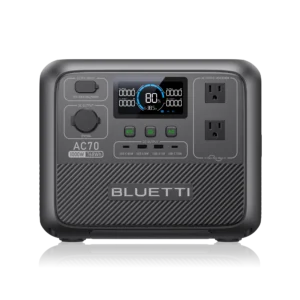
$349 · 768 Wh · 1,000 W continuous · 22.5 lbs · 20 ms UPS. The lightest and cheapest pure-sine LiFePO4 option that clears the budget ceiling. At a real fridge or cooler load, expect roughly 650–700 Wh usable — enough for a single-room or grab-it-too role, but short of what’s needed to carry whole-house essentials through a multi-day outage the way either pick can.
A CPAP — or oxygen concentrator, or other life-sustaining device — has to run overnight, unattended, every night of an outage. There’s no margin for a unit that shuts itself off because it thought the load was too light, resets because a firmware update failed, or drops output without warning. This is the segment where reliability isn’t a preference — it’s the only axis that matters, and a documented unattended-failure path disqualifies a unit regardless of how good it looks on every other measure.
Several otherwise strong units don’t make it here. The EcoFlow DELTA Pro 3 is vetoed by its own review for unattended life-critical use — firmware resets and no shutoff notification are acceptable to a present operator managing an outage, not to someone asleep next to it. The Jackery Explorer 1000 v2 has no configurable low-battery cutoff and a documented silent output-drop pattern. The BLUETTI Elite 100 V2 has a documented ECO-mode shutoff that caused a basement flood, plus an early-failure cluster and fan noise reaching 46–47 dB. The EcoFlow DELTA 3 Plus carries heavy idle drain and a BMS state-of-charge drift that can shut output before the battery indicator suggests it should. All four win or place in other segments; all four are barred here.
Running a CPAP off the DC or USB-C port, independent testing measures up to four nights of runtime on a single charge — the DC port’s efficiency advantage means a humidified CPAP draws a small fraction of the 1,024 Wh pack each night.
The C1000 Gen 2 has the cleanest unattended overnight reliability story of any unit reviewed for this guide. The review calls it ‘well suited to sleep-apnea backup,’ documents up to four nights of CPAP runtime on DC, and reports no ECO-mode or auto-shutoff trap of the kind that eliminated its rivals. The bench-confirmed 10 ms UPS keeps the device running through a grid drop without interruption. At roughly 20 dB under 200 W, it’s genuinely a bedside unit — not just quiet enough to tolerate, but quiet enough to forget it’s there. And owners report 100% charge retention after months unplugged, exactly the behavior you need from a unit that lives in a closet until the grid goes down.
One setup step before you rely on it: complete the Bluetooth app pairing at home before going off-grid. The review notes that skipping this step can leave the outlets inactive. Do it once, verify the outputs turn on, then put it away.
Skip it if: maximum unattended runtime is the priority over switchover speed and silence — the Bluetti AC180 stretches past a week of CPAP nights on DC and is the runner-up for exactly that reason.
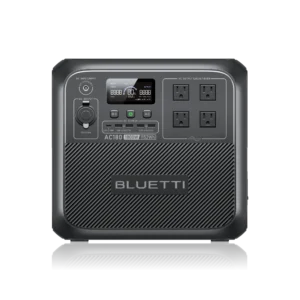
The most overnight margin of any clean candidate here. The review measured a ResMed AirSense 10 drawing just 6% of the battery per night from the 12 V DC port (versus 20% on AC), which stretches 1,152 Wh into well over a week of CPAP nights on a single charge — and the review names CPAP backup a standout use case for this platform.
It steps back on three counts the medical buyer should weigh: a 20 ms switchover (still fine for CPAP, but slower than the C1000‘s 10 ms), the same ECO-mode default you must disable before trusting it overnight, and Bluetooth-only app connectivity with no way to remotely check status on a unit running unattended. Choose it when maximum nights-per-charge matters more than the C1000’s faster, quieter, remotely-monitorable handoff.