
When you purchase through links on our site, we may earn an affiliate commission. Learn more.
EcoFlow makes roughly fourteen power stations, and the product naming works actively against you. Four different units share the 1024Wh capacity tier. Two completely different products share the word ‘Max.’ The ‘DELTA 3 1500‘ runs older software than its cheaper siblings. So ‘best EcoFlow power station’ is not one answer — it’s six, depending on what you’re actually trying to power.
Every pick on this page is judged against the situation it’s built for. The spec sheet tells you what’s possible; extended owner reports and independent testing tell you what actually happens when someone loads the unit up and walks away. Where those two things disagree, the real-world evidence wins every time.
Use the router below to find your situation. Each section leads with the one thing that actually decides the pick for that buyer — and it’s a different thing in every section.
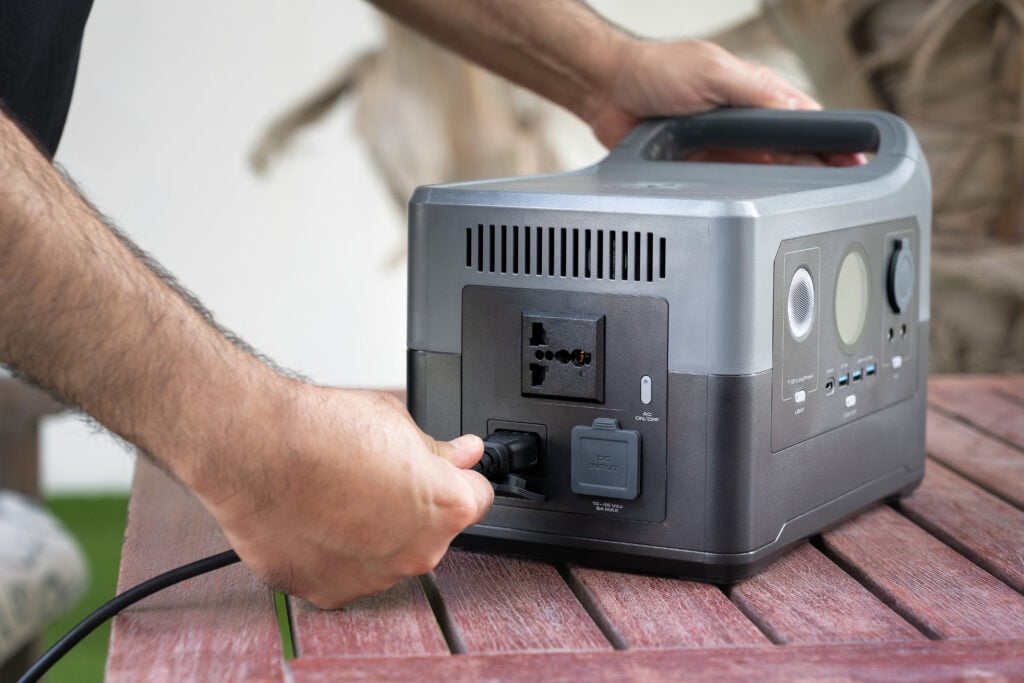
The only thing that separates the units in this tier is weight. Capacity, chemistry, and charge speed are effectively identical across small EcoFlow stations — what changes your day is what you’re lifting. For a buyer who packs it in a bag or carries it one-handed, the decision is settled before you look at a single watt-hour figure.
At 7.8 lbs, the RIVER 3 is a genuine one-hand grab — the lightest and least expensive current EcoFlow. It runs library-quiet; the 30dB spec held up in independent testing, silent enough to use beside a sleeping person. A wall recharge lands under an hour, and the battery lasts where it counts for this buyer: a router, modem, and home-server stack in the 70W range runs for hours, and a CPAP without humidifier gets two-plus nights. Run the CPAP off the DC port rather than the AC inverter and you sidestep the roughly 5W inverter idle entirely — a meaningful stretch on a 245Wh cell.
There is one hard limit, and the RIVER 3’s own review is direct about it: ‘X-Boost 600W’ is a voltage trick, not real headroom. A fridge compressor or a TV’s brightness spike trips it instantly. Size loads on 300W and this unit earns every star of its recommendation; size on 600W and you’ll return it. That ceiling is not a firmware issue or a bad batch — it’s the physical constraint that defines who this unit is for.
Usable capacity runs approximately 210–215Wh at a 300W AC load (around 86% of nameplate on a full discharge bench); DC-port loads run higher by skipping the inverter overhead entirely.
Skip it if: you want to plug something heavier than 300W, or you need a desk UPS that swaps cleanly to battery — the RIVER 3 Plus below handles both.
The flip to the Plus is about output and switchover speed, not portability. It doubles rated output to 600W, adds a bench-confirmed sub-10ms switchover — the single strongest case its review makes is exactly wired-AC UPS duty for a router, NAS, or desktop — and expands to 858Wh with an add-on battery. It also weighs 2.6 pounds more and costs more.
Two review-documented issues keep this a conditional pick rather than a flat upgrade. A solar-charging firmware bug cuts AC output when solar fills the battery to 100% — EcoFlow has acknowledged it across firmware releases without a fix — so it’s the wrong choice for any solar-fed, unattended setup. And owners have logged a recurring chemical smell on charge that drove several returns. Neither problem touches the wired-AC desk-UPS buyer; both can wreck a hands-off solar deployment. Buy the Plus if you’re plugging it into the wall and leaving it there; look elsewhere if the plan involves solar and walking away.
The RIVER 2 Pro — 768Wh but 18.2 lbs and peaking at 61–62dB — is too heavy and too loud for this segment. It earns its place in the camping section instead.
In the 1kWh tier, every serious contender shares the same 1800W output, LiFePO4 chemistry, and roughly the same recharge speed. The decision comes down to the balance of expandability, port selection, idle efficiency, and price — and the reviews break that tie clearly.
The DELTA 3 is the value sweet spot of the home-backup line, and its review calls it the easy pick in its class for exactly this use. It keeps the battery expansion port, the 12V car socket, and six AC outlets that the cheaper Classic deletes — while costing less than the Plus and giving up only dual solar input, which most home backup buyers never use. The 56-minute full wall recharge is independently verified. Below 600W it runs at 32–33dB — quiet enough for a closet or under a desk. The sub-10ms switchover keeps a desktop, router, or NAS running through a grid drop without a hiccup.
Two catches, neither a dealbreaker for this buyer. EcoFlow’s warranty support runs through a ticketing system that owners report as slow — worth weighing hard if this is your only backup for a medical device. And the battery gauge drifts over time; run a full 0–100% cycle every few months to keep the reading honest. One narrow gap for IT-minded buyers: this unit lacks USB-HID signaling, so server auto-shutdown software won’t get a clean handoff — it’s a fine desktop UPS but not a graceful-shutdown server UPS.
One habit that pays off immediately: turn the AC output off when the unit is idle. The inverter draws roughly 17.6W just sitting on, which adds up fast on standby.
Usable capacity runs approximately 900–950Wh at typical mixed home-backup loads — a fridge plus router in the 200–400W range — which works out to five to ten hours per charge depending on the draw.
Skip it if: you know you’ll never expand and you want the lowest possible standby drain — the DELTA 3 Classic below is the better always-on box.
The Classic makes the strongest always-on case in the family. Its idle draw measures around 13W — the lowest in the DELTA 3 line — and its review calls it credible as a true always-on UPS. Measured usable capacity comes in at roughly 940Wh, or about 91.7% of nameplate, which is exceptional for this class.
What demotes it: the expansion port is permanently gone, the 12V car socket is gone, and there is no path back once you’ve bought it. A review-documented BMS MOSFET failure mode under hard daily deep-cycling is also worth knowing about, particularly for buyers who plan to cycle it heavily. And the same slow warranty path applies. One setup step before trusting it unattended: change the auto-shutoff from its default 2-hour idle timer, or a cycling fridge will trip it off mid-night.
The Classic is the right call if your setup is fixed forever and you want the cleanest, lowest-draw standby box. If there’s any chance you’ll want more capacity or a 12V port later, the base DELTA 3 is the better starting point.
If the unit will sit in one place and maximum watt-hours per dollar is the only goal, the 1500 delivers 1536Wh at $599 — the best capacity-to-price ratio of any DELTA 3. Buy it only as a quiet, dumb, large-capacity box. Its review’s verdict is clear: it runs older DELTA 2 software with no Time-of-Use scheduling, no usage graphs, and a broken simultaneous AC-plus-solar charging mode under common settings. Its cells are rated 3,000 cycles to 70% retention — materially worse than the 4,000-to-80% on the base DELTA 3. For anything that needs to be smart or long-lived, the base DELTA 3 is the honest call.
The everyday-home pick and this one look nearly identical on a spec sheet — same 1kWh capacity, same 1800W output, same chemistry. The reviews split them on two things: how much solar they accept and whether the idle behavior fits a unit that moves rather than sits.
The DELTA 3 Plus is the same hardware as the base DELTA 3 with one trade that flips the verdict for the road: dual 1000W solar input versus a single 500W port. That second port refills the battery over a lunch break in decent sun, which is the whole game when a wall outlet is days away. Its review draws the line in a sentence: ‘Buy it for the road, not the closet.’ Owners who upgraded specifically to this model called out how much smaller it is than the old DELTA 2 Max — roughly 40% — which matters when it’s living in a van or a truck bed.
Why it loses the home-backup segment and wins here: its idle draw runs roughly 32–40W, nearly double the base DELTA 3, and its Time-of-Use scheduling is broken. Those flaws ‘all cluster around one scenario: leaving it plugged in and walking away.’ On the road, being cycled daily off solar, neither issue is visible. For a closet unit that needs to sit quietly at near-full charge for weeks, they’re disqualifying. Same unit, opposite verdict, decided entirely by whether it moves.
Two practical limits before you load it up. The surge measured around 2,600W in testing — not the rated 3,600W — and held about a minute, so large compressor motors may not start. At sustained draws above 1,500W, thermal protection can trip near 10% remaining charge, effectively cutting usable capacity by about a quarter under heavy continuous loads. Run a 12V fridge off the DC port, not the AC inverter, to skip the inverter idle overhead and dodge that ceiling. And skip the small bundled solar panels — the 220W or 400W EcoFlow panels from the solar-generator section are the right match for this station.
Usable capacity runs approximately 900Wh at moderate mixed road loads, dropping toward 750Wh under sustained heavy AC draw.
Skip it if: the unit will mostly sit at home on standby — the base DELTA 3 has lower idle draw and working Time-of-Use scheduling, which makes it the better closet unit.
The capacity-per-weight champion for van life specifically: 768Wh and 800W in an 18.2-lb body that nothing else in EcoFlow’s portable line matches at this size. Its review names camping, van life, and CPAP trips as the sweet spot — ‘in regular rotation.’ A car fridge ran approximately 57 hours off the 12V DC port in testing, which is the regime van-lifers actually run.
The reason it stays a runner-up rather than the pick is a storage failure mode that owners have documented clearly: with the AC inverter on, it self-discharges roughly 40% in 24 hours, and units have shown up dead during outages after sitting between trips. For van life — charged daily off solar or the alternator — that drain is a non-issue; for anything that sits more than a few days, you need to power it fully off and top up every two to three weeks. It’s also loud (peaks 61–62dB, no AC passthrough), so sleeping beside it is a real tradeoff. Note it’s a generation-2 clearance unit.
Usable capacity runs approximately 640Wh on AC loads and around 670Wh on the 12V DC port.
For a stationary base camp — you set it down, you run a fridge for three days, you don’t move it — the 1500’s 1536Wh of endurance and near-silent fan operation suit it well. The tradeoffs noted in the home-backup section all apply here too: 36 lbs, single 500W solar, older software, and the weaker cycle-life rating. It’s the right call only when capacity and quiet are the whole job and the software limitations genuinely don’t matter.
Once you’re running a 1300W microwave, a miter saw, or a pressure washer, the 1800W tier runs out of room. You need a station whose inverter genuinely sustains 2,400–3,000W through a full load cycle — and the spec sheet alone won’t tell you whether it does.
The DELTA 3 Max Plus is the most complete 2kWh station EcoFlow makes, and the headline that matters most is that its 3000W continuous rating is real. Independent testing held that output across a full discharge and didn’t trip until load approached 3,600–3,750W — which means fridges, kettles, microwaves, pressure washers, and most power tools all run cleanly. A 6,000W-startup band saw started without issue in testing; only the very highest-surge stationary tools push past what it can deliver.
It’s also the quietest unit in its class — mid-20s dB on light loads, low-40s at near-full draw — expandable to 10kWh, and carries a 30A Anderson DC port that makes it a real centerpiece for an RV or van DC system. Usable capacity at a 2kW AC load measures approximately 1,860–1,900Wh, around 91–93% of nameplate.
Two catches to plan around before you rely on it. The built-in UPS behaves like an EPS rather than a true online UPS — sensitive desktops and NAS units sometimes reboot through the handoff. If that matters, cascade a small line-interactive UPS downstream for critical gear. Standby drain also runs high at roughly 22–25W, and the unit shuts off entirely below about 15W draw, which means a router-only load can drop unexpectedly. Run low-draw gear off the DC and USB ports to avoid that cutoff. At 48.7 lbs it’s a two-handed lift, not a rollable unit — no wheels.
Cycle count is not published for this unit; the five-year warranty is the practical longevity horizon.
Skip it if: your 2kWh need is fixed and you’ll never expand — the DELTA 3 Max below weighs four pounds less, costs significantly less, and handles most big-appliance work at 2400W.
The right unit if your setup is fixed forever and you want the lightest 2kWh station in the line. At 44.8 lbs it’s the easiest to move in this class, genuinely quiet at around 25dB, and a reviewer credits its confirmed sub-10ms UPS with preventing two server crashes over a year of use.
The flipping axes that keep it a runner-up: 2400W, not 3000W; no expansion path at all (a hard ceiling buyers have hit post-purchase with no return option); single 500W solar; and an alternator charge input capped at 500W through the solar port. For fixed essentials backup where those limits don’t apply, it’s a well-executed machine. For anything that grows — more capacity, bigger loads, more solar — the Max Plus is the only one that doesn’t box you in.
If you want the same big-appliance output with more capacity and wheels-and-handle mobility, the Ultra Plus offers 3072Wh and 3600W in a 74.3-lb rollable package. Note it is 120V-only — it is not a whole-home unit and will not run 240V loads. It’s most at home as a 3kWh off-grid solar station, where it appears as the runner-up in the solar-generator section.
Everything else on this page tops out at 120V. If your list includes a well pump, central AC, an electric dryer, or any other 240V load, there is one question that decides the whole segment: does the unit output native 240V split-phase from a single box? Only one EcoFlow portable does.
The DELTA Pro 3 is the only EcoFlow portable that delivers native 120V and 240V split-phase from a single unit — the earlier DELTA Pro needed two units plus a Double Voltage Hub to do the same job. That capability is the reason it sits at the top of this segment, and owners confirm it in practice: central AC, well pumps, furnaces, and 240V welders all run off one box. At 4096Wh and 4000W rated output, it covers 15–22 hours of realistic whole-house essentials per charge, and pairing it with a generator for daytime bulk recharge extends that run indefinitely. It’s UL9540-certified for indoor use and runs around 30dB at the low overnight loads that matter most.
There are four limits the spec sheet doesn’t warn you about, and all four are real.
The 8,000W surge is a paper number. Bench testing held roughly 5,100W for about a minute and shut down as load approached 6,000W. That covers normal appliance startup — but not a sustained 3,000W compressor or a car lift. Size your loads against the measured figure, not the rating on the box.
The firmware enforces one voltage mode at a time — you cannot output 120V and 240V simultaneously. Plan your transfer switch and load priorities accordingly.
Pass-through charging throttles total output to roughly 1,800W when grid-connected, so a momentary surge during a handoff can trip it offline. A real consideration for UPS use and RV-park hookups.
Finally — and this is the most important one for anyone considering life-safety equipment — firmware faults make this unit unreliable as an unattended critical-load backup. A long-term tester logged three unexpected resets in five weeks. If equipment that cannot lose power runs while no one is home, this is the wrong unit. Full stop.
Whole-home deployment requires an electrician-installed transfer switch, interlock, or Smart Home Panel — budget that as a separate line item. The ’48kWh max’ figure in EcoFlow’s marketing refers to a three-unit system plus a gas generator; a single DELTA Pro 3 with two expansion batteries tops out at 12kWh.
Usable capacity measures approximately 3,810Wh on the 120V inverter and around 3,880Wh on 240V under realistic whole-house load conditions.
Skip it if: your loads are 120V-only and you want to spend less — the DELTA Pro below handles essential 120V circuits reliably at a lower price, and its LFP cells hold charge well through long standby periods.
The budget route into this segment, if and only if your loads are 120V. At 3600Wh and 3600W it’s a proven workhorse for essential 120V circuits via a transfer switch or a 30A RV plug, and its LFP cells hold approximately 99–100% charge after a year in storage — ideal for a unit that sits on standby most of the time. Its own review says plainly: step up to the DELTA Pro 3 if 240V is anywhere on your list.
The flipping axis for this segment is decisive: a single DELTA Pro is 120V-only. Reaching 240V means two units plus the Double Voltage Hub — a different budget entirely. It also throttles pass-through to roughly 1,800–2,200W and won’t auto-restart after full depletion, which makes it an attended backup, not a set-and-forget one. For fixed essential 120V circuits it earns its place; for anything on the 240V side of the panel, it doesn’t get there alone.
Usable capacity runs approximately 3,000–3,290Wh at moderate-to-heavy AC loads.
A note on outgrowing portables. If you genuinely need to run a full panel with simultaneous 120V and 240V output, EcoFlow’s installed modular systems — the DELTA Pro Ultra (6.1kWh base, 7.2kW, simultaneous 120V/240V, 0ms online UPS, approximately $4,099) and DELTA Pro Ultra X (12.3kWh base, 12kW, approximately $7,999) — are the right destination. These are two-piece, 180–290 lb inverter-plus-battery systems that mount on a stand with smart-panel integration. They’re a different product class from a portable power station and outside the scope of this guide, but worth knowing about if the DELTA Pro 3 can’t carry the full load.
Every EcoFlow station accepts solar — but ‘solar-chargeable’ and ‘solar generator’ are not the same thing. A true solar generator is sized so the panel array can realistically refill the battery faster than you drain it. That requires knowing not just the station’s solar wattage ceiling but its voltage window, so the panel pairing can be confirmed rather than guessed.
The DELTA Pro 3 has the highest solar input ceiling in EcoFlow’s portable line — 2,600W across two ports — and its voltage window is fully documented. That documentation is what makes the panel pairing verifiable rather than assumed, and it’s a large part of why this station headlines both the whole-home segment and here. The 240V capability is the deciding factor in the backup segment; the solar throughput is the deciding factor here. Same unit, two genuinely different jobs.
The 400W folding panel’s Voc of 48V puts a single panel comfortably above the High-PV port’s 30V floor and well under its 150V ceiling. Two panels in series reach roughly 96V at around 11A — still inside both the voltage ceiling and the 15A current limit even with cold-morning voltage rise, so the daisy-chain topology is confirmed without inventing anything beyond what the published specs show.
Size your expectations to the panel’s real output, not its rating. The panel’s own review confirms it never hits 400W — peak is roughly 300–360W, with typical daily output in the 185–290W range. That means two panels running together in strong midday sun produce approximately 600–730W combined. Over five good solar hours, that’s roughly 3.0–3.6kWh harvested — close to a full daily refill of the 4096Wh battery on a clear day, and a strong partial top-up on an average one. The panel review itself notes a single panel cannot fully refill a DELTA Pro-class station in a day, which is exactly why this pairing runs two.
For sustained multi-day off-grid use — especially in winter or through storms — plan a generator for nightly bulk charging. The DELTA Pro 3 works best as the quiet overnight source paired with daytime solar, not as a pure solar island when the sun doesn’t cooperate for several days running.
One deployment note from the panel review: the 400W is built for active mobile use. Its IP68 rating and rugged construction hold up in the field, but its polymer surface degrades if left mounted outdoors year-round. Set it up at the site and stow it between uses; for a permanent outdoor installation, rigid glass panels are the right choice.
The lighter, less expensive solar generator for off-grid living that doesn’t need 240V. The Ultra Plus’s review explicitly names a solar-first off-grid buyer as a target: 1600W solar input (double the base Ultra), wheels-and-handle mobility at 74 lbs, a Self-Powered Mode that runs on solar between configurable thresholds, and a measured usable capacity of roughly 2,690Wh. The 220W bifacial panel is a strong real-world performer — its review confirms it actually hits 180–210W front-side in good sun, which is rare for a portable panel at this price.
There is one data gap that keeps this pairing in the runner-up position rather than the headline. The DELTA 3 Ultra Plus’s solar voltage window isn’t confirmed in the available specifications — only its 1600W wattage ceiling is documented. The 220W panel’s Voc of 21.5V sits below a 30V High-PV-style input floor as a single panel, so it would likely connect through a low-voltage port or be wired in series — but the Ultra Plus’s actual published voltage range needs to be verified against the panel before you commit the array. Watt-wise, the pairing fits comfortably under the 1600W ceiling regardless.
Two additional review notes on the Ultra Plus: its MPPT efficiency measures around 80%, so size the array with that loss factored in. And AC-input-while-discharging draws from grid pass-through rather than the battery, which means it won’t shave peak grid usage the way a true battery-first system would.
Skip it if: you don’t need 240V capability and want a lighter, less expensive solar system — the DELTA 3 Ultra Plus pairing below covers sustained 120V off-grid living at a lower entry cost.
Picks on this page come from deciding what the use case actually rewards — then judging each unit by how it behaves under those conditions, not by how it reads on a spec sheet. The criteria that matter shift with the job, so a unit that’s decisive in one segment can be disqualified in the next by a single behavior. Where two contenders cleared the same bar, documented performance under real load settled the pick, not a comparison of rated numbers.
Picking the best EcoFlow station means accepting upfront that no single unit is best — the line is built to serve genuinely different jobs, and a unit that excels at one fails predictably at another. What we weighed was usable energy at real loads (not nameplate capacity), sustained output that holds past a brief surge, standby drain for units that live plugged in, solar throughput for units that live off-grid, and the reliability patterns that only show up after extended use.
The spec sheet handles eligibility. What decides the winner is what happens in practice: whether a rated surge actually starts a compressor, whether an idle draw is low enough to justify leaving a unit on standby for weeks, whether solar-charging firmware delivers what it promises in the field. Where owner reports and independent testing contradict a published rating, the real-world figure is the one we size recommendations against — always.
On longevity: the cycle count and the warranty are both carry-forward signals, and where a published cycle figure is missing entirely, the warranty becomes the practical horizon. Chemistry matters too — not all LiFePO4 cells age identically, and one unit in the lineup publishes a meaningfully worse retention figure than its siblings, which shapes exactly where it appears here.
Two units were considered and set aside before ranking. The DELTA 2 Max is a generation-2 clearance product whose UPS capability is simply unknown — the specification is unpublished — and the newer DELTA 3 Max undercuts it on price, weight, and confirmed switchover time. The RIVER 2 Pro appears as a runner-up in the camping segment rather than a primary pick; its storage self-discharge pattern and noise floor keep it out of the top slot.
The picks above answer “which one for my situation.” This table answers “show me everything, I’ll decide.” It lays every unit out on the same axes used to make the calls — measured behavior, not nameplate specs — so a reader whose priorities cross segments can weigh the tradeoffs directly instead of trusting our segmentation.
| Unit | Capacity | Rated Output / Surge | Weight | AC Recharge | Solar Input | Expandable | Price | $/Wh | Buy |
|---|---|---|---|---|---|---|---|---|---|
| RIVER 3 | 245Wh LiFePO4 | 300W / 600W | 7.8 lbs | ~58 min | 110W | No | $199 | $0.81 | Check price |
| RIVER 3 Plus | 286Wh LiFePO4 | 600W / 1200W | 10.4 lbs | ~1 hr | 220W | To 858Wh | $269 | $0.94 | Check price |
| DELTA 3 | 1024Wh LiFePO4 | 1800W / 3600W | 27.6 lbs | 56 min | 500W | To 5kWh | $519 | $0.51 | Check price |
| DELTA 3 Classic | 1024Wh LiFePO4 | 1800W / 3600W | 27.3 lbs | ~55 min | 500W | No | $449 | $0.44 | Check price |
| DELTA 3 Plus | 1024Wh LiFePO4 | 1800W / 3600W | 27.6 lbs | ~55 min | 1000W dual-port | To 5kWh | $599 | $0.59 | Check price |
| RIVER 2 Pro | 768Wh LiFePO4 | 800W / 1600W | 18.2 lbs | 70 min | 220W | No | $339 | $0.44 | Check price |
| DELTA 3 Max Plus | 2048Wh LiFePO4 | 3000W / 6000W | 48.7 lbs | ~64 min | 1000W | To 10kWh | $1099 | $0.54 | Check price |
| DELTA 3 Max | 2048Wh LiFePO4 | 2400W / 4800W | 44.8 lbs | ~68 min | 500W | No | $749 | $0.37 | Check price |
| DELTA Pro 3 | 4096Wh LiFePO4 | 4000W / 8000W rated* | 113.5 lbs | ~75 min (240V) | 2600W dual-port | To 12kWh | $2099 | $0.51 | Check price |
| DELTA Pro | 3600Wh LiFePO4 | 3600W / 7200W | 99 lbs | ~2.7 hr (120V) | 1600W | To 25kWh | $1599 | $0.44 | Check price |
*DELTA Pro 3 surge is rated 8000W; independent bench testing held ~5,100W for approximately one minute with shutdown near 6,000W. Size loads against the measured figure. — = not independently verified for this guide.
The questions here are the ones that don’t belong to any single pick — the cross-cutting concerns that come up regardless of which unit a reader lands on. We pulled them out of the individual segments so each answer lives in one place, addressed against the same standard of evidence used throughout the page.
Nearly identical hardware, but the buyer’s situation flips the verdict entirely. The Plus’s phantom idle draw runs roughly 32–40W and its Time-of-Use scheduling is broken — two flaws that are invisible when you’re cycling the unit daily on the road but disqualifying when it’s sitting in a closet for weeks at a time. The base DELTA 3 runs a lower idle and has working scheduling, which makes it the better always-on box. On the road, the Plus’s dual 1000W solar input — versus the base model’s single 500W port — earns its keep and the idle draw never gets a chance to accumulate. Same unit, opposite answer, based entirely on whether it moves.
Owners confirm both in practice. At 4000W rated continuous and native 240V split-phase output from a single unit, it handles central AC compressors, well pumps, and electric furnaces — loads that nothing else on this page can even attempt. The important planning number is the surge: the 8,000W rating on the box is a paper figure. Independent bench testing held roughly 5,100W for about a minute and tripped near 6,000W. That covers normal appliance startup on most residential equipment, but not sustained 3,000W compressors or high-surge stationary tools. Size your loads against the measured figure. The firmware also enforces one voltage mode at a time — 120V or 240V, not both simultaneously — so plan your transfer switch and priority circuits accordingly before installation.
It’s a real UPS for the loads it’s rated for. The sub-10ms switchover is confirmed, and its review gives it the strongest always-on case in the DELTA 3 family, crediting the roughly 13W idle draw as low enough to justify leaving it plugged in continuously. One setup step matters before you trust it: change the default auto-shutoff from its two-hour idle timer setting, or a cycling fridge will cut the output off mid-cycle. The one gap for server operators is USB-HID signaling — the Classic doesn’t carry it, so server auto-shutdown software won’t get a graceful handoff. It’s a fine desktop and fridge UPS; for a server that needs to shut down cleanly before the battery runs out, add a small line-interactive UPS downstream.
No. The panel’s own review confirms it never reaches its nameplate rating in the field — real peak output runs roughly 300–360W, with typical daily output in the 185–290W range depending on conditions. That’s why the solar-generator section pairs two panels with the DELTA Pro 3 rather than one: a single 400W panel cannot fully refill a 4kWh-class station in a day, but two panels producing a combined 600–730W in strong midday sun can get close over five solid solar hours. The bifacial 220W panel in the runner-up pairing is a better real-world performer relative to its rating — its review confirms 180–210W front-side output in good sun, which is notably consistent for a portable panel at that price point.
The capacity-to-price ratio is genuinely the best in the family, but three issues compound to keep it out of the top slot in every segment. Its cells are rated 3,000 cycles to 70% retention — materially worse than the 4,000-to-80% on the base DELTA 3 and the Plus, which means it ages faster under regular use. It runs older DELTA 2 software, meaning no Time-of-Use scheduling, no usage graphs, and no working API. And simultaneous AC-plus-solar charging is broken under common settings. For a buyer who wants a quiet, dumb, large-capacity box that sits in one place, it’s an honest choice. For anything that needs to be smart, expandable in software capability, or cycled hard over years, those limitations add up to a meaningful step backward relative to its siblings.
Size is relative in this line. At 18.2 lbs and peaks of 61–62dB, the RIVER 2 Pro is too heavy for a bag and too loud to sleep beside — two things that define the grab-and-go buyer. Its 768Wh capacity and 800W output, packed into that 18-pound body, are exactly what a van-lifer or regular camper wants: more endurance than the RIVER 3 can offer, in a package that fits a vehicle without dominating it. The storage self-discharge flaw also shapes where it belongs: for a van-lifer charging it daily off solar or the alternator, that drain is invisible; for a grab-and-go buyer who might leave it on a shelf for two weeks between trips, it’s a real problem. Capacity-per-weight for active outdoor use is the winning ground; quiet, light, and shelf-stable is the grab-and-go ground, and those are different units.
If you came here for one station to handle a home outage — fridge, Wi-Fi, and a few devices for a shift or overnight — the DELTA 3 is the default. It’s the value center of the line, expandable if your needs grow, and its 56-minute recharge and sub-10ms switchover mean it’s ready before the next storm and invisible during a grid drop. The DELTA 3 Classic is the right alternative if the setup is fixed forever and you want the lowest standby draw in the family.
The picks peel off cleanly from there. Carry weight and nothing else? The RIVER 3. Moving it regularly and refilling from solar? The DELTA 3 Plus, which wins on the road precisely because of flaws that disqualify it at home. Running real appliances — a microwave, a saw, a pressure washer? The DELTA 3 Max Plus is the only unit in the 2kWh tier whose 3,000W continuous rating held through independent testing. Need 240V for a well pump or central AC? The DELTA Pro 3 is the only portable that gets there from a single box — bring it with clear eyes about the surge and the firmware limits. And for a true solar generator, the DELTA Pro 3 paired with two 400W folding panels is the one pairing whose station-voltage-to-panel match is fully confirmed; if you want a lighter 120V system, the DELTA 3 Ultra Plus pairing is a strong option once you verify the solar port voltage range against the 220W bifacial panels before committing the array.