
For the RVer wiring a station into the rig as the actual power core — shore cord in, diesel heater and 12V fridge on DC, solar or alternator fills between sites — the capacity number is almost beside the point. The connector suite decides it, and within Bluetti’s lineup exactly one unit has what this job requires.
The Elite 300 is the only unit in Bluetti’s Elite line that pairs a native TT-30 RV outlet with a 12V/30A XT90 DC port. That combination is not available elsewhere in the lineup: the Elite 200 V2 and Premium 200 V2 top out at a 12V/10A car socket that can’t be hardwired and can’t reliably start a diesel heater, and the Elite 400 drops the TT-30 entirely. Every sibling’s own shortcomings on this axis rule it out for an installed-bay build.
The 12V/30A XT90 is the practical center of the case. Independent testing confirmed it holds 30A sustained — just over 31A before the protection circuit trips — which is enough to run diesel heaters that spike well above the 10A limit other Elite units impose. It also eliminates the DC-to-AC-to-DC conversion path that older Bluetti builds forced on rig owners: the fridge and heater run directly off the battery, and the efficiency shows. Usable capacity at DC sits around 93–95% of the rated 3,014 Wh, and with an idle draw under 4 watts on the DC bus, the unit can sit between trips for roughly a month without meaningful self-discharge.
The TT-30 outlet lets the rig’s shore cord plug straight in. Through a transfer switch, it delivers sub-9 ms switchover — fast enough that downstream equipment doesn’t notice the transition. For refills on the road, the Charger 2 alternator accessory pulls up to 1,200 W combined while driving. And for an installed bay, the physical size matters: it’s measurably more compact than comparable 3 kWh units and 26 lbs lighter than the Apex 300, which means it fits electrical bays that won’t accept bulkier hardware.
AC usable capacity lands around 2,760–2,873 Wh at discharge — 92–95% of nameplate, among the strongest efficiency figures in the class.
There are a few hard limits to plan around before committing. The 2,400 W inverter is the lowest-rated in its capacity tier, and sustained loads above roughly 2,450–2,800 W will stop it — there’s no documented evidence it can start an RV air conditioner compressor, and the 4,800 W surge rating applies to resistive loads only. If the rig’s AC is on the list, that’s the next segment. At high load or Turbo charging, fan noise reaches 50–53 dB — audible enough that charging while sleeping beside it isn’t comfortable; charge during the day. Check your panel’s open-circuit voltage before buying: the 60V solar ceiling forces parallel wiring configurations, and at least one owner nearly returned the unit after discovering array incompatibility. Solar cables, car cables, and the XT90 lead are all separate purchases. The unit doesn’t expand and runs 120V only.
Skip it if: The rig’s rooftop AC is on the load list — the Apex 300 in the next segment is the unit with documented compressor-startup capability.
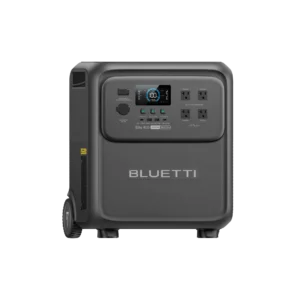
for the RVer who wants maximum runtime per dollar and runs everything through AC outlets
The Elite 400 surfaces here for one specific buyer: someone who wants the most battery for the money, parks the station rather than wiring it in, and adapts all loads to standard AC outlets. At $0.338/Wh and 3,840 Wh usable at around 93% efficiency, it’s the best-value large station Bluetti makes, and its roughly 12 W AC-on idle is class-leading. But it has no TT-30, no high-current DC port, and at 86 lbs it wheels fine on flat ground — less fine up RV steps. Its own review is explicit: for van and RV integration that needs the Elite 300’s port architecture, the 400 isn’t the answer.
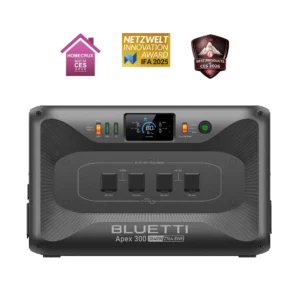
One load separates this segment from every other: the rooftop air conditioner. A compressor startup is the test that separates a station with an impressive surge-wattage spec from one that can actually power an RV — and within Bluetti’s lineup, only one unit has earned that distinction through documented real-world evidence.
The compressor evidence is direct and comes from documented testing: two 15,000 BTU RV air conditioners running simultaneously alongside a heater, sustained at 3,800 W, with bench testers holding rated load for five minutes without thermal shutdown. That’s the performance claim every other Bluetti either fails or leaves unproven — the Elite 300‘s surge is rated for resistive loads only, and the Elite 100 V2 has a documented record of failing a window-AC compressor startup.
The dedicated TT-30R and 50A capability mean the rig plugs straight in — this is the named RV use case in the Apex 300’s own coverage. For rigs that need 240V split-phase, the single unit delivers it, though at 16A. Cold-weather operation is rated to −15°C without pre-warming, a genuine step forward from the prior generation that matters for shoulder-season travel.
The expansion path is what makes this unit scale with ambition: the base 2.76 kWh handles short trips and light AC use, and each B300K expansion pack adds another full 2,764.8 Wh, up to roughly 19.3 kWh on one head unit. Adding capacity as boondocking trips get longer is a straightforward upgrade path.
Owner runtimes at this segment’s loads tell the practical story: running everything at 3,840 W empties the base unit in about 41 minutes; a full cabin-class load including microwave gives roughly a day and a half; lights-and-internet duty stretches to five or seven days.
The limits here are real and worth stating plainly before you buy. At 84 lbs with no wheels, this is stationary equipment — it lives in a basement bay, it doesn’t come out at the campsite, and the rig’s own house battery still handles slide-outs and leveling jacks; the Hub D1’s DC output isn’t rated for those loads. The base unit ships without USB ports, 12V outputs, solar cables, or the turbo charging cable — every accessory is a separate line item, so budget accordingly. The single expansion port creates a documented connection conflict: a DC Hub and an expansion battery can’t both connect to the head unit directly; the Hub chains through one of the battery’s secondary ports. And real-world solar input lands well below the 2,400 W rated figure — expect closer to 1,000–1,100 W in good conditions. The 18–24.7 W idle figure applies to standby mode; under light continuous loads in 240V mode, measured pass-through behavior draws several times the consumed power from the grid while cycling the battery — Bluetti confirms this is intentional, but it means the Apex 300 in 240V mode is not a transparent pass-through device.
Skip it if: The rig’s AC isn’t on the load list and you need DC integration — the Elite 300 in the previous segment is the wired-in power hub with the port architecture for that job.
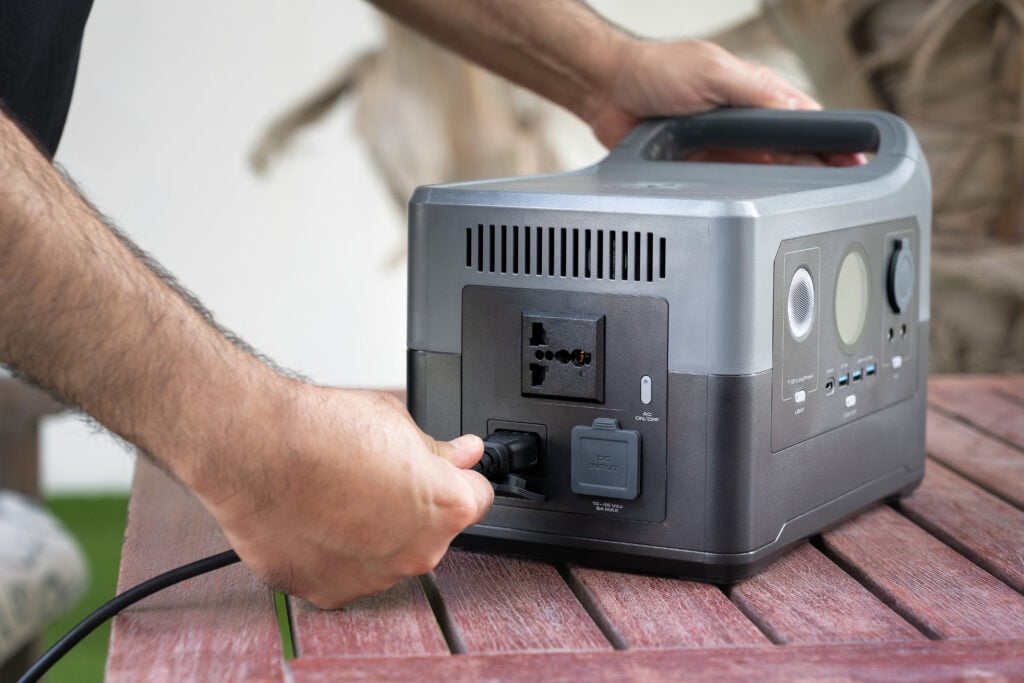
This buyer doesn’t wire anything in — the station rides in the rig, comes out at the picnic table, and goes back in for the drive home. The question is which carry-class Bluetti earns its place in that routine.
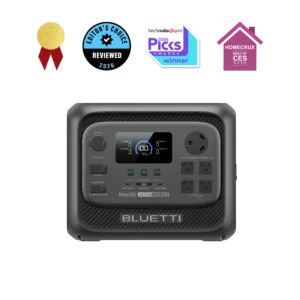
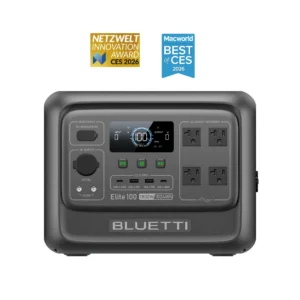
The two carry-class Bluettis — the Elite 100 V2 and the AC70 — sit $50 and 2.5 lbs apart. Across that gap, the Elite 100 V2 delivers 33% more battery, 80% more inverter headroom, and double the solar input. Portability effectively ties; every other axis points the same direction.
The 1,000 W solar input is the standout for a camper who tops up between sites — a 1:1 input-to-capacity ratio that, in ideal sun with a properly configured array, can refill a depleted unit in roughly an hour. The flat top stacks cleanly in a storage bay, and at 25 lbs the body carries one-handed without strain. Front-facing ports stay accessible even when the unit is partially buried in gear.
Usable capacity at camp loads runs about 870–910 Wh — bench-measured at 869 Wh over DC, 880 Wh at the wall, and around 910 Wh under a 1.2 kW AC load, which works out to 85–89% of nameplate. Running the 12V fridge on the DC port bypasses inverter overhead entirely, which is the right approach for always-on refrigeration. Owners run induction cooktops, kettles, and BougeRV diesel heaters without issues — dozens of cold-weather starts on the 10A port have been reported without faults, though it’s worth checking your specific heater’s startup current, since some models exceed the 10A limit. Paired with the Charger 1 or Charger 2 alternator accessory, owner reports describe effectively continuous power while driving between sites.
Before trusting it with anything that matters, two settings need attention. High-current PV mode ships disabled by default — without the app toggle, solar input caps near 130 W regardless of panel size. ECO mode ships enabled and will cut power to low-draw always-on devices; disable it before leaving anything critical plugged in overnight.
The failure to watch for: it won’t start reactive motor loads. A 5,000 BTU window-AC compressor stopped it where competing units ran through — if the rig’s air conditioner is on the list, that’s the previous segment. The 12V port’s 10A ceiling is fine for a portable diesel heater but disqualifying for a hardwired DC bus. A documented early-failure cluster exists — DOA units and failures in the first six months have appeared in owner reports — and while Bluetti honors the 5-year warranty, the return and replacement process adds friction. Not expandable.
Skip it if: The rig’s air conditioner is on the load list — the Apex 300 is the unit with documented compressor-startup capability, and nothing else in this guide substitutes for it on that job.
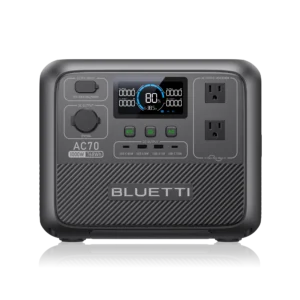
lighter loads, smaller budget
At $349, 22.5 lbs, and 768 Wh, the AC70 is the right step down for campers whose loads stay comfortably under 1,000 W. It hits 0–80% in 43–47 minutes without an external brick, and long-term owners report units still performing well after five years of continuous RV use — the strongest longevity signal in the Bluetti portable lineup. Usable capacity on the AC port runs around 450–500 Wh at typical mixed loads, with DC-port loads running meaningfully higher; a 12V fridge in eco mode can run for the better part of a day. The fork is unambiguous: a Keurig trips the Power Lifting ceiling, and owners who misjudged their loads ended up upgrading within months. One RV-specific catch: the 400–500 W minimum draw on AC charging will overload a vehicle inverter rated at 400 W — charge from the 12V port (slower, around 6.5 hours) or a larger inverter if you’re topping up while driving.