
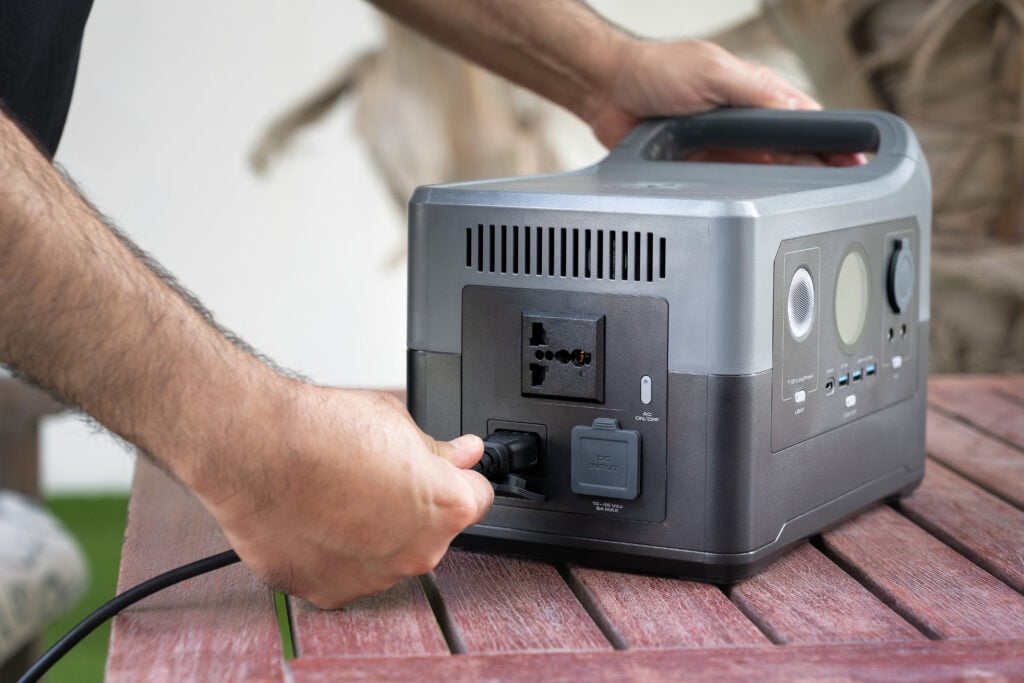

The decision in this tier isn’t which unit has better specs — both Anker options refuse the same loads (heating elements, full-draw kitchen appliances) and neither is wrong. The question is which trade-off fits you: recharge speed and port quality, or raw watt-hours per dollar. That’s genuinely a preference call, and this section walks through both sides.
The C300 earns the pick because it wins the modern-use axes clearly: an hour from dead to full (independently bench-confirmed at 66 minutes, 80% in roughly 50–55 minutes), with the charger built in so there’s no brick to pack. The 10ms UPS switchover is real — routers and CPAP-class devices keep running through a grid drop without a hiccup. Pure sine output is scope-verified. The fan is effectively silent in normal use, which matters when it’s sitting beside your bunk. Two 140W USB-C ports make it a serious field charger for drones, cameras, and laptops — not a concession item.
Owner-reported runtimes put things in perspective for this buyer: about 8 hours on a 60W router-and-modem stack, 9-plus hours on a 21W TV, roughly 5 hours on a 40–50W 12V fridge (run it on the DC port to preserve efficiency). CPAP works in dry mode; expect 2.5–3.5 hours at a full 54W humidified draw — enough for most nights if you top it up during the day.
Two operational catches to respect before you depend on it. The inverter pulls about 12 watts at idle, which drains the 288Wh pack in a day or two if you leave it on — switch AC off when nothing’s drawing. The low-current USB-C output ports auto-cut after roughly two hours of very light draw, which is a real problem if you need continuous USB-powered overnight monitoring. And independent testing put sustained AC output around 255W in practice, with the 600W SurgePad holding only seconds — it will not run a hair dryer, a space heater, or a coffee maker. Heating elements trip it cold, full stop.
Skip it if: you’re running a CPAP all night and don’t want to top up mid-trip — the 535 PowerHouse below roughly doubles your runtime per dollar for that job.
At $299.99 with 512Wh and a $0.59/Wh value, the 535 is the best watt-hours-per-dollar in the Anker lineup — and if overnight CPAP runtime is the thing you care most about, it’s the smarter buy. Owners report 12-plus hours on a 40W CPAP, 7-plus on a 60W mini-fridge. The LFP cells are built to 3,000 cycles, and independent testing found no measurable capacity drop across 50-plus discharge cycles.
What it gives up: AC recharge takes 4.5–5 hours (versus the C300’s one), there’s only one 60W USB-C port, no companion app, and real-world solar intake measured just 60–75W from a 100W panel. A Review-flagged outlet quirk blocked some grounded three-prong cords — worth checking in the return window. Weight is roughly 16.5 lbs, nearly double the C300. Choose this one when overnight battery life matters more than how quickly you refill it.
Note on the 535’s specs: weight, surge, solar input, and switchover figures aren’t published by Anker — the numbers above come from independent testing and are flagged as estimates.
The two Anker 1kWh units split the axes almost perfectly, which makes this segment’s choice unusually clean once you know which axis is yours. The Gen 2 is the faster, lighter, more UPS-capable machine. The Gen 1 is cheaper, slightly larger, and — uniquely — can grow to 2kWh with a battery pack. Neither is a compromise pick; they’re just built for different priorities.
It’s the lightest 1kWh-class unit in independent testing, and the fastest recharger — dead to full in under an hour is a meaningful operational shift from a unit that takes most of the morning. On a camping trip that changes how freely you draw; you can drain it overnight and refill while making coffee. Independent bench testing put usable capacity at 850–907Wh at a 1,000W AC load (83–89% efficiency at full draw), which is what this segment’s buyer actually runs.
The sub-10ms UPS is bench-verified — desktops, NAS boxes, and networking gear ride through an outage without a reboot. Owners report 8–12-plus hours on a cycling fridge, three days on a 50W DC cooler, and four nights of CPAP via USB-C direct. Near-silent under 200W means it can sit on the bedroom floor without being noticed.
Three limits worth planning around. The 600W solar ceiling is real, but reaching it requires 29–60V panels — the common 11–28V panels most buyers own cap out near 200W, so check your panel voltage before buying for solar-first use. UltraFast charging needs cells above 68°F and runs a loud fan at about 42dB; if you’re in a cold van, recharge will be slower and noisier than the headline suggests. And the SurgePad can’t be disabled — it tripped an 1,800W table saw and caused some microwaves to cut out within seconds. Most kitchen appliances are fine; high-inrush motors are the edge case. Complete the initial Bluetooth pairing before your first off-grid trip or the outlets may not activate.
The one permanent limit: no expansion port. What you buy is what you have, forever.
Skip it if: you know you’ll want 2kWh of capacity later — the Gen 1 runner-up below is the only 1kWh Anker that can grow.
At $429.99 with 1,056Wh and a $0.41/Wh value, the Gen 1 is $70 cheaper and can double to 2,112Wh via the BP1000 expansion battery — a path the Gen 2 simply doesn’t offer. Independent bench testing put usable capacity at 85–90% of nameplate across three of four tests (roughly 900–950Wh at mid-load AC draw), and build quality in comparative testing ranked at or above the EcoFlow Delta 2. Several owners chose it over Gen 2 for exactly the expansion option.
The reason it’s the runner-up rather than the pick: the 12V DC port auto-disables after roughly an hour of sub-10W draw, a behavior multiple owners discovered the hard way when they woke to a cycled-off 12V fridge and spoiled food overnight. Disabling that behavior requires navigating several buried power-save toggles — find and change them before any overnight food run. The UPS switchover is 20ms (versus the Gen 2’s sub-10ms), which lets a desktop or networked 3D printer blink during a grid drop. Fast charging and heavy loads spin up a fan owners describe as ‘jet engine’ loud. If you’re running an overnight DC fridge, the auto-shutoff trap is real; go in knowing where those settings live.
Home backup is an economics problem: how fast can you refill the tank, and how slowly does it drain when nothing is happening? A unit that bleeds 45 watts at standby costs you most of a day of buffer every few days — before the outage it was bought for. That single operational reality separates the field here.
The C2000 Gen 2 is the only unit in the Anker catalog that earns an unqualified strong recommendation, and the reason comes down to two converged findings. Idle draw with AC output off measures around 9 watts — rising to about 18 watts with outlets active. Against the F2000‘s roughly 45 watts at standby, that difference compounds into days of extra reserve over a week of pre-charged waiting. AC recharge in 80–90 minutes turns a generator into a brief top-up stop rather than an all-afternoon commitment.
Real fridge runtime — based on converged owner and testing data with normal door use — lands between 14 and 22 hours on a full-size refrigerator. The 32-hour marketing figure is a laboratory number; plan multi-day outage math on the real range. Surge capacity is genuine: a kettle drawing 2,162W ran successfully, an air fryer held at 1,420W sustained, and the 10ms UPS switchover is seamless in firsthand tests with computers, routers, and CPAPs. One owner logged 21% battery per 6-hour CPAP night with humidifier and hose warmer running. The unit expands to 4,096Wh via the BP2000 Gen 2 if you eventually need more runtime.
Two one-time setup steps the unit requires before any unattended backup trip. Default AC input is 1,800W — on a shared 15A circuit that will trip a loaded breaker, so drop it below 1,500W the first time you plug in. Enable the ‘Output Port Memory Switch’ buried in the settings; without it, AC output won’t restart automatically after a full drain. Do both before you leave the house. One reliability note worth watching in the return window: two confirmed reports of intermittent front USB-C port failures — low frequency but high consequence, so verify those ports before you’re past the return date.
Skip it if: your rig’s rooftop air conditioner needs to start from battery — the F3000 in the RV segment handles that motor-start load where this unit’s 2,400W inverter ceiling creates a hard cap.
The F2600 earns a mention for one specific buyer: a household with a transfer-switch essentials circuit that wants WiFi remote monitoring while away from home, plus the extra 512Wh over the C2000 Gen 2. Independent testing confirmed roughly 2,480Wh of usable capacity from its 2,560Wh pack, and a sustained 2,200W combined heater-and-coffee-maker load held. Fridge runtime clocks in around 40–45 hours at a roughly 150W average draw. At $1,099, though, everyone else in this segment is better served by the C2000 Gen 2 $300 cheaper — it matches the F2600’s inverter and beats it on weight, idle drain, recharge speed, and simultaneous AC-plus-solar charging. One cold-weather note from owner reports: one unit shut down around 35°F in an unheated shed despite the stated −4°F discharge rating — keep it warm for winter backup duty.
On the F2000: at first glance it looks like the C2000 Gen 2’s value twin — same 2,048Wh, same 2,400W rated output, one dollar less at $799. The difference is standby behavior. Owner reports document a unit drained from full to empty over 3–4 months of shelf storage, discovered during the actual outage it was bought for. Idle draw with the inverter on runs roughly 1% of capacity per hour. For a set-and-forget emergency unit, that’s a maintenance schedule, not a backup plan. It’s not a bad product — it’s the quietest, best-wheeled chassis in the line — but for this segment’s use case, the C2000 Gen 2 doesn’t impose the same obligation.
Four Anker stations carry a TT-30 outlet and a 2,400W-or-better inverter. On paper they look interchangeable; in practice, two of them fail the specific load that defines RV power: a rooftop air conditioner compressor coming up under load. The motor-start behavior, not the printed surge number, is the entire question in this segment.
An owner’s RV air conditioner high-cool startup surge — exactly the load that brings lesser units down — was handled without complaint, and the inverter held its full 3,600W from the TT-30R for 15-plus minutes in testing, with an overload threshold measured around 5,300W. It simultaneously surge-started a 15A table saw and a 12A vacuum without flinching. That’s the winning ground, and nothing else in the Anker lineup can match it on this specific axis.
Beyond the motor-start case: it’s the only Anker with full 3,600W pass-through charging, so it recharges and powers the rig at full speed simultaneously — the F2000 and F2600 cap pass-through at 1,440W, which means they can’t keep up with a real shore load while refilling. Idle draw measured 20–35W. It runs about 35dB at moderate loads, 53dB at full output — quiet enough for an evening at a campsite. The wheeled horizontal chassis stores better in an RV bay than a tower unit, and the Anderson 30A DC port integrates directly with camper 12V systems. Independent bench testing found roughly 2,760Wh usable at low discharge and about 2,650Wh in a heavier bench run.
Before you depend on it, the Review documentation surfaces several limits worth knowing. The AC charging cable and high-voltage solar connector are proprietary — carry spares on a deployed unit, because a failed cable leaves you stranded. Cramped AC outlet spacing blocks neighbors when multiple bulky bricks are plugged in at once. iOS firmware updates are currently broken (Android works fine). The four NEMA 5-20R outlets cap at 2,400W combined; the full 3,600W lives on the TT-30R only. This is a native 120V machine — 240V service needs two units plus the Double Voltage Hub. Standby runtime measured roughly 30% short of the advertised 5-day claim; plan around actual idle draw.
Skip it if: your rig doesn’t need to run the rooftop AC — the C2000 Gen 2 runner-up saves $600 and 50 lbs for boondockers whose heaviest loads are resistive.
The same machine that wins the home-backup segment recurs here because it genuinely belongs on this shortlist — just with one decisive caveat. Its TT-30R is capped at 20A/2,400W by the inverter, not true 30A service, so a high-draw rooftop air conditioner plus simultaneous camp loads hits a ceiling the F3000 clears. For boondockers who don’t run rooftop AC, it’s arguably the smarter buy: $600 less, 50 lbs lighter, with an 800W UltraFast alternator-charging path that refills eight times faster than a standard car socket. One overlander kept a 5-gallon electric water heater warm overnight near freezing and woke to more than 70% remaining. The question is simple: does your rig’s air conditioner need to start from this battery? If yes, go F3000. If no, save the money.
On the F2000 and F2600 in this segment: both carry TT-30 outlets and look like candidates. In testing, an 8,000 BTU window AC powered through an F2000 ramped to 1,900W then collapsed to 90W — the compressor simply failed to start. A 20A welder tripped it in 5 seconds; a circular saw shut it down in half a second through a 30A adapter. The F2600 shares the same chassis and the same honest 2,800W surge; a 15K BTU RV air conditioner drained it in about 1.5 hours, and independent review framing describes it as a supplement to a propane generator for AC use, not a replacement. Both units do fine on resistive camp loads — the F2000 is the quietest station multiple long-term owners say they’ve used, with the best wheels in the line — but neither is an answer for motor-start RV duty.
The F3800 and F3800 Plus share a pack, a rated inverter output, and a price difference of $700. What they don’t share is recharge architecture — and for a unit that’s meant to pair with a generator or a serious solar array, that difference is the whole decision.
The original F3800 had two documented failures for its core use case: plugging a generator into the 120V AC input killed the 240V output, and its 60V solar ceiling made standard third-party panels effectively useless. The Plus was designed to fix both, and independent testing confirms it did. Charge from a 240V generator while powering 240V loads — testing confirmed roughly 6,000W in and 6,000W out simultaneously. Wire standard third-party panels in series and reach the MPPT ceiling: in testing, a 48V series array produced 830W where the same panels in parallel managed only 623W through the original’s 60V-capped input.
The 6,000W sustained output is not a paper figure — testing held it for 15-plus minutes with an air compressor, table saw, and vacuum running at once, at a measured 52–54dB. Independent runtime testing found about 12 hours on a full-size refrigerator, 9 hours across 10 house circuits averaging 300–600W run down to 2% remaining, and 12–15 hours at a roughly 700W whole-house draw. A 100W office load ran a full 8-hour day to 26%. Firmware updated post-launch cut idle drain substantially — update any new unit immediately, before anything else.
The architecture has real constraints that matter for installation planning. True UPS coverage — with the measured 14.3ms switchover — protects only the three leftmost 120V outlets, and only while on 120V wall charging; the 240V ports get a fast-transfer (roughly half a second), not a UPS. When you’re charging from a 240V generator, the six 120V receptacles go offline; 120V wall charging can’t coexist with 240V output. Single-unit generator charging caps near 3,300W — the 6,000W headline requires two expansion batteries installed. The generator bypass supports a single unit only; a buyer who planned to run two units through one bypass was burned post-install. Solar connectors are proprietary. At 136.7 lbs, ‘portable’ is a legal term — plan this as a semi-permanent install that happens to have wheels.
Skip it if: your outages are hours-to-a-day and your recharge plan is the wall between events — the F3800 runner-up below is the same inverter and pack for $700 less, and the generator/solar limitations only matter if you’re actually pairing those sources.
The same 3,840Wh pack, the same 6,000W split-phase inverter, the same expansion ceiling, and the same quiet operation at 50–60dB even under 3,200W kitchen loads — for $700 less. Owners rode out Hurricane Helene on one unit plus a BP3800 expansion battery, running essentials at roughly 300W for about 26 hours. For the buyer whose outages are measured in hours and whose recharge plan is the household wall socket, saving $700 is the easy call.
The limit is precise: plug a generator into the 120V AC input and the 240V output and three of the six 120V outlets shut off — meaning a 240V freezer or a well pump stops every recharge cycle. The workaround (routing power through a 48V battery or a chargeverter into the DC solar port) adds cost and complexity that most buyers aren’t looking for. Standby drain runs roughly 50–57W (~0.8–1.2 kWh per day) with no internal heater to offset it; the BMS throttles AC charging below 50°F and refuses below 32°F. Weight, surge, AC recharge time, and UPS switchover are not published by Anker — the figures used here are derived from independent testing and flagged as estimates. Short-outage, wall-recharge buyer: take the $700 savings. Generator or serious solar pairing: pay for the Plus.
Scoped redirect: Anker SOLIX E10
The E10 is not a portable power station — it’s a wall- or pad-mounted home battery system (NEMA 4 outdoor-rated, 60.6 lb power module plus 130 lb battery module) and is not ranked against anything else on this page. It surfaces here because it’s the answer when this segment’s buyer actually means ‘back up the whole house, including central air.’ Independent testing confirmed a 6.15kW central-AC startup and a full 5-ton system running — something the F3800 line cannot reliably do without a soft-start device. It’s passively cooled and confirmed silent under load; owners report going through real outages without noticing the transfer. Base configuration starts at $4,299 (1 power module + 1 battery, 6,144Wh); a real whole-home Power Dock installation with a licensed electrician runs well into five figures. The Smart Generator that pairs with it can’t ship to California. App-only control — there’s no built-in display. If this is where your needs actually land, it’s a different purchase process than anything else on this page.