
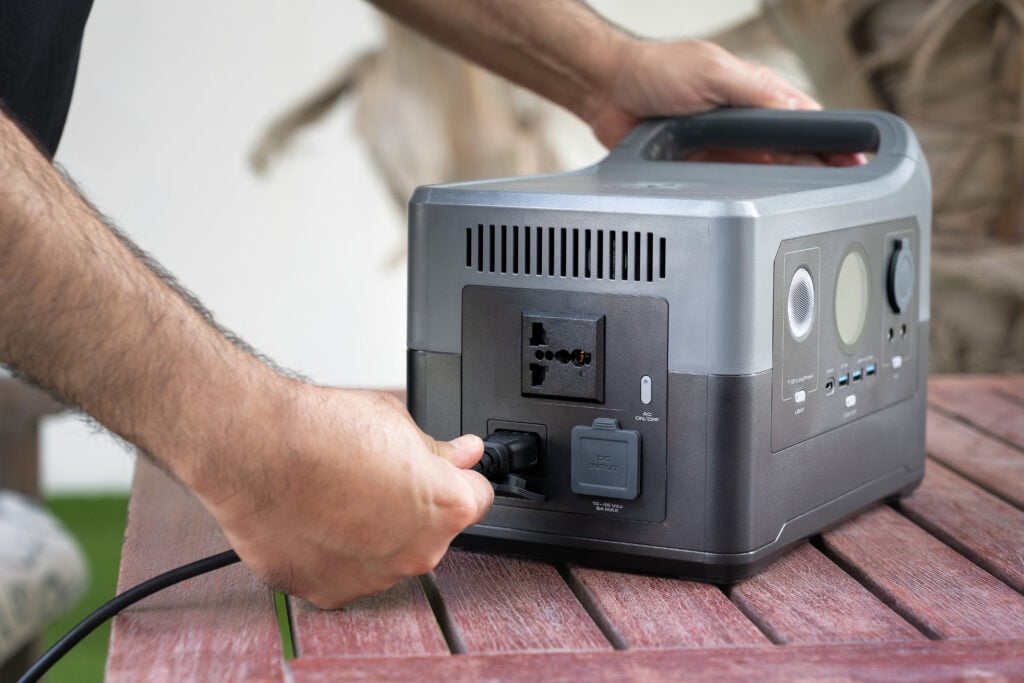

For the camper who drives in, travels light, and powers only electronics, the whole decision is carry weight. Every Anker station in the lineup handles a phone-and-camera load. Only one of them weighs 9 pounds.
The C300 is the lightest eligible Anker by more than 7 pounds — and that gap is the argument in full for anyone who handles the unit constantly. It delivers bench-verified pure sine output, a wall recharge that hits 66 minutes on the clock, and a fan quiet enough to ignore. Owner reports put a 12V fridge at roughly 5 hours and a 21W TV at 9-plus hours; a laptop drawing around 60W pulls about 240Wh usable at the AC port. USB and DC loads skip most of the ~12W inverter idle, so your phone and camera charging costs less than the AC numbers suggest.
The built-in ambient light with SOS mode is a real item — it replaces a dedicated lantern, which matters when every ounce counts. And the Anker marketing that shows someone hiking with it? Independent testing calls that imagery unrealistic at 9.1 lbs, but the same assessment names drive-in camping as the honest fit. That is exactly this buyer.
There are three hard limits to respect. The 300W rated output is a genuine ceiling — sustained draw in testing settled around 255W, so anything with a heating element shuts it down cold. The 600W surge holds only seconds, not minutes. And the low-current USB-C ports auto-shut after roughly 2 hours of continuous draw — plug in overnight USB devices before you go to sleep, or you will wake to a dead battery.
On solar: the C300 pairs only with Anker’s 60W and 100W panels — not the larger PS200 or PS400. Solar and USB-C charging cannot run at the same time.
Skip it if: runtime through a weekend matters more than the carry weight — the 535 PowerHouse holds 78% more battery for the same money and wins Segment 2 on exactly that reversal.
Same price, 512Wh versus 288Wh. The moment runtime beats carry weight — the weekend family trip, the small fridge running all day — the calculus flips completely and the 535 is the right box. That is Segment 2.
With a firm $300 ceiling and a weekend of family devices plus a small fridge to get through, the decision comes down to one number: watt-hours per dollar. At identical price points, 512Wh outlasts 288Wh every time.
The 535 PowerHouse offers the best watt-hours per dollar of any Anker in the eligible set, and testing pegs its best use as exactly this: camp lights, fans, a small fridge, device charging, and air-mattress inflation across a weekend. Owner reports put a 60W mini-fridge at 7-plus hours and a 40W CPAP at 12-plus hours from the AC port — enough to cover two nights of each without rationing. A family of four ran phones, tablets, and lights for 24 hours with capacity to spare. The car charger that ships in the box handles top-ups during the drive.
The LiFePO4 chemistry and 5-year warranty are worth naming at this price: owners logged no measurable capacity loss over 50-plus cycles, and the reinforced corners survived tailgate drops. This is a buy-it-once value at the $300 ceiling.
The catches are real. The 500W ceiling is firm — a 659W hair dryer triggered an immediate shutdown in testing, so leave every heating element at home. Some grounded three-prong plugs do not seat cleanly in the AC outlets; check your specific gear before the trip. There is no app, only one USB-C port, and at 120W the solar ceiling makes panels a slow top-up rather than a same-day refill.
A note on the spec confidence here: weight, surge rating, and solar-input figures are absent from the manufacturer’s published specs; the weight and realistic solar rates above come from owner and review reporting rather than the spec sheet, so treat them as reliable estimates rather than certified figures.
Skip it if: carry weight is the binding constraint — the SOLIX C300 is 7-plus pounds lighter for the same money and wins Segment 1 on exactly that ground.
A dollar more, 288Wh less — but 9.1 lbs versus 16.5 lbs. If the runtime buffer matters less than the ease of carrying the box from car to table and back, the C300 takes over. That is the exact reversal that makes it the Segment 1 winner.
Two people, two or three nights, a 12V compressor cooler cycling all night on the DC port — that last detail is what decides this segment, and it decides it in a way the spec sheet completely hides.
On paper, the C1000 Gen 1 and the C1000 Gen 2 look like the same machine: near-identical capacity, comparable output, both LFP, both quiet under 200W. The lived evidence breaks them apart on exactly the load that defines this segment.
The Gen 1’s documented behavior on an overnight DC load is a problem: a designed auto-shutoff triggers after roughly an hour of sub-10W draw on the 12V port. Owners running DC fridges overnight have found their coolers off and their food warm by morning, even after believing the unit was set up correctly — defeating the shutoff requires tracking down several independent power-save toggles inside the settings. The Gen 2 shows the opposite pattern: a 50W DC cooler ran three full days without interruption. Same spec sheet, opposite real-world behavior, and for this trip that difference is the whole decision.
Beyond the cooler problem, the Gen 2 earns its place on its own merits. It is the lightest 1kWh-class unit in independent testing at 24.9 lbs — a genuine one-hand carry to the site. It is near-silent below 200W, which covers everything a sleeping campsite runs. And a full recharge benchmarks at 46–47 minutes, meaning a mid-trip top-up at a campground outlet takes about as long as coffee. If one of you runs a CPAP, DC-direct operation covers up to four nights on a single charge.
Two setup details to handle before leaving the driveway: complete the initial Bluetooth app pairing at home, because owners report outlets may not activate off-grid without it. And know the solar reality — common 11–28V panels cap the 600W input near 200W; the full harvest rate requires 29–60V panels.
Skip it if: you want to save $70 and don’t need worry-free overnight DC operation — the Gen 1 is expandable to 2,112Wh with the BP1000 battery and kept the built-in light bar the Gen 2 dropped, but you must neutralize every power-save toggle before trusting it with an overnight cooler.
Seventy dollars cheaper, expandable to 2,112Wh with the BP1000, and it has the light bar the Gen 2 dropped — three real camp-relevant wins. Testing confirms 85–90% usable capacity at the wall and a 54-minute UltraFast recharge. It loses this segment on the 12V auto-shutoff behavior described above: if you buy it for overnight DC-cooler duty, hunt down and disable every power-save setting before you trust it, and confirm the MC4-to-XT60 adapter is in the box before counting on solar. If you don’t need overnight DC reliability, or you’re pairing it with a 120V fridge via AC, those wins are worth $70.
A group at a vehicle-accessible site running a real electric kitchen — kettle, griddle, coffee maker, maybe a microwave — needs a station that actually clears those surge loads, not just one rated to clear them. That distinction is where this segment gets decided.
Three 2kWh-class Anker units sit at nearly the same price: the C2000 Gen 2, the F2000, and the F2600. The spec sheets nearly tie them. What breaks the tie is real surge behavior and carry weight — two axes the spec sheet ranks secondary but the camp kitchen ranks first.
The C2000 Gen 2 passes the kitchen test in practice: a 2,162W kettle ran cleanly, a 1,420W air fryer sustained, a 1,600W microwave cleared — and measured burst surge reached near 6,000W, well past the 4,000W rating. The F2000, at essentially the same price, weighs 67 pounds and its surge collapses on motor and inrush loads despite the rated number. The F2000 also carries a documented standby self-discharge pattern that drained a stored unit to zero over months — a real problem for gear that lives in a garage between trips. The C2000 Gen 2’s own review puts it plainly: it beats the F2000 ‘on every axis its buyer cares about.’
At 41.7 pounds it is 25 pounds lighter than either F-series unit at this capacity. It is near-silent below 1,000W. Idle draw is 9W with AC output off and roughly 18W with outlets live — low enough that it does not visibly drain between meals. And at $0.39/Wh it sits at the best value on the page. If the group grows, the BP2000 expands it to 4,096Wh.
Two operational quirks to handle up front: the default 1,800W AC charge rate will trip a standard 15A campground circuit — drop the input wattage in the app before plugging in at a powered site. And the rubber feet slide on smooth surfaces; something to know before setting it on a camp table.
Skip it if: your group is large enough that 2,048Wh won’t cover a full day, or you’re staying long enough that solar replenishment matters as much as the kitchen load — the F2600 adds 512Wh, a 1,000W solar ceiling, and wheels, and it wins Segment 5 on exactly that case.
For bigger groups or longer stays: 2,560Wh with roughly 2,480Wh measured usable, sustained 2,200W combined loads confirmed in testing, about 45dB under 1,000W, and wheels plus a telescoping handle that make the 69.7 pounds manageable. The $299 premium and the extra weight are what you trade for the larger tank and higher solar ceiling — the same reversal that makes it the Segment 5 winner.
Long-term owners consistently describe it as the quietest station they have used, and the wheeled chassis plus TT-30 outlet are genuine conveniences. At the same price as the C2000 Gen 2, though, it carries three compounding strikes: 25 extra pounds, surge that fails under motor and inrush loads in testing, and a standby self-discharge that left one unit at zero months after a full charge. Its own review’s cross-shop guidance points to the C2000 Gen 2 unless wheels and the TT-30 are specifically what you need.
A week-long stationary camp running entirely on solar is a different math problem than every other segment: the question isn’t how much you stored before you left, it’s how much you can pull in each day and how many days of clouds you can absorb. Those two numbers — harvest rate and buffer — are what this decision turns on.
When panels are the only fuel, the harvest math decides everything — and the F2600 holds the highest usable solar ceiling in the eligible set paired with the largest battery. In testing, it hit 80% recharged in about 2 hours under strong sun at the full 1,000W input, and a single 400W panel gets it there in roughly 5.7 hours. The buffer is generous: bench testing measured roughly 2,480Wh delivered — about 97% of the nameplate — and a fridge-class load ran 40–45 hours per charge. That is close to two full cloudy days of buffer built into the base unit before you touch expansion.
The panel rule is straightforward and worth knowing precisely: keep total panel voltage inside 11–60V, and the watt rating may safely exceed 1,000W — the MPPT controller simply caps input. That opens up third-party panel pairings cleanly. Anker’s own SOLIX PS400 and PS200 are the in-catalog matches.
If someone in the group needs a week-plus stretch, the F2600 expands to 4,608Wh via the BP2600 or the older BP2000 — the same ceiling either way.
One cold-weather note that overrides the spec sheet: one owner’s unit shut down around 35°F during overnight storage in a shed, well above the −4°F discharge rating on the label. For shoulder-season camping or cold nights, keep the unit insulated or inside the vehicle overnight — plan the real cold floor as higher than the spec claims.
Skip it if: 69.7 pounds is genuinely too heavy to move and you’d rather make two trips with a lighter box — the C2000 Gen 2 expands to 4,096Wh and charges from AC and solar simultaneously, but its solar ceiling is 800W and low-voltage panel inputs cap earlier, so panel choice becomes more important.
If carrying 41.7 pounds twice beats moving 70 pounds once: the C2000 Gen 2 reaches 4,096Wh with the BP2000 and handles simultaneous AC plus solar charging, but the 800W solar ceiling and the 8.2A current cap on the lower-voltage input range mean you need to choose panels carefully to get close to that ceiling. The F2600’s solar harvest advantage and single-unit buffer are the reason it leads this segment — the C2000 Gen 2’s edge is carry weight and base price.