
When you purchase through links on our site, we may earn an affiliate commission. Learn more.
EcoFlow makes a range of portable power stations that spans from sub-8-pound backpack companions to 48-pound basecamp anchors — and the best one for you is not the biggest one you can afford, nor the smallest you can get away with. It’s the one whose weight, capacity, output, and recharge method actually match how you camp.
A solo hiker sleeping beside their pack and a four-person group cooking hot meals at a fixed site have almost nothing in common as buyers. The unit that’s perfect for one is genuinely wrong for the other — wrong weight class, wrong capacity tier, wrong recharge path. This page splits the camping population into four real situations, names the EcoFlow that wins each, and explains exactly why the runner-up lost.
Use the table below to find your row, then jump to that segment for the full argument.
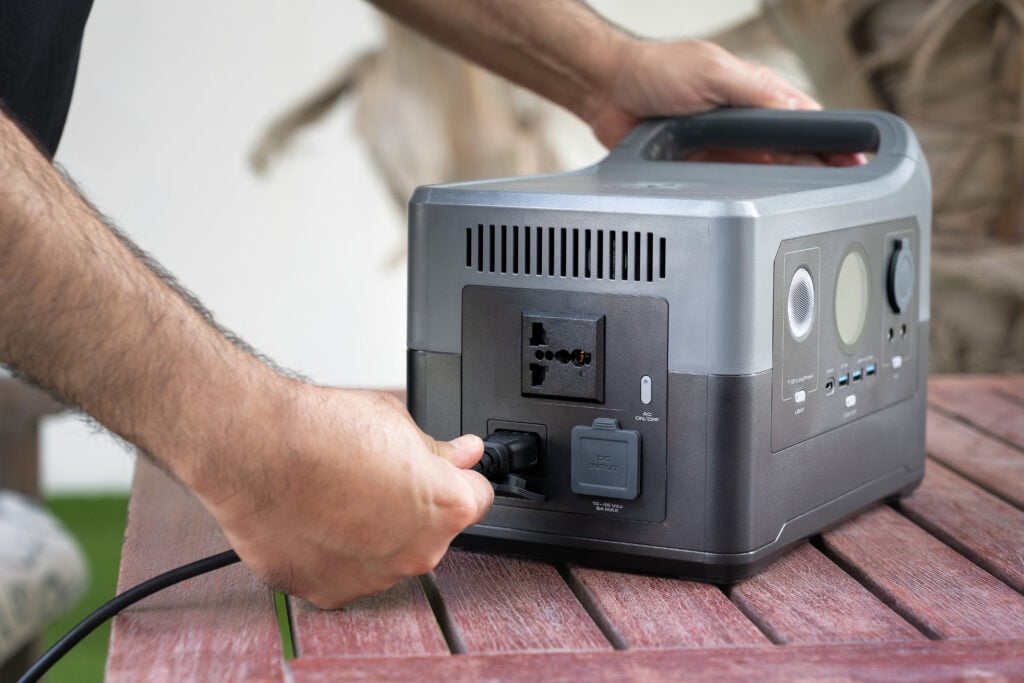
For the solo hiker, the whole game is weight and standby readiness — it has to be light enough to carry without noticing and charged enough to matter on night two. Output ceiling and sustained wattage barely enter the picture; a phone, a headlamp, and maybe a GPS draw so little that almost any unit can handle them. What a spec sheet doesn’t tell you is how the unit behaves sitting in your bag for three days, and whether it hums loud enough to keep you awake.
The RIVER 3 wins this segment on the two things the spec sheet doesn’t print. Independent testing confirms its idle draw sits near 5W, and owner reports put standby retention around 85 hours at idle from full — it simply doesn’t hemorrhage charge while it’s packed away. That’s the axis that matters most for a multi-night trip with no outlet, and it’s the axis where the RIVER 2 fails. The fan only spins up during high-wattage fast charging; trickle-charging a phone off USB, it’s genuinely inaudible — one owner ran it in their bedroom all night and couldn’t hear it, which is exactly the behavior you want from something sitting a foot from your sleeping bag. Independent testing pulled about 210Wh of the 245Wh rating to the load at a gentle discharge, and the GaN electronics cut idle losses enough that DC charging from the USB port stretches the usable figure further still.
There are real limits: 300W is a hard ceiling, which is fine for phones and lights and a complete non-starter for anything that surges higher. And 245Wh is a genuinely small tank — it’s enough for a solo hiker’s two or three nights, not a group weekend. The bundled 45W solar panel barely dents it; if solar matters to you, pair a 100W+ panel instead.
Spend $70 more and carry 2.6 extra pounds and you get double the output, 220W solar input that can actually refill the tank in a reasonable afternoon, a built-in light useful enough to run a campsite, and confirmed near-silence even under load. Its one documented flaw — AC output cutting when solar charging hits 100% — is a problem for unattended-solar-backup setups, not for a camper using it as a daytime charging hub. Choose it over the base RIVER 3 if the light and the output headroom appeal more than the absolute minimum carry weight.
Skip it if: You’re genuinely counting ounces and a phone plus a headlamp is the whole load — the base RIVER 3 is the lighter, cheaper, right-sized tool.
Why the RIVER 2 lost: On paper the RIVER 2 is the better pick — 256Wh to the RIVER 3’s 245, 7.7 lbs to 7.8, $189 to $199. The spec sheet would call it for the RIVER 2. The field evidence overrules it. Owner reports document a parasitic drain that can empty the battery in days to a couple of weeks sitting unplugged — EcoFlow acknowledges it as normal ‘ghost drain.’ Owners who compared it directly to other brands watched those units hold charge while the RIVER 2 ran down. On a multi-day solo trip, a unit that arrives dead is worse than a unit that’s 10 dollars more expensive. Its fan also measured 53–54 dB under load — described as sounding like an old PC — which rules it out as a sleep-beside companion. Lighter, cheaper, and the wrong tool for this job.
Car-camping for one to three nights with another person changes the math in a specific way: the load isn’t just phones and lights anymore, it’s a 12V cooler running continuously in the background. That cooler is the swing factor — and it wants a 12V DC port, not an inverter. Running it on DC bypasses the inverter idle tax entirely and pushes usable energy closer to the unit’s ceiling rather than its floor.
The RIVER 2 Pro wins because it has the 12V DC port the cooler wants, the capacity to carry a one-to-two-night cooler-plus-devices load, and the best capacity-per-pound in EcoFlow’s RIVER line — 768Wh in 18.2 lbs. Independent bench testing measures around 640Wh usable on AC loads and closer to 670Wh on DC-only draws, where the inverter never enters the picture. The cooler running on the DC port sits squarely in that better regime. A 70-minute wall recharge or a roughly four-hour solar top-up covers the gap between nights.
This unit carries a known self-discharge issue, but the concern is specifically about shelf storage — a unit sitting uncharged for months stranding an emergency load. The context here is the opposite: a unit actively cycled over a camping weekend, kept topped between trips every two to three weeks. Read through a camping lens, the flaw evaporates. The unit’s own review names ‘camping and van-life users with regular solar or AC recharge access’ as its clearest recommended buyer.
Two things to manage in practice: keep the inverter fully off during storage or it loses roughly 40% charge over 24 hours with AC output active, and expect the fan to be audible — peaks around 61–62 dB and erratic — whenever AC output is running. The weekend-pair pattern sidesteps the noise naturally: with the cooler on DC, the inverter is off overnight and the fan is quiet while you sleep. If you run AC loads at night, expect to hear it.
Skip it if: The extra weight and price aren’t justified by your load — one to two nights with a cooler and phones is well within the RIVER 2 Pro’s range.
Carry 9 more pounds and pay $180 more and the DELTA 3 delivers nearly a kilowatt-hour usable at the same DC-cooler-plus-devices regime, six outlets, a 56-minute recharge, and genuinely quiet operation — independent testing puts it at 32–33 dB even at maximum charge, with owner consensus describing it as near-silent. Standby retention is better than the RIVER 2 Pro’s, which matters if the trip stretches past two nights without a top-up. It also doubles as a capable home-backup unit between camping seasons. The 12V car port is the specific reason the base DELTA 3 is the right runner-up here and not the DELTA 3 Classic, which deletes that port — and the cooler relies on it.
Once the unit rides in a vehicle and gets set down once, weight nearly stops mattering. What the group actually needs is the ability to run a fridge, lights, fans, and a kettle or hot plate at the same time without tripping an inverter — and enough stored energy to do that for several days between recharges from the car or a generator. Sustained output and capacity are the whole conversation.
The DELTA 3 Max wins because 2400W of sustained output handles the group’s many-simultaneous-loads profile without flinching — a fridge plus lights plus a kettle-or-microwave burst all sit inside its envelope. A firsthand camping report ran a kettle, a hot plate across two meals, an electric blanket through the night, and continuous phone charging, and landed at 20–35% remaining — genuine multi-day group capacity. At 25 dB it’s quiet enough to run near where people sleep, which matters when the fridge cycles all night. And at $0.37/Wh it’s the best value in the 2kWh tier for a basecamp that recharges from a vehicle or generator.
One thing to know before you buy: the DELTA 3 Max is not expandable. 2048Wh is a permanent ceiling. Owner reports flag this as a post-purchase surprise for some buyers who assumed DELTA 3 branding implied an expansion path — it doesn’t. Buy it knowing that. Its single 500W solar port also means a four-plus-hour refill in good sun, which is why it’s the right pick for vehicle-recharged basecamps and the wrong pick for pure off-grid solar use — that’s the next segment.
Honorable mention: EcoFlow DELTA 3 Max Plus — If your group’s loads climb toward 3000W or you want a path to 10kWh, the Max Plus is the same chassis with 3000W sustained output and dual 1000W solar. At $1099 it’s overkill for a basecamp recharging from a vehicle; its decisive advantage only pays off when solar is the only refill path, which is Segment 4’s whole premise.
Skip it if: Your group’s loads regularly stack above 1800W, or you want the larger 2048Wh tank — the DELTA 3 Max handles both.
The DELTA 3 1500 carries a ‘Skip Unless’ verdict whose stated reason — it runs older DELTA 2 software with no Time-of-Use scheduling, no usage graphs, no working API — is completely irrelevant at a campsite. Read through basecamp axes, what’s left is a near-silent box (owners running a fridge overnight describe it as ‘dead silent and cool’) with 1536Wh at $0.39/Wh. The flipping axis versus the Max is output ceiling and capacity: if your group’s peak loads stay under 1800W and you want the most quiet watt-hours per dollar at $599, the 1500 is the call. Step up to the Max when simultaneous high-draw loads push toward 2400W or you want the larger tank for longer stretches.
One reliability note worth carrying: the DELTA 3 1500’s cycle rating is 3,000 cycles to 70% — compared to 4,000 cycles to 80% on other DELTA 3 units. Fine for seasonal camping use; worth knowing if you plan to cycle it daily.
No wall outlet changes the math in a fundamental way. It’s no longer just about how much you can store — it’s about how fast the sun can put it back. A unit with twice the solar input doesn’t just refill faster in a single session; over a multi-day off-grid stretch it’s the difference between staying ahead of your daily draw and slowly falling behind it until night three leaves you dark.
The Max Plus wins on solar input. Its 1000W dual-MPPT capability is double the DELTA 3 Max‘s single 500W port — the one axis that decides this segment — and independent testing confirms it holds 3000W of sustained output through a full discharge. The 30A Anderson DC port, rated at 378W, feeds 12V fridges, pumps, and fans directly without touching the inverter, which is the efficiency move that stretches an off-grid day furthest. Independent testing calls that DC port the clearest reason to choose this unit over competitors in its tier for DC-integrated setups. At lighter loads it operates in the mid-20s dB range; near its 3000W ceiling it climbs to the low-40s — audible but not disruptive at a campsite. Independent testing measured roughly 91–93% of the 2048Wh rating reaching the load at sustained 2kW AC draws.
Its two documented weaknesses are worth naming and then dismissing for this use case. The UPS switching isn’t reliable enough for sensitive electronics like a NAS — there’s no NAS at a campsite. The standby drain runs around 22–25W with AC output on — but a unit in daily off-grid cycling is never sitting idle with AC on for extended periods. Run low-draw gear off the DC ports and neither issue surfaces. If you park it for weeks between trips with AC output active, the drain matters; in active off-grid use, it doesn’t.
Solar pairing for off-grid use: The off-grid picks have 1000W of dual-MPPT solar input across two ports rated at 500W each. From EcoFlow’s own lineup, the natural pairings are the EcoFlow 400W Portable Solar Panel ($599, 35.3 lbs) as the serious-recharge option — one panel per port, or two for roughly 800W toward the 1000W ceiling — or the lighter EcoFlow NextGen 220W Bifacial ($299, 15.4 lbs) for a packable single-panel top-up. These pairings are validated against the wattage ceiling of each port; a full voltage-window check against the DELTA 3 family’s MPPT range and a measured daily-recharge calculation were not completed for this guide. Treat the panel pairings as a sound starting point and verify voltage compatibility before purchase.
Skip it if: Your group’s daily draw regularly exceeds a kilowatt-hour, or you want the expansion path to 10kWh — step up to the DELTA 3 Max Plus.
The DELTA 3 Plus shares the decisive 1000W dual-MPPT solar input with the Max Plus and adds the best cycle life in EcoFlow’s portable lineup — 4,000 cycles to 80%. It charges in 56 minutes from a wall, carries an IP65-rated battery pack for rough conditions, and weighs 27.6 lbs against the Max Plus’s 48.7. The case for it is simple: same solar refill rate, lighter body, $500 less.
The flipping axis is capacity. At 1024Wh against the Max Plus’s 2048, a solo or pair with modest loads — a fridge, lights, phones, occasional fan — can stay ahead of daily draw with good solar exposure. A larger group, or a load that regularly consumes more than a kilowatt-hour per day, will find the smaller tank running short before the sun comes back up. One thing to know: independent testing documents a roughly 25% effective capacity hit at sustained draws above 1500W from thermal cycling — but that high-draw regime is outside the 150–400W load range this segment targets, so usable stays near 930Wh for typical off-grid camping use.
The unit’s known issues — a heavy idle drain and non-functional Time-of-Use scheduling — cluster on always-on home-storage use and don’t touch an actively-cycled off-grid setup.
Picks on this page come from deciding what the use case actually rewards — then judging each unit by how it behaves under those conditions, not by how it reads on a spec sheet. The criteria that matter shift with the job, so a unit that’s decisive in one segment can be disqualified in the next by a single behavior. Where two contenders cleared the same bar, documented performance under real load settled the pick, not a comparison of rated numbers.
Portable power stations are full of numbers that don’t mean what they appear to mean. Nameplate capacity is what the chemistry holds; what reaches your device is always less — sometimes meaningfully less — because inverter idle draw, thermal throttling, and efficiency losses all carve into the rating before anything plugs in. Every capacity and runtime figure on this page is stated at the real load each segment actually runs, not at a gentle bench discharge or the number on the box.
Beyond raw capacity, the things that decided close calls were: whether a unit held its charge sitting in a bag between trips, how loud the fan ran at the loads a camper actually uses (a unit you sleep beside gets judged differently than one that sits at the edge of a site), how fast solar input could refill the tank relative to a day’s draw, and whether documented failure modes mattered at a campsite or only in a different context entirely. A ‘Skip Unless’ verdict from a review means nothing if the reason for it is irrelevant to how campers use equipment.
Output headroom matters in a different way here than it does for home backup: a camper doesn’t need 2400W because they’re running a refrigerator and a sump pump simultaneously — they need it because a kettle and a fridge and three charging devices can stack up faster than the math suggests, and tripping an inverter at a remote site is a worse outcome than tripping one at home.
Weights, capacities, solar input ceilings, and output ratings come from manufacturer specifications and independent bench testing. Standby behavior, fan acoustics, and real-world load handling are drawn from owner reports and independent testing. Where a published spec and a measured result diverged, the conservative figure governs — and where a unit’s documented behavior in the field contradicted what its spec sheet would predict, the field evidence settled the pick.
The picks above answer “which one for my situation.” This table answers “show me everything, I’ll decide.” It lays every unit out on the same axes used to make the calls — measured behavior, not nameplate specs — so a reader whose priorities cross segments can weigh the tradeoffs directly instead of trusting our segmentation.
| Unit | Capacity | Rated output | Surge | Weight | Solar input | AC recharge | Expandable | Price | $/Wh | Buy |
|---|---|---|---|---|---|---|---|---|---|---|
| RIVER 3 | 245Wh | 300W | 600W | 7.8 lbs | 110W | ~1.0 hr | No | $199 | $0.81 | Check price |
| RIVER 3 Plus | 286Wh | 600W | 1200W | 10.4 lbs | 220W | ~1.0 hr | — | $269 | $0.94 | Check price |
| RIVER 2 Pro | 768Wh | 800W | 1600W | 18.2 lbs | 220W | ~70 min | — | $339 | $0.44 | Check price |
| DELTA 3 | 1024Wh | 1800W | 3600W | 27.6 lbs | 500W | ~56 min | Yes, to 5000Wh | $519 | $0.51 | Check price |
| DELTA 3 1500 | 1536Wh | 1800W | 3600W | 36 lbs | 500W | ~90 min | Yes, to 5500Wh | $599 | $0.39 | Check price |
| DELTA 3 Max | 2048Wh | 2400W | 4800W | 44.8 lbs | 500W | ~89 min | No | $749 | $0.37 | Check price |
| DELTA 3 Max Plus | 2048Wh | 3000W | 6000W | 48.7 lbs | 1000W dual-MPPT | ~1.1 hr | Yes, to 10,000Wh | $1099 | $0.54 | Check price |
| DELTA 3 Plus | 1024Wh | 1800W | 3600W | 27.6 lbs | 1000W dual-MPPT | ~56 min | Yes, to 5000Wh | $599 | $0.59 | Check price |
— = not independently verified for this guide.
The questions here are the ones that don’t belong to any single pick — the cross-cutting concerns that come up regardless of which unit a reader lands on. We pulled them out of the individual segments so each answer lives in one place, addressed against the same standard of evidence used throughout the page.
Because the self-discharge issue is specifically a shelf-storage problem, not a cycling problem. Owner reports and testing document the RIVER 2 Pro draining significantly when left uncharged for extended periods with its inverter on — the scenario that would strand an emergency-backup unit sitting in a closet for months. The weekend-pair camping pattern is the opposite of that: the unit gets charged at home, runs actively over two or three days at the site, and gets topped up every two to three weeks between trips. Keep the inverter off during storage and the drain is a non-issue. The unit’s own review identifies ‘camping and van-life users with regular solar or AC recharge access’ as its clearest recommended use case — which is exactly this segment.
The axis that decides the two segments is completely different. At a basecamp with a vehicle, generator, or shore power nearby, recharge speed and solar input don’t matter much — what matters is how much you can store and how much you can deliver simultaneously. The DELTA 3 Max wins that argument at $749 with 2048Wh and 2400W of sustained output. Off-grid with no wall access, the game shifts to solar throughput: how fast can daylight refill what last night consumed. The DELTA 3 Max has a single 500W solar port, which means a four-plus-hour refill in good conditions. The DELTA 3 Max Plus has dual 1000W MPPT input — double the throughput — and that gap compounds over several days. Same chassis, different recharge path, completely different verdict.
It can physically connect to one via the 12V car port, but 245Wh is a tight fit for a cooler that duty-cycles all night. A 12V compressor cooler drawing 25–40W averaged over time will run through the RIVER 3‘s usable capacity in roughly five to eight hours of sustained cooling — which may not carry a full overnight on a warm night. The RIVER 3 is sized for phones, lights, and a GPS over multi-night trips at intermittent loads, not for continuous cooling. If a cooler is part of the load, the RIVER 2 Pro‘s 768Wh and dedicated 12V DC port at $339 is the right step up.
Not much for seasonal use. The DELTA 3 1500 is rated at 3,000 cycles to 70% retained capacity, compared to 4,000 cycles to 80% on other DELTA 3 units — a meaningful difference on paper. For a camper who uses the unit a few times a season and charges it between trips, reaching 3,000 cycles takes decades of that use pattern. The weaker rating matters most for someone cycling the unit daily — a van-lifer, a home-backup user running daily charge cycles, or anyone treating it as a primary energy source year-round. For seasonal camping, the cycle life is a non-issue and the quieter operation and lower price per watt-hour make the 1500 a sound choice for groups whose peak loads stay under 1800W.
The decisive shared feature is the 1000W dual-MPPT solar input — both units refill from panels at the same ceiling rate, which is the axis that decides the off-grid segment. The DELTA 3 Plus gets there in a 27.6-pound, 1024Wh body at $599; the Max Plus puts the same solar input into a 48.7-pound, 2048Wh frame at $1099, and adds 3000W sustained output and an expansion path to 10kWh. The choice is about how much stored energy you need to carry the loads between solar sessions. A solo camper or pair with modest daily draw can stay ahead of consumption with a 1024Wh tank and good sun; a larger group, or one running heavier loads, will outpace what the smaller tank can hold overnight and needs the 2048Wh floor to stay comfortable.
If you carry the unit on your back and sleep beside it, the RIVER 3 is the clear answer — it holds its charge between nights and stays inaudible while you do. If you car-camp with a cooler as a pair, the RIVER 2 Pro‘s 12V DC port and 768Wh of capacity at $339 is hard to argue against, provided you keep it charged and the inverter off in storage. Groups at a fixed site with vehicle recharge access get the DELTA 3 Max: 2048Wh, 2400W sustained, and the lowest price per watt-hour in the 2kWh tier — though its fixed capacity and single solar port are permanent constraints worth knowing before purchase. And if solar is your only refill path, the DELTA 3 Max Plus owns that job with its dual 1000W MPPT input; the DELTA 3 Plus offers the same solar ceiling in a lighter, cheaper body for solo and pair off-grid loads that don’t need the larger tank.
The pattern across all four segments: the spec sheet is a reasonable starting point, but field behavior — standby retention, fan acoustics, real load handling, and how the documented failure modes map onto an actual camping pattern — is what settled every close call on this page.