

When the power station is the electrical system — not a backup, not a weekend kit, the actual grid — the only question that matters at the start of every day is whether the sun put back what yesterday took out. Everything else is downstream of that. The unit that harvests the most from a fixed array and banks the most per charge is the right one here, and the field thins quickly once you add the requirement that it keep running on its own after a depletion event.
The DELTA Pro 3 leads the portable class on solar intake — 2,600 W across two independent MPPT ports — and pairs it with the deepest single-unit bank of any Review-backed unit here. Owners have stacked that into a 48 kWh system. The combination means a good sun day fills the tank; a bad one leaves enough reserve to coast. Independent testing puts usable delivery at roughly 3,810 Wh at 120V and closer to 3,880 Wh in 240V split-phase mode — near-nameplate performance at the mixed household loads this buyer runs.
The real-world evidence is unusually direct. One long-term owner has run it daily off-grid for over a year. Others run saunas, chest freezers, and 240V power tools from it. At a fridge-plus-furnace-plus-tankless-water-heater load, independent testing measured 20–22 hours per charge — enough to weather an overcast day without anxiety. Native split-phase 120V/240V from a single box means a well pump or a 240V shop tool plugs straight in, no second unit required.
There are two real conditions to respect. First, the dual solar ports use non-overlapping voltage windows — one handles high-voltage arrays (30–150V), the other low-voltage (11–60V) — so wiring both into a single panel string doesn’t work; you need two separate sub-arrays. Second, this is an attended-duty unit. A long-term tester logged three firmware-triggered resets over five weeks with no push notification; the unit doesn’t alert you when it faults. For a primary residence where someone is home, that’s manageable. For a remote site with week-long gaps between visits, it’s a genuine concern — which is what makes it the right pick here rather than the one in Segment 2. Owners running true off-grid stretches also report that solar alone won’t carry multi-day winter loads at full draw; an hour or two of generator charging fills the gap.
Skip it if: the unit will sit unattended for days or weeks between visits — the firmware fault behavior and lack of remote notifications make that a real operational risk; look at Segment 2’s pick instead.
The F3000 costs $700 less and gets close on the solar side — 2,400 W rated, with independent real-world arrays pushing roughly 1,900 W — while idling at a measured 20–35 watts versus the DELTA Pro 3’s higher baseline. That low idle matters in daily-cycling use, where every watt of standby drain is energy the array has to replace before breakfast. It’s expandable to 24 kWh, and independent testing has validated it running multi-day farm construction loads and a 13-plus-hour partial-home draw.
What keeps it in second place for full-time off-grid duty is the same class of friction that haunts anything living in a remote setting: panels can’t stay connected overnight without drawing extra current, there are no remote notifications if something goes wrong, and both the AC charging cable and the high-voltage solar adapter are proprietary single points of failure. Lose one at a remote site and the refill path is gone until the replacement arrives. The F3000 is the better choice if the budget is firm and the site gets regular visits — the harvest is nearly as good, the idle is better, and the price gap is real. For a true off-grid primary with the budget to close it, the DELTA Pro 3’s extra solar headroom and larger base tank earn the premium.
The weekend cabin buyer has a different problem than the full-time homesteader: the unit sits unattended with panels connected for most of the week, and it needs to handle that without failing silently. The dominant question here isn’t peak harvest — it’s whether the station reliably accepts and stores what a modest fixed array sends it, day after day, while nobody is watching.
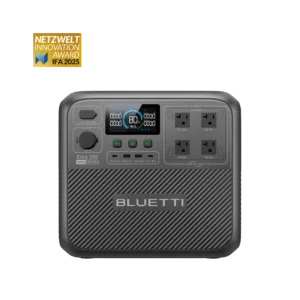
The case for the Elite 200 V2 here is about what it doesn’t waste. Independent testing measured 96% AC inverter efficiency and a ~10-watt idle with the inverter on — low enough that the Review says you can leave the inverter running for days without it meaningfully denting the bank. On a cabin array that might push 300–500 watts on a good afternoon, the unit that loses the least between harvest and output is the one that keeps the fridge cold by Friday. Independent testing confirmed 22–30 hours of full-size fridge runtime per charge at this segment’s anchor load. Real-world solar peaks around 800 watts against the 1,000 W rating — best confirmed intake in this class once the Jackery is removed from consideration.
Two settings need to change before you leave it. Default ECO mode will shut the unit off after a period of low draw — a fridge cycling at 80–150 watts is exactly the load pattern that can trigger it. Turn ECO mode off. Second, plan panel strings around the 60V ceiling: series-wired residential panels can exceed it (typical VOC runs 50–56V in parallel strings, which stays inside the window). The Elite 200 V2 is also not expandable — the 2,073.6 Wh is permanent — so size your expectations at purchase.
Skip it if: your cabin loads have outgrown 2 kWh or you’re planning to add battery packs later — the Bluetti Premium 200 V2 shares the same chemistry and opens an expansion path to over 8 kWh, or look at Segment 1 for deeper banks.

At $800, the C2000 Gen 2 is within a dollar of the pick, weighs about 12 pounds less, and carries the lowest confirmed idle in this class — 9 watts with AC off, 18 watts with it on. Independent bench testing puts real-world fridge runtime at 14–22 hours per charge (the 32-hour marketing figure comes from lab conditions). It’s expandable to 4 kWh and AC recharges in about 90 minutes.
It can handle unattended cabin duty, but it arrives needing two settings changed first. The Output Port Memory Switch — which tells the unit to restart AC after a full drain-and-recharge — is off by default and not documented in the quick-start guide. Smart AC Output Mode needs to be disabled separately, or the unit’s compressor-cycling detection may trigger a shutoff. Both are one-time changes, but they’re not obvious, and skipping either one means coming back to a warm fridge. The Elite 200 V2 needs only one setting changed and takes in 200 more watts of solar — on the harvest axis, it leads.
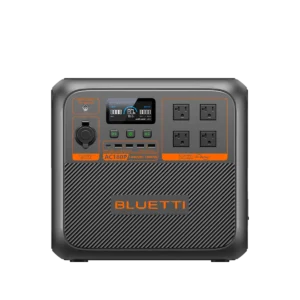
At $1,499, the Premium 200 V2 carries the same 2,073.6 Wh base as the pick and the same 1,000 W solar ceiling, but it opens an expansion path to over 8 kWh via B300 packs — and its off-grid credentials are unusually well documented. An owner on a 400-watt array reported full daily self-replenishment from sun alone; a boat owner ran a fridge continuously with no wall charging, ever. The Bluetti review of these two units says plainly: buy the Elite unless expansion or the last 100 W of output matters. If either does — if today’s 2 kWh feels like it might not be enough in a season — the Premium’s upgrade path is the reason to pay the premium. The same ECO-mode caveat applies: a documented 5-watt floor and 4-hour idle cutoff can interrupt an unattended fridge; disable it before leaving.
The spec-sheet leader of this segment was the Jackery Explorer 2000 Plus — highest solar input in the class at 1,400 W, expandable to 24 kWh. It doesn’t place here because of a recurring owner-reported failure: the solar input port reading zero with panels connected, both at initial setup and after extended use. Panels left connected overnight in low light trigger an F7 error — a weekend cabin’s normal state every Sunday through Friday. Real-world solar input fell well short of the rating across multiple owner reports, and a separate firmware bug caused the unit to silently drain while appearing to accept input. The Jackery’s own review frames the failure this way: it eliminates the unit’s core value exactly when it’s needed most. For an attended, full-time build where someone checks it daily, the same unit’s review endorses it confidently — one owner ran 1.5 years off-grid after a wildfire. The problem is specifically unattended panel duty, which is precisely what this segment requires.
Van and truck dwellers need a station that earns its keep every single day — light enough to reposition, fast enough to refill from a panel string at camp, and proven enough to run a 12V compressor fridge for the weeks between towns. The anchor load here is DC, not AC, which changes the math: bypassing the inverter means standby drain nearly disappears from the equation, and usable energy sits near the top of each unit’s curve.
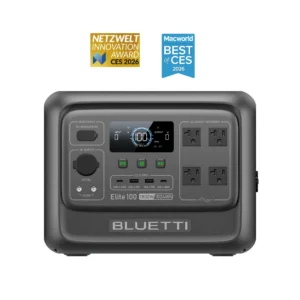
At 25 pounds with a flat top that stacks clean in a van garage, the Elite 100 V2 is the box the Review specifically names for this buyer: ‘the best portable in Bluetti’s lineup for the buyer who actually moves it — campers, van lifers, overlanders, and anyone topping up from solar or an alternator.’ Independent testing measured 869 Wh over DC and 880 Wh at the wall — near-nameplate, which holds because the fridge runs DC and the inverter mostly stays out of it. The 1,000 W solar ceiling is rare at this size; testers called it one of the fastest solar chargers they had seen in the 1 kWh class, translating to roughly an hour of refill in strong sun. Paired with alternator charging via an add-on unit, the Review describes effectively unlimited off-grid range while driving — 12V fridges and diesel heaters across dozens of cold starts confirmed by owners.
Before parking it in the van: the full 1,000 W solar input requires two things that aren’t obvious. First, panels need to be wired for 48V or higher. Second, the high-current PV mode in the app is off by default and undocumented — until it’s enabled, actual solar input is capped near 130 W. Change that setting on day one. Also worth knowing: Power Lifting on this unit is resistive-only, so it will not start motor loads like a compressor-based AC unit. And there’s a documented early-failure cluster — DOA and BMS faults inside the first six months — with warranty honored, but test everything hard before the return window closes. The car charging cable doesn’t come in the box.
Skip it if: you’re planning to run a window AC unit or add expansion batteries down the road — the EcoFlow DELTA 3 Plus handles motor loads and takes on up to 5 kWh of additional battery packs.
The DELTA 3 Plus matches the Elite 100 V2 exactly on solar capacity — 1,000 W — but splits it across two independent 500-watt MPPT ports, which means you can run solar and car input simultaneously without one blocking the other. A reviewer ran fridge, Starlink Mini, and laptops across a 7,100-mile trip; EcoFlow’s own naming is ‘overlanders, van lifers, vehicle dwellers.’ Three things it can do that the Elite 100 V2 cannot: start motor loads (an owner ran a 1,275 W window AC the Bluetti refused), expand to 5 kWh by accepting DELTA 3-series battery packs, and accept an 800 W hardwired alternator charger for faster road charging.
At $599 it costs $200 more and weighs 2.6 pounds more. There are two noted quirks — a 32–40 W idle when running always-on, and broken Time-of-Use scheduling — but both are stationary-use problems that barely surface in a daily-cycling van context. If a compressor AC load or a future expansion battery is anywhere in the plan, pay the difference. If it isn’t, you’re buying headroom you won’t use.
The third candidate for this segment was the Jackery Explorer 1000 v2 — the lightest option at 23.8 pounds, with a fast AC recharge. Its review is positive for attended mobile use where charging comes from a wall or generator. It doesn’t fit here because its solar ceiling is 400 W, less than half of either finalist, and because the DC8020 solar connector is proprietary — the Review documents it rejecting third-party panels and adapters, with support pushing owners toward Jackery’s own panels. For a solar-primary nomad who needs to charge from whatever panels are at hand, that combination of a low ceiling and a fussy connector fails the brief. Where the charging comes from a wall or generator, it’s a different story.
A detached shed or workshop without a grid connection presents a specific problem: the loads aren’t gentle. A circular saw, a heat gun, a compressor-fed tool — these hit the inverter hard and briefly, then go quiet. The station needs to absorb those spikes without tripping, and keep the lights on in between. Solar trickle-charges it from a fixed panel through the week.
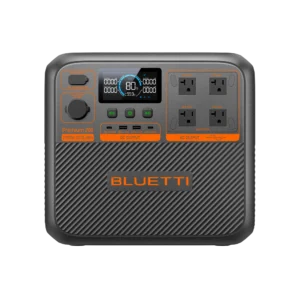
The AC180P is the pick here for one concrete reason: it runs the loads. Independent testing confirmed sustained 1,800 W output against exactly the kind of tools this buyer uses — 1,500 W heaters, 1,800 W coffee makers, a ~1,589 W leaf blower, a ~2,100 W pressure-washer-plus-vacuum setup — without fluctuation. One owner runs vacuum, compressor, and pressure washer daily for an auto-detailing business. At this segment’s bursting tool loads, inverter overhead is proportionally small against the draw, and independent testing puts usable delivery around 1,150 Wh. Paired with a 400-watt array — which the Review calls the realistic floor for daily replenishment, with real-world solar peaks running 250–485 W — it qualifies as genuine multi-day off-grid power. It also happens to be the most affordable unit per watt-hour of any pick on this page.
There are four things worth knowing before committing. First, expansion doesn’t exist despite some marketing language — Bluetti’s own documentation confirms no capacity add-on; 1,440 Wh is permanent, so size that honestly against your tool sessions. Second, the UPS mode can lock out AC output after a messy grid transition and require a manual reset — irrelevant in a gridless shed, but don’t repurpose this unit as a house UPS. Third, monitoring is Bluetooth-only, no remote visibility. Fourth, the advertised Turbo-charge speed is specific to the US market.
Skip it if: the tool list stays under 1,000 W and budget is the main constraint — the Bluetti AC70 handles lighter shed duty for $150 less.
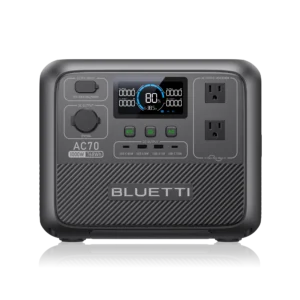
For a workshop that means lights, a battery charger, a fan, and tools that stay under 1,000 W, the AC70 at $349 and 22.5 pounds does the job and takes the same 500 W of solar as the pick. The reason it doesn’t win is that the Review documents trips on loads at roughly 1,000 W and above — even a Keurig trips it in Power Lifting mode — and Power Lifting drops voltage to a measured 62–96 V under heavy load, which the Review explicitly calls unsafe for motors and compressors. That covers most of a workshop. Owners who found out the hard way ‘almost always upgraded’ to the AC180P. There is also a documented first-year failure pattern involving the DC port (E065 faults, acknowledged by Bluetti) — test it on arrival. One more real constraint for shed setups: Standard charging mode pulls 400–500 W minimum, which will trip small generators and vehicle inverters. If the shed’s only charging source is a small generator, that matters.