
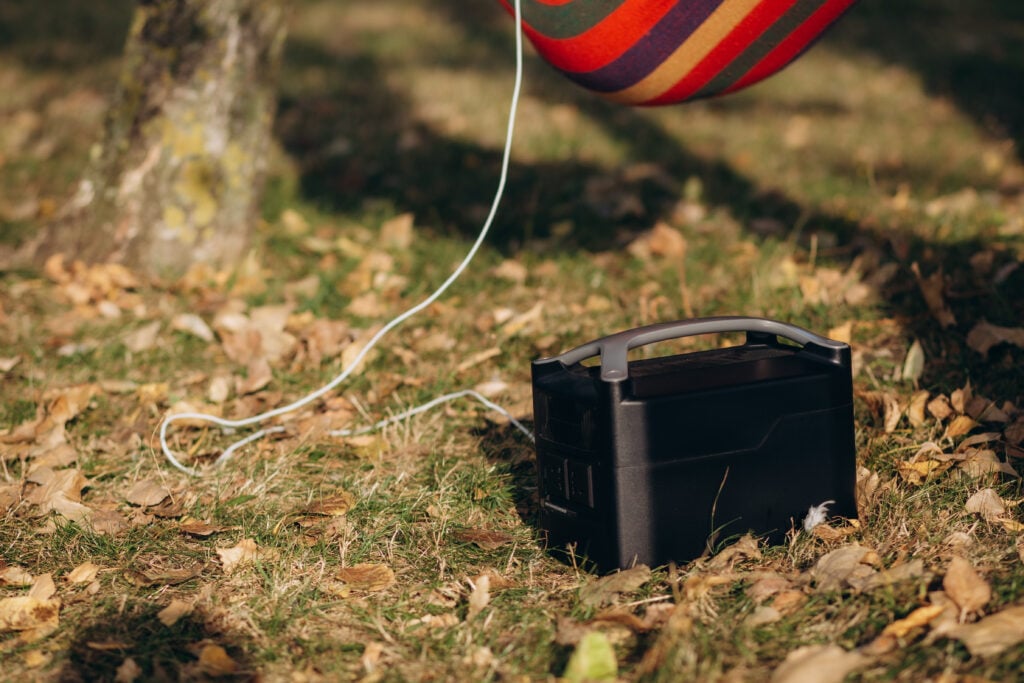
When the power station rides on your back, every ounce is real money. The load is small — phones, a headlamp, maybe a camera or drone battery — and the entire buying decision collapses to a single question: what is the lightest unit that actually covers two nights of device charging? AC output, expandability, solar throughput — none of it matters here.
The Elite 10 is in a different weight class than everything else eligible here — at 3.97 lb it is roughly half the weight of the next lightest option. For this buyer, that gap ends the conversation before it starts. What the review confirms is that the capacity actually holds up for the job: five to ten full phone charges per fill, steady output on USB and DC ports for lights and a 12V fan, and drone batteries topped up — all in a unit that fits in a coat pocket and carries one-handed. The built-in LED with three modes is a genuine camp tool, not a checkbox feature, according to owners. And the 128 Wh capacity sits inside the FAA 100–160 Wh carry-on window — the only unit on this page that flies with you.
The ~70-minute Turbo wall recharge is confirmed in the field, but it requires enabling Turbo mode in the app before you leave home. One practical note: charge devices over USB or DC, not the AC outlet. Running AC on a battery this small wakes the fan and burns inverter idle watts against a tank that does not have them to spare. The 3-year warranty is shorter than the 5-year coverage on every other pick here — on a unit used for occasional single trips, that is a light concern, but it is a real one.
Skip it if: you are carrying more than a phone and lights and expect two full nights of use — the EcoFlow RIVER 3 doubles the energy at double the weight and holds the same price.
At 7.8 lb and $199 it costs the same and delivers nearly twice the usable energy — independent testing measured 213 Wh delivered, roughly 86% of nameplate, which is strong for the class, and the 30 dB quiet claim held up in testing, with one owner sleeping next to it running in a bedroom. Its IP54-rated battery pack handles rain and dew that would give a lighter unit pause. Take it if you can live with the extra weight and want a genuine multi-night buffer with margin left over.
The 288 Wh nameplate is the most capacity per pound in this set, and the 5-year warranty is the best coverage here. It earned a strong review recommendation for exactly this device-charging job. One important caveat: nearly all of its performance figures — cycle life, recharge times, runtimes — trace to Jackery’s published specifications rather than independent bench measurements of this unit. That unverified delivery record is what keeps it below the bench-confirmed RIVER 3. Worth considering if availability or pricing shifts the math.
One unit worth addressing directly: the Bluetti AC2P is priced at $129 and weighs 7.9 lb — attractive on both counts. It does not make the page because its review documents a persistent, unresolved power-on failure pattern (E113/E116 errors after idle storage or a power event) across markets and conditions, with support defaulting to troubleshooting steps rather than fixes. A unit that might refuse to start in the field is not a camping unit. That failure pattern travels with it until the record changes.
The defining load for this segment is a 12V cooler running continuously on the DC port — not a brief AC draw, but a constant, low-watt pull that runs all weekend. Add two people’s phones, lights, and a laptop, and you need a unit with real energy at DC-dominant loads, a carry weight that does not punish you on the hike to the site, and a DC port you can trust over three days.
Before the picks: the Bluetti AC70 has a widely-cited ‘450–500 Wh usable’ figure that often appears in weekend-camping comparisons. That figure comes from low-load AC testing — the worst possible regime for efficiency, where the inverter’s idle draw is proportionally enormous. Running a cooler off the DC port at this segment’s actual load, the AC70 delivers roughly 650–700 Wh. Any ranking that uses the 450 Wh number for this job is measuring the wrong thing. The 600 Plus still wins here — but on weight and confirmed runtime, not on a misleading capacity comparison.
It is the lightest eligible unit for this job — 16.1 lb against the AC70’s 22.5 lb, a 6.4 lb difference that is real every time the unit moves between car and campsite. The review confirms the scenario directly: owners call it the ‘sweet spot’ for a couple of camping days, a three-day trip ended with 25% battery remaining, and a two-night trip ended at 80%. A CPAP ran at least two nights per charge off the 12V DC port — the same efficiency path the cooler uses. The wall recharge genuinely lands around 1.5 hours with the cable plugging straight into the outlet, no external brick. Usable energy at this DC-dominant load is approximately 540–560 Wh, derived from the DC asymptote and consistent with those trip reports.
There are three things to sort before the trip. The cooling fan can ramp audibly under thermal stress — one owner was woken around 5.5 hours in; keeping the cooler on DC rather than AC reduces heat and noise. The DC8020 charging connector is not backward-compatible with older Jackery DC7909 car and solar cables — if you have older Jackery panels or a car adapter, get the adapter before you leave. And outputs left enabled with no load draw measurable standby power — one test confirmed it, mechanism corroborated — so switch outputs off when the unit is sitting idle.
Skip it if: you can handle 22.5 lb and want more solar input or a lower price — the Bluetti AC70 carries 500 W of solar intake and holds roughly 100–150 Wh more energy at this load, for $80 less.
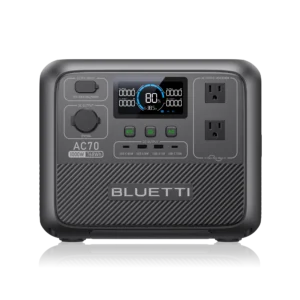
If you can carry 22.5 lb, the AC70 makes a strong case: $80 cheaper than the 600 Plus, approximately 100–150 Wh more usable energy at this DC-port load (650–700 Wh at this regime — not the 450 Wh low-load AC figure), the highest solar input of any unit on this half of the page at 500 W, and a bench-confirmed 80% Turbo recharge in about 45 minutes. The reason it is runner-up rather than winner is two-fold: the weight penalty is real at every carry, and the review documents a first-year failure cluster centered on the DC ports — E065 errors, acknowledged by Bluetti. The DC port is exactly where the cooler lives. The 5-year warranty is honored consistently, but a failed cooler port mid-trip is a spoiled-food problem, not a warranty problem.
The value play of this segment: independent testing measuring roughly 670 Wh usable on DC, with one careful owner running a 12V fridge for 57 hours on a single charge, and a price that gives the best dollars-per-watt-hour on this half of the page. Its review endorses the camper who keeps it in rotation. Two things hold it to a mention for a couple sleeping nearby: the fan is erratic and loud, with measured peaks around 61–62 dB, and it has a real self-discharge trait — roughly 40% per 24 hours with the inverter left on — that demands a discipline of powering it fully off and topping it up before every trip. An organized owner manages that easily; a casual user gets surprised. Also verify your specific 12V fridge connector: EcoFlow acknowledged a cigarette-socket compatibility issue with some models.
Two units were reviewed and set aside at the spec level. The Bluetti AC50B‘s review documents a design behavior where AC output will not auto-resume after a solar wake from full drain — for an overnight cooler left running, a brief drain-and-recover event silently leaves the cooler off. The Jackery Explorer 500 uses legacy lithium-ion chemistry with a 7.5-hour AC recharge; it is outclassed by everything else in this segment on every meaningful axis.
The family camp load has two distinct demands: a fridge running continuously in the background, and a kettle or induction burner drawing hard in the morning. Four finalists at roughly 1 kWh, all LiFePO4, all within 3.5 lb and 500 W of one another, and all delivering approximately 850–940 Wh usable at a family’s real load. The specs are nearly identical — so the actual decision comes down to the two axes where the field genuinely separates: how fast the sun refills it, and what it costs.
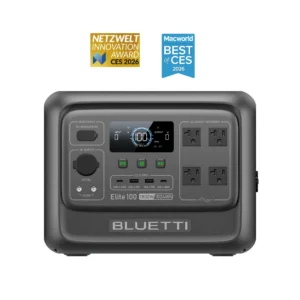
Among four near-identical spec sheets, the Elite 100 V2 holds both tie-breaking axes outright. Its 1,000 W solar ceiling is in a different class from every rival here — a 1:1 solar-to-capacity ratio means one good sun window can refill a full day of cooking and fridge spend. And at $399 it is the cheapest unit in this tier. Independent bench testing confirms the usable figures: 869 Wh over DC, 880 Wh at the wall, and approximately 910 Wh extracted under a 1,200 W load — 85–89% of nameplate at exactly the loads a family camp runs. The 1,800 W inverter held its rating without throttling under an air fryer, a coffee machine, and toaster-plus-kettle combinations, so your morning kettle is covered with headroom.
Two setup steps are mandatory before trusting this unit overnight. ECO mode ships enabled by default, and its inactivity shutdown will cut AC output during the low-draw idle periods that an overnight camp fridge looks exactly like — disable it before the first trip. The high-current PV mode is also off by default; without it, solar input caps near 130 W regardless of panel capacity. Enable it in the app at home. The full 1,000 W solar input requires panels wired to 48–60 V; at 24 V it pulls around 460 W — still well ahead of any rival, but plan the array accordingly. Above 1,800 W the Power Lifting mode handles resistive loads only — it will not start reactive motor loads like window-AC compressors, only cooking appliances. Finally, the review documents a real early-failure cluster — DOA and failures in the first six months — and Bluetti honors the 5-year warranty, but buy with a clean return path in hand.
Skip it if: your top-up source is a wall outlet or campground hookup rather than the sun — the Anker SOLIX C1000 Gen 2 recharges dead-to-full in about 47 minutes and runs more quietly under light loads, at the cost of a lower solar ceiling and a $101 premium.

The right pick if your top-up source is a wall outlet, campground hookup, or generator: dead-to-full in 47 minutes is the fastest recharge on this page and changes how you camp with it. It also carries 200 W more sustained output than the Elite 100 V2 — 1,600 W hair dryers and 1,700 W air fryers are owner-confirmed — and it is the quietest unit in this class under light loads, measured at 20 dB below 200 W. The solar ceiling is the reason it does not win: the 600 W input is hard to reach in practice, with common 11–28 V panels capping input near 200 W. Setup note: complete the initial Bluetooth pairing at home, or the outlets may not activate off-grid. SurgePad cannot be disabled and will trip some microwaves and motor loads.
The lightest 1 kWh box in this comparison at 23.8 lb, with a camping record that genuinely fits this segment — months of car camping with a 12V fridge, Starlink, and a laptop, reportedly never dropping below 60% with panel and vehicle top-ups. Three things hold it to a mention: usable AC energy lands near 900 Wh once conversion losses are accounted for, the 1,500 W ceiling is tight for a kettle morning (owner trip reports came in at 1,400–1,550 W, and bench shutoff was measured near 2,200 W despite the 3,000 W surge label), and the proprietary DC8020 solar connector makes third-party panels an adapter gamble.
The EcoFlow DELTA 3 Classic earned the best measured efficiency in this class — 940 Wh usable out of 1,024 Wh, held across a full discharge at 1,800 W. It does not make this segment because it deletes the 12V car port, forcing the camp fridge onto the AC path where inverter idle taxes run all night — and many 12V fridges simply cannot connect via AC. Its review also documents a default 2-hour inactivity timer that silently cut a camper’s load twice over a single weekend. Wrong feature set for a fridge-centric camp. It remains a strong option for wall-powered home backup — that is a different conversation entirely.
The unit parks. It does not move. The question for a group basecamp is simple and unforgiving: who can push the most watts into stacked loads, and how much of the nameplate actually reaches the cooking and cooling? Weight has almost no purchase here — it rides in a vehicle and gets lifted twice. What matters is sustained output and the efficiency of the inverter under the loads a group actually runs.
It leads on sustained output outright — 2,600 W, the highest in the eligible set — and the inverter efficiency behind that number is what separates it from same-nameplate rivals. Independent bench testing measured 96% AC inverter efficiency with approximately 9.5–10 W idle, the best conversion figures in the class. That efficiency advantage compounds across a full discharge: at the same full-size-fridge regime, owners report 22–30 hours per charge, against 14–22 hours for the runner-up — same capacity class, a wide real-world gap. Camp kitchen evidence is direct: kettles, microwaves, power tools, and a small window A/C all ran in owner testing, and camping owners consistently report leftover charge at the end of the trip. The 1,000 W solar input refills a hard day of cooking in one sun window. At 53.4 lb it is the heaviest unit on this page; in this segment, that barely registers.
Before leaving it unattended with an overnight fridge, disable ECO mode — one owner on a low-draw continuous load came close to a shutdown. The 16 dB noise figure applies to Silent mode at low loads only; Turbo charging runs around 45 dB, so recharge it before the group turns in, not during. Solar planning note: the 60 V input ceiling rules out series-wiring standard residential panels — target approximately 50–56 V VOC panels in parallel, which realistically peaks around 800 W in the field. The display reads VA rather than watts, so it will overstate draw on some loads. It is not expandable — for a stationary basecamp, size it correctly at purchase and that is a non-issue.
Skip it if: the group moves camp frequently or the unit needs to ferry between locations — the Anker SOLIX C2000 Gen 2 is 11.7 lb lighter, recharges in under 90 minutes on AC, and can double its capacity with an add-on battery pack.
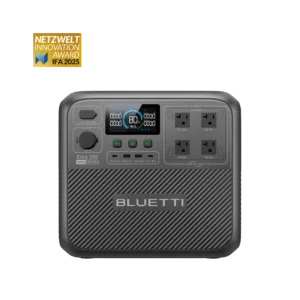
The right pick for two specific basecamp scenarios: the camp that grows (it is the only expandable unit here — a BP2000 battery pack doubles it to roughly 4,096 Wh) and the camp that moves the unit often (11.7 lb lighter than the Elite 200 V2, and the fastest big-battery recharge in this class at 80–90 minutes on AC, or 58 minutes with solar stacked). Surge handling is generous — a kettle drew 2,162 W in testing without complaint, and brief tolerance was measured near 6,000 W. Idle draw is class-competitive at 9–18 W. The TT-30R outlet is a useful addition for any RV-adjacent group. It loses the segment on the dominant axis: 200 W less sustained output, and meaningfully less delivered energy at the same fridge regime (14–22 h vs 22–30 h). Unattended-fridge setup: enable the Output Port Memory Switch and disable Smart AC Output Mode — both default to the wrong setting for a continuously-running cooler.
The cheapest 2 kWh box here at $749, the quietest rating of the three (25 dB at 600 W), and the only finalist with a firsthand overnight camp trip in its review — kettle, hot plate for two meals, and an electric blanket running all night, landing at 20–35% remaining. What holds it to a mention: the 500 W single-MPPT solar input is the weakest of the three, meaning a full refill on solar takes more than four hours under ideal sun — the binding constraint for a multi-day solar-fed camp. It is not expandable. For a group that recharges from a wall or generator and is watching the budget, it closes the gap quickly.
Two units came up against this segment and did not fit. The Jackery Explorer 2000 v2 is the right unit for a different buyer — the one person hauling the biggest battery they can carry, with the fastest wall recharge in its class. One owner test in stationary multi-load use saw two 1,100 W appliances combined trip it instantly at 2,200 W, and its 400 W proprietary-connector solar input is the weakest in the class. Its review is explicit: it is the portable 2 kWh, not the stationary one. Two other units — the EcoFlow DELTA 2 Max and the Bluetti Premium 200 V2 — did not receive a full review read and cannot be scored; they are excluded on that basis alone, not ruled unworthy.