When you purchase through links on our site, we may earn an affiliate commission. Learn more.

Bluetti Elite 300vsJackery HomePower 3000

These two 3kWh LiFePO4 portable power stations land within $50 of each other, share nearly identical usable capacity at the wall, and both run 120V only with no expansion. Capacity and price are a wash, so the decision rests on five measured differences: inverter strength, noise, the DC port suite, UPS switchover speed, and long-term charge retention. The winner flips based on which of those five matters most to your setup.

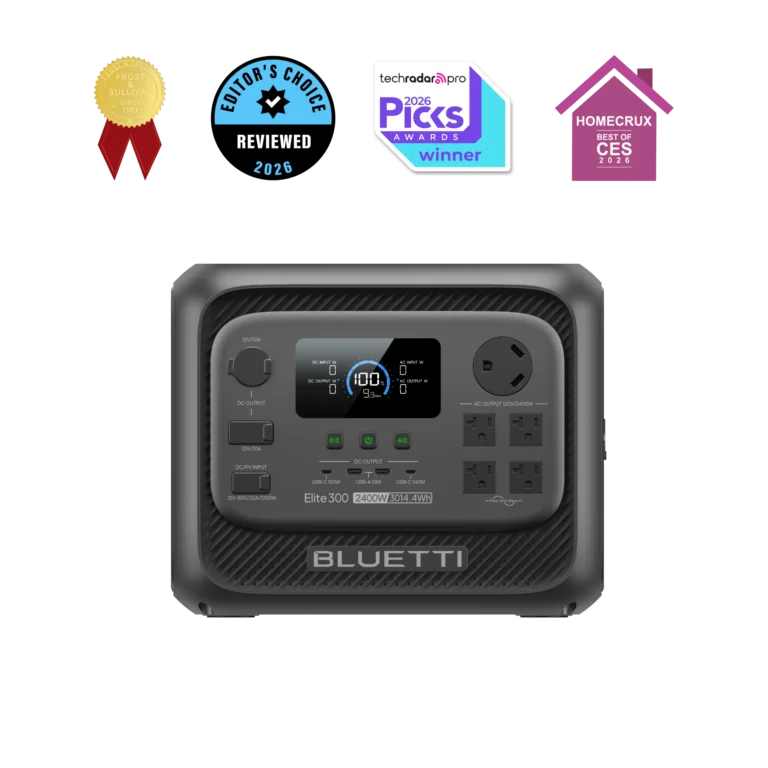
Bluetti Elite 300
$1,649 ($0.547/Wh)
Check price
Prices and availability change frequently
Jackery HomePower 3000
$1,699 ($0.553/Wh)
Check price
Prices and availability change frequently
Spec Bluetti Elite 300 Jackery HomePower 3000
Capacity 3,014.4 Wh 3,072 Wh
Rated output 2,400 W 3,600 W
Surge 4,800 W 7,200 W
Weight 57.98 lbs 59.52 lbs
Chemistry LiFePO4 (6,000 cycles to 80%, 5-yr warranty) LiFePO4 (4,000+ cycles to 70%, 5-yr warranty)
AC recharge time ~2h44m (US 15A circuit at 1,350–1,400 W; 1.7 hr spec requires app-unlocked 1,800 W on 20A circuit) ~2h15m at ~1,700 W wall-only
Solar input 1,200 W rated (~1,000–1,100 W real-world; 60V ceiling requires parallel wiring; standard MC4/XT60) 1,000 W (proprietary 8mm connectors)
AC outlets 4× 120V 20A, 1× NEMA TT-30 (30A RV) 4× 120V 20A (2,400 W combined), 1× NEMA TT-30 (30A, full 3,600 W)
DC ports 1× 12V/30A XT90, 1× cigarette 120W 1× cigarette 12V/10A
USB ports 2× USB-A 15W, 1× USB-C 100W, 1× USB-C 140W
UPS switchover 8.1–8.9 ms (measured) ~20 ms (rated)
Idle noise ~50–53 dB under load or Turbo charging 42 dB at idle
Price $1,649 ($0.547/Wh) $1,699 ($0.553/Wh)

Full 3,600 W available only on the 30A TT-30 outlet; the four standard 20A outlets share two breakers and cap at 2,400 W combined.

Heavy-appliance backup

$1,699 ($0.553/Wh)
Check price
  • For loads genuinely exceeding 2,400 W — microwave plus kettle, induction burner plus air fryer, or RV shore-level draw with simultaneous high-draw appliances — raw sustained inverter output is the deciding factor. The HomePower delivers a true 3,600 W rated output, tested at full power for 10 minutes with no voltage drop and sustained a ~3,400 W home-office-plus-heaters load.
  • The Elite 300 runs a 2,400 W inverter and hard-stops above roughly 2,450–2,800 W sustained; independent testing confirmed it could not start machinery drawing over ~26A. Its 4,800 W surge applies only to resistive loads via Power Lifting mode, which drops output voltage and cannot be credited as motor-start capability.
  • The HomePower’s full 3,600 W lives only on the 30A TT-30 outlet. Its four standard 20A outlets share two breakers and cap at 2,400 W combined — one owner tripped a breaker running two 1,500 W heaters on the same outlet pair. Route high-draw appliances through the 30A port or the advantage is lost.
  • Usable capacity at high load (2,000–3,600 W) is ~2,825 Wh at the wall, effectively matched to the Elite 300’s ~2,760–2,873 Wh — capacity is not the differentiator here.

Quiet overnight & bedside medical

$1,699 ($0.553/Wh)
Check price
  • For anyone sleeping in the same room as the unit — CPAP or medical-device users needing multi-night backup, or light sleepers running a fan and phone charger overnight — a unit too loud to sleep beside is disqualified regardless of other specs.
  • The HomePower is one of the quietest units in its class at 42 dB idle, with a reviewer noting you have to put your ear six inches from it near max load to hear it. Its review documents real CPAP runtime: 10+ nights with the humidifier off, 3–4 nights with it on.
  • The Elite 300 runs roughly 50–53 dB under load or Turbo charging, and one tester flatly stated he would not want it running near him while sleeping. Its ECO mode (default-on) can cause low-load shutoff, precisely the wrong behavior for a light, always-on bedside load like a CPAP.
  • The Elite 300 review is silent on actual CPAP runtime, so no like-for-like nights figure is available — but the noise issue plus the low-load shutoff risk demote it for this scenario. If you run a humidifier with the HomePower, size your expectation to the lower 3–4 night figure.

Van life, overland & solar-leaning off-grid

$1,649 ($0.547/Wh)
Check price
  • For mobile installations — van or overland builds with a diesel heater, 12V fridge, dual laptops, alternator charging while driving, and solar as the primary refill — the deciding hardware is a high-amp DC port and the smallest possible box in a space-constrained build.
  • The Elite 300 is the only one with a 12V/30A XT90 DC port, tested to hold 31.1A before overload, which runs diesel heaters (they spike well past the usual 10A limit), DC fridges, and multiple DC loads directly, bypassing wasteful conversion. DC loads also dodge inverter idle losses, so DC-side usable energy sits near 93–95%. Its dual USB-C (140 W measured at 132 W, plus a 100 W port) runs two laptops at full speed simultaneously.
  • It is the most compact 3kWh portable made — certified as the world’s smallest 3 kWh portable — measured 20–30% smaller than rivals, and the lighter of the two at 57.98 lbs, which is the difference between fitting a van electrical bay and not.
  • On the solar side it offers a higher 1,200 W rated ceiling (~1,000–1,100 W realistic) with standard MC4/XT60 connectors, versus the HomePower’s lower 1,000 W ceiling and proprietary 8mm connectors that effectively lock you into Jackery SolarSaga panels. The HomePower review also flags daily lockups during variable morning solar input — a real strike against a solar-primary off-grid plan.
  • The Elite 300’s solar input is capped at 60V by a hard voltage ceiling. Series arrays will overrun it — you must wire panels in parallel and check open-circuit voltage before buying. Plan around a realistic ~1,000–1,100 W peak with low-voltage, parallel-wired panels. Neither solar nor car cables are in the box on either unit.
  • The HomePower can still do RV/van duty via its TT-30 outlet — it just lacks the high-amp DC port, uses proprietary solar connectors, has the lower solar ceiling, and is slightly heavier. For a DC-heavy mobile build, those add up to second place.
  • Usable capacity on DC loads bypassing the inverter is ~2,800–2,860 Wh (≈93–95%), the Elite 300’s strongest regime. The HomePower’s only DC path is the 12V/10A cigarette port — far too limited for this build.

Sensitive electronics that can't tolerate a reboot

$1,649 ($0.547/Wh)
Check price
  • For a desktop PC, gaming rig, NAS, or workstation on UPS duty — a load that will crash or corrupt if power blinks during a grid-to-battery handoff — the single deciding number is switchover time. A typical ATX power supply rides through roughly 16 ms; anything slower risks a hard reboot.
  • The Elite 300’s UPS switchover was independently measured at 8.1–8.9 ms — comfortably under the ride-through window — and its review confirms a desktop PC running a graphics benchmark survived the cutover intact.
  • The HomePower’s switchover is rated around 20 ms, which sits right at or just past the edge of what a desktop PSU tolerates — fine for a fridge or router, dicey for a PC mid-write. It also carries scattered reports of random AC cutoffs and error codes (some firmware-related, and firmware is not pushed automatically), a second reason to be cautious about trusting it with reboot-sensitive gear.
  • Run the Elite 300 with ECO mode off for this duty — its default-on ECO mode can drop very light always-on loads, and a sleeping NAS or idle PC is exactly the kind of light load that triggers it. With ECO off, expect ~19 W/hr of inverter idle draw — a fair trade for a clean, fast, reliable handoff.
  • Usable capacity at mid load is near-identical for both (~2,800 Wh at the wall) — capacity is not deciding this; switchover speed is.

Set-and-forget closet emergency backup

$1,699 ($0.553/Wh)
Check price
  • For the homeowner in an outage-prone area who charges a unit, stores it in a closet, and expects it to come alive and run the fridge, Wi-Fi, and lights for a day or two when the grid drops — months or a year later — the decision comes down to which unit’s review actually confirms long-term charge retention and unattended reliability versus which is merely strong but unproven on them.
  • The HomePower is purpose-built for this and its review confirms the deciding axis directly: it holds roughly 95% charge after 12 months of storage, and reviewers explicitly frame it as a credible buy-and-forget emergency unit (charge it, store it, forget it). Its sub-20 ms UPS is plenty fast for a fridge-and-router load, and wall recharge is the quicker of the two at ~2h15m.
  • The HomePower carries an honest asterisk for unattended duty specifically — the scattered AC-cutoff and error-code reports, with a manual-only firmware path, cut against set and forget. The Elite 300 answers several of those concerns: it is $50 cheaper, posts the best usable efficiency in the class, has the faster and cleaner 8–9 ms UPS, draws under 4 W at DC idle (enabling roughly month-long standby), and earns consistently praised build quality. What holds it to runner-up is that its review is silent on 12-month retention (the spec was not recorded), and it actively flags two things that bite this scenario — fan noise when it kicks on, and the ECO-mode low-load shutoff.
  • Honest read: If you will verify firmware and test AC output under load within the return window, the HomePower is the buy-and-forget unit it is built to be. If you would rather have the cheaper, more efficient, faster-switching box and you are willing to accept an unproven long-term-retention figure and a louder kick-in, the Elite 300 is a legitimate alternative — this is the closest call on the page.
  • Usable capacity at fridge + router cycling mid load (~150–400 W) is ~2,800 Wh effective at the wall for both — a true tie, which is why the verdict rests on retention and reliability, not capacity.
The bottom line

Both units carry the same energy at nearly the same price, so the pick depends on which measured difference matters most to your setup. The HomePower 3000 wins when you need real output (3,600 W sustained), near-silence (42 dB idle, tested multi-night CPAP runtime), or trustworthy long-term storage (95% charge after 12 months). The Elite 300 wins when you need direct high-amp DC (12V/30A XT90 for diesel heaters and DC fridges), the smallest and lightest box (certified world’s smallest 3 kWh portable at 57.98 lbs), flexible standard-connector solar (MC4/XT60, 1,200 W rated ceiling), or the fastest UPS handoff (8.1–8.9 ms measured, safe for desktop PCs). Neither does 240V and neither expands — if you need either, both are the wrong purchase.