When you purchase through links on our site, we may earn an affiliate commission. Learn more.

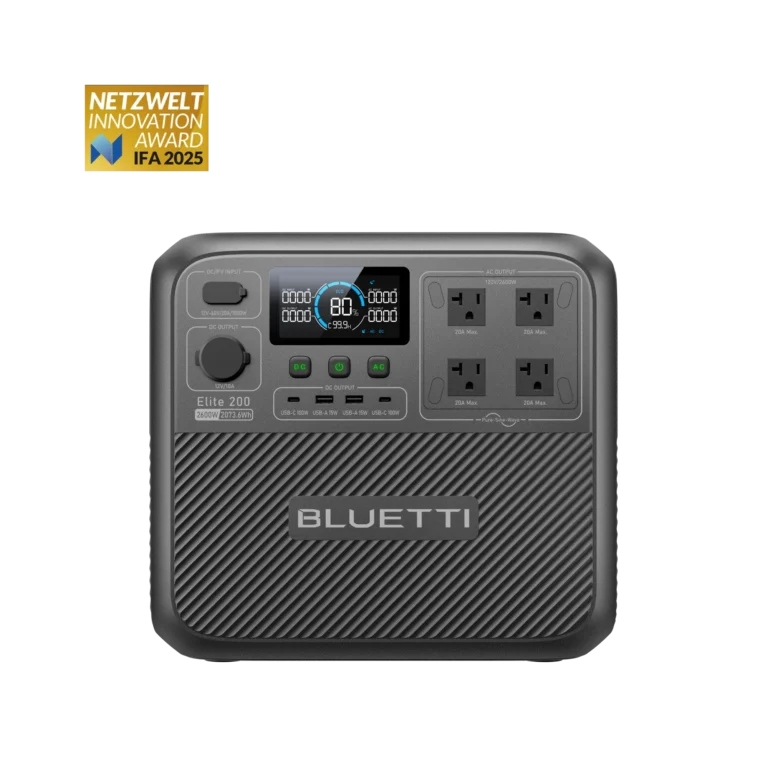
Bluetti Elite 200 V2vsAnker SOLIX F2000 (2026)

These are the closest spec twins in the 2kWh class. Both are $799, both deliver around 2,050 Wh from LiFePO4 cells, both are 120V-only (no 240V split-phase), both support UPS operation, both rate 1,000W solar input, and both carry 5-year warranties. On paper there is almost nothing to choose between them. The decision therefore comes down to how each one behaves in practice and on two or three hard capability differences the spec sheet hides. This page resolves the 2kWh buyer population into five real situations and names which unit wins each — and why.

Check price
Prices and availability change frequently
Check price
Prices and availability change frequently
Spec Bluetti Elite 200 V2 Anker SOLIX F2000
Price $799 $799
Capacity 2,073.6 Wh 2,048 Wh
Rated output 2,600W 2,400W
Surge output 3,900W* 2,800W**
Weight 53.4 lb 67.2 lb
Portability No wheels Integrated wheels + telescoping handle
Chemistry LiFePO4, rated 6,000 cycles to 80% LiFePO4, rated 3,000 cycles to 80%
AC recharge time ~1.5 hr full / ~1 hr to 80% Under 2 hr full / under 1 hr to 80%
Solar recharge time ~2.4 hr at rated input Not published
AC outlets 4× 120V 4× NEMA 5-20 + 1× NEMA TT-30 (RV)
USB-C 2× 100W 3× 100W
USB-A 2× 15W 2× 12W
12V car ports 1× 12V/10A 2× 12V/10A
Solar input 1,000W max (60V ceiling) 1,000W max (11–60V MPPT, 20A cap above 32V)
UPS switchover 15ms 20ms
Expandability None Up to 4,608 Wh with BP2600
Price per Wh $0.39/Wh $0.39/Wh

*Resistive Power Lifting mode only, not motor-start headroom. **Does not reliably start motor loads; documented to collapse on window A/C, 20A welder, and circular/miter saws. A blank spec means we did not record that figure in our research, not that the feature is absent.

Set-and-forget emergency home backup

  • Who it’s for: You buy it as insurance. It gets charged once, stored, and is expected to be ready months later when a storm takes the grid down — running a fridge, internet, and possibly medical gear.
  • Why the Elite wins: The F2000 has a disqualifying failure for this exact role. Our review documents an owner whose unit drained from 100% to 0% over 3–4 months of standby — during the very fire/wind outage it was bought for. Anker’s onboarding doesn’t warn buyers, and the only mitigation is a monthly calendar reminder to top it off. A unit you have to babysit is not set-and-forget. The Elite 200 V2 is built for dormancy by comparison. Independent bench testing measured ~9.5–10W idle draw with the inverter on and no load, and 96% AC inverter efficiency — low enough that owners leave it running for days without meaningful drain. The 15ms UPS switchover bridges grid drops cleanly for desktops, modems, routers, and servers. At a fridge-class load of roughly 100–150W on the AC inverter, usable energy sits near the high end of the curve; our review reports a full-size refrigerator running ~22–30 hours on a charge.
  • Why the F2000 loses here but wins elsewhere: The single flipping axis is standby retention. Cycle it regularly and the drain never bites. Leave it dormant and it defeats the entire purpose.
  • Mandatory setup step for critical low-watt loads: The Elite’s ECO mode ships on and will auto-shut the inverter at very low AC draws — it nearly killed an owner’s reptile life-support setup. If you’re backing up an always-on low-wattage device (CPAP, medical monitor, network), disable ECO mode in the app first.

RV & travel-trailer

  • Who it’s for: The unit lives in or travels with an RV or travel trailer, supplementing shore power and running trailer appliances on the road. Mobility is rides in a vehicle and gets rolled around; the load profile is RV-appliance.
  • Why the F2000 wins: The F2000 has the one port the Elite simply doesn’t: a dedicated NEMA TT-30 RV outlet. Owners plug travel trailers in directly and run lights, microwave, and trailer circuits through it — no adapters, no improvising. The Elite 200 V2’s port array is standard 120V household outlets only; there is no TT-30 on it. For a trailer buyer that is a hard connectivity gate. The chassis seals it. The F2000 carries integrated 4.72-inch wheels and a telescoping EasyTow handle, and owners repeatedly call it the deciding factor — as easy to transport as airport luggage. At 67.2 lb that matters; the Elite’s 53.4 lb is lighter to lift but has no wheels, so moving it in and out of a trailer is a two-hand carry every time.
  • Why the Elite loses here but wins elsewhere: The flipping axes are RV connectivity and rolling portability — neither of which the Elite offers. Take the same Elite into a closet and it wins outright.
  • The honest envelope — do not buy it to run rooftop A/C: Our review shows an 8,000 BTU window A/C ramping to 1,900W then collapsing to 90W and failing; high-inrush rooftop A/C startup is exactly the load it can’t sustain. And note two more RV-specific quirks: AC and solar charging cannot run simultaneously (AC is prioritized), and pass-through is capped at 1,440W — so summing loads near 2,400W while plugged into shore power will hit a ceiling the marketing doesn’t mention. Buy it for trailer hookup, resistive loads, and quiet camp power, not for cooling the rig.

Daily-cycled home-office UPS & sensitive electronics

  • Who it’s for: It sits under a desk and works every day — bridging brownouts for a computer, monitors, network gear, and a NAS, and getting cycled regularly. Duty cycle is daily for years; criticality is moderate-to-high.
  • Why the Elite wins: For something cycled daily, battery longevity is the axis that compounds. The Elite is rated 6,000 cycles to 80% versus the F2000’s 3,000 — a clean 2× endurance margin from the spec sheet, and the single biggest reason to prefer it for a heavy daily duty cycle. Its 96% inverter efficiency and ~10W idle mean more of every charge reaches the load and standby waste is trivial — our review calls this efficiency the reason its runtimes hold up in the real world. On UPS quality the Elite is also the cleaner choice, though by a smaller margin. Its 15ms switchover is validated in our review to keep enterprise home-lab gear, desktops, and networking up through repeated grid drops with no reboots — with one honest caveat: an owner found 15ms too slow for one specific PC power supply, so treat it as works for the vast majority, not guaranteed for every sensitive PSU. At a typical desk-plus-network load (~150–400W AC), both units deliver ~85–90% of nameplate, so effective energy is near-identical.
  • Why the F2000 is only runner-up here: The F2000’s 20ms switchover sits closer to the edge, and our review documents more reboot cases on the wrong devices — a Samsung Family Hub fridge screen, routers, and cable modems have rebooted on switchover. It’s a perfectly capable daily UPS if you already own it — it just trades away half the rated cycle life and runs a touch closer to the switchover edge.
  • Setup note: Disable the Elite’s default-on ECO mode so it doesn’t shut off under a light idle network load, and run one calibration cycle so the SOC gauge reports accurately.

Growable off-grid (capacity will increase)

  • Who it’s for: 2kWh covers today’s needs, but the plan is to add battery later — a longer off-grid stay, a bigger load list, a cabin that grows. The weighted axis is expandability, and it’s a hard capability question.
  • Why the F2000 wins: The F2000 is expandable to 4,608 Wh with the BP2600 battery (or 4,096 Wh with the BP2000). The Elite 200 V2 is a sealed, fixed 2,073.6 Wh unit with no expansion support whatsoever — our review calls this a one-way wall and the central reason it’s a conditional rather than unconditional buy. This is a hardware gate: no firmware update or clever wiring turns a non-expandable unit into an expandable one, so the Elite cannot win this segment regardless of how well it otherwise performs. Our review confirms the payoff — a fridge stretches past 48 hours with the expansion battery attached. For continuous off-grid loads in the mid-to-high regime, both base units deliver ~85–90% of nameplate; the difference this buyer cares about is the ceiling, and only the F2000 raises it (to ~3,900–4,150 Wh usable at the expanded 4,608 Wh nameplate).
  • Why the Elite loses here but wins elsewhere: The flipping axis is expandability — the only segment where the Elite’s fixed-capacity design is disqualifying rather than an efficiency advantage.
  • Realistic solar caveat for off-grid buyers: Both units rate 1,000W solar but neither hits it easily with third-party panels. The F2000’s 11–60V MPPT caps current at 20A above 32V, so owners typically land ~650–800W in practice (the full 1,000W needs a specific config such as five Anker 200W panels). The Elite’s 60V input ceiling forces parallel wiring, rules out standard residential panels in series, and yields ~800W peak flat-mount in real conditions — with multiple owners (some misadvised by support) buying panels they couldn’t use as intended. Plan solar carefully for either; this is category-typical for low-voltage MPPTs, not a unique flaw.

Weekend car-camping

  • Who it’s for: Weekends in the truck or at a campsite — lights, phone charging, a 12V cooler, occasional cooking — then back in the garage until next time. Mobility is carried to site; loads are light and intermittent; the unit sits idle between trips.
  • Why the Elite wins (close): Two tiebreakers tilt it. First, carry weight: 53.4 lb versus 67.2 lb. Campsite ground is uneven, so the F2000’s wheels do little there — you’re lifting it into and out of the vehicle, and the Elite is ~14 lb lighter to lift, with a more compact footprint that tucks into a truck bed or RV corner. Second, storage between trips: a unit that sits for weeks benefits from the Elite’s low idle and fixable standby behavior, where the F2000 would want a top-off before each trip. Both are near-silent at light camp loads — the Elite’s 16dB figure applies only to Silent mode at low load (its fan ramps to ~45dB under Turbo charging), and the F2000 measures ~43dB charging and is silent at light output — so noise is effectively a wash and doesn’t break the tie. The 12V cooler runs on the DC port, bypassing the inverter entirely, so it sees no idle tax. A light weekend (cooler + lights + devices) leaves both with comfortable margin from ~2,050 Wh; capacity is not the deciding factor.
  • Runner-up: Anker SOLIX F2000 — and a legitimate one if your camping is pavement-and-tailgate rather than backcountry (the wheels then earn their keep), if you use it often enough that standby never matters, or if you want the option to bolt on expansion for bigger car-camping loads later.

True of both units — Neither unit starts high-inrush motor loads reliably. The Elite’s 3,900W figure is Bluetti’s Power Lifting mode — a resistive-load voltage-drop trick for kettles, heaters, and hair dryers, not motor-start headroom. The F2000’s 2,800W surge is documented in our review to collapse on a window A/C, a 20A welder, and circular/miter saws. Treat both as resistive-load stations. Neither is a whole-home unit; both are 120V single-phase only.

The bottom line

Spec-for-spec and dollar-for-dollar these are twins, so buy for behavior, not the data sheet. Buy the Bluetti Elite 200 V2 if it will sit as emergency insurance (Segment 1), run sensitive electronics daily (Segment 3), or get carried to weekend camps (Segment 5) — its low idle, 96% efficiency, 6,000-cycle battery, and 15ms UPS win the dormant, daily, and carried roles. Buy the Anker SOLIX F2000 if it lives with an RV (Segment 2: the TT-30 outlet and wheels are decisive) or if you’ll grow past 2kWh (Segment 4: it’s the only one of the two that expands) — just keep it cycled or set a monthly top-off reminder so its standby drain never catches you out. If your real need is 240V appliances, a well pump, or whole-home circuits via a transfer switch, neither of these qualifies — both are 120V single-phase only.