When you purchase through links on our site, we may earn an affiliate commission. Learn more.

Bluetti Elite 30 V2vsEcoFlow RIVER 3 Plus (2026)

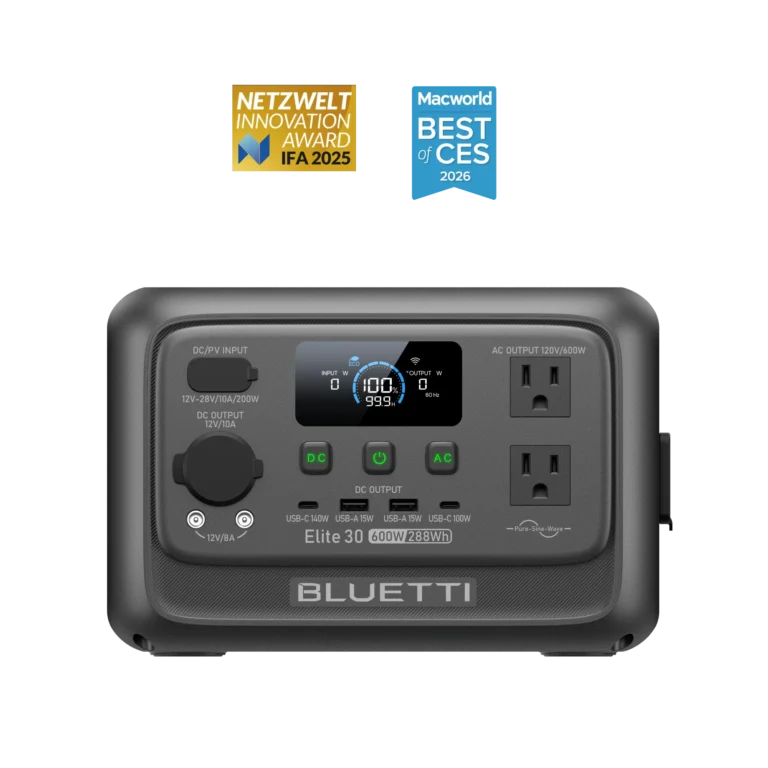
The Bluetti Elite 30 V2 and the EcoFlow RIVER 3 Plus are near-identical on paper — both around 288Wh, both 600W, both LiFePO4, both rated for 10ms UPS switchover, both 5-year warranty. The specification tie means the decision comes down to real-world behavior documented in independent reviews, and the right unit changes completely depending on your use case. There is no single winner across all buyers.

Check price
Prices and availability change frequently
Check price
Prices and availability change frequently
Spec Bluetti Elite 30 V2 EcoFlow RIVER 3 Plus
Capacity 288Wh 286Wh
Continuous Output 600W 600W
Surge 1500W1 1200W1
Weight 9.48 lb 10.4 lb
Battery Type LiFePO4 LiFePO4
AC Recharge Time ~1.17 hr (70 min, 380W) ~1.0 hr (375W)
Solar Recharge Time ~2.2 hr @ 200W ~1.5 hr @ 220W
AC Outlets 2×, 120V 3×, 120V (2 rear-mounted)
USB-C 1× 140W, 1× 100W 1× 100W
USB-A 2× 15W 2× 12W
12V Car Outlet 1× 10A
DC Barrel Ports 2× 12V/5A
Solar Input Max 200W 220W
Expandable No Yes, to 858Wh
Price $199 $269
Price per Wh $0.69 $0.94

1 Surge ratings use voltage-drop mechanisms (Power Lifting and X-Boost) that work only with resistive loads and fail on motors, compressors, and high-inrush devices — not true power ceilings. Both units should be treated as 600W for load planning.

Always-on home network / electronics UPS

  • Who it’s for: Stationary wall-powered operation running 24/7 to guard a router, modem, NAS, or desktop drawing well under 300W, where the wall may go down but the gear must never notice.
  • Sub-10ms switchover holds in practice: Independent testing and owner reports confirm computers and network equipment ride through outages with no reboot on the rated 10ms switchover.
  • No eco-mode shutoff trap at trickle loads: Unlike the Elite 30 V2, which shuts off under very small loads like a bare router when eco mode is enabled, the RIVER 3 Plus handles low-power network equipment reliably without eco-related cutoffs.
  • Runtime: Approximately 10 hours on a router and modem drawing 20–40W, or about 1.5 hours on a NAS with network stack drawing around 150W. Usable capacity for this AC regime is roughly 240–260Wh.
  • Quiet under sustained load: Independent reviews report the unit is barely audible even at continuous 600W operation, making it suitable for living spaces.
  • Why the Elite 30 V2 is demoted here: Its eco mode — the only practical solution to its 11–19W idle overhead — shuts the unit off under the very small loads a bare router presents, creating a structural mismatch for trickle-power UPS duty. With eco mode disabled, the inverter idle burns significant power on top of the load. This is precisely the failure mode for router backup use.
  • Catch: Independent reviews document a recurring chemical or plastic odor during charging that several owners found objectionable enough to return the unit, with replacement units sometimes exhibiting the same smell. For a device running 24/7 in a bedroom or office, this odor may be a dealbreaker despite the unit’s technical advantages.

CPAP / bedside medical backup

  • Who it’s for: Sits on the nightstand overnight to keep a CPAP machine alive through power outages, where pure-sine output and a full night of runtime headroom are hard requirements and medical criticality demands review-documented reliability.
  • DC-port runtime is the headline: Running a CPAP off the 12V DC port via a converter, owners report 30-plus hours of operation — roughly eight times the AC figure — because the DC path bypasses inverter idle entirely. Usable capacity over DC is approximately 274Wh (about 95% of nameplate). On AC with humidifier and heated tube active, runtime drops to around 6 hours.
  • Quiet at light loads: Independent reviews describe the unit as whisper-quiet when powering low-draw devices like a CPAP — you will forget it is running.
  • Pure-sine and cheaper: Clears the medical-grade pure-sine requirement at $199, $70 less than the RIVER 3 Plus.
  • Why the RIVER 3 Plus is demoted here: Despite being spec-competitive for CPAP runtime and quiet operation, independent reviews document a persistent chemical smell during charging and firmware edge cases where AC output cuts unexpectedly (during firmware updates and when solar charging tops the battery to 100%). For a medical-criticality nightstand device, these reliability concerns are disqualifying.
  • Catch: This win depends entirely on running the CPAP off the 12V DC port, not AC. On AC at typical CPAP draw, the 11–19W inverter idle dominates and runtime collapses to the 6-hour figure. If using the unit as a standby backup (idle until the outage), turn AC output off or enable eco mode, or idle drain can empty the battery before you need it. The DC-and-standby discipline is mandatory for the pick to hold.

Compact camping / van / road-trip power

  • Who it’s for: Carried to a vehicle or campsite for single-to-few-day trips, charging phones and laptops, running a 12V fridge, fans, or satellite internet. Solar and the car top it up between uses. Convenience matters more than criticality; weight, ports, and price carry the decision.
  • Lighter to carry: 9.48 lb versus 10.4 lb — a pound less in the pack or truck bed.
  • Far better device charging: Dual USB-C ports delivering 140W and 100W simultaneously (240W combined measured) versus the RIVER’s single 100W USB-C. The difference is fast-charging a laptop and phone at the same time versus queuing them.
  • Car charging in the box plus robust 12V output: Includes a car charger and offers a 12V/10A car outlet plus two DC barrel ports. Owners ran a 12V fridge for 33 hours on a charge and powered satellite internet, laptops, and fans across multi-day van trips on DC. Fast wall recharge tops it back up during drives.
  • Cheaper: $199 versus $269, saving $70.
  • Why the RIVER 3 Plus is demoted here: It is heavier by a pound, offers only a single USB-C port, has two of its three AC outlets rear-mounted (creating cable headaches in a tent), and costs $70 more. Its advantages — a built-in light and expandability — matter more for longer or growing trips (see expandability segment) than for compact weekend camping.
  • Catch: The Elite 30 V2 will not charge below 32°F. Discharge works fine to −4°F, but a cold-morning solar or car top-up fails, and one owner’s sub-freezing unheated storage deployment failed outright. For winter camping where you need to recharge in the cold, that single fact can flip this pick to the RIVER 3 Plus (which has a similar charge floor but no documented cold-charge failure and no eco-mode shutoff to manage). For three-season use, the Elite wins clearly.

Solar-fed, set-and-forget backup

  • Who it’s for: Stationary, unattended operation where a solar panel keeps the unit topped up indefinitely while it holds a small load alive — a remote camera, a cabin router, an off-grid sensor. Solar is the primary replenishment and nobody is managing it daily.
  • No documented solar-charging firmware defect: The Elite takes 200W solar input and recharges in approximately 2.2 hours of good sun, with no reports of the AC-cutoff behavior that disqualifies the RIVER 3 Plus for this segment.
  • Why the RIVER 3 Plus is vetoed here: Independent reviews document a firmware defect where AC output cuts off when solar charging tops the battery to 100%, and the unit can fail to wake to solar input at daybreak. EcoFlow has acknowledged the AC-shutoff issue across multiple firmware releases and has not fixed it — one owner observed it on all three units purchased. A solar-fed backup whose AC dies the moment the sun fully charges it is not a backup, defeating the entire premise of unattended operation.
  • Catch — this is a heavily qualified win, not a clean one: The Elite 30 V2 has its own problems that bite this exact use case. With AC on and eco mode off, 11–19W of inverter idle can empty the battery overnight under a tiny load. Eco mode fixes the idle drain but shuts off very small loads — the same trap as network UPS use. You must size the held load above the eco threshold or accept manual management. Additionally, the unit will not recharge below 32°F, so as an unattended winter solar backup in a cold climate it is effectively disqualified — it will discharge and then fail to refill on a cold morning. For a temperate-climate, set-and-forget solar load sized sensibly, the Elite is the pick because the RIVER’s defect is absolute and the Elite’s issues are manageable. For a cold-climate unattended solar backup, neither unit is reliable.

Small now, room to grow later

  • Who it’s for: Wants a compact unit today but needs a documented path to more capacity without replacing the entire system.
  • Expandable to 858Wh: Wire-free magnetic stacking to 572Wh with the EB300 or 858Wh with the EB600 battery pack. The Bluetti Elite 30 V2 is not expandable — its FAQ confirms no battery expansion, and the B80 power-bank mode charges the unit but does not extend runtime beyond 288Wh.
  • Why the Elite 30 V2 is absent here: It cannot expand, period. Only one unit clears the expandability requirement.
  • Catch — expansion economics collapse: At current EB300 and EB600 street prices, independent reviews note that buying a second RIVER 3 Plus gets you equivalent watt-hours plus a second inverter, and stepping up to a larger single unit in a different class gets you more capacity and far more output for similar total money. The expansion path only pays off in narrow cases, such as keeping the base unit light and portable most of the time while charging the battery pack separately. If you already know you will need around 850Wh, you should buy bigger now rather than buy this and expand it later. Expandability is a real differentiator and a weak value play at the same time.

True of both units — Neither unit is suitable for high-power appliances. The Elite 30 V2’s 1500W Power Lifting and the RIVER 3 Plus’s 1200W X-Boost are both voltage-drop mechanisms, not real power ceilings. They work only with resistive loads like incandescent lights and fail on motors, compressors, microwaves, hair dryers, space heaters, and air conditioners. Treat both as honest 600W units. If your load list includes any motor-driven or high-inrush appliance, neither of these is your unit — step up a full capacity tier.

The bottom line

The Bluetti Elite 30 V2 wins three segments: CPAP and bedside medical backup (on DC-port runtime margin and the absence of bedside odor or firmware reliability concerns), compact camping and van power (on lighter weight, dual high-wattage USB-C, included car charging, and lower price), and solar-fed set-and-forget backup (by elimination, because the RIVER’s unfixed solar-charging firmware defect is disqualifying, though the Elite’s own idle-drain and cold-charge limitations make this a qualified win). The EcoFlow RIVER 3 Plus wins two: always-on home network and electronics UPS (on the absence of a low-load eco-mode shutoff trap and purpose-built wired-AC switchover reliability) and expandability (as the only unit that can grow to 858Wh, though the expansion economics favor buying bigger upfront). The same hardware flips between winner and runner-up because the deciding axis changes per use case — DC versus AC regime, stationary versus portable duty, trickle-load behavior versus mid-range draw, firmware reliability under solar versus wired operation, and expandability as a gate versus a non-requirement. No single unit wins globally, and declaring one the overall winner would mislead two-thirds of readers.