When you purchase through links on our site, we may earn an affiliate commission. Learn more.

Bluetti Elite 100 V2vsBluetti AC180P (2026)

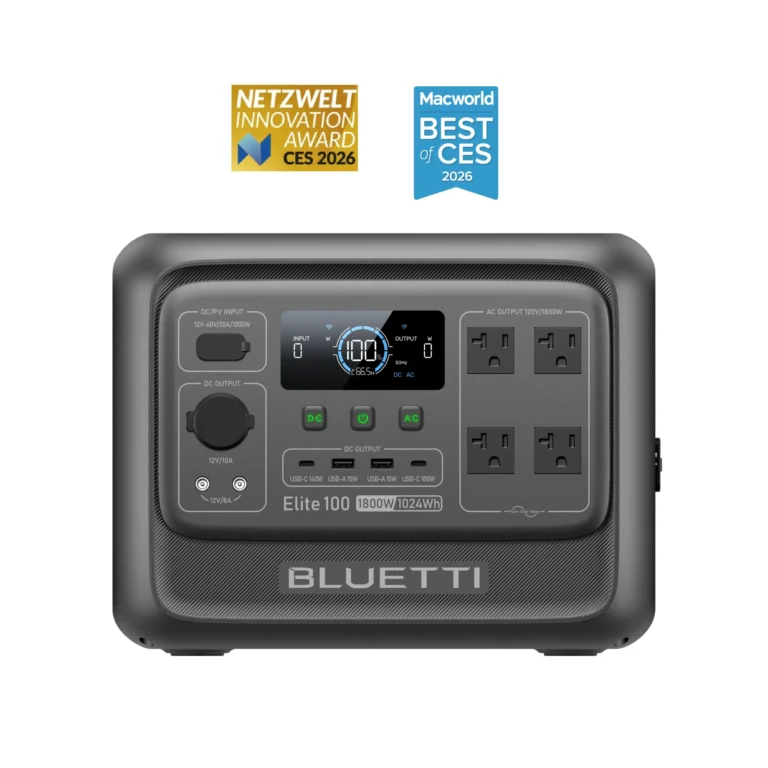
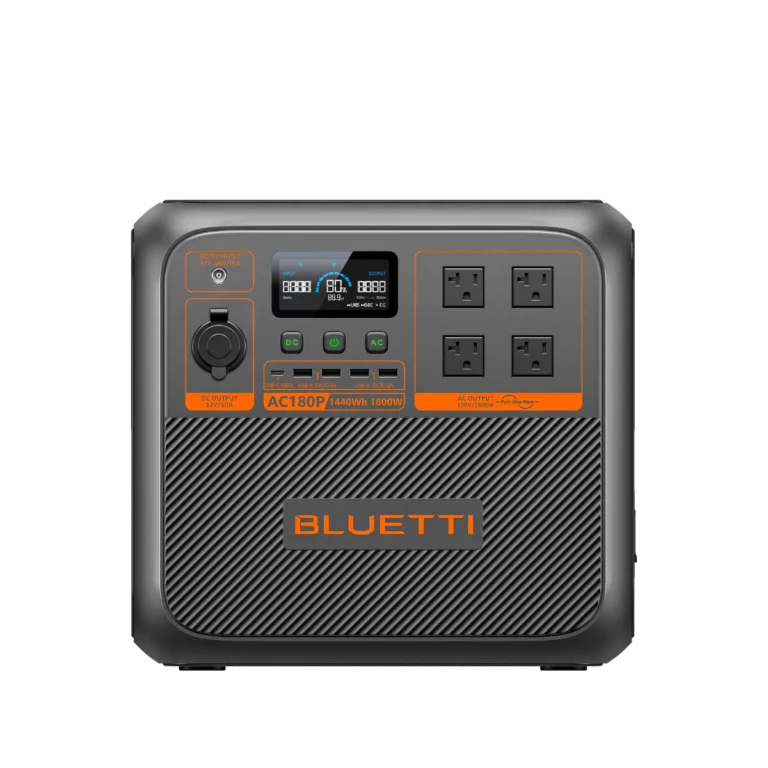
The Bluetti Elite 100 V2 and Bluetti AC180P share an 1,800W inverter and both sell for $400–500, but they’re built for opposite uses. The Elite trades battery for speed and portability — 1,024 Wh, 25 lbs, with 1,000W solar input that refills it in about an hour. The AC180P answers with 40% more capacity (1,440 Wh) at a lower cost per watt-hour, accepting the extra weight and slower recharge. Neither expands. Neither starts motor loads, despite the surge specs. The decision forks on whether you move the unit and recharge it daily, or park it and drain it for days with no way to refill.

Check price
Prices and availability change frequently
Check price
Prices and availability change frequently
Spec Bluetti Elite 100 V2 Bluetti AC180P
Capacity 1,024 Wh 1,440 Wh
Rated output 1,800W 1,800W
Surge 3,600W HyperVolt peak (2,700W Power Lifting, resistive-only — does not start motor loads) 2,700W (Power Lifting, resistive-only — does not start motor loads)
Weight 25 lbs 35.3 lbs
Chemistry LiFePO4 (4,000 cycles to 80%) LiFePO4 (3,500+ cycles)
AC recharge ~1.17 hr (≈45 min to 80%, Turbo) ~1.4 hr (≈45 min to 80%, Turbo, US-market)
Solar recharge ~1.17 hr (ideal sun at 48V+)* ~3.6 hr
Solar input 1,000W* 500W (real peaks ~250–485W; 10A / 12–60V)
Ports 11 (4× 120V/15A AC, 1× USB-C 100W, 1× USB-C 140W, 2× USB-A 15W, 1× 12V/10A car, 2× 12V/5A DC5521; WiFi + Bluetooth app) 11 (4× 120V AC, 1× USB-C 100W, 4× USB-A, 1× 12V/10A car, 1× 15W wireless pad; Bluetooth-only app)
Price $399 $499
Cost per watt-hour $0.39/Wh $0.347/Wh

Neither unit starts reactive motor loads (window AC, compressor freezer, sump or well pump on inrush). The Elite’s higher surge number is for resistive transients only; both are limited to resistive loads.
*The Elite’s 1,000W solar input requires panels wired at 48V or 60V (24V yields ~460W, 12V ~230W), and high-current PV mode must be enabled in the app to exceed ~130W of input. Without both conditions met, it charges no faster than the AC180P.
UK and Australian owners report Turbo charging capped at 280–830W; figures here reflect US-market performance.
Blank cells indicate our research did not record that specification, not that the feature is absent.

Move it constantly and recharge from solar or while driving

  • Who it’s for: Van life, overlanding, and camping with solar panels. The unit rides in a vehicle, gets carried one-handed to where it’s needed, runs a 12V fridge, cooktop, diesel heater, and devices, and gets topped up daily from a solar array or an alternator charger while driving. Weight and refill speed are felt every single day; the size of the battery matters less because the sun keeps refilling it.
  • Usable capacity: approximately 880–910 Wh under mid AC load (~200W, AC port, DC for fridge). Our testing measured ~880 Wh at the wall and ~910 Wh under a 1.2kW pull (85–89% of nameplate). That’s less than the AC180P’s approximately 1,150 Wh at the same regime, but the Elite refills that gap in about 1 hour of sun versus the AC180P’s roughly 3.6 hours.
  • Twice the solar input, ~1-hour refill: 1,000W (at 48V or higher panel voltage) versus 500W. A single sun window resets the unit mid-trip. This is the decisive axis for mobile use with solar.
  • About 10 lbs lighter, smaller, flat-topped: 25 lbs versus 35.3 lbs. One-handed carry and van-stackable, repeatedly cited by owners. Stows in a van garage without the bulk.
  • Alternator-charge path for unlimited off-grid: Pairs with optional Charger 1 or Charger 2 for drive-charging (full in roughly 1.8 hours while driving). The car cable is not included in the box; AC and solar cables only.
  • Dual USB-C including 140W: Charges a MacBook Pro at full speed. A concrete daily edge over the AC180P’s single 100W USB-C for a mobile-office setup.
  • The AC180P is the right call here only if your trips run long between recharges or you can’t carry solar, in which case its 40% larger battery is a real buffer and you accept the extra 10 lbs. The moment you have panels, the Elite’s refill speed makes its smaller battery a non-issue.
  • Setup required: The Elite’s win is conditional on realizing the 1,000W solar input. Panels must be wired at 48V or 60V (24V yields ~460W, 12V ~230W), and high-current PV mode must be enabled in the app to exceed ~130W of input. Wired wrong, it loses its headline advantage and the AC180P’s bigger battery starts to look better even here.

Park it and drain it for days with little or no recharge

  • Who it’s for: Boondocking or base camp with no solar (or not enough), cooking and running a fridge for days on a single charge. Here you can’t refill, so the only thing that matters is how much energy is in the box to begin with — and neither unit can add a battery.
  • Usable capacity: approximately 1,150 Wh under mid AC load (~300W, AC port). The Elite delivers approximately 880–910 Wh at the same regime. That’s roughly 240–270 Wh more real runtime per charge — about an extra third of a day before you’re dead, with no way to refill either unit. Decisive when recharge isn’t on the table.
  • 40% more battery, better value per watt-hour: 1,440 Wh versus 1,024 Wh at $0.347 versus $0.39 per watt-hour. More buffer and cheaper per unit of energy — the rare case where the bigger unit is also the better deal per watt-hour.
  • Neither expands — so capacity bought today is the ceiling forever: The Elite’s only add-on (B80, Power Bank Mode) doesn’t extend its 1,024 Wh, and the bundled B300K isn’t natively compatible. The AC180P’s larger fixed pack is the higher floor.
  • Runs the same appliances, longer: Identical 1,800W inverter, so the difference here is purely how many hours before empty — and the AC180P wins those hours.
  • Weight is nearly irrelevant: Parked at camp, the Elite’s 10-lb advantage stops paying for itself.
  • The Elite flips back to a strong pick the instant you can bring even a modest solar panel, because its 1,000W input refills the smaller battery fast. Strictly no recharge, the bigger battery wins.

Home or IT UPS for electronics you want to monitor remotely

  • Who it’s for: The unit sits plugged in, backing a networking rack, NAS, home office, or entertainment setup through outages — non-critical electronics where a clean, fast switchover and the ability to check status remotely are what you’re paying for. (Truly critical loads — sump pump, medical — are a different story; see the catch below.)
  • Usable capacity: approximately 880 Wh under ~200W continuous electronics (AC port). The AC180P delivers approximately 1,150 Wh at the same regime. The AC180P genuinely bridges longer here (roughly 5.7 hours versus roughly 4.4 hours at 200W); the Elite wins the segment anyway because continuity and remote control beat raw runtime for an IT UPS — the AC180P’s structural lockout can zero out its runtime advantage on a bad transition.
  • Faster, lockout-free switchover: Sub-10ms measured, validated by owners on racks and NAS, with no documented structural lockout. This is the deciding axis against the AC180P.
  • WiFi remote monitoring and auto-resume: Check and recover it from afar, with Power Memory Mode auto-resume after outages. The AC180P (Bluetooth-only) can’t be watched remotely.
  • Deep configurability: Custom state-of-charge ranges, multiple UPS modes, Time-of-Use scheduling — useful for an always-on home UPS and absent on the AC180P.
  • Required setup, stated plainly: Disable ECO mode and enable System Switch Recovery first. Out of the box neither unit is drop-in safe for loads that cycle low.
  • The AC180P is the pick only if maximum unattended bridging runtime outweighs everything and you’ll accept the lockout risk and no remote monitoring. Its 40% bigger battery holds the rack up longer when it doesn’t lock out.
  • The AC180P is demoted here because our research documents a structural lockout — on a messy grid transition it can report an AC short and kill output until you manually reset it, with no firmware fix — and it’s Bluetooth-only, so you can’t monitor or recover it remotely when you’re away.
  • Catch — critical or unattended loads (neither wins cleanly): For a sump pump, medical device, or anything where failure means damage, neither is drop-in safe. Both ship with ECO mode shutting AC off at low draw — the Elite has a documented case of this cutting outlets during a sump pump’s idle and causing a basement flood despite correct UPS mode. The AC180P adds its structural lockout; the Elite adds a recurring early-failure cluster (DOA or 1–6-month deaths, warranty-honored but with return friction) and meaningful self-discharge in standby. Configure either correctly and keep a generator or second line of defense behind it. We do not name a winner for critical-unattended backup, because the evidence supports neither as a sole guard.
The bottom line

The Bluetti Elite 100 V2 wins where you move the unit and recharge it daily — van life, overlanding, and camping with solar panels — because its 1,000W solar input (at 48V or higher panel voltage) and 10-lb-lighter body solve the problems you feel every day. It also wins for home or IT UPS use backing electronics you want to monitor remotely, where its sub-10ms lockout-free switchover and WiFi remote monitoring outweigh the AC180P‘s longer bridging runtime. The Bluetti AC180P wins where you park the unit and drain it for days with little or no recharge — boondocking or base camp — because its 40% larger battery (1,440 Wh versus 1,024 Wh) at a lower cost per watt-hour is the entire decision when you can’t refill. The Elite’s smaller battery is a non-issue when you refill it and a liability when you can’t. The AC180P’s bigger battery is real in every segment; it only becomes the deciding axis when recharge is off the table.