When you purchase through links on our site, we may earn an affiliate commission. Learn more.

Bluetti AC70vsEcoFlow RIVER 2 Pro (2026)

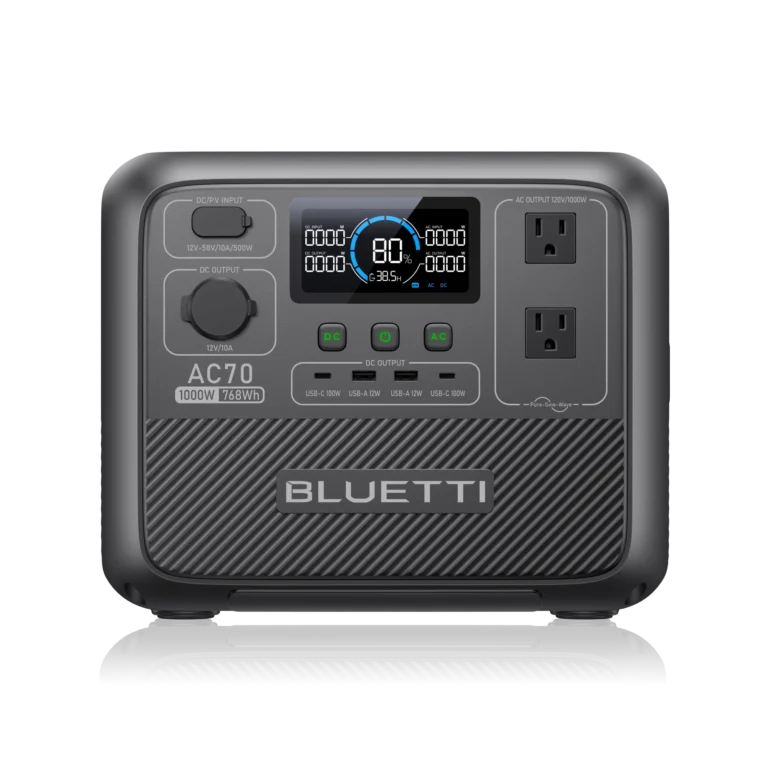
The Bluetti AC70 and EcoFlow RIVER 2 Pro are nearly twins on paper—768Wh LiFePO4 batteries, 120V-only output, no expansion, five-year warranties, and a $10 price difference that lands them at the same value per watt-hour. The spec sheet barely separates them. The real differences emerge in how each behaves in the field, and the right choice depends entirely on what you do with it.

Check price
Prices and availability change frequently
Check price
Prices and availability change frequently
Spec Bluetti AC70 EcoFlow RIVER 2 Pro
Capacity 768Wh 768Wh
Chemistry LiFePO4 LiFePO4
Rated output 1000W 800W
Surge 2000W Power Lifting* 1600W X-Boost*
Weight 22.5 lbs 18.2 lbs
AC outlets 2 4
USB-C 100W 100W
DC ports USB-A, 12V car port USB-A, 12V car port, DC5521
Solar input max 500W 220W
AC recharge time ~86–90 min ~70 min
Solar recharge time ~2.15 hr at 500W ~3.5–4 hr at 220W
UPS switchover 20ms 30ms (measured 15–20ms)
Warranty 5 years 5 years
Price $349 $339
$/Wh $0.45 $0.44

* Both surge modes are resistive-only, voltage-drop designs that cap near rated continuous output—not true high-wattage surge capability.

Grab-and-Go Mobile

  • Who it’s for: You physically move the unit constantly—car camping, van life, craft markets, jobsite charging—and it stays in active rotation, recharged every day or two from shore power, vehicle, or solar. Loads stay under 800W.
  • The pick: At 18.2 lbs versus 22.5, the RIVER 2 Pro is 4.3 lbs lighter. It refills from a wall outlet in around 70 minutes instead of 86–90, gives you four AC outlets instead of two for a campsite or market table, and adds WiFi app monitoring the AC70 lacks. Our review confirms this unit is built for mobile, active use that gets recharged frequently.
  • Usable energy at this regime: With a 12V cooler on the DC port (which bypasses inverter idle entirely) plus light device charging, the RIVER 2 Pro delivers approximately 640–670Wh in full-AC-to-DC mixed load, DC-favored operation. The AC70 at a similar mid-range load sits at around 650–700Wh in 200W-plus AC/DC mixed use. The two are effectively level on energy at this regime, so weight and ergonomics decide it.
  • Why not the AC70: It carries 4.3 lbs more and offers only two outlets. It stays in contention if your mobile life drifts toward off-grid solar dependence or toward 1000W loads, but you give up weight and outlet count for that headroom.
  • One important note: The storage-drain problem that disqualifies the RIVER 2 Pro elsewhere is irrelevant here—a unit in daily rotation never sits long enough to self-discharge.

Solar-Only Off-Grid

  • Who it’s for: You’re remote for multiple days with no shore power and no vehicle to lean on. Solar is the only way the battery refills.
  • The pick: The AC70’s 500W solar ceiling is 2.3 times the RIVER 2 Pro’s 220W, so on a good day it harvests far more energy and refills far faster—our review clocks a roughly two-hour fill from two panels and calls the 500W input high for its size. For solar-primary refill, the AC70 simply moves more energy per sunny hour.
  • Usable energy at this regime: Daytime off-grid loads—fridge, lights, fans, charging—run mid-range, so the AC70 delivers approximately 650–700Wh in 200W-plus mixed load, well clear of its low-load floor.
  • Why not the RIVER 2 Pro: It caps at 220W (requiring roughly 3.5–4 hours from a matched panel) and carries a disqualifying quirk for this exact scenario—AC charging disables solar input, so you cannot blend wall and sun, which matters the moment you’re cycling between a generator top-up and solar.

CPAP & Medical Overnight (in-rotation)

  • Who it’s for: You run a CPAP (often with humidifier and heated tube) on trips, typically a few nights between recharge opportunities, and the unit stays in active rotation.
  • The pick: Our review documents the decisive trick—running CPAP from the 12V DC power brick instead of the AC adapter drops draw from around 20W/hr to around 8W/hr, because the DC port bypasses inverter idle. That yields a measured three to five nights of seven to eight hour use per charge, and it does it 4.3 lbs lighter.
  • Usable energy at this regime (condition-matched): RIVER 2 Pro on the 12V DC brick at approximately 8W draw delivers around 670Wh from the DC port at low draw, enabling multi-night use. The AC70 on AC with a roughly 40W CPAP draw delivers approximately 450–500Wh from the AC port at low load, good for one full night—our review documents 7.5 to 8.5 hours with humidifier and heated tube, waking with over 30 percent left.
  • Why not the AC70: It provides one full night of CPAP runtime via the AC port, but the RIVER 2 Pro’s DC-brick path stretches that to multiple nights for the same 768Wh battery.
  • The fork—read this carefully: If your CPAP unit is standby or emergency gear that sits charged for hurricane season rather than traveling in rotation, the verdict flips to the AC70. The RIVER 2 Pro’s self-discharge means it can be dead when you reach for it, the worst possible failure for medical backup. Match the pick to whether the unit lives in use or waits on a shelf.

Set-and-Forget Emergency Backup

Quiet Always-On Network UPS

  • Who it’s for: You keep the unit running continuously as a UPS for a router, modem, NAS, or Starlink, and it lives somewhere quiet—a bedroom, a home office, a recording space.
  • The pick: The RIVER 2 Pro has no AC-passthrough mode, so its fan runs whenever AC output is active, not just during charging—and our review describes the fan as erratic, ramping unpredictably from around 45 dB to peaks of 61–62 dB. That alone rules it out of a bedroom or recording environment. The AC70 runs near-silent at low idle, and our review confirms the 20ms switchover holds routers, modems, NAS boxes, mini-PCs, and Starlink seamlessly, at roughly 6W idle—cheaper to leave running than a lead-acid UPS.
  • Usable energy at this regime: Network gear is a light continuous load, often under 60W. This is the AC70’s idle-taxed regime, so plan its runtime nearer the approximately 450–500Wh AC port, low-load figure, not nameplate—fine for ride-through, and you’re on grid most of the time anyway.
  • Why not the RIVER 2 Pro: Drop the noise constraint—a garage, a utility closet—and the RIVER 2 Pro re-enters, as its measured switchover is actually faster at 15–20ms. But the fan keeps it out of any quiet space.
  • One caveat that bounds both: The AC70’s UPS is excellent for network gear but fails on heavy desktop PCs—see the next section.

Higher-Wattage Resistive Loads

  • Who it’s for: You need to run something in the 800–1000W resistive band—a heating element, a kettle, a hairdryer on a resistive setting—at the top of these units’ envelopes.
  • The pick: The AC70’s 1000W continuous rating gives 200W more real headroom than the RIVER 2 Pro’s 800W—enough to clear a band of resistive devices the EcoFlow cannot. Our review even shows a 1300W impact-wrench burst clearing without invoking Power Lifting.
  • Why not the RIVER 2 Pro: Its 800W ceiling cuts 200W off the top of the resistive band the AC70 clears.
  • The gate—true for both, cannot be reviewed away: Neither surge spec buys you motor or high-wattage capability. The AC70’s 2000W Power Lifting caps near 1000W and drops voltage—measured as low as 62–96V—to get there. Our review confirms it is resistive-only and that a Keurig trips it even in Power Lifting mode. The RIVER 2 Pro’s 1600W X-Boost works the same way, and our review documents it failing on a 1500W space heater (shut down) and an 1800W heat gun (got around half rated). Above roughly 1000W resistive, and on anything with a motor or compressor, the honest answer is that neither qualifies, and our review for the AC70 names the same-brand step up by name: the AC180.

Desktop / Gaming-PC UPS

  • Who it’s for: You want a battery UPS for a 300W-plus desktop or gaming PC.
  • The honest answer: Neither unit is the right choice. The AC70’s UPS reboots on heavy desktop loads despite its 20ms spec—our review documents a state-dependent failure that works while charging but fails at full charge or idle, with no setting that resolves it. The only fix is cascading a traditional UPS in front. The RIVER 2 Pro brings a slower 30ms switchover plus the storage-drain risk from emergency backup use. For a 300W-plus PC, the documented workaround in our review—a dedicated traditional UPS between the station and the PC—is the real solution, or step up to a unit with confirmed heavy-load passthrough.
The bottom line

The Bluetti AC70 wins when solar input, standby reliability, quiet continuous operation, or higher-wattage resistive loads decide the call. The EcoFlow RIVER 2 Pro wins when weight, outlet count, AC recharge speed, app connectivity, or DC-brick CPAP runtime matter most—but only when the unit stays in active rotation that prevents its standby self-discharge from becoming a problem. For grab-and-go mobile use recharged frequently, the RIVER 2 Pro’s lighter weight and four outlets carry it. For solar-only off-grid refill, the AC70’s 500W solar ceiling harvests 2.3 times the energy per sunny hour. For in-rotation CPAP on trips, the RIVER 2 Pro’s 12V DC-brick path stretches runtime to three to five nights; for standby medical backup that sits charged, the AC70’s storage reliability is non-negotiable. For set-and-forget emergency backup, the AC70 holds its charge; the RIVER 2 Pro self-discharges and can be dead when the power drops. For quiet always-on network UPS duty, the AC70 runs near-silent; the RIVER 2 Pro’s fan disqualifies it from bedrooms and recording spaces. For 800–1000W resistive loads, the AC70’s 1000W rating clears a band the 800W RIVER 2 Pro cannot—but above 1000W or on motor loads, neither qualifies. For desktop or gaming-PC UPS, neither unit delivers reliable heavy-load passthrough. Same hardware, different weighted axes per use case—no contradiction, just the right match to what you actually do with it.