When you purchase through links on our site, we may earn an affiliate commission. Learn more.

Bluetti AC50BvsBluetti AC70 (2026)

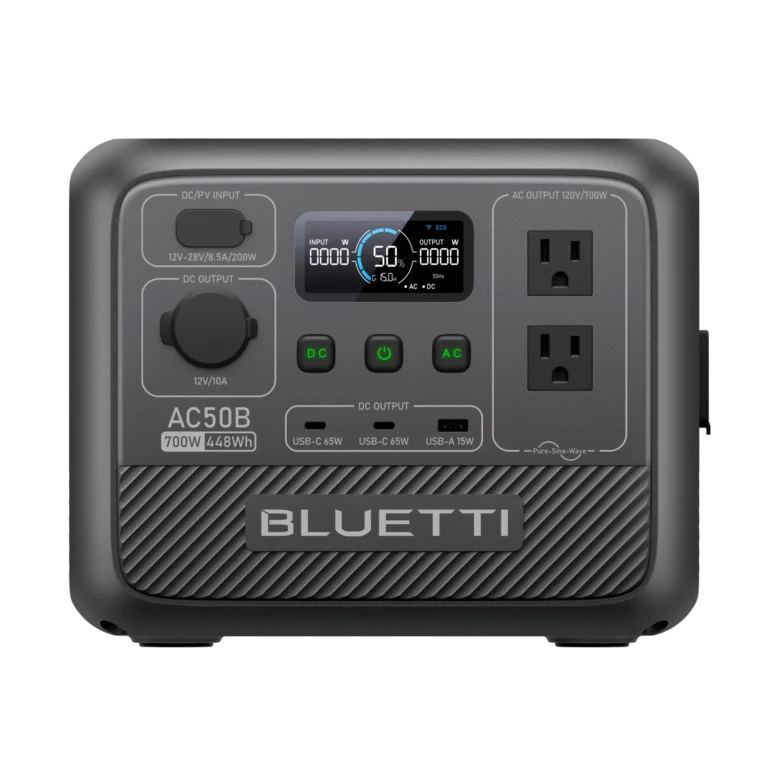
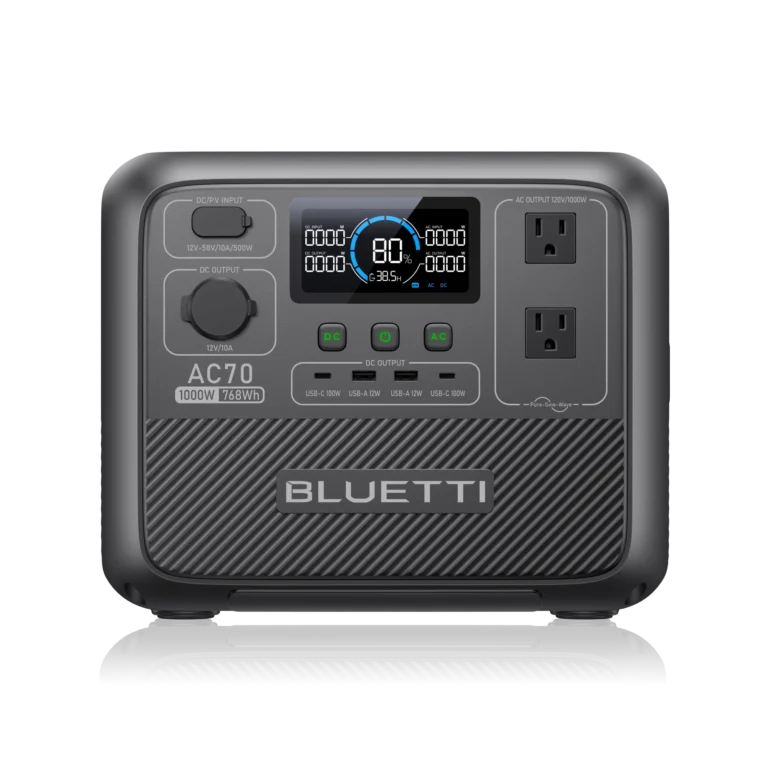
These two look like neighbors in Bluetti’s lineup, but they are built for different buyers — and the pricing makes the decision sharper than the model numbers suggest. At Bluetti’s canonical street price, the bigger AC70 ($349) is cheaper than the smaller AC50B ($399), delivers more capacity, more output, and far more solar input, and is the only one of the two rated for UPS duty. That means the AC50B does not win on value, capacity, or power — it wins on exactly one thing: it is six pounds lighter. The entire choice comes down to whether that weight saving outranks everything the AC70 gives you for less money.

Check price
Prices and availability change frequently
Check price
Prices and availability change frequently
Spec Bluetti AC50B Bluetti AC70
Capacity 448 Wh 768 Wh
Rated output 700 W 1,000 W
Surge 1,000 W* 2,000 W*
Weight 16.5 lb 22.5 lb
Chemistry LiFePO4 LiFePO4
AC recharge ≈1.17 hr ≈1.5 hr
Solar recharge ≈3 hr ≈2.15 hr
Ports 2× AC (700 W), 2× 65 W USB-C, 1× 15 W USB-A, 1× 120 W car (6 total) 2× AC (1,000 W), 100 W USB-C, USB-A, 12 V DC (6 usable)
Solar input 200 W 500 W
Price $399 $349
$/Wh $0.891 $0.454

*Power Lifting mode, resistive loads only — not true inductive surge. AC50B real-world ~715 W on a kettle, will not run a microwave. AC70 caps near 1,000 W and drops voltage, unsafe for motors.

Carry it constantly and loads are tiny

  • You carry the unit far more than you charge from it — frequent solo car-camping, a unit that moves between tent, kayak, and trunk, or anyone for whom six pounds is a real ergonomic line. Your loads genuinely live under 700 W and one small-load night is enough runtime.
  • At 16.5 lb it is a genuine one-hand carry; the AC70 at 22.5 lb sits at the upper edge of one-hand portability and our review describes it as the size you don’t dread loading rather than the size you forget you’re carrying. The AC50B’s review confirms the weight claim and confirms the capacity holds up honestly for this buyer — usable energy lands right around its rating rather than collapsing. Usable capacity: approximately 400 Wh on light mixed loads at the AC outlet, approximately 410 Wh on light loads at the DC/USB-C port. That is a fan overnight, LED lights, phone/tablet charging, and a 12 V cooler through a weekend with a daytime solar top-up.
  • Why not the AC70: It is the better machine and the cheaper one, but for a buyer whose loads never touch 700 W and who values minimum carry weight above all, you’d be carrying 6 extra pounds of capacity you won’t spend. The AC70 is demoted here purely on weight — the flipping axis that reverses everywhere else.

Camping, van, RV, or multi-day essentials

  • The largest buyer group — car camping with a fridge and lights, van/RV trips with mixed simultaneous loads, or a multi-day essentials kit that keeps a fridge, TV, internet, and devices alive. Loads are mid-range and runtime matters more than the last pound of carry weight.
  • The 1,000 W envelope clears loads the AC50B’s 700 W ceiling shuts down (the AC50B can’t run a microwave, hair dryer on high, or most cooking appliances — and its 1,000 W Power Lifting is a resistive-only voltage-sag trick, not real headroom). Our review explicitly names camping, van life, and RV as its heartland and confirms multi-day device-and-fridge duty with vehicle/solar top-ups between stops. The 500 W solar ceiling (versus 200 W) means a real recharge from panels on the road, not a trickle. Usable capacity: approximately 650–700 Wh at mid loads (~200 W and up — fridge plus lights plus charging). Against the AC50B’s approximately 400 Wh at the same mid-load regime, that’s roughly a 60–75% runtime advantage where it counts.
  • Why not the AC50B: It costs more for less of everything this buyer uses, and its 700 W ceiling is a hard gate that the AC70 clears. Demoted on capacity, output, and value simultaneously.

Overnight CPAP or medical backup

  • You need a CPAP or similar device alive overnight during an outage or while traveling, and reliability of the unit you depend on matters as much as runtime.
  • On margin: the AC70 runs a full night with humidifier and heated tube and still wakes with 30%+ left, per our review — meaningful buffer for a long night or an imperfect charge. On reliability, the deciding fact: both units have a first-year hardware-failure tail (DC-port/screen issues on each), but the AC70’s warranty is honored consistently, while the AC50B’s review documents inconsistent handling — some replacements, some refusals. For a device you sleep on, a warranty that reliably backs the unit is the tiebreak, and it favors the AC70. Usable capacity: approximately 450–500 Wh at CPAP-level low loads (~40 W on the AC inverter); on a bare CPAP on the DC port the effective figure is higher and the AC70 carries clear multi-night headroom.
  • Runner-up: Bluetti AC50B — the genuine lighter alternative, and the runner-up case is real here in a way it isn’t in mainstream camping. For a single-night-per-charge traveler running a bare CPAP (humidifier off) on the DC/USB-C port, the AC50B does multiple nights per charge (one owner used approximately 8% over 7.5 hours), at 6 pounds less to pack. Usable capacity in this regime: approximately 410 Wh on bare CPAP, DC port, humidifier off; on AC with humidifier and heated hose it’s about one full night with less buffer than the AC70. Choose it only if minimum travel weight outranks runtime margin and you’ve accepted the warranty-consistency risk.

Continuous desk or network UPS

  • A unit left plugged in to ride the grid for a router, modem, NAS, Starlink, or a small mini-PC — and you want it silent and seamless.
  • For light network gear our review is unreserved: routers, modems, NAS, mini-PCs, and Starlink ride its 20 ms switchover with no caveats, and at approximately 6 W idle it’s cheap to leave running. The AC50B works as a UPS — but our review surfaces two always-on quirks the AC70 doesn’t have: with no float-charging stage it micro-cycles near full charge and the fan wakes repeatedly (owners pulled it from quiet offices over this), and after a full drain-and-solar-recovery its AC output won’t auto-resume until you toggle it manually — a silent failure for anything unattended. Those behaviors demote the AC50B for continuous duty even though its raw switchover is fine. The AC70 also has more runtime to actually ride out a long outage. Usable capacity: approximately 480–520 Wh at light continuous loads (~30–80 W on AC).
  • Why not the AC50B: Its switchover works, but the pass-through fan-cycling and no-auto-resume quirks make it a poor choice for continuous always-on duty despite its functional UPS capability.
  • Hard limit both share: Neither unit is a safe UPS for a 300 W+ desktop or workstation. Our review documents PCs rebooting on heavy desktop loads despite the 20 ms spec, including a state-dependent failure (works while charging, fails at full charge), with the only fix being a traditional UPS cascaded in front of it. The AC50B’s smaller cell and 700 W ceiling make it no better here. If a high-power desktop UPS is your actual need, neither of these is the answer.
The bottom line

The AC70 wins in mainstream portable power (camping, van, RV, multi-day essentials), overnight CPAP and medical backup, and continuous desk or network UPS duty. It is demoted only in the ultralight grab-and-go segment, where its 6 extra pounds outweigh everything it offers — but that reversal is confined to buyers whose loads are tiny and who carry the unit constantly. The AC50B wins that one segment on weight, appears as a lighter runner-up in the CPAP segment for single-night travel with humidifier off, and is demoted everywhere else on capacity, output, and value in mainstream camping, and on pass-through fan-cycling and no-auto-resume quirks in continuous UPS duty. The counterintuitive pricing — the bigger AC70 is $50 cheaper than the smaller AC50B — sharpens every segment: the AC70 gives you more for less unless weight is your whole game.