
When you purchase through links on our site, we may earn an affiliate commission. Learn more.
Jackery builds for campers and overlanders first — which means most of its lineup was designed around portability, not the specific demands of home backup. Those demands are different: a unit that sits uncharged in a closet for six months, fires up the moment the grid drops, and runs a fridge overnight without anyone babysitting it needs properties the hiking spec sheet doesn’t advertise. Standby retention, switchover speed, low-battery cutoffs, and the gap between a nameplate wattage and what actually sustains a compressor load are the numbers that matter here.
The right Jackery for backup depends almost entirely on who is home during an outage and what they need to run. A bedside CPAP backup is a completely different purchase from a unit wired into your panel for a well pump. The segments below are arranged around those actual use cases — not by price or size — because the same machine that wins one scenario loses another on a completely different axis.
Use the table below to find your situation first, then read that section. Every pick here is the result of working through real-load runtimes, owner outage reports, and independent testing — not box figures.
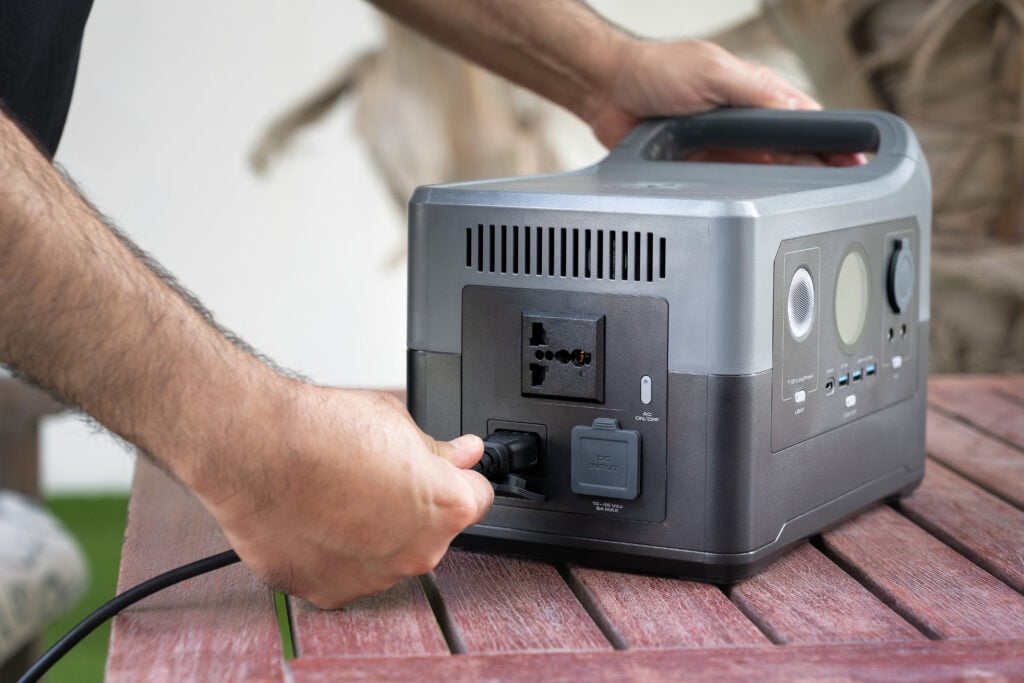
The classic closet-backup scenario has a simple test: can a non-technical person press one button during a 2 a.m. power failure and trust the unit to hold the fridge, freezer, lights, router, and phones — possibly a microwave or coffee maker — until the grid comes back? The HomePower 3600 Plus passes that test and adds something the other candidate cannot: the capacity to grow.
Independent bench testing puts usable energy at roughly 90–91% of nameplate at the AC outlets — about 3,240–3,270 Wh in real conditions. At that output it sustained stacked kitchen loads around 3,200 W cleanly and held 4,700 W combined under stress testing. The TT-30 30A outlet delivers a true continuous 30A. In actual outages, owners report a 30-year-old refrigerator running 24 hours on under half the battery; plan on roughly 1–2 days of fridge-plus-essentials per charge on the base unit.
The property that separates it from the HomePower 3000 — its closest rival — is the expansion path. This unit scales to 21 kWh across five battery packs; the 3000 is sealed at its starting capacity forever. Both units pass a clean review on core backup function. The decision the reviews treat as the purchase question is simply: can your capacity needs grow? If there is any chance they can, this is the unit. If you are certain 3 kWh is your ceiling for the life of the purchase, the 3000 saves $200 and is 20 lbs lighter.
Two more properties matter for closet duty specifically. The 6,000-cycle LiFePO4 cells top the lineup; the 10 ms UPS switchover is fast enough that no one notices the grid dropped; and the unit charges down to −4 °F — the widest cold window at this size, which protects units stored in garages through winter. One-button deployment that owners specifically flag for non-technical household members completes the picture.
There are real operating limits to respect. Bypass and UPS mode caps outlet output near 1,440 W while the unit is wall-connected — an 1,800 W space heater trips it instantly, so run heavy loads off battery when needed. The standard AC outlets are split across two breaker banks; the full 3,600 W is only available on the TT-30. The two solar input ports share one charge controller, so mismatched third-party panels risk overcurrent into the lower-rated port — match panels per port. There is no 12V DC output. And the often-quoted 14-day runtime describes the fully expanded 21 kWh system, not the base unit; an independent fridge-only test reached roughly 9.5 days even on the full stack.
Skip it if: you are certain you will never need more than 3 kWh and want to save $200 and 20 lbs — the HomePower 3000 wins that version of this buy.
The HomePower 3000 gets a full review in the quiet medical-night segment below, where it wins outright. The short version here: $1,699, 3,072 Wh, same 3,600 W rating, 20 lbs lighter, and measurably quieter than its sibling — but sealed at that capacity with no expansion path and no wheels. Its own reviews document buyers who assumed the Plus-line expandability and were surprised to find none. If 3 kWh is genuinely your ceiling, take it; the reviews note that two 3000s is the honest way to scale later if your needs grow.
Running a CPAP through a multi-night outage from a unit on the nightstand is a different problem from filling the fridge. The questions that matter here are how quiet it is at 2 a.m., how long it runs a medical device per charge, and whether it still has charge after sitting untouched for six months. The HomePower 3000 wins all three.
Noise is the axis here, and the 3000 wins it outright. Independent testing ranks it among the quietest units at 42 dB idle; one reviewer had to put an ear six inches from the unit near max load. For a box running overnight in a room where people sleep, that is the whole case for this pick over its larger sibling.
The CPAP runtimes are the figures to plan around: independent testing puts it at 10 or more nights with the humidifier off, 3–4 nights with it on. The humidifier is the dominant drain, and switching it off is the single most effective way to extend per-charge runtime for medical backup. Bench testing confirms roughly 92% usable energy at the AC outlets; for the lowest-draw devices, running off the 12V DC port rather than the AC inverter reduces idle losses and stretches effective runtime further.
Standby retention is the other deciding property. The ZeroDrain feature holds roughly 95% charge after 12 months of storage — closer to true buy-and-forget readiness than anything else in the lineup. One important caveat: that figure assumes the inverter is off. With AC outputs enabled, idle draw measured up to around 30 W — roughly 1% per hour — so the readiness claim only holds if you leave outputs off between events.
The sub-20 ms UPS switchover is confirmed; outage coverage extends well beyond the bedroom when needed, with owners reporting 24–30+ hours of fridge runtime when the outage stretches past overnight.
A few limits are worth naming before you buy. The unit is not expandable — 3,072 Wh is the permanent ceiling, and this is a documented source of buyer surprise. The app is unreliable: 2.4 GHz-only Wi-Fi, Bluetooth that drops and resets settings. Manage this one from the unit itself. Some units have shown AC output errors tied to older firmware that does not push automatically — verify AC output under real load inside your return window.
Skip it if: you only need to run one medical device and want to save over $1,200 — the Explorer 600 Plus covers a single CPAP for two or more nights via DC and costs a fraction of the price.
At $429 and 16.1 lbs, the 600 Plus is the single-device bedside option: 632 Wh, 800 W output, and a review-validated two or more nights of CPAP per charge running off the 12V DC adapter. The sub-20 ms UPS and an app-configurable charge floor make it genuinely purpose-fit for one device. Two cautions for this specific use: the fan ramps audibly under thermal load — one light sleeper was woken roughly 5.5 hours in, and keeping the device on DC rather than AC keeps it cooler and quieter. More importantly, measured standby drain with outputs left enabled ran to 23% over 12 hours in one flagged test, which means months-long closet readiness is not available here — keep outputs off and top it up before storm season. It backs up the machine, not the household.
With a hard budget under $800 and someone home to manage things, the question collapses to a simple one: which unit delivers the most verified outage coverage per dollar? The Explorer 2000 v2 is not a close call on that axis — it is the best-value unit in the Jackery lineup, and the cases where it fails all trace to one thing: leaving it unsupervised.
Outage backup is the dominant reason owners buy this unit, and the real-world evidence holds up: owners across hurricane, cold-weather, and rural-grid events report a full-size fridge running 21.3 hours, a kitchen fridge lasting 12 hours on 38% of the battery, and routers and computers staying online. Independent bench testing measured roughly 84–85% of nameplate at the wall — about 1,710–1,740 Wh in real conditions. The strategy for this buyer is the fast recharge: top off in under two hours on wall power between outage windows, or run it through a mid-size inverter generator. Reviews call this the real advantage for someone who is present and managing the event.
The 2,200 W output rating holds under real loads — a coffee machine and heat gun, a 1,600 W air fryer, and a 2,100 W steam iron all ran cleanly. The practical rule: run high-draw appliances one at a time. Two stacked 1,100 W loads tripped it in one owner test, so plan around continuous draw, not surge stacking.
There are three caveats that genuinely affect who should buy this unit. First, the UPS auto-switchover occasionally fails to engage — one owner describes it as a known issue — so do not put it on unattended fridge protection. A manual transfer switch removes the lockout risk, but not the supervision requirement. Second, it will not charge below 32 °F; if the unit is stored in an unheated garage, the recharge step of the strategy breaks down in a cold-weather outage. Third, owners running oxygen concentrators — which draw 300–600 W continuously — got under three hours of runtime, and multiple buyers returned units over this. It is not a concentrator backup.
Reviews name essential-circuit home backup as one of the 1500 v2’s two core uses: fridge, Wi-Fi, lights, and TV held through outages behind a 10 ms UPS — the quickest switchover spec in the sub-HomePower lineup, and without the engagement lapses the 2000 v2 has shown. The 6,000-cycle cells match the top tier in the lineup and handle years of standby plus cycling; owners confirm a generator recharge path. Runtime evidence — four CPAP nights while charging phones and electronics; simultaneous air fryer, Starlink, and fridge — comes from owner reports rather than a measured discharge figure, so treat capacity claims here as directional rather than bench-confirmed. It is the runner-up rather than the pick because $100 less buys 25% less energy: at $0.46 versus $0.39 per watt-hour, the 2000 v2 delivers more outage per dollar on the axis this segment is scored on. Take the 1500 v2 when 1.5 kWh genuinely covers your outage plan, or when a clean 10 ms UPS matters more than maximum coverage per dollar.
Skip it if: you need unattended switchover protection or an oxygen concentrator backup — the Explorer 1500 v2 has a cleaner 10 ms UPS record and the Explorer 1000 Plus has a configurable low-battery cutoff, or move up to the HomePower line for hands-off deployment.
At $599 for 1,264 Wh and 2,000 W output, the 1000 Plus earns a mention specifically for two properties: independent testing confirmed the inverter actually sustains 2,136 W — inverter honesty that is not universal in this price tier — and it has a configurable low-battery cutoff that the v2 line lacks, plus an expansion path to over 5,000 Wh if the budget grows. Usable energy in mixed AC loads runs around 1,100 Wh. Take it if the budget floor and a future growth option matter and you will actively manage load draw. Before trusting it as a hands-off UPS, test your specific low-draw device: the EPS standby mode auto-shuts off below a minimum load threshold and can silently drop sub-10 W devices. Also keep outputs off when it is staged — with the inverter on, idle drain empties it in just over a day.
If the plan is to start with one unit and build toward multi-day coverage over a season or two — adding expansion batteries, adding panels, staging the investment — the question is not which box has the biggest number on the side. It is which platform scales the way you actually want to scale it. On that question, the Explorer 2000 Plus beats its bigger sibling.
The review’s thesis for this unit is straightforward: buy it for what it will become. Start at 2 kWh; scale to 12 kWh on one unit, 24 kWh across two. Owners running expansion packs report meaningfully longer outage coverage, and one ran off-grid for a year and a half after a wildfire on six panels plus an expansion battery. The base unit covers essentials for 1–2 days — roughly 1,678–1,780 Wh usable at essentials loads on AC, about 1,821 Wh over DC — and week-long coverage is a solar-plus-expansion outcome, not a base-unit promise.
The solar story is the decisive edge over the HomePower 3600 Plus for this buyer. The 2000 Plus takes 1,400 W versus the 3600 Plus’s 1,000 W ceiling, and every expansion battery adds its own solar inputs — that stacking property is what makes multi-day solar recovery scale as the system grows. Two 200 W panels delivered 393–430 W measured. The 3,000 W output was bench-verified for 15 minutes with clean 60 Hz sine at a steady 118.4 V; the 30A outlet wires through a manual transfer switch for essential circuits, which is a recurring stated purchase reason.
This is an actively managed unit, and that posture is not optional. The single most important operating limit: after roughly a week of continuous pass-through, one detailed owner report shows the unit losing grid recognition and silently draining its battery until rebooted. That pattern is exactly why this pick lives in the system-builder segment rather than the sealed-closet one. Beyond that: bypass mode caps near 1,440 W while charging — a 1,500 W heater cut out and confused one owner against the 3,000 W rating — and the 60 V solar-input ceiling with 12 A per port makes third-party panel selection homework. Both DC ports share one charge controller; panels left connected overnight will throw a recoverable F7 error that a sunset timer prevents. Test the solar input before you need it — a recurring pattern of zero-watt port complaints has led to accepted returns. Battery-saving mode is app-only, and the app is the weak point of the platform.
Skip it if: you want a sealed always-on closet unit rather than an actively managed system — the HomePower 3600 Plus gives you 75% more base capacity, a cleaner hands-off record, and cold-window charging for $500 more.
If the system you are building stays modest — one or two expansion packs, solar as a supplement rather than primary recovery — the 3600 Plus is worth the $500 premium: 75% more base usable energy, 600 W more output, the −4 °F cold-charge window, and a stronger record for sealed unattended deployment. The axes it concedes here are solar throughput (1,000 W versus 1,400 W) and staged-entry price, since expansion packs on the 2000 Plus cost meaningfully less per watt-hour than the base unit. The flip between these two is simple: if solar-recharge throughput and staged investment economics are what drive your purchase, the 2000 Plus wins; if you want more base capacity and a cleaner always-on record today, take the 3600 Plus.
A well pump, an electric range, a dryer circuit, central AC — these loads require split-phase 240V output, and that is a physical requirement no 120V unit can meet from a single box. Exactly one Jackery clears it: the Explorer 5000 Plus. The HomePower 3600 Plus can reach 240V as a two-unit pair, but its own review redirects the 240V buyer here because the native unit costs less and handles the voltage class by design.
The deployment this unit is built for is a Smart Transfer Switch installed by an electrician, and owners in that setup report outages they simply did not notice — true 0 ms switchover exists in Online UPS mode via the STS. Standalone backup mode delivers under 20 ms with a brief cut. Online mode costs roughly 50–58 W in continuous idle draw, which is the inherent price of seamless switchover at this topology. The choice between modes is a planning decision, not a flaw.
Independent testing confirmed clean split-phase output at 2.2–2.6% THD up to 7,200 W: dual RV air conditioners, a 2,400 W well pump, and full kitchen loads all validated. Central AC needs a soft-start capacitor; the measured surge could not start a unit requiring a 10,000 W startup draw, so confirm your AC’s surge requirement before buying. At real outage loads — a 21 cu ft refrigerator runs 28 hours; a home office 18 hours; essentials circuits roughly 10 hours without solar. Central AC draws the battery down in about 2.8 hours. Multi-day whole-home coverage requires expansion batteries or meaningful solar offset.
The expansion ceiling is the deepest in the lineup — to 60 kWh per unit; owners have built 10–20 kWh systems, and one account describes running a whole house for three days on two units plus eight packs. The 4,000 W solar input via standard MC4 connectors is the brand’s strongest solar-primary recovery path. One wiring constraint to note: the high-PV input has a 135 V floor, which means SolarSaga 500X panels need a minimum of four in series to clear it — three panels fall short.
Hard operating realities that belong in the purchase decision: AC wall charging disables 240V output entirely, so generator users recharge fast and then disconnect before resuming 240V loads. DC and solar input do not carry this restriction. Pass-through caps at 500 W with a 1,500 W system ceiling while charging. The NEMA 14-50 outlet is physically 50A but rated for 30A service. The unit is IP20 — indoors only; the cooling fans draw in humidity, so route solar cables through a window rather than leaving the unit outside. The app is the most consistent complaint across owner reports — Wi-Fi drops and a timezone bug that corrupts schedules — but the core backup function runs from physical buttons and is unaffected. Budget the Smart Transfer Switch and electrician installation as part of the purchase from the start.
Skip it if: 240V is not genuinely required — at 134.5 lbs it is a wired-in fixture, not a portable, and every other segment on this page offers a lighter, less expensive option for 120V backup needs.
Picks on this page come from deciding what the use case actually rewards — then judging each unit by how it behaves under those conditions, not by how it reads on a spec sheet. The criteria that matter shift with the job, so a unit that’s decisive in one segment can be disqualified in the next by a single behavior. Where two contenders cleared the same bar, documented performance under real load settled the pick, not a comparison of rated numbers.
Home backup punishes spec-sheet reading. Nameplate capacity assumes ideal conditions; what actually matters is how much energy reaches your outlets at real loads, whether the unit will switch over reliably when you’re not watching, and whether it still holds a charge after six months in a closet. Those properties only show up in sustained-load testing and extended owner reports — not in marketing copy.
For each segment we weighted the axes that the use case actually demands: usable energy at the buyer’s real load draw, sustained output that holds past a brief surge, standby retention for units that sit idle for months, switchover speed and reliability for anything running unattended, and the solar-recharge throughput that determines multi-day recovery. Value — cost per watt-hour of verified capacity — decided the budget segment outright.
Numbers in this guide are drawn from independent bench testing and owner-reported real-outage results, stated at the loads each segment actually runs. Manufacturer ratings are labeled as such. The per-unit sections carry the specific figures and their sources.
Two units were ruled out before we reached the segment analysis. The Explorer 1500 Ultra is a capable machine for overlanding but its backup-mode power ceiling and documented voltage sag under sustained load make it wrong for any of the deployment patterns here. The Explorer 1000 v2 has no configurable low-battery cutoff and a documented pattern of silently dropping AC output — both disqualifying for any backup you walk away from. It remains the brand’s strongest attended all-rounder; the ruling is against backup deployment, not the unit itself.
The picks above answer “which one for my situation.” This table answers “show me everything, I’ll decide.” It lays every unit out on the same axes used to make the calls — measured behavior, not nameplate specs — so a reader whose priorities cross segments can weigh the tradeoffs directly instead of trusting our segmentation.
| Unit | Capacity | Rated output | Surge | Weight | AC recharge | Solar input | Price | $/Wh | Buy |
|---|---|---|---|---|---|---|---|---|---|
| HomePower 3600 Plus | 3,584 Wh | 3,600 W | 7,200 W | 77.16 lbs | ~2.5 hr | 1,000 W | $1,899 | $0.53 | Check price |
| HomePower 3000 | 3,072 Wh | 3,600 W | 7,200 W | 59.52 lbs | ~2 hr 15 min | 1,000 W | $1,699 | $0.55 | Check price |
| Explorer 2000 v2 | 2,042 Wh | 2,200 W | 4,400 W | 39.5 lbs | ~1 hr 42 min | 400 W | $799 | $0.39 | Check price |
| Explorer 2000 Plus | 2,042 Wh | 3,000 W | 6,000 W | 61.5 lbs | ~2 hr (measured ~95 min) | 1,400 W | $1,399 | $0.69 | Check price |
| Explorer 1500 v2 | 1,536 Wh | 2,000 W | 4,000 W | 31.97 lbs | ~1.07 hr rated | 400 W | $699 | $0.46 | Check price |
| Explorer 5000 Plus | 5,040 Wh | 7,200 W | ~8,000 W (measured / 30 s) | 134.5 lbs | ~3.5 hr rated (measured 1 hr 42 min) | 4,000 W | $2,899 | $0.58 | Check price |
| Explorer 600 Plus | 632 Wh | 800 W | — | 16.1 lbs | — | — | $429 | $0.68 | Check price |
— = not independently verified for this guide.
The questions here are the ones that don’t belong to any single pick — the cross-cutting concerns that come up regardless of which unit a reader lands on. We pulled them out of the individual segments so each answer lives in one place, addressed against the same standard of evidence used throughout the page.
The 2000 v2’s strengths — best cost per watt-hour in the lineup, fast recharge, and solid real-load runtimes — all assume someone is home to deploy it, manage load draw, and notice if something goes wrong. The specific issue is an occasional UPS auto-switchover failure that owners have documented: the unit sometimes does not engage when the grid drops. For a supervised outage where you manually connect loads, that is irrelevant. For a fridge running unattended through the night, it is the difference between food safety and a spoiled freezer. The attended requirement is the tradeoff for the price, not a flaw — it is why the HomePower units win the closet and this unit wins the value segment.
On core backup function they are nearly the same machine: same output rating, same surge, similar recharge times, both LiFePO4, both passing a clean review for the use case. Three things break the tie. The 3600 Plus expands to 21 kWh across five battery packs; the 3000 is sealed at 3,072 Wh permanently. The 3600 Plus has wheels and a telescoping handle; the 3000 has side handles and is 20 lbs lighter — easier to store, harder to move. And the 3600 Plus charges down to −4 °F, which matters for garage storage in winter. The 3000 is measurably quieter and saves $200. If you will never need more than 3 kWh and want the quietest bedside-capable unit in the lineup, the 3000 wins. If there is any chance your needs grow, the 3600 Plus is the safer purchase.
Not reliably. One detailed owner account documents the 2000 Plus losing grid recognition after roughly a week of continuous pass-through and silently draining its battery until rebooted. The HomePower 3600 Plus does not carry that pattern. The 2000 Plus is built for a buyer who actively manages the system — checking on it, cycling solar, adding expansion capacity over time. The always-on closet deployment is the HomePower’s territory; the 2000 Plus wins on solar throughput and staged expansion economics for someone who is engaged with the system.
For a well pump, yes — independent testing validated a 2,400 W well pump on clean split-phase output. For central AC, it depends on the unit’s startup surge: testing confirmed clean output up to 7,200 W, but the measured surge could not start a unit requiring a 10,000 W startup draw. A soft-start capacitor is the standard fix and is typically required. Beyond the hardware, the full capability of this unit — including the true 0 ms switchover — requires a Smart Transfer Switch installed by a licensed electrician. Budget that installation as part of the purchase; the standalone backup mode delivers under 20 ms but is not seamless. Also note that AC wall charging disables 240V output entirely, which affects how you plan generator recharge during an extended event.
The Explorer 600 Plus covers exactly that scenario well and costs a fraction of the HomePower 3000. It delivers two or more nights of CPAP runtime per charge via the 12V DC adapter — DC keeps it cooler and quieter than running through the AC inverter — and the sub-20 ms UPS handles switchover. The two caveats to manage: the fan ramps audibly under thermal load, which can disturb light sleepers, and standby drain with outputs enabled measured 23% over 12 hours in one test, so keep outputs off between events and top it up before storm season rather than relying on months of passive readiness. If the outage plan includes a fridge, lights, or any other household load alongside the CPAP, step up to the HomePower 3000.
If you came here wanting one unit that charges once, sits in a closet, and handles a fridge plus household essentials without anyone managing it, the HomePower 3600 Plus is the default — it passes the hands-off test cleanly and is the only unit in the lineup that can grow with you if your needs change. The HomePower 3000 wins the bedroom: quieter, lighter, and closer to true set-and-forget standby retention, at the cost of a sealed capacity ceiling. For buyers with a hard budget under $800 who will be home during outages, the Explorer 2000 v2 delivers more verified outage coverage per dollar than anything else in the lineup — the supervision requirement is the honest tradeoff for that value. The Explorer 2000 Plus is for a different kind of buyer entirely: someone building a solar-plus-expansion system over time, actively engaged with the platform, who values solar throughput and staged-investment economics over a bigger tank on day one. And the Explorer 5000 Plus stands alone — if a well pump, electric range, or central AC circuit is in the outage plan, it is the only Jackery that physically handles the job from a single unit.