
When you purchase through links on our site, we may earn an affiliate commission. Learn more.
EcoFlow’s RV lineup looks like a single family of products. It isn’t. The same company makes a 4,096Wh rolling power plant with a dedicated 30A outlet and an 18-lb carryable station you can set beside a bed — and the right one depends entirely on what your rig actually asks of it. Pick the wrong unit and you’re either hauling a 113-lb anchor when a 27-lb box would have done the job, or you’re watching a lightweight station run dry because the rooftop AC compressor kicked on.
Four distinct buyer situations map to four different picks here. The segments are defined by the job — power plant for a boondocking rig, shore-style weekend power without the weight penalty, off-grid DC-heavy refueling, or a carryable companion that moves around the camp. Each segment has one winner on the axis that actually decides it, a runner-up for the buyer one condition removed, and a plain statement of the one real catch.
Find yourself in the router below, then jump to your segment for the full argument.
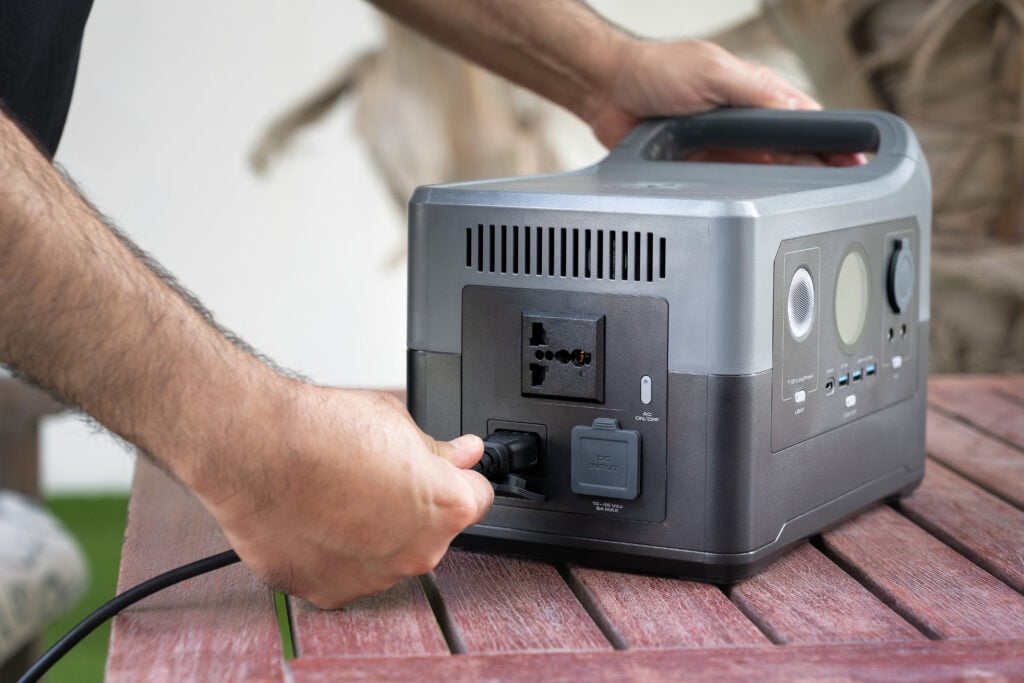
If the station is the rig’s primary electrical system — not a supplement, but the thing everything plugs into — the decision turns on one question: how many hours does the battery last under real whole-rig loads, and can you add more capacity when those hours aren’t enough? Inverter headroom to start a compressor is just the entry ticket. The game is watt-hours and expansion runway.
It’s the largest, most capable portable battery EcoFlow makes for RV use — 4,096Wh, a 4,000W inverter with 8,000W surge, and a front-panel TT-30R outlet that connects directly to a 30A shore-power inlet. Owners run Class C motorhomes off it: independent accounts describe carrying everything short of running AC, microwave, and propane heater simultaneously. At mixed whole-rig draws of 1,000–2,000W, usable energy runs around 3,810Wh — the high-load regime is exactly where this unit’s efficiency holds up best, because inverter idle becomes a rounding error when the fridge, furnace, and water heater are all pulling.
The expansion path is the second reason this is the power-plant pick. A 48,000Wh system ceiling means you can add batteries as your boondocking ambitions grow — and 12kWh single-unit expansions are well-proven in owner use. Native 120V/240V output matters if your rig ever adapts down from 50A service. LiFePO4 chemistry and a 5-year warranty back the daily-cycling duty this kind of use implies. The 2,600W dual-port solar ceiling means a serious roof array can actually refill it in a day.
There are two real catches. The first is shore-power pass-through: while the unit is grid-connected and charging, output throttles to roughly 1,800W — not enough headroom for a rooftop AC compressor’s startup surge, which will trip the unit offline. The documented fix is simple: run the AC off the battery directly, or charge the station separately from the rig’s shore connection. This isn’t a flaw unique to the DELTA Pro 3 — the runner-up has the same behavior — but it’s the one habit every buyer here must build before their first park stay. The second catch is narrower: this unit has documented firmware faults that require manual resets, which disqualifies it as an unattended critical-load backup (a medical device left running while no one’s home, for instance). In an RV, someone is always around, so this is manageable — but if you’re also counting on it as an unmanned home backup, it’s the wrong tool for that second job.
Skip it if: Your camping trips run a weekend at a time and you’d rather save $650 and 39 lbs — the DELTA 3 Ultra Plus in the next segment does everything a 30A weekend rig needs at three-quarters the weight.
The original 3,600Wh / 3,600W workhorse, also with a front-panel TT-30 outlet — owners specifically cite that outlet as the feature that sold them, and it has run a 13,500 BTU RV AC off-grid. At $1,599 it’s the most affordable large battery EcoFlow makes, and at $0.44/Wh it’s the best value figure of any unit on this page. Usable energy at heavy AC loads runs 3,060–3,280Wh — independent testing put it at roughly 91% of rating at moderate sustained draws, dropping toward 85% under heavier AC output.
It’s second rather than first because it shares the pass-through throttle problem without any of the newer-generation refinements — owner reports document repeated overload errors on RV AC while shore-connected — and its inverter does not auto-restart after a low-battery shutdown, which is an operational nuisance in a power-plant role. Its 120V-only architecture, 25,000Wh expansion ceiling, and 1,600W solar ceiling all sit below the DELTA Pro 3’s on every axis this segment weights. If your budget ends at $1,599 and you’ll actively manage the shore-power behavior, it’s a legitimate power plant. The DELTA Pro 3 is simply more of one.
A weekend travel trailer or small motorhome needs the same capability as a full-time rig — the rooftop AC has to start, the microwave has to run, the 30A inlet has to work — just for a shorter stretch, and ideally without recruiting a second person to load the truck. When all three capable units clear the same gates, the decision comes down to what you’re paying and what you’re lifting.
It plugs straight into a 30A shore-power inlet and the inverter handled RV air-conditioner loads in trip testing — that’s the confirmation that clears the only real gate in this segment. Everything else is about what you give up to get a unit that’s 39 lbs lighter than the DELTA Pro 3 and $650 cheaper. The answer, for a weekend camper, is very little: you trade 1,024Wh of raw capacity and the expansion ceiling beyond 11,000Wh, and you give up 240V output that a 30A rig doesn’t use anyway.
What you keep: a genuinely mobile station with a metal telescoping handle, rear wheels, and rubber feet — the most mature mobility system EcoFlow ships. It runs at or under 25dB below 600W loads, which covers fridge duty, LED lighting, and device charging at the picnic table without the unit becoming the loudest thing at the site. Measured usable energy at AC load runs around 2,690Wh — roughly 88% of the 3,072Wh nameplate — and one owner’s camping weekend with a residential 12V fridge, diesel heater, TV, and coffee pods used about 75% of a charge, leaving meaningful reserve for the drive home. Solar intake at 1,600W means a reasonable roof array refills it in a day, and it expands to 11,000Wh if weekend trips start turning into week-long ones.
Four things to know before you commit. Low wheel clearance makes gravel and sand genuinely difficult — roll it on solid ground at the campsite and store it in place rather than moving it over rough surfaces. Idle draw with outputs active runs 19–30W; switching outputs off between uses rather than leaving the unit humming all week makes a real difference to the battery’s state by Sunday. Fan noise climbs to roughly 60dB when the AC compressor is running hard — ‘quietest in class’ holds at camp-evening loads, not at maximum sustained output. And the 25dB quiet spec is a below-600W claim the manufacturer makes and independent testing confirms inside that window; once you push past it, the fans catch up.
Skip it if: You’re running the rig for a week or more at a stretch and want room to add expansion batteries — the DELTA Pro 3 carries more watt-hours, a higher expansion ceiling, and 240V flexibility, at the cost of 39 lbs and $650.
Segment 1’s winner earns a second look here only if you want the larger battery, the 240V/50A-adjacent output, or the deeper expansion path, and you’re willing to accept 113.5 lbs and the $650 premium to get them. The same shore-power pass-through throttle applies. For a straight weekend-power job in a 30A rig, the Ultra Plus is the smarter fit; the DELTA Pro 3 is the answer to a different question.
Off-hookup camping for days at a time changes the math in two ways. The rooftop AC is off the table, which means the station doesn’t need a 3,600W inverter — but the fridge, pump, and fans run all day and all night, and the battery has to refill from whatever solar and driving the day provides. How power leaves and re-enters the unit matters more than the inverter headline.
The 30A Anderson DC port is the reason this unit wins this segment. Running a 12V fridge, pump, and fans directly off DC bypasses the inverter entirely — which means no 22–25W of idle overhead taxing the battery every hour the compressor isn’t even running. That’s a meaningful efficiency gain over a full day of DC-heavy loads, and independent bench reporting backs it up: DC-port idle runs 4–9W versus 22–25W with the AC side active. For the load profile this segment runs, that difference compounds.
On the refill side, 1,000W of solar across dual MPPT inputs is double what the base DELTA 3 Max takes, and native alternator charging adds a path the cheaper sibling caps or limits. Driving a few hours genuinely contributes to the next night’s battery. The 3,000W inverter handles microwave and kettle bursts without complaint — independent testing held it at rated output through a full discharge, tripping only above 3,600W. At 48.7 lbs it loads in and out of a storage bay without a second person, it runs in the mid-20s dB at light loads and around 33–34dB under heavier draw, and it expands to 10,000Wh for longer trips. Usable energy at mixed mid-to-high loads runs 1,860–1,900Wh — independent testing measured 91–93% of the 2,048Wh rating at a 2kW AC load, and the DC-fridge portion does better than that figure because the inverter never enters the calculation.
Two standby traps are worth building habits around. With the AC inverter active and no load drawing more than about 15W, the unit shuts the AC side off entirely even with timeout set to never — but overnight fridge, fans, and a router run off DC anyway, which is the natural state for this segment. And AC-on idle at 22–25W means you want outputs switched off when nothing’s actually drawing. Neither of these is a surprise failure; both resolve into the DC-first habit this load profile already calls for. Cycle life is not manufacturer-stated for this SKU — endurance rests on LiFePO4 chemistry and the 5-year warranty rather than a published cycle count, which lowers certainty slightly for a buyer planning daily cycling over years.
Skip it if: Your solar setup is modest, your recharge needs are light, and you’d rather save $350 — the DELTA 3 Max below has the same battery at lower cost, with the tradeoffs clearly stated.
Same 2,048Wh cell, 4 lbs lighter, $350 less — and a confirmed camping performer: one independently reported overnight with kettle, hot plate, electric blanket, and phone charging landed at 20–35% remaining. It earns the runner-up spot for buyers whose refill situation is simple and whose capacity needs are settled. The reason it’s not the pick: 500W of single-port solar means 4-plus hours to refill in ideal direct sun (independently measured), there’s no expansion path if your trips lengthen, and alternator charging is capped at 500W through the solar port. If fast vehicle charging is a meaningful part of how you stay topped up, this unit makes you wait. No measured usable-capacity figure exists for this unit — runtime confidence here rests on owner-reported weekends rather than bench data, which is a notch lower than the Plus.
At $599 and 36 lbs it carries 1,536Wh and near-silent fridge duty — the best raw capacity-per-dollar in the lineup. Worth considering only if your refill path is entirely solar or entirely AC, never both at once: owner-documented reports confirm it cuts solar input when AC charging starts, making combined recharge unreliable. Its cells are also rated to 3,000 cycles to 70% retention rather than the 80% figure the rest of the line carries, which is a real long-term discount for a daily-cycling boondocker. Buy it as a budget capacity play with a single recharge source; skip it if you rely on both.
The companion unit has a different job than everything else on this page. It isn’t the rig’s power plant — it’s the unit that moves. Into the cab for the drive, onto the picnic table in the afternoon, beside the bed for a CPAP night. One hand lifts it. And it runs low-draw gear for long stretches, which means the inverter idle tax is the main thing standing between a good night’s sleep and a dead battery at 3 a.m.
The RIVER 2 Pro carries the best capacity-to-weight ratio in EcoFlow’s carryable class — 768Wh in 18.2 lbs — and the numbers behind the CPAP case are specific enough to be worth stating plainly. On the 12V DC brick, a CPAP draws roughly 8W per hour. On AC through the inverter, the same machine draws roughly 20W per hour because the inverter’s own overhead adds to the load. At 8W/hr on DC, the 670Wh usable from the DC ports (independently measured) translates directly to the three-to-five nights of 7–8 hour use multiple owners have reported. That figure isn’t a surprise — it follows from the math — but the owner reports confirming it close any doubt about real-world CPAP behavior on this unit specifically.
It refills in about 70 minutes from a shore pedestal (independently verified), takes 220W of solar for a 3.5–4 hour full refill in strong sun, and offers four AC outlets for the picnic table when you need them. The 12V car socket runs a small cooler directly. Nothing here is overbuilt for the job, which is the point — a heavier, higher-output unit would cost you the one-hand carry without adding anything this load profile uses.
Three behaviors to know. The AC inverter’s self-discharge is aggressive: left on with nothing connected, it drains roughly 40% of the battery in 24 hours. Left off — which is the natural state for DC-only CPAP duty — drain is negligible. Build the habit: inverter off, plug in the CPAP brick to DC, top up from the pedestal or panel when you have access. Fan noise under AC load peaks to 61–62dB, which matters if you plan to run AC loads overnight; the DC path the CPAP uses is silent. X-Boost does not extend the inverter’s effective wattage to motor loads or high-draw devices — treat this as an 800W inverter and plan accordingly.
Skip it if: The companion also has to be a small kitchen — running a kettle and induction simultaneously — or refill in under an hour from a panel; the DELTA 3 Plus below handles those jobs and stays under 30 lbs.
One reviewer ran a fridge, Starlink Mini, and laptops across a 7,100-mile trip on this unit — that’s the case for it as a companion that can also be the station. Its 1,800W inverter reaches a kettle and an induction burner, dual 500W solar ports fill it in about an hour in strong sun (independently measured), and an 800W alternator charger means driving actually tops it up. Why it’s second in this segment: 27.6 lbs versus 18.2, and $260 more. It also carries an inverter-on idle of 32–40W — brutal at CPAP-scale draws, though the fix is identical to the pick’s: run the CPAP off DC and the idle disappears. Its fan runs near-constantly under 600W loads and is audible in a quiet room, which costs it the sleeping-nearby comfort the RIVER 2 Pro’s DC path sidesteps. For a pure carry-and-sleep companion, the RIVER 2 Pro is lighter and quieter where it counts; for a companion that doubles as a serious power source, the DELTA 3 Plus is the answer.
At 10.4 lbs it’s the lightest option EcoFlow makes with a real inverter, and its own testing puts CPAP drain at roughly 25–35% per charge per night — call it two-plus nights at moderate pressure with humidity. Right for the strict minimalist or the one-to-two night tripper. Two issues keep it out of the top two: a documented firmware bug that cuts AC output when solar charging pushes the battery to 100% — relevant if you plan to leave it solar-fed in the camper — and a recurring chemical smell during charging that drove returns for some buyers. At $0.94/Wh you’re paying for the weight class, not the energy.
Picks on this page come from deciding what the use case actually rewards — then judging each unit by how it behaves under those conditions, not by how it reads on a spec sheet. The criteria that matter shift with the job, so a unit that’s decisive in one segment can be disqualified in the next by a single behavior. Where two contenders cleared the same bar, documented performance under real load settled the pick, not a comparison of rated numbers.
Portable power stations earn their RV credentials on two things a spec sheet routinely obscures: how much usable energy they deliver at the load the rig actually runs, and whether the recharge path can keep up with daily cycling. A 2,048Wh nameplate means something different at a 2kW AC draw than at an 8W CPAP trickle on DC — and the gap between those two numbers is where the right pick separates from the wrong one.
We looked hard at output behavior under real RV loads: whether a unit’s inverter holds its rated watts through a full discharge, how standby idle taxes the battery during low-draw overnight use, and whether the DC ports bypass the inverter entirely (they do, and for a fridge-and-fans boondocker that matters enormously). On the recharge side, solar MPPT ceiling and alternator charging support decided more than raw watt-hour counts for the segments that live off hookups.
Surge handling for compressor starts is the entry requirement for any 30A-outlet segment — a unit that trips offline when the rooftop AC kicks on is useless regardless of its other merits. Shore-power pass-through behavior under the same load is a separate wrinkle that every buyer in the big-unit segments needs to plan around. Mobility — real handle-and-wheel systems, not just rolled-to-destination specs — shaped the weekender pick. Quiet operation and DC-port idle draw shaped the companion pick, because the buyer sleeping next to the unit cares about both.
All performance figures are drawn from independent testing and owner reports at the loads and conditions stated in each segment. Prices are manufacturer street prices. The DELTA Pro Ultra and Pro Ultra X are fixed-installation home battery systems, not portable RV stations, and don’t appear here.
The picks above answer “which one for my situation.” This table answers “show me everything, I’ll decide.” It lays every unit out on the same axes used to make the calls — measured behavior, not nameplate specs — so a reader whose priorities cross segments can weigh the tradeoffs directly instead of trusting our segmentation.
| Unit | Capacity (Wh) | Rated Output (W) | Surge (W) | Weight (lbs) | AC Recharge | Solar Input (W) | Price | $/Wh | Buy |
|---|---|---|---|---|---|---|---|---|---|
| EcoFlow DELTA Pro 3 | 4,096 | 4,000 | 8,000 | 113.54 | ~0.83 hr | 2,600 | $2,099 | $0.51 | Check price |
| EcoFlow DELTA Pro | 3,600 | 3,600 | 7,200 | 99 | ~2.7 hr | 1,600 | $1,599 | $0.44 | Check price |
| EcoFlow DELTA 3 Ultra Plus | 3,072 | 3,600 | 7,200 | 74.3 | ~1.48 hr | 1,600 | $1,449 | $0.47 | Check price |
| EcoFlow DELTA 3 Max Plus | 2,048 | 3,000 | 6,000 | 48.7 | ~1.07 hr | 1,000 | $1,099 | $0.54 | Check price |
| EcoFlow DELTA 3 Max | 2,048 | 2,400 | 4,800 | 44.8 | ~1.42 hr | 500 | $749 | $0.37 | Check price |
| EcoFlow DELTA 3 Plus | 1,024 | 1,800 | 3,600 | 27.6 | ~0.93 hr | 1,000 | $599 | $0.58 | Check price |
| EcoFlow RIVER 2 Pro | 768 | 800 | 1,600 | 18.2 | ~1.17 hr | 220 | $339 | $0.44 | Check price |
— = not independently verified for this guide. All specs from manufacturer spec cards; prices are street MSRP.
The questions here are the ones that don’t belong to any single pick — the cross-cutting concerns that come up regardless of which unit a reader lands on. We pulled them out of the individual segments so each answer lives in one place, addressed against the same standard of evidence used throughout the page.
The outlet and the inverter headroom are the same entry ticket for both segments. What separates them is the question the segment is actually asking. Segment 1 is about sustained boondocking — how many hours of whole-rig loads the battery carries and whether you can add more capacity when hours run short. On that question the DELTA Pro 3‘s 4,096Wh and 48,000Wh expansion ceiling beat the Ultra Plus’s 3,072Wh and 11,000Wh ceiling decisively. Segment 2 is about a weekend’s worth of shore-style power from a unit one person can still move — and there the DELTA Pro 3’s extra 1,024Wh and 39-lb penalty stop paying for themselves. Same capability, different question: one segment values the tank, the other values the carry weight.
Not reliably, with any of the big units. Both the DELTA Pro 3 and the DELTA Pro throttle output to roughly 1,800–2,200W while grid-connected and charging — not enough headroom for a rooftop AC compressor’s startup surge. Owner reports on both units document the unit tripping offline when the AC kicks on during shore charging. The clean workaround is to run the rooftop AC directly off the battery, or charge the station separately from the rig’s shore connection rather than using the unit as a pass-through. This is a behavior to plan around before the first park stay, not a flaw that varies unit to unit within this family.
The RIVER 2 Pro is the right answer if the CPAP is the primary use case and you want a unit you can carry in one hand. Running the CPAP from the 12V DC brick rather than through the AC inverter drops the effective draw from roughly 20W/hr to roughly 8W/hr — and at that rate, the 670Wh available from the DC ports supports three to five nights of 7–8 hour use per charge, which multiple owners have confirmed. The habit that makes this work: inverter off, CPAP to DC, top up from a pedestal or solar panel when you have access.
If the CPAP is one load among several and you also want a kettle or a small kitchen in reach, the DELTA 3 Plus handles a heavier load set and refills faster, at the cost of 9.4 more pounds and $260 more. Its DC ports work the same way for CPAP duty.
Both carry the same 2,048Wh battery. The differences are in how fast each one refills and whether it can grow. The DELTA 3 Max takes 500W through a single solar input — independently measured at 4-plus hours to a full refill in ideal direct sun. The Max Plus takes 1,000W across dual inputs, roughly cutting that time in half, and it supports alternator charging without a hard cap on the vehicle-side path. The Max also cannot expand beyond its built-in 2,048Wh; the Max Plus can grow to 10,000Wh. If your camping trips are consistent in length and your refill needs are light, the Max’s $350 savings are real. If driving contributes meaningfully to your next night’s battery, or if longer trips are possible, the Max Plus earns the premium.
It’s worth considering in one specific scenario: your only recharge source is solar, or your only recharge source is AC — never both. Owner-documented reports confirm the unit cuts solar input when AC charging starts, making combined recharge unreliable. Its cells are also rated to 70% retention at 3,000 cycles rather than the 80% figure the rest of the line carries, which is a meaningful endurance discount for a boondocker who cycles the battery daily over years. Within those constraints — single recharge path, budget-focused, and 1,536Wh is enough — it’s the best capacity-per-dollar in the lineup. Outside those constraints, the DELTA 3 Max at $749 or the Max Plus at $1,099 is the right call.
If you’re treating a portable station as a full RV power plant, the DELTA Pro 3 is the default: the largest battery, the deepest expansion path, and the only portable EcoFlow with native 120V/240V. Its shore-power pass-through throttle is a real operational constraint — plan the park routine before you arrive, not after. If you have a 30A weekend rig and want the same 30A capability at roughly two-thirds the weight, the DELTA 3 Ultra Plus delivers the confirmed inverter performance and the mobility, and gives up only the raw capacity and expansion ceiling that a weekend trip doesn’t need.
Boondockers who leave the rooftop AC off and run DC loads all day will find the DELTA 3 Max Plus earns its segment on the Anderson port and the dual-input solar ceiling — the DC-first habit this load profile calls for is also the habit that gets the most from the battery. The DELTA 3 Max is the right savings trade only if your refill path is simple and your capacity needs are settled. And for the unit that moves around camp rather than anchoring the rig, the RIVER 2 Pro‘s 18.2 lbs and three-to-five CPAP nights per charge make it the clear answer — as long as the CPAP runs off DC and the inverter stays off overnight.