
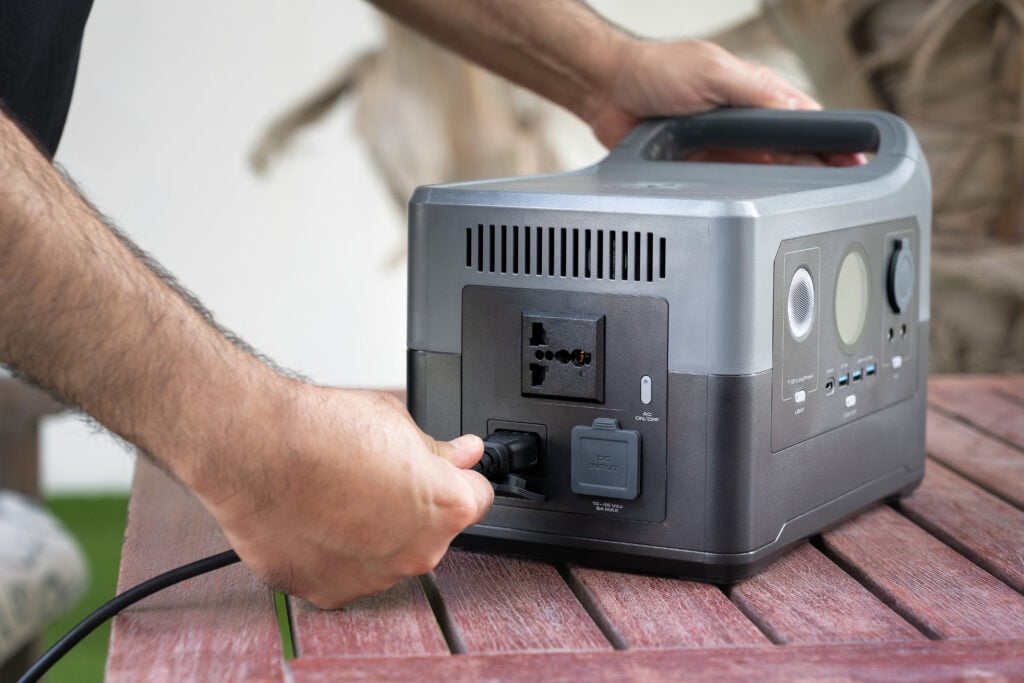
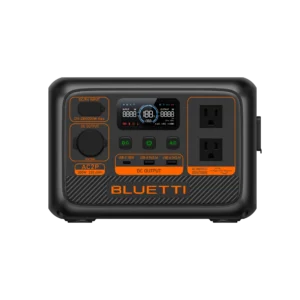
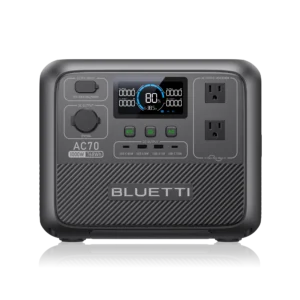
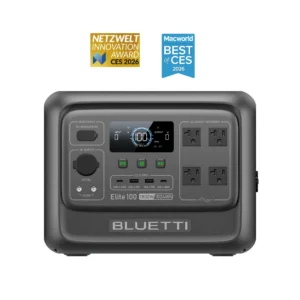
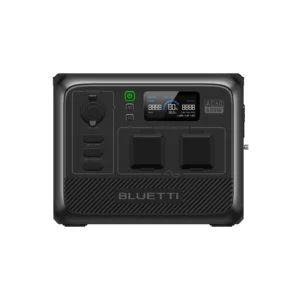
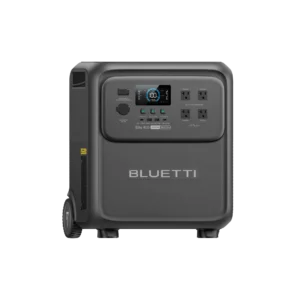
The buyer here wants the lowest price and the lightest body for keeping phones, a laptop, a camera, and maybe a 12V cooler topped up on day trips. Loads are small and mostly USB and DC — running appliances is not the job. The contenders sit close enough on raw specs that price, carry weight, and one documented reliability pattern settle it.
At $129 and 7.9 lb with an integrated handle, the AC2P is the cheapest real LiFePO4 capacity in the Bluetti lineup for this job — and the best value at this size. The 100W USB-C port charges most modern laptops directly, bypassing the inverter entirely, which is the smart way to run a battery this small: the idle tax that would otherwise chew through a 230Wh pack barely registers when the laptop draws straight from the battery. Independent sources consistently flag that port as the unit’s most practical feature.
At a sustained 300W AC draw it empties in roughly half an hour, which is the honest framing: this is a device charger, not a backup box. Running your phone and laptop over USB keeps usable energy in the 200–220Wh range; switching to heavy AC loads cuts that sharply.
There is one real catch. Owner and review reports document a recurring ‘won’t power on after idle storage’ failure pattern — the E113/E116 error family — with Bluetti typically walking buyers through troubleshooting rather than issuing immediate replacements. It is not universal, but it is consistent enough to plan around: buy from a retailer with a straightforward return policy and register the unit immediately. Test it on arrival rather than discovering the problem during a trip.
Skip it if: you need to fly with it or your carry weight ceiling is under 4 lb — the Elite 10 is the move, and it lives in the runner-up slot below.
the flyer’s pick. At 128Wh and 3.97 lb, it is the only Bluetti that fits the FAA 100–160Wh carry-on window and the only one under 4 lb with a real AC outlet. Independent testing measured roughly 100Wh usable at a 170W draw. Buy it only for that reason: at $199 it costs $70 more for 100Wh less capacity, the 3-year warranty is the shortest in the line, and its 100W USB-C port has been documented to reboot Starlink Mini under sustained high draws. Flight-legality and sub-4-lb weight are its entire argument.
Two other units were close enough to name. The AC2A ($219, 204.8Wh) costs $90 more than the AC2P for less capacity in effectively the same body — it shares the same 300W ceiling and the same error-code failure family, so price decides it and the AC2P wins. The Elite 30 V2 ($199, 288Wh) is a genuine step up — its 600W inverter and 10ms UPS push it toward small-UPS duty — but that makes it a different product for a different buyer, not a budget competitor here.
A CPAP buyer’s requirement is not a performance spec — it is a pass/fail question: does this unit actually carry a CPAP with humidifier and heated tube through a full night without cutting out? The two hard gates (pure sine wave output and enough usable overnight energy at the ~40W CPAP load) narrow the field quickly, but the deciding factor is real-world confirmation, not nameplate watt-hours. At a gentle 40W draw, inverter idle taxes a large share of the stored energy before a device ever plugs in, so nameplate Wh is a misleading planning number here.
The AC70 wins this segment on a direct, documented result: independent testing and owner reports confirm 7.5–8.5 hours running a CPAP with humidifier and heated tube, with 30% or more charge remaining at wake-up. That is the specific outcome a medical-backup buyer needs confirmed before trusting a unit in the dark, and it is confirmed. Pure sine wave output is bench-verified clean for sensitive medical and audio equipment. The 5-year warranty is also doing real work here — early production units showed a first-year hardware failure cluster (E065 DC-port fault, plus screen and charge failures), and Bluetti has acknowledged it and honored replacements consistently. Register it the day it arrives and test it before you need it.
Plan around roughly 450–500Wh usable at the CPAP load regime. The 768Wh nameplate is not the overnight planning number — at a gentle 40W draw the inverter idle taxes a meaningful fraction of stored energy before it reaches your machine. The honest figure is what matters, and that honest figure clears a full night.
One limit worth naming: the AC70’s UPS is well-suited to routers and CPAP-class loads, but it has been documented to fail on 300W-plus desktop PCs. That does not affect a CPAP buyer, but do not repurpose this unit as a gaming-PC or server UPS.
Skip it if: you want to run the CPAP over DC to stretch to multiple nights and are comfortable with a lighter, more hands-on setup — the AC50B runner-up below handles that job better.
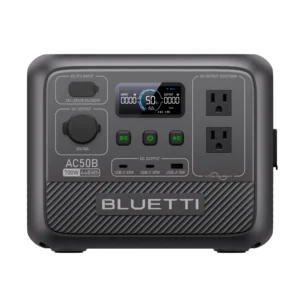
the DC-first, multi-night option. At 16.53 lb and $399 it is 6 lb lighter, and owner reports show multiple nights on a ResMed AirSense running off the DC/USB-C path with the humidifier off — one owner logged 8% drawn over 7.5 hours. That is the efficient path for sleep therapy if you are willing to skip heated accessories. Two things keep it from the top spot for critical overnight duty: Bluetti’s manual explicitly disclaims medical-UPS use, and a documented quirk prevents AC output from auto-resuming after a deep drain — a meaningful risk for unattended overnight use. The AC70 carries a marketed, independently validated UPS; the AC50B is the right call only if DC operation and lighter weight are more important than that assurance.
Two others were considered. The Elite 30 V2 ($199, 288Wh) has a genuine 10ms UPS and is small, but independent testing gives it roughly 6 hours on AC with humidifier and heated tube — short of a full night — which forces the DC path to stretch. Too tight for unattended medical backup unless you run DC and forgo heating. The AC70P ($699, 864Wh) adds 96Wh and a true 2,000W surge over the standard AC70, but the additional usable energy at the CPAP load does not justify the premium for this specific job.
The camping and van buyer needs one box that can go anywhere — run a 12V fridge, charge devices, power a fan, and occasionally fire an induction burner or kettle across a weekend or a solar-supplemented week. The unit has to be light enough to move yourself but capable enough to actually cook. Capacity-to-weight, output headroom, solar replenishment, and value all pull in slightly different directions, and the winner is the unit that balances them best with independent confirmation of the mobile use case.
At $399 for 1,024Wh and a real 1,800W inverter, the Elite 100 V2 delivers the best capability-per-dollar in the Bluetti lineup’s middle tier. Independent testing measured 869Wh usable over DC, 880Wh at the wall, and roughly 910Wh under a 1.2kW draw — 85–89% of nameplate at the loads you actually run at camp. That is enough to stretch a 12V fridge across a couple of days on battery alone. The 1,800W inverter runs air fryers and induction burners without throttling; independent testing confirmed 1,400W air fryers and 1,500W coffee machines handled cleanly.
The 1,000W solar input is the standout spec for mobile use — a 1:1 ratio to battery capacity means one good sun window refills the pack, and it is double the ceiling of units like the AC180 at 500W. At 25 lb with a flat stackable top and dual high-watt USB-C (140W + 100W), it fits the van-and-overland lifestyle that independent sources consistently name as its home turf.
Two setup details matter for mobile use. First, the high-current PV mode is off by default — until you enable it in the app, solar input is capped at roughly 130W regardless of panel size. Do that before your first trip. Second, the Elite 100 V2 cannot start a window-AC compressor even in Power Lifting mode. Neither affects normal camp loads, but both are worth knowing before you load it up.
Skip it if: portability beats runtime for your trips — a solo weekender who will not cook much does fine with the AC70 runner-up below at 22.5 lb and $349.
the lighter weekender. At 22.5 lb and $349 it is 2.5 lb lighter and $50 cheaper. Independent sources that cover camping and van life consistently name it the grab-and-go in this tier. The trade-off is capacity and solar ceiling: usable energy at a weekend cooler-and-mixed-load regime sits near 650–700Wh — well above its 450–500Wh CPAP-regime figure, because a 12V cooler runs on the DC port where the inverter idle tax all but disappears — but still meaningfully less than the Elite 100 V2’s 869–910Wh, and the 500W solar ceiling is the harder constraint for multi-day off-grid trips. Step down to the AC70 for shorter weekends and lighter kits; step up to the Elite 100 V2 the moment you want multi-day cooking and faster solar refill.
Two others were considered. The AC180P ($499, 1,440Wh, $0.347/Wh) has more capacity and the best value per watt-hour among these contenders, but at 35.3 lb it is a meaningfully bigger haul, and independent coverage flags fans that spin up earlier than the standard AC180. A strong choice when capacity beats portability. The Elite 200 V2 (2,073.6Wh, 53.4 lb) is basecamp-grade and stops being a carry-it-anywhere unit — it reappears in the Home Backup segment where carry weight drops out of the equation.
Some buyers do not have the option of keeping their power station dry. Rain, dust, boat spray, and job-site mud are part of the deal — and a unit that warns you to store it away from moisture is simply not the right product. The question here has a short answer: which Bluetti carry an IP65 rating? Two do, and that fact decides the segment before anything else.
The AC60P is IP65 — dust-tight and resistant to water jets from any direction — validated in real rainy-day field testing, not just a lab sticker. At 20 lb it moves easily, accepts B80P expansion batteries (unusual at this size, and useful for splitting the base unit and a battery between two locations), and carries a 6-year warranty — the longest in the lineup, fitting for a unit you are buying to take abuse outdoors.
Be honest about what this rating costs you elsewhere. Strip away the IP65 and the AC60P is a 504Wh unit its own siblings outclass on capacity, solar flexibility, and inverter headroom. Its 12–28V solar window is narrow and underdelivers — real-world testing shows roughly 143W from a 200W panel in optimal conditions. AC output derates from 600W to 500W between 86–104°F, and Power Lifting is unavailable while AC-charging. If you pair it for real camping runtime, a B80P expansion battery is close to mandatory.
Skip it if: weather sealing is not a genuine requirement — in any other context the AC60P’s siblings deliver more for less, and the right choice is one of the other segments on this page.
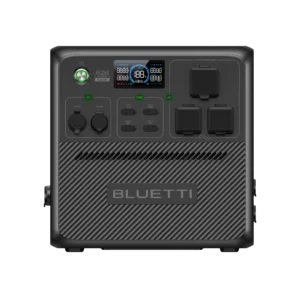
rugged and large. At 1,843Wh, 2,400W output, IP65 sealing, a TT-30 RV outlet, and expandable to 10,443Wh with B210P batteries, the AC240P is the weatherproof choice when you need serious capacity on a job site or a boat. Independent testing confirms it sustains a combined heater-and-griddle load near 2,300W. At 72 lb it is a two-person semi-permanent installation — where the AC60P stays a 20-lb grab-and-go, the AC240P parks. Its 1,200W solar rating is also optimistic in practice (real-world testing sees roughly 600–720W staying under the 60V ceiling), and both Turbo and shore cables are sold separately. The right call when you need IP65 plus serious capacity; the wrong call when portability matters at all.
For most home-backup buyers the question is not output — it is runtime. How many hours does a fridge stay cold? How long does the internet stay up? How much margin is left in the morning? The unit that answers those questions best is the one with the most usable energy per dollar and the lowest idle draw, because both translate directly into days of fridge backup per charge cycle.
The Elite 400 stores the most usable energy per dollar in the entire Bluetti catalog — $0.338/Wh for 3,840Wh — and it actually delivers close to that nameplate in use. Independent testing measured 3,576Wh delivered under a 1,500W draw, roughly 93% of nameplate. The ~12W AC idle is genuinely class-leading; at a gentle overnight draw that low standing consumption translates directly into more hours of fridge runtime compared with units idling at 35W or more. Owner reports back this out: a fridge plus TV plus router plus lights through a 10-hour outage with roughly 20% remaining, and a furnace running about 24 hours with 40% still in the tank.
The wheeled, telescoping-handle chassis is a real feature for a unit this size — store it in a closet, roll it to the kitchen when the power drops. Independent coverage repeatedly compares it to rolling luggage, and that is exactly the right mental model.
Four structural limits define this unit, and all four matter. It is 120V only — no 240V, no transfer panel compatibility. Its hard 2,600W ceiling is real: independent testing tripped it adding a kettle on top of a 2,000W base load, so you cannot run a kettle, fridge, and pumps simultaneously. Like everything in the Bluetti line, disable ECO mode before connecting any intermittent critical load — the default will cut the circuit. And while the 1,000W solar input looks good on paper, it is hard to reach in practice, so treat this as a battery-first unit rather than a solar one. Vertical lifts — stairs — are a three-person job at 86 lb.
Skip it if: your outages are shorter, your budget is tighter, or you need to move the unit yourself — the Elite 200 V2 below is 33 lb lighter, $500 cheaper, and carries the lineup’s highest measured inverter efficiency.
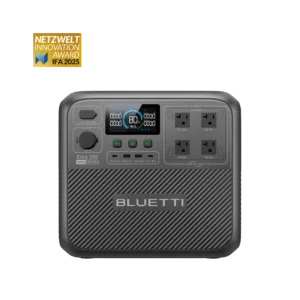
lighter, cheaper, the efficiency leader. At 53.4 lb and $799 it is meaningfully more manageable, and independent testing measured 96% AC inverter efficiency with an idle draw near 9.5–10W — the best in its class. A full-size fridge runs 22–30 hours per charge. Its 6,000-cycle battery is also the longest-cycle-life in this tier. The flipping axis against the Elite 400 is capacity: roughly 1,900–1,990Wh usable versus 3,576Wh — a real gap for multi-day outages. One planning note: its 60V solar ceiling requires parallel panel wiring, not series — a trap that catches buyers who assume standard series strings. The single 10A DC port also rules it out as a van DC hub. Step down to it for shorter outages and tighter budgets; step up to the Elite 400 for multi-day runtime and the roll-anywhere chassis.
Two others came up. The Elite 300 ($1,649, 3,014.4Wh) has more capacity than the 200 V2 but a weaker 2,400W inverter — the lowest in its tier — and a fan that independent sources measure at 50–53dB under high load. At $0.547/Wh it costs more per watt-hour than the Elite 400. Its native TT-30 and 12V/30A DC ports make it the right call for a van build or RV install, not for stationary home backup. The AC200P L ($1,999, 2,304Wh) is expandable, but at $0.868/Wh its value case collapses against the Elite 400, and the expandable role is better served by the Apex 300 in the next segment.
A well pump, an electric range circuit, a transfer switch feeding multiple circuits — these are 240V loads, and nothing in the Bluetti lineup delivers simultaneous 120V and 240V split-phase from a single chassis except one unit. That fact alone decides the segment. There is no runner-up in the traditional sense because no other Bluetti qualifies for the core job.
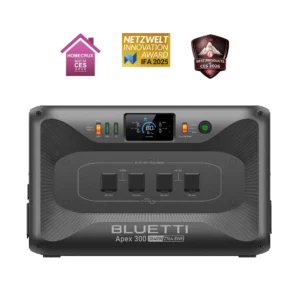
The Apex 300 is the only Bluetti that delivers simultaneous 120V and 240V split-phase from a single chassis — the capability every unit on this page that lacks it cannot be reviewed up to. Independent coverage names this as the primary reason to choose it, and it is. The expansion platform is the second argument: each B300K adds a full 2,764.8Wh, stackable up to 6 per head unit for roughly 19.3kWh, or about 58kWh across three units in parallel. That is genuine multi-day whole-home territory, bought incrementally as budget allows.
At 18–24.7W standby idle it sips significantly less than comparable split-phase alternatives while waiting for an outage — owner reports of a cabin on lights and internet running 5–7 days on a charge reflect that efficiency.
Two things the marketing undersells, both confirmed by independent review, and both decision-relevant:
First, the low idle figure is a standby-only number. In 240V mode under light continuous loads the non-standard pass-through architecture draws 3–4 times the consumed power from the grid — Bluetti has confirmed this is intentional. Do not extrapolate the 18–24.7W figure to inverter-on light-load operation, and expect more battery cycling than the standby spec implies on small continuous loads.
Second, this unit is deliberately unbundled. There are no built-in USB or 12V DC ports — you need the Hub D1 accessory for those. The solar PV cable and the L14-50P Turbo charging cable are not included. And 240V output at only 16A comes from a single unit; 30A service requires two units, 50A requires three. Walk in with an installation plan and an accessory budget before you order.
The 2,400W solar rating is also optimistic for the built-in MPPT (real-world input runs roughly 1,000–1,100W), and a 60–150V dead zone exists between the built-in controller’s ceiling and the SolarX 4K accessory’s floor. If solar is your primary recharge source and you need more than about 660W of panel input, budget for the SolarX 4K.
Skip it if: you do not actually need 240V and weatherproofing is the priority — the AC240P honorable mention below delivers IP65 and serious expandability in a 120V-only body.
It is IP65, expandable to 10,443Wh, and carries a TT-30 RV outlet — a capable platform if a weatherproof body and large-scale 120V expansion matter more than split-phase. The reason it is not the pick here is simple: it is 120V only. For a wired home-backup application where 240V loads exist, the Apex 300 is the only answer. Choose the AC240P only if weather sealing genuinely outranks split-phase in your installation — which for a fixed home backup rarely happens.
Every Bluetti accepts solar, but that does not make every Bluetti a solar generator. The difference is whether the station can actually be recharged day-over-day from panels in the field — and that question is a system problem, not a station-only question. The panel has to fit the station’s MPPT voltage window, the wiring topology has to stay inside both the station’s current cap and the panels’ safe operating range, and the daily harvest has to cover real loads. Getting any of those wrong produces a system that charges slowly, throws errors, or simply does not charge at all.
The pick (portable off-grid): Bluetti Elite 100 V2 + 2× PV350 (parallel)
The Elite 100 V2 accepts 1,000W of solar input across a 12–60V MPPT window with a 20A current cap. The PV350 panel is rated at 350W with a Voc of 46.5V and a Vmp of 37.5V at 9.2A. That voltage sits comfortably inside the 60V ceiling — but only one panel at a time. Two PV350 panels in series would push Voc to 93V, well over the limit and an immediate error. Wire them parallel instead: voltage stays at approximately 37.5V Vmp, current sums to roughly 18.4A, just under the 20A cap. Independent testing measures real output from the PV350 at approximately 280–330W per panel in good direct sun. Two panels in parallel deliver roughly 560–660W, recharging the 1,024Wh pack in about 1.5–2 hours of strong sun. At roughly 600W over five peak-sun-hours, daily harvest comes to approximately 3,000Wh — comfortably more than one full recharge of the Elite 100 V2, so you can run camp loads and refill daily without rationing.
Before the panels ever unfold, enable the high-current PV mode in the app. Independent testing confirms the Elite 100 V2 caps solar input at roughly 130W in its default state and unlocks the full input only after that setting is changed. It is a one-time setup step, but skipping it produces a solar system that runs at a fraction of its capacity.
A few panel notes worth carrying into the field. The PV350 is IP65 — splash-resistant, not waterproof — bring it inside during rain. Do not mix PV-series and SP-series panels; Bluetti states they are not intermixable. If 60 lb of panels is more than your kit allows, a single PV350 (roughly 300W real, about 3.5–4 hours to recharge) is a viable lighter option. For buyers with smaller stations or a preference for shade-tolerant panels, 2× SP200L ($349 each, Voc 24.62V, roughly 130W real each, parallel-wired) fits any Bluetti in the lineup and works well in partial shade — though daily harvest is lower. One hard rule: do not pair the PV350 with small Bluettis like the AC2P, AC50B, or AC70. The PV350’s 46.5V Voc exceeds those stations’ roughly 28V input ceilings and throws an overload error.
Skip this pairing if: you need 240V output or cabin-scale capacity — the Apex 300 pairing below is the right system for that job.
The pick (cabin / high-capacity off-grid): Bluetti Apex 300 + 2× PV350
The Apex 300 carries dual MPPT ports, each accepting 12–60V at up to 1,200W. One PV350 per port — the same 46.5V Voc fits the window; two panels into one port in series would exceed the 60V ceiling. Two panels across both ports deliver roughly 560–660W real, and at approximately 3,000Wh of daily harvest over five peak-sun-hours the 2,764.8Wh base unit refills in roughly a day of good sun. Cabin essentials — lights, internet, a small fridge — can run indefinitely on that cycle, and the B300K expansion batteries let the platform grow as loads grow.
The Apex 300’s built-in MPPT is not the limiting factor for small arrays — it handles two PV350 panels cleanly — but its 2,400W solar headline rating is not reachable through the built-in controller alone (real ceiling near 1,000–1,100W). A 60–150V dead zone also exists between the built-in MPPT’s ceiling and the SolarX 4K accessory’s minimum. For arrays larger than roughly 660W of real input, the SolarX 4K is a required addition, not an upgrade — budget for it from the start if solar is the primary recharge source.