
When you purchase through links on our site, we may earn an affiliate commission. Learn more.
Jackery makes thirteen stations. That’s not a lineup designed to make a single right answer easy to find — it’s designed to have a right answer for each kind of buyer. The person who stuffs a power station into a backpack for weekend photography has almost nothing in common with the homeowner who needs to run a well pump through a winter storm. Buy for the wrong job and you’ll either carry unnecessary weight, run out of battery mid-trip, or plug in an appliance the inverter can’t handle.
The honest structure of this page is: buyers first, then the best Jackery for each situation. No unit wins every segment. The 300 v2 is perfect until you want to run a fridge. The 5000 Plus solves 240V loads that no other Jackery can touch — but it weighs 134 lbs and belongs in a garage, not a tent. Several units appear in multiple segments and win in one while losing in another, always for a concrete reason.
Two older models — the original Explorer 300 and Explorer 500 — don’t appear as picks anywhere on this page. Both use older NMC chemistry with shorter cycle life and slower recharge than their LFP successors at similar prices. The 300 v2 and 600 Plus replaced them on every axis that matters for the jobs they’d be asked to do.
Use the table below to find your situation, then read that segment for the full case.
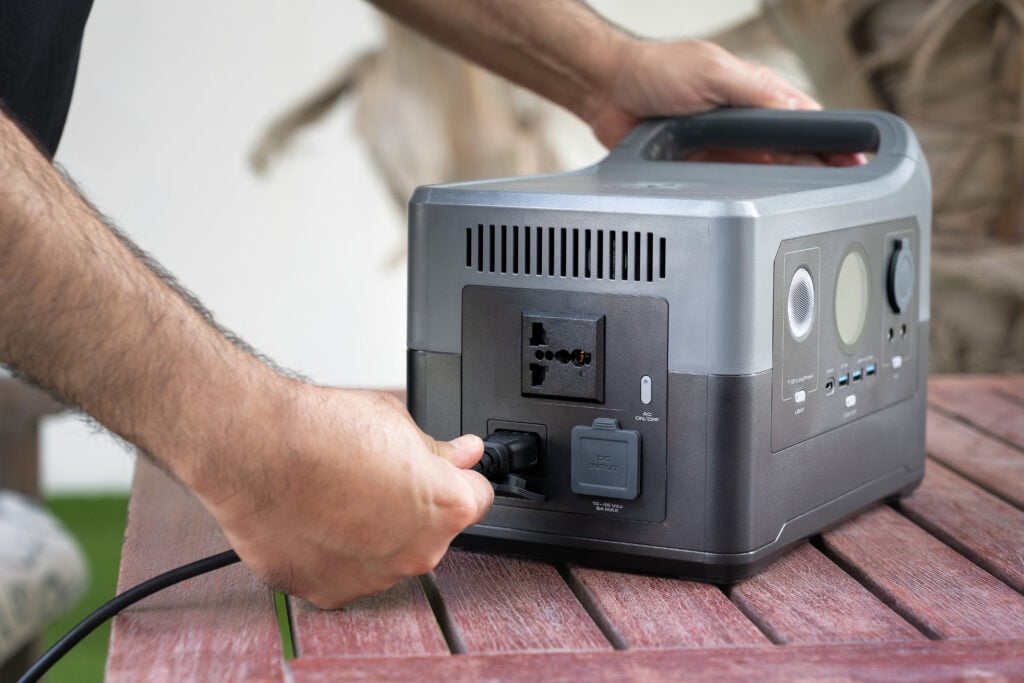
Everything else on this page gets heavier from here. If the station is going on your body or being carried one-handed to a site, the question isn’t which unit has the most features — it’s which unit you’ll actually bring instead of leaving in the car.
The 300 v2 is the lightest station Jackery makes, and that’s the whole case for it in this segment. At 8.16 lbs with a foldable handle, it actually goes where you go. The wall recharge is quick — roughly 76 minutes to full — which means a morning charge before you drive out gets you there at 100%.
The generational story matters here too. The original Explorer 300 the v2 replaced ran on older lithium-ion cells rated for roughly 500–800 cycles; the v2 uses LFP rated 4,000-plus cycles, backed by a five-year warranty. That’s not a minor spec delta — it’s the difference between a station that degrades noticeably over two or three years of seasonal use and one that’s still at full capacity when you replace the tent.
One ceiling to take seriously: a 60–80 W mini-fridge gets three to four hours from this unit and then you’re done. That’s not a flaw — it’s a definition. The 300 v2 is a device charger, not a fridge unit, and the two jobs genuinely require different hardware. At this segment’s real loads (phones, laptops, cameras, lights, drones), expect the inverter’s idle draw to take a meaningful bite out of the 288 Wh nameplate on AC — the DC port returns more. A measured usable-capacity figure for AC loads wasn’t available; plan conservatively.
One setup note worth verifying before you pair it with a 12V compressor fridge: the compatibility fix for that combination is believed to apply to this unit but hasn’t been independently confirmed.
Skip it if: you want to run a fridge at camp — step up to the Explorer 600 Plus, which handles that job cleanly and still comes in under 17 lbs.
Two Jackery units fight for this segment and neither wins cleanly on every axis. The 1000 v2 is lighter and faster to recharge; the 1000 Plus has a bigger inverter and can grow its capacity. The deciding question is whether you’ll be standing next to it — because one behavioral quirk in the v2 only matters when you aren’t.
The flattest stackable top in the 1 kWh class means owners actually carry it instead of leaving it in the trunk — the most-cited reason the v2 edges the competition here. At 23.8 lbs, it moves between car, campsite, and living room without an event. And where older 1 kWh stations demanded a full evening to recharge, the v2 tops up in under an hour and a half from the wall, or under an hour in app Emergency mode. That change alone eliminates the power-rationing mindset that comes with a 7-hour overnight recharge.
The 1,500 W inverter handles a 1,200 W coffee maker, a microwave, and full-size fridges — owners logged 15-plus-hour fridge runs. Plan loads around 1,500 W continuous; the 3,000 W surge rating is optimistic, with bench shutoff observed near 2,200 W. Running near-silently at camp loads (under 22 dB during standard charging, with the fan only becoming audible past roughly 1,000 W), it’s genuinely unobtrusive at a site.
At real AC loads in the 100–300 W range, plan around roughly 900 Wh usable — Jackery support acknowledges a 15% AC conversion loss plus about 10 W of idle draw, and independent multi-unit run-downs averaged even lower. The on-unit display understates energy consumption at light loads because it ignores idle draw. DC-port loads bypass the inverter and land closer to nameplate, so a 12V cooler runs longer than the AC-port math would suggest.
There’s one behavioral limit that defines who this unit is and isn’t for: the 1000 v2 has no configurable low-battery cutoff, and a pattern of silent AC-output drops has been documented. Neither matters when you’re at the campsite watching it. Both are disqualifying if you want to set it up as an unattended multi-day fridge backup — that’s a different segment.
Skip it if: you want to set it up as an unattended backup and walk away — the HomePower 3000 or 3600 Plus is the right tool for that job.
The 1000 Plus costs $100 more and weighs about 8 lbs more, and in exchange you get a genuine 2,000 W inverter — independently verified at 2,136 W sustained under thermal stress — plus an expansion path to just over 5 kWh via the Battery Pack 1000 Plus. Fridge-compressor startups that occasionally cause a moment of drama with the v2 are a non-event here. If you know you’ll use either the higher output ceiling or the expansion slot, it’s worth the premium and the carry weight. If you won’t, you’re paying for ports you’ll never touch. Note that this expansion ecosystem is closed — the 1000 Plus packs aren’t cross-compatible with the 2000 Plus or 1000 v2 lines. One real-world habit worth building: with the inverter on and no load connected, the 1000 Plus depletes in just over a day — switch outputs off when it’s sitting idle.
If your loads genuinely stay under 800 W — no kettle, no Keurig, no portable heater — the 600 Plus at $429 delivers a Review-confirmed three-day camping endurance (one trip ended at 25% remaining) in a 16-lb body. The 800 W ceiling isn’t a soft limit; it’s a hard wall. That’s exactly why this segment steps up to the 1 kWh class for general all-around use, but if 800 W honestly covers your kit, there’s no reason to pay for more. Full treatment in the CPAP segment below.
The CPAP buyer has a different problem than every other segment on this page: the draw is tiny — 30 to 50 watts — and it runs all night, next to a sleeping person. At that load profile, the choice of output port matters more than total capacity. An AC inverter that idles at 10 watts while delivering 40 watts burns through a battery twice as fast as a 12V DC connection to the same machine. That arithmetic makes the DC port the most important spec on this page for this buyer.
At least two full nights of CPAP runtime from the 12V DC output — without touching the AC inverter — is the owner-confirmed use case that earns the 600 Plus this segment. That result appears repeatedly across owner reports, in the lightest body in the Jackery lineup that also clears the 800 W output threshold for occasional real-world loads. The unit charges in about 1.6 hours from the wall, and an app-configurable charge floor lets you protect the cells if you’re storing it between uses. Sub-20 ms UPS keeps the machine alive through a grid dropout without a sleep interruption.
One bedside reality to know before you buy: the fan ramps audibly under thermal load. One owner was woken at roughly the 5.5-hour mark. Running off the 12V DC port rather than AC keeps the unit cooler and the fan quieter — which also happens to be the right call for runtime, so the two interests align. If truly silent operation is a hard requirement, this is a known friction point.
Setup note: the 600 Plus uses a new DC8020 connector. Older Jackery car or solar cables need an adapter that doesn’t ship in the box.
The AC usable figure for this unit wasn’t measured in available sources; the runtime data above is DC-port-specific. Don’t apply the overnight DC runtime to estimate AC-port endurance — the inverter idle makes the comparison meaningless.
Skip it if: you travel with a humidifier and want four-plus nights between charges — the Explorer 1000 v2 covers that and costs $70 more.
For longer trips or humidifier use, the 1000 v2 is the natural step up: owners report two full nights with the humidifier running, or four-plus nights running dry off the DC output. The humidifier draw is the variable that decides which number applies to you. At $499 and 23.8 lbs, it costs $70 more than the 600 Plus and carries 7.7 extra pounds you don’t need if the CPAP is the only job — but if it’s also your weekend camping station, that weight is already justified elsewhere.
For a stationary bedside backup through extended outages, the HomePower 3000 operates in a different class entirely: owners measured ten-plus nights with the humidifier off and three to four with it on. It’s among the quietest units measured (42 dB idle), which matters as much as the capacity when something is running in a bedroom. At 59.52 lbs and $1,699, it belongs in a closet with a power cord to the outlet — not in a travel bag. Full treatment in the home backup segment.
At the 2 kWh tier, every Jackery in the field nearly ties on paper. The 2000 v2 and 2000 Plus carry the same 2,042 Wh of cells; the 1500 v2 runs 25% less capacity for $100 less. What actually separates them is physical — how often you lift the unit, and where you recharge it.
Against the 2000 Plus’s 61.5 lbs for the same energy, the 2000 v2 at 38.9 lbs measured isn’t a modest advantage — it’s the difference between a unit you move freely and one that needs two people and a plan. For a buyer who loads and unloads at every site, that gap is transformative, and it’s the reason this unit wins the segment.
The 2,200 W inverter earns its rating: testers ran a 2,100 W coffee machine plus heat gun, a 1,600 W air fryer, and a 2,100 W steam iron without trouble. The planning ceiling is 2,200 W continuous — running two 1,100 W appliances simultaneously tripped the unit in at least one owner test, so the 4,400 W surge figure isn’t a load to size against. Measured runtimes put a full-size fridge at 21.3 hours; a 12V camper fridge stretched five days (78% to 13% battery); a 12V freezer at −18 °C held 86 hours. Usable energy at real appliance loads measures roughly 1,710–1,740 Wh — about 84–85% of nameplate, which is normal inverter loss at this load level.
Two limits to plan around. First, cold weather: this unit won’t accept a charge below 32 °F, and discharge drops out at 14 °F — winter campers need to keep it warm to top up overnight. Second, the 400 W solar input is the single most-criticized trait in owner reports, and justifiably so. For a buyer who plugs into shore power between sites, it’s a non-issue. For a buyer who wants to run solar-primary off-grid with no wall access, it’s the binding constraint — and that buyer should be looking at the 2000 Plus instead.
One more note for anyone considering this as an unattended home backup: the auto-switchover to UPS mode has a documented pattern of occasionally failing to engage. It’s a real pick for attended outage use; unattended fridge-and-leave duty belongs with the HomePower units.
Skip it if: solar is your primary recharge source rather than a top-off — the Explorer 2000 Plus‘s 1,400 W solar input changes the off-grid math entirely.
The 2000 Plus carries the same 2,042 Wh but answers two different questions: can it run heavier loads, and can it grow. On loads, independently verified 3,000 W held for 15 minutes — it powered an RV 30A outlet where a 2,000 W competitor stalled, and ran a 12,500 BTU air conditioner for about 1.2 hours at full draw. On growth, it expands from 2 kWh up to 12 kWh on a single unit (24 kWh across two), with each expansion pack adding its own solar inputs and the 1,400 W solar ceiling making genuine off-grid top-up viable. Usable energy at AC appliance loads runs roughly 1,678–1,780 Wh. The honest trade: it weighs 61.5 lbs on wheels, costs $1,399, and the expansion and inverter headroom are wasted money if you’ll never use either. Two quirks worth knowing: a 1,440 W bypass cap applies while AC-charging, and there’s a documented overnight-panel behavior (labeled F7 in owner discussions) if you wire solar — worth reading the manual on before a long off-grid stint.
If 1.5 kWh honestly covers your usage — you’re not pushing the top end and every pound of carry weight counts — the 1500 v2 at $699 and 31.97 lbs deserves a look. Its LFP cells are rated 6,000 cycles, the highest tier in the lineup, and the 10 ms UPS is one of the faster switchovers Jackery offers. A Review-validated simultaneous load of air fryer, Starlink, and fridge confirms it handles real cooking setups. Two things it shares with the 2000 v2: the same 400 W solar ceiling, and no expansion path. One hard exclusion the Review is direct about: it is not an EV range-extender — a full discharge added about two miles to a Cybertruck test, which tells you everything about the energy-to-EV-range math.
The usual calculus — capacity versus weight versus price — doesn’t decide this segment. The moment a station lives in a truck bed or at an unprotected site, one question supersedes all others: what happens when it gets wet?
The 1500 Ultra is the only Jackery portable with an IP65 rating, and that’s the whole reason it wins here — everything else in the lineup is an indoor or sheltered unit that happens to be portable. IP65 was independently verified through rain exposure, a one-meter concrete drop, and 90 minutes of rough-terrain transport. The engineering choice behind the rating is internal-only cooling with bottom vents: no exposed side fans means no apertures for water or dust to enter under normal field conditions, a design nothing else in this class offers.
The inverter overdelivers for its rating: bench testing found it sustaining roughly 2,200 W before cutting near 2,300 W, with measured efficiency at 91% sustained and up to 98% peak — figures one lab described as among the best it had recorded for a unit in this class. Running under 30 dB at normal operation and around 40 dB under load, it’s quiet enough for tent and van use. Measured runtimes: a kitchen fridge for 10 hours 40 minutes, Starlink Mini for up to 50 hours.
Three operating realities to plan around. Cold derating is manufacturer-stated — output drops to 1,000 W between 5 °F and 14 °F — but that figure hasn’t been independently tested; treat it as the planning floor for deep-winter loads, not a confirmed measurement. Backup mode caps near 1,300 W and voltage sags to 114 V by 30% charge, which rules it out for precision-UPS duty; that buyer belongs with the HomePower 3600 Plus. AC outlets don’t auto-resume after a full drain. And the bottom intake vents, while cleanable via the removable metal base, collect dust in exactly the environments this segment describes — build cleaning into your maintenance routine rather than assuming it takes care of itself. There is no expansion path.
One note for buyers considering it as an indoor alternative to the 1500 v2: without weather exposure in play, the 1500 v2 handles the same 1.5 kWh job for about $300 less. The Ultra’s premium buys the IP rating; if you’re not in the field, you’re buying it for no reason.
Skip it if: you need it for a home UPS role — backup mode’s 1,300 W cap and the voltage sag at low charge make the HomePower 3600 Plus the right call for that job.
A closet power station is a different machine than a camping one. It sits idle for months, then has to deliver the moment the grid cuts — no warm-up, no reconfiguration, no one standing over it. Standby retention, switchover speed, and the question of whether your needs might grow are the axes that matter, and two Jackery units split them almost perfectly between them.
The reason the 3600 Plus takes this segment over the HomePower 3000 comes down to one question: do you need your capacity to stay fixed forever? If there’s any chance your needs grow — a second fridge, a medical device added to the circuit, a generator-free ambition — the 3600 Plus expands to 21 kWh across five packs, and the HomePower 3000 does not expand at all. For a unit you’re buying to live in a closet for a decade, that’s the deciding fork.
The hardware clears the bar on every essentials axis. Independent bench testing found roughly 90–91% of rated capacity available at the AC outlets. Stacked kitchen loads ran cleanly near 3,200 W, with 4,700 W held in stress testing. The TT-30 30A outlet outputs a true continuous 30 amps — relevant for transfer-switch wiring. At light load it runs near 30 dB in Quiet Mode (climbing to about 55 dB at full draw). Ten millisecond UPS keeps essentials alive through a switchover. A 30-year-old refrigerator ran 24 hours on under half the battery; a realistic fridge-plus-essentials estimate is one to two days per charge.
Cold-weather charging is a genuine differentiator at this size: the 3600 Plus accepts charge and delivers power from −4 °F to 113 °F, which is the stated reason off-grid owners chose it over the HomePower 3000. No other Jackery at this capacity tier matches that window.
Several operating details matter for safe setup. Bypass and UPS mode cap outlet output near 1,440 W — an 1,800 W space heater trips it instantly while plugged in, so don’t plan that circuit while on grid power. The standard AC outlets split across two breaker banks; the full 3,600 W lives on the TT-30, not the standard outlets. The two solar ports share a single charge controller: mismatched third-party panels can drive damaging overcurrent into the lower-spec port, so match panel specs per port carefully. There is no 12V DC output on this unit.
The 14-day marketing runtime figure is a fully-expanded-system number; an independent fridge-only test at 21 kWh reached about 9.5 days, which gives you a realistic anchor for planning your expansion needs.
Skip it if: you’re certain your capacity needs will never change and want the quietest possible unit — the HomePower 3000 is the better closet machine for a buyer who’ll never expand.
The HomePower 3000 is the quietest unit in the Jackery lineup by measured accounts — 42 dB at idle, described in one test as near-silent even at close range under near-maximum load. It’s also the truest buy-and-forget closet unit in the range: ZeroDrain holds roughly 95% of charge after 12 months on the shelf, assuming the inverter outputs are switched off (with AC on, idle draw measured up to about 30 watts, or roughly 1% per hour — turn the outputs off before storing). Independent bench testing found 92% of rated capacity usable at the AC outlets; the TT-30 held 3,600 W for 10 minutes without voltage drop; fridge runtimes ran 24 to 30-plus hours. At $1,699, it’s $200 less than the 3600 Plus and 17 lbs lighter without wheels. The reason it’s runner-up is single and absolute: it does not expand. Its own coverage documents buyers who assumed it shared Plus-line expandability and felt deceived by that assumption. If you’ve accepted the no-expansion reality and want the quietest, simplest closet machine Jackery makes, this is it. If there’s any doubt, the 3600 Plus is the safer buy.
The 2000 Plus at $1,399 is the entry point for buyers who want an expandable system without the HomePower price. It reaches 24 kWh across two units, has a 30A outlet for transfer-switch integration, and delivers 3,000 W from its inverter. The reason it sits below the HomePower pair here: one detailed owner report documents a firmware pattern after roughly a week of continuous pass-through use where the unit stopped recognizing grid input and began silently draining its own battery. That’s thin evidence, but the consequence is severe for a set-and-forget backup. Deploy it as attended or periodically-checked backup rather than sealed-closet UPS duty, and it earns its place in this segment.
Split-phase 240V output isn’t a preference — it’s a physical requirement for well pumps, electric ranges, and central air conditioning. Either a unit delivers it or it doesn’t, and the entire field of Jackery portables collapses to one name.
The 5000 Plus is the only 240V Jackery. Split-phase output was independently verified at 2.2–2.6% total harmonic distortion across loads up to 7,200 W — clean enough for sensitive electronics. Testing confirmed it powered dual RV air conditioners, a 2,400 W well pump, and full kitchen loads simultaneously. The NEMA 14-50 delivers true 120V/240V split-phase; owners run it into a transfer switch for multi-circuit coverage.
Charging is one of its genuine headline achievements: wall to full in 1 hour 42 minutes measured — faster than the 3.5-hour rated figure suggests. The 4,000 W solar input is the deepest in the Jackery lineup, fed via standard MC4 on the high-PV input port, and verified real-world intake ran 3,600–3,900 W with a strong array. Owners build 10–20 kWh systems routinely; expansion reaches 60 kWh per unit on proprietary packs that aren’t cross-compatible with the Explorer 2000 or 1000 Plus lines.
The measured surge numbers matter here: independent testing put the surge at roughly 8,000 W over 30 seconds and about 9,500 W over 20 seconds. The 14,400 W marketing claim is not a figure to size loads against. True 0 ms UPS requires Online mode via the Smart Transfer Switch, which needs an electrician install and carries a continuous idle draw of 50–58 watts — that’s the topology, and it doesn’t go away. Standalone backup mode switches in under 20 ms with a brief cut. Central air conditioning needs a soft-start capacitor to manage compressor startup.
Several operating rules are firm. AC wall charging disables 240V output entirely — generator users recharge fast, then disconnect before reconnecting 240V loads. Pass-through is capped at 500 W with a 1,500 W system ceiling while charging. The NEMA 14-50 is physically a 50-amp receptacle but rated for 30-amp service — don’t wire it for more. IP20 means indoor installation only; the cooling fans pull in whatever air surrounds the unit, so keep it away from moisture and dust. One solar wiring detail: the high-PV input has a 135 V floor on panel strings, which means SolarSaga 500X panels need a minimum of four in series to clear it — three panels at 41.7 V each falls 10 volts short.
Measured runtimes at this segment’s loads: a 21 cubic-foot refrigerator for 28 hours, a home office for 18 hours, central air conditioning for 2.8 hours. Essential circuits without solar top out at roughly 10 hours; multi-day whole-home coverage requires expansion packs or solar offset. The HomePower 3600 Plus can reach 240V as a two-unit pair, but that configuration costs more than a single 5000 Plus, and the 3600 Plus’s own coverage redirects that buyer here.
Skip it if: your loads are all 120V — the HomePower 3600 Plus does everything a 120V home backup needs at $1,000 less, with a fraction of the weight.
Picks on this page come from deciding what the use case actually rewards — then judging each unit by how it behaves under those conditions, not by how it reads on a spec sheet. The criteria that matter shift with the job, so a unit that’s decisive in one segment can be disqualified in the next by a single behavior. Where two contenders cleared the same bar, documented performance under real load settled the pick, not a comparison of rated numbers.
Portable power stations hide most of what matters behind the nameplate. Rated capacity tells you almost nothing about the energy you actually get: inverter idle draw eats into every watt-hour delivered at AC, so a light load through an AC port returns far less than the same load through a 12V DC port — and that gap is the single biggest runtime lever on every unit in this lineup. Sustained output is another number the box often flatters; what matters is whether the inverter holds its rated wattage for the duration of a cooking session, not just for a five-second surge test. Standby drain decides whether a closet unit arrives at an outage with useful charge. Switchover speed and low-battery behavior determine whether backup duty is attended or unattended — a distinction that changes the pick entirely in two of these segments.
We weighed those factors — real-load usable energy, sustained output, standby retention, recharge speed, and the reliability patterns that only surface in extended use — against each buyer’s actual situation. Numbers on this page reflect the conditions under which a given buyer would run the unit, not best-case lab figures. Chemistry and cycle life informed long-term value; LFP’s 4,000–6,000-cycle ratings versus older NMC’s roughly 500–800 set a durability floor that shaped several decisions.
Source material spans independent bench testing, owner reports from extended real-world use, and manufacturer specifications — with independent measurements given priority wherever they diverged from the label. Per-unit evidence lives in each segment below, not here.
The picks above answer “which one for my situation.” This table answers “show me everything, I’ll decide.” It lays every unit out on the same axes used to make the calls — measured behavior, not nameplate specs — so a reader whose priorities cross segments can weigh the tradeoffs directly instead of trusting our segmentation.
| Unit | Capacity (Wh) | Rated Output (W) | Surge (W) | Weight (lbs) | AC Recharge | Solar Input (W) | Price | Value ($/Wh) | Buy |
|---|---|---|---|---|---|---|---|---|---|
| Explorer 300 v2 | 288 | 300 | 600 | 8.16 | ~1.27 hr | 100 | $269 | $0.93 | Check price |
| Explorer 600 Plus | 632 | 800 | 1,600 | 16.1 | ~1.6 hr | 200 | $429 | $0.68 | Check price |
| Explorer 1000 v2 | 1,070 | 1,500 | 3,000 | 23.8 | ~1.58 hr | 400 | $499 | $0.47 | Check price |
| Explorer 1000 Plus | 1,264 | 2,000 | 4,000 | 32 | ~1.7 hr | 800 | $599 | $0.47 | Check price |
| Explorer 1500 v2 | 1,536 | 2,000 | — | 31.97 | — | 400 | $699 | $0.46 | Check price |
| Explorer 1500 Ultra | 1,536 | 1,800 | 3,600 | 38.6 | ~2 hr | 800 | $999 | $0.65 | Check price |
| Explorer 2000 v2 | 2,042 | 2,200 | 4,400 | 39.5 | ~1.75 hr | 400 | $799 | $0.39 | Check price |
| Explorer 2000 Plus | 2,042 | 3,000 | 6,000 | 61.5 | ~2 hr | 1,400 | $1,399 | $0.69 | Check price |
| HomePower 3000 | 3,072 | 3,600 | 7,200 | 59.52 | ~2.2 hr | 1,000 | $1,699 | $0.55 | Check price |
| HomePower 3600 Plus | 3,584 | 3,600 | 7,200 | 77.16 | ~2.5 hr | 1,000 | $1,899 | $0.53 | Check price |
| Explorer 5000 Plus | 5,040 | 7,200 | ~8,000–9,500 W measured | 134.5 | ~3.5 hr rated / 1 hr 42 min measured | 4,000 | $2,899 | $0.58 | Check price |
— = not independently verified for this guide.
The questions here are the ones that don’t belong to any single pick — the cross-cutting concerns that come up regardless of which unit a reader lands on. We pulled them out of the individual segments so each answer lives in one place, addressed against the same standard of evidence used throughout the page.
The 1000 v2 has two behavioral quirks that are irrelevant when you’re present and disqualifying when you’re not: it has no configurable low-battery cutoff, and a pattern of silent AC output drops has been documented in owner reports. At a campsite, either of those is a minor nuisance you notice and address. In a closet running a fridge through a two-day outage while you’re asleep, the fridge goes warm before you realize the station stopped delivering. The unit itself hasn’t changed — the supervision regime has. The HomePower units are designed for exactly the closet-and-forget deployment the 1000 v2 isn’t suited for.
The short answer is yes, briefly — but it’s not the right tool for that job. The 600 Plus’s 800 W rated output is a hard ceiling, not a soft guideline, and most compressor fridges draw well under that on steady state. The problem is runtime: at fridge loads through the AC port, you’re fighting both the actual fridge draw and the inverter’s idle tax on a 632 Wh battery. The 300 v2’s write-up notes a three-to-four-hour ceiling for a 60–80 W mini-fridge at that capacity class, and the 600 Plus carries roughly twice the capacity, so you’d expect roughly double the runtime before the math bottoms out — still not a multi-day solution. If continuous fridge duty is the job, the Explorer 1000 v2 at $499 is the step up that changes the answer, and running fridge loads through a 12V DC port rather than AC makes every station in the lineup last meaningfully longer.
Three things: inverter headroom, solar input, and expansion. The 2000 Plus delivers a verified 3,000 W continuous — enough for an RV 30A outlet and a 12,500 BTU air conditioner — where the 2000 v2 plans around 2,200 W. Its solar input ceiling is 1,400 W versus the v2’s 400 W, which changes the off-grid recharge math entirely for a solar-primary setup. And it expands from 2 kWh to 12 kWh on one unit, 24 kWh across two, where the v2 is sealed at 2 kWh. If none of those three things apply to how you’ll actually use it — you recharge from shore power, your heaviest appliance stays under 2,200 W, and you’ll never add packs — you’re paying $600 for capability you won’t touch, and you’re also picking up 22 extra pounds. The 2000 v2’s $0.39/Wh is the best value figure in the Jackery lineup; the Plus earns its premium only when the premium buys something real.
One reason: the 3000 cannot expand, ever. The 3600 Plus grows to 21 kWh across five packs; the 3000 is sealed at 3,072 Wh for its lifetime. For a unit you’re buying as a long-term home backup, that finality matters — needs change, appliances get added, medical equipment enters the picture. The 3600 Plus also charges and discharges in temperatures as low as −4 °F, a window the 3000 doesn’t match, which is the documented reason off-grid buyers chose it. The 3000 wins on quiet (42 dB idle versus the Plus’s 30 dB Quiet Mode — though both are livable), on price ($200 less), and on weight (17 lbs lighter without wheels). If you’re certain your capacity needs will never change and you want the most silent, unobtrusive closet unit Jackery makes, the 3000 is the better machine. The 3600 Plus wins for everyone who can’t say ‘never’ with confidence.
The 3600 Plus can reach 240V, but only as a two-unit pair — and that pair costs more than a single 5000 Plus. The 5000 Plus delivers native split-phase 240V from one unit, independently verified at clean 2.2–2.6% THD across loads up to 7,200 W. If 240V is your requirement, the 5000 Plus is the straightforward answer and the 3600 Plus’s own coverage redirects that buyer to it. The 3600 Plus is the right machine when your loads are all 120V and you want the most capable single-unit home backup Jackery makes at that voltage class.
All current Jackery picks on this page use LFP (LiFePO4) cells, which is a meaningful baseline — longer cycle life, safer thermal behavior, and better long-term retention than the older NMC chemistry the original Explorer 300 and 500 used. Within LFP, there’s a tier difference: most of the lineup is rated 4,000-plus cycles, but the Explorer 1500 v2 and HomePower 3600 Plus carry 6,000-cycle cells — the highest tier in the lineup. For a unit that will see heavy daily use or sit as a decade-long home backup, that extra longevity has real value. For a station you charge and discharge a handful of times a year at camp, the practical difference between 4,000 and 6,000 cycles is negligible — either outlasts reasonable ownership on that use pattern. The five-year warranty Jackery backs LFP with across the lineup is the more immediately relevant figure for most buyers.
If you came here wanting one portable station for camping and the occasional home outage you’ll be around for, the Explorer 1000 v2 is the default: it’s the lightest 1 kWh option, recharges faster than anything in its class, and handles the mid-load appliance draws most people actually run. Step up to the Explorer 1000 Plus if you know you’ll use a 2,000 W inverter or want the expansion slot; step down to the Explorer 600 Plus if your loads stay modest and CPAP overnight runtime is the headline job. For anyone who needs to move a 2 kWh station regularly and recharges from shore power or a campsite outlet, the Explorer 2000 v2 wins on weight and value — $0.39/Wh and under 40 lbs is a combination the 2000 Plus can’t match unless the expansion or solar headroom is real for you.
The specialty picks are clear in their lanes. The Explorer 1500 Ultra wins the moment weather enters the picture — IP65 is the only weatherproofing in the Jackery portable line, and that gap doesn’t close. The HomePower 3600 Plus is the closet backup for anyone whose needs might grow; the HomePower 3000 is the quieter, cheaper answer for anyone certain they won’t expand. The Explorer 5000 Plus stands alone for 240V loads — well pumps, ranges, central air — where no other Jackery gets you there from a single unit. And the Explorer 300 v2 remains the right answer for the buyer who values the lightest possible carry above everything else, as long as they understand it’s a device charger, not an appliance runner.