

When you purchase through links on our site, we may earn an affiliate commission. Learn more.
Van-life solar doesn’t work like camping solar. The panel lives outside permanently, conforms to a roof that curves, and feeds a power station from a moving vehicle — or it deploys every morning on a cable and gets stowed every night. Those two jobs want completely different panels, and the camping instinct to grab the lightest foldable is often the wrong call here.
The buying decision really comes down to how you’re mounting it. A flexible that conforms to your roof and harvests while you drive is one answer. A rigid glass panel bolted to a roof rack for a decade of trouble-free service is another. A modular setup you run out into the sun from a shaded parking spot is a third. Each paradigm has a clear winner — and a panel that’s the right call in one role can be the wrong tool in another.
Two voltage warnings apply across every choice here: the Bluetti PV100 FX runs a 41.4V open-circuit voltage that exceeds the input ceiling of Bluetti’s smaller stations, and the EcoFlow 125W Modular runs 50V, which clears the input window of most non-EcoFlow stations and several smaller EcoFlow units. Neither issue is fixable with an adapter. Verify your station’s solar input range before anything else.
Use the table below to find the mounting paradigm that matches how you’re running the van, then read that segment for the full case — output numbers, weatherproofing ratings, and the catches that change decisions.
The curved van roof is the whole problem. No rigid panel conforms to fiberglass contours, no foldable stays aerodynamic at highway speeds, and a panel with a weather restriction is simply the wrong choice for a surface that sits in rain every time clouds roll through. For a flush-mount rooftop install, the decision comes down to one question: is the panel genuinely built to live outside indefinitely?
The EcoFlow 100W Flexible wins this segment on the axis that a roof panel cannot compromise: it is genuinely rated for submersion, confirmed in long-term outdoor installs that included hail, and carries no manufacturer restriction against standing rain. That IP68 certification is what separates it from every other flexible in this comparison. Its 258° flex arc conforms to curved van and cathedral roofs where no rigid panel can follow, and it mounts flat — adhesive strip or grommet, no roof penetrations required. At 5.1 lb it barely registers on the roof load, which is consistently the most-noted virtue in long-term installs.
Output in direct sun runs 70–90W per panel. Run two in series and independent testing shows the pair delivering 158–159W — strong for flexible-cell hardware. The 20.3V Voc sits inside EcoFlow’s entire station lineup’s 11–30V input window without ceiling risk, a real advantage over higher-Voc flexibles. For non-EcoFlow stations, verify the input range before wiring.
Two catches are worth taking seriously. The warranty is approximately 12 months — not prominently disclosed — and there is a documented failure at 15 months alongside category-level evidence that flush mounting on a hot roof accelerates heat degradation faster than a freestanding panel would. Longevity past that window is not independently established. And this panel has notable shade sensitivity: a hand-shadow or leaf-filtered light can drop output toward zero, worse than bypass diodes should produce. Site it where the roof gets clean, unobstructed sun — a partially shaded install will underperform well below what the output figures suggest.
The short warranty and heat-degradation uncertainty are real. Going in with eyes open means treating a flush flexible as a medium-term install — not the decade-plus service life the rigid segment’s pick offers.
Skip it if: your roof gets partial shade for much of the day, in which case the deploy-and-aim segment’s pick will put far more watt-hours into your station by letting you chase the sun.
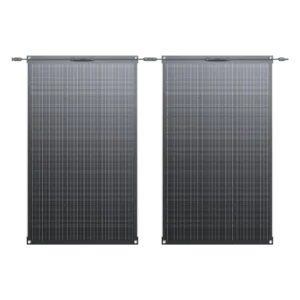
The PV100 FX is lighter (4.85 lb), cheaper ($164.50), and for a Bluetti owner running an AC180, AC200, or Apex-class station it has the appeal of staying in-ecosystem. It loses the segment on the one axis that matters most for a roof panel: its IP67 rating comes with an explicit manufacturer caution against leaving it in standing rain, and a permanently mounted roof panel lives in standing rain as a matter of course. There is also no independent real-world output measurement for this panel and no long-term durability data to lean on — so you’d be accepting both a weather-exposure risk and an output planning gap simultaneously.
One hard constraint before purchasing: the PV100 FX’s 41.4V Voc exceeds the solar input ceiling of Bluetti’s smaller current stations — the AC2A ceiling is around 28V. The same-brand badge does not bridge that gap. This panel is only safe on AC180, AC200, Apex-class, and larger Bluetti stations; on a smaller unit, it is simply the wrong panel regardless of other considerations.
The case for a rigid roof panel is the case against flexible longevity. Flush flexibles bring conformance and low weight; they also bring a heat-degradation question mark and warranties measured in months, not years. A van full-timer optimizing over years rather than seasons often lands on a different answer: bolt tempered glass and an aluminum frame to the roof rack and stop thinking about panel replacement.
Among the rigid panels in this comparison, the SolarSaga 100 Prime is the only one purpose-engineered for living on a vehicle roof. It ships with a Z-bracket mounting kit, 12 pre-drilled holes, an aerodynamic low profile designed for a moving vehicle, and IP68 weatherproofing — the full stack of what a permanent bolt-down install actually requires. Jackery’s own foldable SolarSagas use ETFE and canvas construction and come with instructions to bring them in when it rains; this panel has no such restriction. An overlander reports keeping a Jackery 1000 charged while driving with it mounted — that harvests-while-moving capability is exactly the permanent-mount advantage.
The durability profile is the real argument here. A tempered-glass panel with a 5-year warranty and an 80%-at-10-years output claim is a fundamentally different proposition than any flexible on this page, and for a full-timer who expects to live with the same roof panel for years, that gap is the decision.
One planning note on output: real-world numbers swing from 93W at an optimized roof angle down to around 45W when the host station is drawing idle power. Part of that lower figure is host draw, not panel performance. On a fixed non-tiltable roof angle, plan around the conservative end of that range rather than the peak.
Connector logistics are worth sorting before install day: the in-box Anderson-to-DC8020 adapter covers current Jackery Explorers. Older Explorer models need a DC7909 adapter, and parallel multi-panel strings need additional Jackery adapters — neither is in the box by default.
A natural-seeming candidate for this segment is the EcoFlow 125W Bifacial Modular — rigid tempered glass, strong output numbers, IP68. It is not a fixed-mount option. EcoFlow positions it explicitly as a deploy-and-stow panel: it has no mounting feet, it is light enough that wind tips it over, and our EcoFlow 125W Modular review identifies permanent mounting as the wrong job for it. It is the pick for the deploy-and-aim segment below, where its design does exactly what it was built for.
Skip it if: you’re not running a Jackery station and don’t want to manage adapter compatibility — or if you park in shade and need a panel that moves with you, in which case the deploy-and-aim pick is the right tool.
Parking in shade is one of the better van-life heat management moves, and it costs nothing in solar harvest if you’re running a panel on a cable out into the sun. The panel gets deployed in the morning, aimed at the sun, and stowed before you move — every day, for months. That daily rhythm changes what matters: raw output gets you to shortlist; surviving that handling pattern is what gets you to a pick.
The 125W Modular is essentially designed for the deploy-and-aim pattern: set out exactly as many panels as the day’s power budget needs, aim each one individually with the integrated kickstand and sun-angle guide, then pack flat and move. Single-panel output hits 110–112W in testing — that’s at or slightly above rating, with good performance as clouds thicken, courtesy of the TOPCon cells. Scale to four panels and independent testing puts the array at 525–537W with peaks to 556W.
What keeps it here over alternatives with higher single-panel wattage is the durability spec: a 5-year warranty and a 30-year-to-90% lifespan claim are the strongest numbers among the deployables, and those figures matter when the panel is going through a full fold-out-and-stow cycle every day for months. Daily cycling is exactly the handling profile that exposed the cracking liability in the panel it beat for this pick.
The bifacial rear-side gain is real but conditional — it lands meaningfully over snow, white gravel, or sand; independent testing put it at roughly 52% of its rated rear contribution on grass. Treat the bifacial bonus as a genuine gain on reflective ground and a rounding error everywhere else, not a planning figure.
There are two operational constraints to account for before you set up. First: anchor it. The build is light enough that wind tips it, and the tempered glass — though durable under normal handling — cracked in a drop of roughly 1.5 feet (it kept producing ~157W after, but a cracked panel is a cracked panel). Sandbag or stake it on any day with real wind. Second: the interconnect pigtails between panels run about six inches, which is tight for sun-tracking across a deploy. XT60i extension cables solve it, but they are not in the box.
One hard voltage note: the 50V Voc exceeds the solar input ceiling of smaller EcoFlow stations and most non-EcoFlow stations — the Anker C300, for example, tops out at 28V DC. This is an EcoFlow-ecosystem pick at its native spec; cross-brand use requires an external MPPT step-down controller.
Skip it if: you’re not running an EcoFlow station and don’t want to add an external MPPT — in that case the runner-up below is the safer plug-and-play choice for a Jackery setup, or check your station’s solar input ceiling before purchasing.
For a Jackery van, the SolarSaga 200W is the durable deploy-and-aim alternative. It hits its 200W rating when aligned with the working SolarTarget sight, carries the same 5-year warranty as the pick, and its IP68 rating means it survives storms during a day’s deployment. The reasons it lands second rather than first: it’s heavier (14.33 lb), more expensive per watt ($1.90/W at $379), its dual kickstands produce a mid-panel sag that can affect angle consistency, there is a documented connector-seating and burn report that warrants attention, and its DC8020 connector is proprietary — no native cross-brand compatibility. The condition that flips a buyer to it is straightforward: if you’re in the Jackery ecosystem and want to stay there, or if you want a single-panel deployable without scaling complexity, this is the honest pick for that situation.
The EcoFlow NextGen 220W Bifacial was the natural candidate for this segment — it leads on value at $1.36/W, hits its output rating, and carries a solid output spec. It’s here as a deliberate pass-over, not an oversight. Its tempered-glass hinge and edge cracking pattern shows up under repeated folding and transport — multiple owners report cracks within days or a single trip, and one lost three of four panels from ordinary careful handling. A van-lifer who deploys and stows daily is running exactly the cycle that triggers that failure. The 12-month warranty does not cover it adequately. At a basecamp where you fold it out once on arrival and once on departure, the cracking liability is mostly irrelevant; for daily van-life cycling, it’s a near-veto.
Picks on this page come from deciding what the use case actually rewards — then judging each unit by how it behaves under those conditions, not by how it reads on a spec sheet. The criteria that matter shift with the job, so a unit that’s decisive in one segment can be disqualified in the next by a single behavior. Where two contenders cleared the same bar, documented performance under real load settled the pick, not a comparison of rated numbers.
Van-life solar separates into mounting paradigms first, panel specs second. A flexible’s ability to conform to a curved fiberglass or metal roof matters more than its rated wattage — because a panel that can’t stay on the roof in a storm doesn’t harvest anything. A rigid panel’s fixed-mount engineering matters more than efficiency — because a glass panel with no mounting hardware and a wind-tipping problem is not a roof panel, whatever the spec sheet says. And a deployable’s daily-cycling durability matters more than peak output — because a panel that cracks under repeated folding costs more in weeks than the best-in-class alternative costs upfront.
The factors that actually decided each pick: weatherproofing rating and whether the manufacturer explicitly restricts outdoor exposure, real-world output at the relevant orientation (not nameplate), voltage compatibility with the station it’s feeding, durability evidence from extended field use, and — for the deploy-and-aim segment — documented structural integrity under frequent handling. Output numbers here are measured under real-world sun and angle conditions, not box figures, and they’re tied to specific orientations and load conditions in each segment.
A few panels were considered and set aside. One highly capable rigid glass deployable was demoted from the deploy-and-aim pick because its tempered-glass hinge cracking pattern under repeated folding is a documented problem — and daily stow-and-deploy is exactly the pattern that triggers it. Voltage ceiling incompatibility with smaller stations ruled two otherwise attractive options out of certain pairings before weatherproofing or output entered the conversation.
The picks above answer “which one for my situation.” This table answers “show me everything, I’ll decide.” It lays every unit out on the same axes used to make the calls — measured behavior, not nameplate specs — so a reader whose priorities cross segments can weigh the tradeoffs directly instead of trusting our segmentation.
| Panel | Rated / real-world output | Cell type | Weight | Form factor | Weatherproofing | Connector / Voc | Warranty | Price | $/W | Buy |
|---|---|---|---|---|---|---|---|---|---|---|
| EcoFlow 100W Flexible | 100W rated / ~70–90W (single); ~158–159W (pair in series) | 23% mono | 5.1 lb | Flexible (258° flex), adhesive/grommet flush mount | IP68 | MC4, 20.3V Voc (XT60 cable not included) | ~12 months | $199 | $1.99/W | Check price |
| Bluetti PV100 FX | 100W rated / not independently measured | 23.4% mono flexible | 4.85 lb | Flexible (240° bend), adhesive/strap flush mount | IP67 — do not leave in standing rain | MC4, 41.4V Voc | 1 year | $164.50 | $1.65/W | Check price |
| Jackery SolarSaga 100 Prime | 100W rated (108W BNPI bifacial) / ~45–93W (angle- and host-dependent) | IBC bifacial | 13.23 lb | Rigid, tempered glass + aluminum frame, Z-bracket kit | IP68 | Anderson (DC8020 adapter included), — | 5 years | $199 | $1.99/W | Check price |
| EcoFlow 125W Bifacial Modular | 125W rated (138W bifacial) / ~110–112W single; ~525–537W (4-panel set) | 25% TOPCon bifacial | 9.26 lb each | Rigid modular, integrated kickstands + angle guide, 1–8 panels parallel | IP68 | XT60, 50V Voc | 5 years | $249 | $1.99/W | Check price |
| Jackery SolarSaga 200W | 200W rated / ~100–160W typical (hits 198–200W aligned); ~60W overcast | 25% TOPCon bifacial | 14.33 lb | Foldable, 2 kickstands, SolarTarget alignment sight | IP68 | DC8020 proprietary, — | 5 years | $379 | $1.90/W | Check price |
— = figure not published by the manufacturer or not independently verified for this guide.
The questions here are the ones that don’t belong to any single pick — the cross-cutting concerns that come up regardless of which unit a reader lands on. We pulled them out of the individual segments so each answer lives in one place, addressed against the same standard of evidence used throughout the page.
It depends on the panel’s open-circuit voltage and your station’s solar input ceiling — and two panels on this page have voltage specs that create real compatibility problems beyond their native ecosystems.
The EcoFlow 125W Bifacial Modular runs a 50V Voc, which clears the solar input ceiling of most non-EcoFlow stations and even some smaller EcoFlow units. Cross-brand use needs an external MPPT step-down controller — this is not an adapter fix. The Bluetti PV100 FX runs 41.4V Voc, which exceeds the solar input window of Bluetti’s smaller stations (the AC2A tops out around 28V) — same brand, incompatible without a larger station.
The EcoFlow 100W Flexible‘s 20.3V Voc sits safely inside most stations’ input windows, including EcoFlow’s full lineup. The Jackery SolarSaga 100 Prime and SolarSaga 200W use proprietary connectors (Anderson and DC8020 respectively) that are built for the Jackery ecosystem; adapters exist but add friction. Check your station’s solar input voltage range — not just wattage — before purchasing any panel on this page.
These are two completely different physical objects that get conflated by the word ‘portable.’ A flexible panel — like the EcoFlow 100W Flexible or the Bluetti PV100 FX — is a full-size sheet that bends to conform to a curved surface. It cannot be folded or packed; it is a mount-and-leave panel. That conformance is exactly what makes it useful on a curved van roof.
A foldable panel — like the Jackery SolarSaga 200W or the EcoFlow 125W Modular — is designed to be packed and carried. It folds for transport and unfolds for deployment. Foldables are built for the deploy-and-aim pattern: set out in the sun, stowed when you move. They are generally not suited for permanent roof mounting — most are not aerodynamically shaped for highway speeds, and several manufacturers explicitly restrict exposure to continuous rain.
The rigid Jackery SolarSaga 100 Prime is the exception that proves the rule: it’s a rigid panel that ships with a Z-bracket mounting kit and is explicitly engineered for permanent vehicle roof installation, which no foldable on this page is.
Because rigid glass and fixed-mount engineering are not the same thing. The 125W Modular has no mounting feet, no bracket hardware, and a light enough build that wind tips it over when it is standing. EcoFlow positions it explicitly as a deploy-and-stow product, not a fixed install — the design intent is ‘set out what you need today and pack it away.’ Permanently bolting a panel to a roof rack requires aerodynamic shaping, mounting hardware, and a weight-to-wind-load profile that this panel was not built around.
The Jackery SolarSaga 100 Prime has all of those: a Z-bracket kit, 12 pre-drilled mounting holes, an aerodynamic low profile designed for a moving vehicle, and IP68 weatherproofing. That fixed-mount engineering stack is what puts it in the framed segment and keeps the Modular in deploy-and-aim, where its design does exactly what it was built for.
The NextGen 220W hits its output rating and leads on value among the deployables. The problem is structural: its tempered-glass hinge and edge cracking pattern surfaces under repeated folding and transport. Multiple owners report cracks within days or a single trip, and one account describes losing three of four panels from ordinary careful handling.
For a van-lifer who deploys and stows daily, that is the handling profile the cracking failure tracks most closely. The 12-month warranty does not provide meaningful coverage for a failure mode that can appear within a week of regular use. The EcoFlow 125W Modular carries a 5-year warranty and a 30-year lifespan claim with no equivalent cracking documentation under comparable cycling — that durability gap is the deciding difference, not output or price.
Plan around real-world output, not nameplate, and attach conditions to every number. For the EcoFlow 100W Flexible, independent testing puts a single panel at 70–90W in direct sun, with two in series delivering around 158–159W. For the Jackery SolarSaga 100 Prime, the range runs from roughly 45W into an idle-drawing host station up to 93W at an optimized roof angle — the spread reflects both roof angle and host idle draw, not panel inconsistency. For the EcoFlow 125W Modular, a single panel tests at 110–112W, and a four-panel set delivers 525–537W with peaks to 556W. The Jackery SolarSaga 200W hits 198–200W when aligned with its SolarTarget sight and runs around 60W in overcast conditions.
The bifacial rear-side gain is real but surface-dependent. Testing puts the EcoFlow 125W Modular’s rear contribution at roughly 52% of its rated rear spec on grass — meaningful over snow, white gravel, or sand, but close to a rounding error on an ordinary grass or asphalt surface. The Jackery SolarSaga 200W’s bifacial gain on grass or when elevated runs 1–3%. Treat it as a genuine bonus in the right conditions and not a figure to size loads against on typical ground.
If you want a panel that conforms to a curved van roof and harvests every hour the sun is up — including while driving — the EcoFlow 100W Flexible is the call. Its IP68 weatherproofing is the reason it beats lighter and cheaper alternatives for a surface that lives in the rain, and its 20.3V Voc avoids the voltage ceiling problems that complicate the runner-up’s compatibility story. Go in knowing the warranty is approximately 12 months and that flush mounting on a hot roof adds heat stress; treat it as a medium-term install and plan accordingly.
If you’re a full-timer building for years rather than seasons, the Jackery SolarSaga 100 Prime changes the conversation. It’s the only panel here that ships as a complete roof-mount kit — Z-brackets, pre-drilled holes, aerodynamic profile for highway speeds — with a 5-year warranty and an 80%-at-10-years output claim. The flexible heat-degradation gamble simply isn’t on the table with tempered glass. For the deploy-and-aim van-lifer, the EcoFlow 125W Modular delivers 110–112W per panel in testing, scales to a multi-panel array in parallel, and carries the strongest durability spec among the deployables — the 5-year warranty and 30-year lifespan claim are what kept a higher-output, cheaper-per-watt alternative off the pick, once the daily-cycling cracking risk came into focus. Jackery station owners have the SolarSaga 200W as a well-matched single-panel alternative with the same warranty and proven output. Across all three segments, verify your station’s solar input voltage ceiling before purchasing — two panels on this page will exceed it on certain station pairings.