
When you purchase through links on our site, we may earn an affiliate commission. Learn more.
A flexible solar panel solves exactly one problem: getting solar onto a surface a rigid panel can’t sit flat on. Curved van or RV roofs, boat decks, membrane surfaces you can’t drill — those are the jobs a flexible panel was built for. But before any product comparison, there’s a more important question to settle: do you actually need a flexible panel at all?
Both candidates here are blunt about the category’s core trade. A flexible panel laminated flush against a hot surface runs hotter and degrades faster than rigid glass — realistic lifespan is 2–5 years (shorter in sustained heat), against 20-plus for a rigid panel. If your surface is flat and can accept a mounting bracket, a rigid panel is the better long-term investment, full stop. And if you want something you can fold up and carry to a campsite, ‘flexible’ is not ‘foldable’ — these are large sheets that conform to curves, not packable camping panels. That’s a different product class entirely.
If your situation is genuinely curved or no-drill — a cathedral van roof, a rounded boat deck, a membrane surface — then a flexible panel is the right tool, and the trade is worth accepting. This page covers the two panels in the category that actually bend to conform to a curved surface, and the situations where the verdict flips between them.
Use the table below to find your situation, then read that section for the full argument.
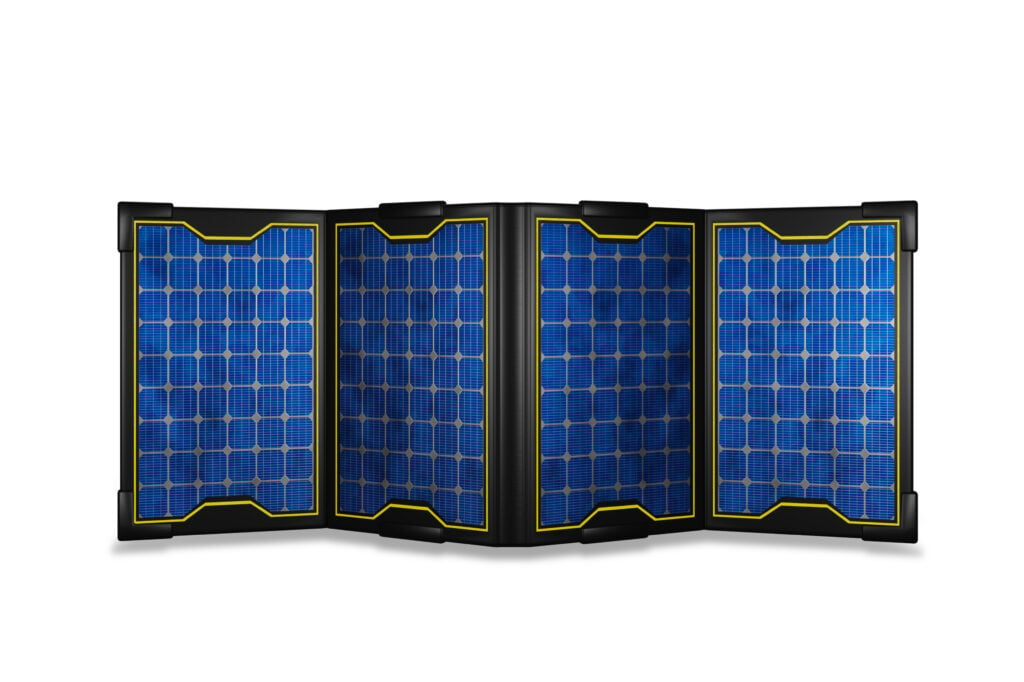
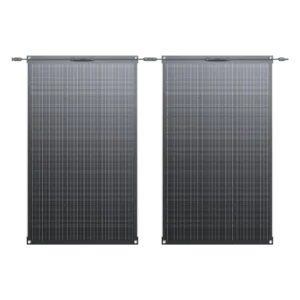
The van owner, the RV renovator, the boat outfitter — whoever is gluing or eyelet-mounting a panel on a curved surface and leaving it to weather sun, rain, and hail for the life of the install. This is the buyer flexible panels were built for. What decides it: confirmed weather survival, proven output at real operating conditions, and a voltage that pairs cleanly with their charge controller or station. Everything else is secondary.
The case for this panel is built on proof, not paper. Independent testing measured 70–90W per panel in direct sun — strong for the flexible category — and two panels in series measured around 158–159W in slight haze. The alternative has no independent output measurement at all. For a panel you mount once and trust outdoors, that asymmetry is decisive.
The weatherproofing story is just as clear. IP68 means confirmed submersion to 1 m for 72 hours, backed by documented long-term outdoor installs and confirmed hail survival on a trailer roof. The alternative is IP67 — splash-rated, with the manufacturer advising against leaving it in standing rain. For an always-mounted roof panel, that difference matters every time it rains.
Voltage is the third axis. The 20.3V open-circuit voltage fits every EcoFlow station’s 11–30V input window cleanly, with no risk of overloading any unit in the lineup. It’s also low enough that parallel-wiring multiple panels stays safe and simple. The panel conforms to a curved or cathedral roof via pre-cut eyelets or adhesive, and at 5.1 lbs it’s a fraction of the weight of a rigid 100W equivalent.
There are two things to know before you order. First, shade sensitivity is severe — a hand shadow drops output to a third or less, and light cloud can push it close to zero, worse than the bypass-diode marketing implies. Placement matters: site this panel where it sees clean, unobstructed sun. Second, the solar-to-XT60 cable ships with EcoFlow stations, not with the panel — if you’re buying it standalone, order that cable explicitly or it won’t connect to anything.
The warranty gap is the remaining honest caveat. EcoFlow doesn’t publish a warranty term; owner reports suggest around 12 months, and one documented failure at 15 months came with poor out-of-warranty support. For a category where heat-longevity is already the open question, it’s worth verifying the current warranty at checkout before committing.
Skip it if: your station is a mid-to-large Bluetti unit, weight and per-panel cost are your top priorities, and you accept that real-world output isn’t independently verified — that’s the Bluetti PV100 FX‘s buyer.
A narrower buyer than the default: someone already running a mid-size or larger Bluetti station — an AC180, AC200, or Apex-class unit — who wants the lightest and cheapest flexible panel available, values a stated warranty, and whose station’s solar input can accept a 41.4V open-circuit voltage. That last requirement is a hard compatibility gate, not a preference, and it defines who this pick is and isn’t for.
On the axes this buyer prioritizes, the PV100 FX wins cleanly. It’s lighter (4.85 lbs vs 5.1 lbs), cheaper per panel ($164.50 vs $199), and carries a marginally higher rated efficiency (23.4% vs 23%). It also has something the EcoFlow lacks: a stated 1-year warranty — a real, if modest, edge in a category where longevity in heat is genuinely uncertain. Its 240° bend conforms to the same curved surfaces. And the same 41.4V open-circuit voltage that creates the compatibility gate below also wires cleanly in series into a larger Bluetti station’s MPPT window for multi-panel roof setups.
The tradeoffs are real and should be weighed honestly. No independent real-world output measurement exists for this panel — plan below the 100W nameplate, and factor in that the EcoFlow’s proven 70–90W is a specific data point this panel simply can’t match with equivalent evidence. The IP67 rating is a meaningful step down from IP68 for a panel that lives outside: Bluetti’s own guidance says not to leave it in standing rain, which is a hard ask for a roof mount. And there is no long-term durability data for this specific panel — the more-durable construction claim is plausible but unproven.
The compatibility gate deserves its own paragraph because it’s not a caveat to work around — it’s a disqualifier. The 41.4V Voc exceeds the input ceiling of small Bluetti stations. An owner who bought this panel for a compact Bluetti unit was advised to return it. Before buying, confirm your specific station’s solar input window accepts 41.4V. If it doesn’t, this is simply the wrong panel, regardless of the weight and cost advantages.
Skip it if: your surface is exposed to rain and you need genuine weatherproofing, your Bluetti station is a smaller unit whose solar input can’t accept 41.4V, or proven real-world output matters more than per-panel savings — the EcoFlow 100W Flexible is the right panel in any of those cases.
Picks on this page come from deciding what the use case actually rewards — then judging each unit by how it behaves under those conditions, not by how it reads on a spec sheet. The criteria that matter shift with the job, so a unit that’s decisive in one segment can be disqualified in the next by a single behavior. Where two contenders cleared the same bar, documented performance under real load settled the pick, not a comparison of rated numbers.
The category gate here is simple and strict: a panel qualifies only if it genuinely conforms to a curved surface. Foldable ‘portable’ panels are rigid monocrystalline cells that hinge between sections — bending the cells themselves cracks them, which their own product documentation warns against. The EcoFlow 125W Modular is rigid tempered glass on an aluminum frame. Neither class belongs on a flexible-panel page, for the same reason a power station doesn’t belong in a solar-panel roundup. That filter leaves exactly two panels.
Within those two, the decision turns on the axes that matter for the dominant use case — an outdoor fixed install on a curved surface. Proven real-world output carries more weight than rated efficiency, because lab ceilings and lived performance routinely diverge in this category. Weatherproofing depth is load-bearing for a panel that lives outside year-round; there’s a meaningful difference between a submersion rating with confirmed long-term-exposure data and a splash rating with a manufacturer caution against standing water. Voltage compatibility is a hard compatibility check, not a preference — a panel whose open-circuit voltage exceeds a station’s input ceiling is simply the wrong panel for that station, regardless of everything else. Weight and per-panel cost matter for buyers with a specific ecosystem and a prioritized set of tradeoffs. And warranty terms, while secondary to performance proof, carry more weight in a category where heat-degradation lifespan is an open question.
Real-world output figures cited throughout are at actual operating conditions — sun angle, temperature, and shading all affect harvest — never nameplate ratings passed off as usable numbers. Where independent measurement exists, it’s attributed to that source; where it doesn’t, that gap is stated plainly, because planning around a figure that was never independently verified is how buyers get surprised.
The picks above answer “which one for my situation.” This table answers “show me everything, I’ll decide.” It lays every unit out on the same axes used to make the calls — measured behavior, not nameplate specs — so a reader whose priorities cross segments can weigh the tradeoffs directly instead of trusting our segmentation.
| Spec | EcoFlow 100W Flexible | Bluetti PV100 FX | Buy |
|---|---|---|---|
| Rated output | 100W | 100W | Check price |
| Real-world output | ≈70–90W (direct sun, single panel) | Not independently measured | Check price |
| Cell type / efficiency | Monocrystalline, 23% | Monocrystalline flexible, 23.4% | Check price |
| Weight | 5.1 lbs | 4.85 lbs | Check price |
| Weather rating | IP68 (1 m / 72 hr submersion) | IP67 (splash only; no standing rain) | Check price |
| Connector | MC4-compatible | MC4 | Check price |
| Voc / Vmp | 20.3V / 17.1V | 41.4V / 34.5V | Check price |
| Max system voltage | 600V | — | Check price |
| Flex angle | 258° | 240° | Check price |
| Warranty | Not stated (≈12 mo owner-reported) | 1 year (stated) | Check price |
| Price (MSRP) | $199 | $164.50/panel | Check price |
| Price per watt | $1.99/W | $1.65/W | Check price |
— = not independently verified for this guide
The questions here are the ones that don’t belong to any single pick — the cross-cutting concerns that come up regardless of which unit a reader lands on. We pulled them out of the individual segments so each answer lives in one place, addressed against the same standard of evidence used throughout the page.
Flexible panels earn their place on curved or no-drill surfaces — a rounded van or RV roof, a boat deck, a membrane surface you can’t drill through. If that’s your situation, they’re the right tool and the shorter lifespan is a fair trade for the ability to conform.
On a flat surface where a rigid panel and a standard mount would fit, a rigid glass panel is the better long-term investment: more watts per dollar, far longer service life (20-plus years vs a realistic 2–5 for flexible), and less heat-degradation risk. Buying a flexible panel for a flat roof just because it’s thin is a trade you’ll regret over time.
And if your goal is something you can fold and carry to a campsite, neither of these panels is what you’re after — ‘flexible’ means they conform to a curve, not that they fold up for transport. That’s a separate product class.
Both ratings mean the panel can handle rain. The gap shows up in prolonged or standing-water exposure. IP68 — the EcoFlow’s rating — covers submersion to 1 meter for 72 hours, and the panel’s field record includes documented hail survival and long-term outdoor installs. IP67 covers immersion to 1 meter but only briefly; Bluetti’s own guidance says not to leave the PV100 FX in standing rain.
For a panel permanently mounted on a roof, that distinction matters every time water pools — after heavy rain, in low-slope installs, or in climates with frequent standing water. If the panel lives outside year-round, IP68 with a confirmed long-term exposure record is the more reliable choice.
No. The PV100 FX has a 41.4V open-circuit voltage, which exceeds the input ceiling of small Bluetti stations including the AC2A. An owner who bought this exact combination was advised to return the panel. Before purchasing, confirm your specific station’s solar input window accepts 41.4V — if it doesn’t, this is the wrong panel regardless of any other advantage. The EcoFlow 100W Flexible, with its 20.3V Voc, is the safer cross-lineup default for lower-voltage input windows.
The 100W figure is a lab ceiling measured under standard test conditions — a specific irradiance level, cell temperature, and spectrum that almost never align perfectly in the field. Real operating conditions (sun angle, ambient temperature, shading, roof surface heat) all reduce harvest. For the EcoFlow 100W Flexible, independent testing measured 70–90W per panel in direct unobstructed sun — that’s the planning figure, not 100W.
The Bluetti PV100 FX has no equivalent independent measurement, so its real-world output is unknown. Planning below nameplate is the right posture for any flexible panel, and especially for one with no field data to anchor the estimate.
Shade sensitivity is severe on both panels, but it’s a documented specific weakness of the EcoFlow 100W Flexible in particular — a hand shadow can drop output to a third or less, and light cloud cover can push it close to zero. This is worse than the bypass-diode marketing suggests. The practical implication: placement matters more than it would with a rigid panel, and a curved-roof install should be positioned to see clean, unobstructed sun. Partial shading from a vent, antenna, or nearby structure will cost more output than you’d expect.
If your surface is curved or can’t be drilled, you have two genuine options — and for most buyers, the pick is clear. The EcoFlow 100W Flexible is the default: it’s the only one with measured real-world output (70–90W in direct sun), confirmed IP68 weatherproofing, and a field record that includes long-term outdoor installs and hail survival. Its 20.3V open-circuit voltage works safely across every EcoFlow station and keeps parallel wiring simple. The unlisted warranty is the honest weak spot — verify the current terms at checkout, and know that the category’s heat-longevity question applies to both panels equally.
The Bluetti PV100 FX is the right call for a specific, narrower buyer: someone already running a compatible mid-to-large Bluetti station who prioritizes lighter weight (4.85 lbs), lower per-panel cost ($164.50), and a stated 1-year warranty, and who accepts that real-world output has never been independently measured. The 41.4V voltage is a hard compatibility check — it locks out small Bluetti stations entirely, and it has to be confirmed before buying. Both panels carry the same category-wide reality: 2–5 year realistic lifespan, heat-degradation risk in flush-mounted installs, and 100W as the maximum panel size available.