
When you purchase through links on our site, we may earn an affiliate commission. Learn more.
An RV power station has to be three different things depending on how you use it — and the right one for a hookup-heavy campground tripper is the wrong one for a week off-grid, which is itself the wrong one for feeding a 30-amp inlet in a January freeze. No single Jackery wins every scenario, and any page that ranks them globally is hiding that tension from you.
What actually separates the right unit from the wrong one: how much solar it can accept, whether it handles your rig’s shore-power inlet, what it weighs when you’re dragging it across a parking lot at checkout, and whether cold weather turns it into a paperweight. The spec sheet hides most of this — rated capacity overstates what you actually get at real loads, solar ceilings rarely translate directly to real-world throughput, and surge ratings can be generous in ways that matter when a compressor starts. The picks below are built around those real-world numbers and the conditions each type of RVer actually puts a station through.
Use the table below to find your situation first. Each section makes the case for one unit on the ground that actually decides this buying choice — and tells you plainly when someone else’s pick is the better fit for your rig.
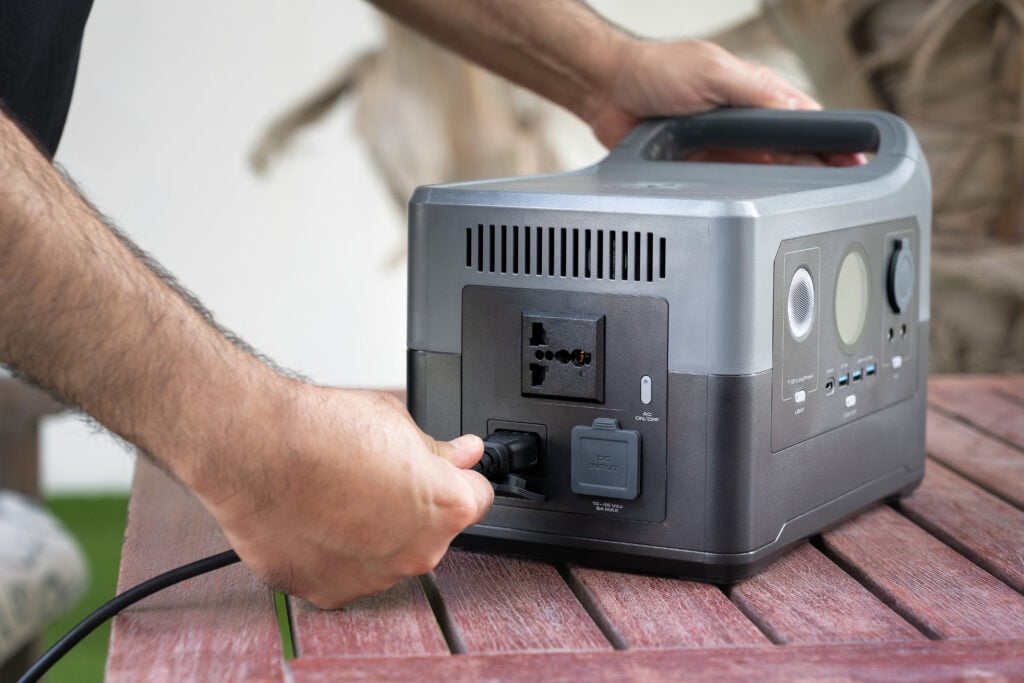
The job here is specific: keep a 12V compressor fridge running through a full travel day on the DC port, cover CPAP and devices overnight, and be ready to top up from the pedestal or a car port every time you move. This station goes to the picnic table and comes back. Weight is a real variable, and so is whether you actually need the headroom a bigger unit offers.
It wins on the axis that actually settles this segment: it is the lightest ~1 kWh box in its class, and the transit fridge is what makes capacity matter here. Run a 12V compressor cooler on the DC port through a long drive and you want the inverter out of the loop — which means conversion losses don’t eat into your usable energy, and the unit genuinely has the headroom to run that fridge all day and cover the evening’s devices. At mid loads through the AC ports the usable figure sits around 900 Wh; the DC-port fridge path keeps more of the 1,070 Wh working for you. One owner ran months of vehicle living — 12V fridge, Starlink, laptop — and never dropped below 60% paired with a 150W panel and vehicle charging.
The sub-90-minute pedestal recharge is the other load-bearing fact: it’s always full by checkout, which means this station’s limitation is never the hookup-to-hookup trip. Near-silent operation (one measurement under 22 dB during standard charging) makes it a non-issue on the nightstand.
Two catches worth knowing before you leave it unattended. There is no configurable low-battery cutoff, and there is a documented pattern of AC output cutting silently while the indicators stay lit — fine when you are in the rig and can see what is happening, the reason not to leave it running the fridge in a parked rig for days without you. The DC8020 solar connector is proprietary; many third-party panels need an adapter that is not included, so confirm compatibility before your first trip. Car charging cable is sold separately. Below 32°F the unit will not charge — keep it inside a heated cabin in winter.
Skip it if: you are leaving this station to run the fridge unattended for days at a stretch — the silent-cutoff behavior makes the 2000 Plus (Segment 2) the appropriate architecture for that job.
The case for the 600 Plus is simplicity: 16.1 lbs, a roughly 1.5-hour wall recharge, two nights of CPAP per charge off the 12V adapter, and two to three days of typical device runtime. If you hook up every night and the transit fridge is not in your setup, 632 Wh is enough and the lighter, cheaper unit is the right call. The moment you add a compressor load over a long travel day, 632 Wh runs thin — which is exactly the margin the 1000 v2 buys back.
Off hookups for days, solar has to put back what a day takes out — fridge, furnace fan, lights, water pump, devices, and an occasional microwave burst. The question is not just how much battery you start with. It is how fast the sun can refill it, and what happens when you need more.
The solar ceiling is what settles this segment. At 1,400 W the 2000 Plus holds the highest solar input of any portable Jackery, and each expansion battery brings its own solar inputs — so capacity growth and recharge growth scale together. That architecture is unique to this line within the Jackery portable range. Essentials (fridge, lights, internet, TV) run for one to two days on the base unit; a ~150 W fridge runs around 23 hours per charge. One owner has run off-grid for a year and a half on six panels with the 2000 Plus and an expansion battery, which is the clearest evidence of what the system can sustain long-term. The 30A RV outlet wires directly into the rig, and one owner specifically reported it powering an RV’s 30A outlet where a 2,000 W competitor failed.
A note on what ‘buy it for what it will become’ means here: expansion batteries on this line cost meaningfully less per watt-hour than the base unit and each adds its own solar input. A boondocker who starts at 2 kWh and adds a battery adds recharge capability at the same time — the system scales the way the off-grid lifestyle scales.
Solar planning deserves a realistic target. In practice, two 200W panels delivered 393–430 W in direct sun during testing — not the 400 W ceiling, just shy of it — and one owner’s six-panel array maxed around 300 W. Plan 4–6 hours of good sun per refill with a real array, not the spec figure. Third-party panels need homework: a 60 V input cap per port (exceeding it destroys the controller), 12 A per port, and both ports share one charge controller, so mismatched panels can cause problems. Panels left connected overnight trigger an F7 error — the fix is a timer that disconnects at sunset. Pass-through output while charging caps near 1,440 W, and app connectivity is unreliable enough that you should not depend on it for anything time-sensitive. The configurable low-battery cutoff lives in the app, so connectivity matters if you rely on that setting.
Skip it if: your rig feeds a 30A inlet and your primary sessions are short enough that 2 kWh of base capacity puts you on a recharge treadmill with the air conditioner running — the HomePower 3600 Plus (Segment 3) is built for that job.
For the smaller rig or tighter budget, the 1000 Plus brings 1,264 Wh expandable to 5,056 Wh, a genuinely honest 2,000 W inverter (independent testing confirmed 2,136 W sustained), and a configurable low-battery cutoff that the 2000 Plus lacks in hardware. At $0.47/Wh it is the better-value entry into the Jackery expansion ecosystem. The flip comes on two axes: real-world solar throughput measured nearer 550 W than its 800 W rating, and the 5 kWh expansion ceiling is a firm stop for the serious boondock build. One critical note: the 1000 Plus expansion packs are not cross-compatible with the 2000 Plus ecosystem — commit to a line before you buy the first battery, not after.
The Explorer 2000 v2 has the best value-per-watt-hour of any unit in the Jackery portable range and a strong spec sheet, but its own published review is explicit that it is the wrong buy for solar-dependent off-grid use — a 400 W solar ceiling and no 30A outlet put it outside what this segment requires. It earns its place on other buying guides for other use cases; here it does not fit.
You want one box that feeds the rig’s 30A shore-power inlet — air conditioner, microwave, converter, the whole panel — handles compressor starts, replaces the generator, and still accepts a charge when the morning is below freezing. Every one of those requirements has to be met simultaneously. One unit in the Jackery lineup meets all of them.
The cold-charge window is the deciding fact. Every other unit on this page has a 32°F charge floor; the 3600 Plus charges down to -4°F and is the only sub-freezing charger in the Jackery lineup. For a winter RVer who needs the generator replaced, not just supplemented, that is a non-negotiable spec — and it is the specific reason one owner chose this unit over both the Explorer 5000 Plus and the HomePower 3000, as documented in the review.
The TT-30 outlet delivers its full 30 amps continuously — the review explicitly notes that not every unit in this class manages full sustained current at that outlet. Usable energy measured at the AC outlets by independent bench testing lands at roughly 3,240–3,270 Wh, or 90–91% of nameplate; plan around that figure, not the 3,584 Wh on the label. That is what powered a full camper (AC compressor, microwave, fridge, lights) at 1,600 W sustained in testing, and what one off-grid RV owner ran for roughly 18 hours covering fridge, furnace, lights, and occasional microwave. A 30-year-old fridge ran 24 hours on under half the battery. The wheels work on concrete, gravel, and snow; getting it into position the first time is still a two-person job, but it is the lightest, most movable box in its capacity class.
Three catches matter for planning. The unit has no 12V DC output — a 12V compressor fridge plugs into the rig’s own converter, which is fine, but standalone 12V accessory duty requires a different unit or a 12V adapter off the AC side. When plugged into shore power in bypass mode, pass-through output caps near 1,440 W — run high-draw loads off the battery. The standard AC outlets are wired across two banks with per-bank ceilings, so distribute heavy loads across both rather than stacking them on one side.
Solar is deliberately placed last because it is a supplement here, not a primary recharge path. The 1,000 W input ceiling against a 3,584 Wh battery means two 200W panels represent about 10 hours of ideal-condition sun for a full charge; the bundled solar panel measured 150–340 W against its 500 W rating, and the MPPT loses roughly a quarter of input as heat. This is a wall-and-generator charger with solar as a bonus — which is the right frame for a segment where the generator replacement is the whole point.
Skip it if: you need 12V DC output for a compressor fridge running outside the rig’s own converter, or your rig is wired for 50A/240V service — the Explorer 5000 Plus handles both of those and is the right unit for the larger rig.
The 5000 Plus answers two things the 3600 Plus cannot: true split-phase 120V/240V output and dual-air-conditioner capacity — independent testing ran two RV AC units simultaneously on it. Base capacity is 5,040 Wh, the 12V car socket is something RV owners specifically praise, and a real solar array (4,000 W input verified at 3,600–3,900 W on an actual array) makes it viable for solar-heavy installs. The flipping axes are weight and fit: at 134.5 lbs it is a two-person lift the review describes as a permanent-install backup system that happens to have wheels, and the NEMA 14-50 port is rated for 30A service only — a disclosed mismatch for anyone expecting full 50A hookup capability. AC charging disables 240V output entirely; DC and solar input do not have that restriction. Pass-through caps at 500 W. IP20 indoor-only. The high-PV solar input requires a 135 V minimum string. This is the unit for a rig built around it, not moved with it.
Most power-station comparisons assume the unit lives in a bay or inside the camper. This one does not. It rides in an open truck bed, eats dust on washboard forest roads, and sits through a rainstorm without your intervention. That changes the spec that matters most, and only one Jackery speaks to it.
IP65 is the whole argument. It is the only sealed, internally-cooled, drop-rated build in the Jackery lineup — verified through rain, a one-meter concrete drop, and rough-terrain transport during testing. The internal-only cooling means there are no exposed side fans for water or dust to enter; the port covers under the cantilevered weather flap protect the AC outlets. Testers ran microwave, coffee pot, heated blanket, and Starlink simultaneously without issue. A kitchen refrigerator ran 10 hours 40 minutes on a single charge; a Starlink Mini ran up to 50 hours. Usable capacity at mixed AC loads measures around 1,400 Wh. It is also the quietest Jackery testers have measured — under 30 dB during normal operation — and the lightest IP65 unit in its class.
The bottom intake collects dust in exactly these environments. The removable metal base makes cleaning it out possible, but treat it as recurring maintenance, not a one-time task. AC outlets do not auto-resume after a full drain-and-recharge cycle — if it runs flat, you restart manually. There is no expansion path. Output derates to 1,000 W in the 5–14°F range, and the charge floor is 32°F, same as the rest of the lineup.
The premium over a comparable bay-stored unit is real — $0.65/Wh is what the IP65 shell costs. If your station lives in a protected compartment, Segment 1 or Segment 2 gets you more capacity or more recharge for the same money.
Skip it if: your station lives in a sheltered bay or inside the camper — the Explorer 1000 v2 or Explorer 2000 Plus covers that use case for less, with more capacity per dollar.
The Explorer 1500 v2 is cheaper, lighter, and faster-charging — and it is not sealed. If the environment is protected, that is a different segment. There is no close-second option that preserves the IP65 rating within the Jackery lineup.
Picks on this page come from deciding what the use case actually rewards — then judging each unit by how it behaves under those conditions, not by how it reads on a spec sheet. The criteria that matter shift with the job, so a unit that’s decisive in one segment can be disqualified in the next by a single behavior. Where two contenders cleared the same bar, documented performance under real load settled the pick, not a comparison of rated numbers.
Portable power stations for RVs get judged on a handful of things the box rarely tells you plainly: how much energy is actually usable at the loads a given rig draws (not the nameplate number), whether the solar input can realistically keep pace with a day’s consumption off hookups, how the unit handles compressor starts and sustained high draws, what the standby habits cost you in stored charge, and whether the build tolerates the physical environment the rig puts it in. Chemistry and cycle rating matter differently here than in a home-backup context — a unit you’re pulling in and out of a truck bed is a different durability ask than one that sits in a garage.
We weighed usable energy at real loads, sustained output (not peak surge), solar replenishment architecture including what happens when you add capacity, 30A inlet compatibility, weight and moveability, and the reliability patterns that only surface after extended use in field conditions. Numbers are stated at the load conditions relevant to each use case, not off the spec sheet. The picks and the reasoning behind each one are in the sections below.
A few units came up in research and don’t appear as picks. The Explorer 500 carries NMC chemistry with a limited cycle life and an effective solar ceiling that makes it a poor fit for any of the use cases here — its strengths are addressed by stronger units on this page. The HomePower 3000 has no TT-30 outlet, no expansion path, and a chassis with no wheels at nearly 60 pounds, which puts it outside the RV use cases this page covers. Sub-300 Wh units were set aside as device chargers rather than rig-power candidates.
The picks above answer “which one for my situation.” This table answers “show me everything, I’ll decide.” It lays every unit out on the same axes used to make the calls — measured behavior, not nameplate specs — so a reader whose priorities cross segments can weigh the tradeoffs directly instead of trusting our segmentation.
| Unit | Capacity (Wh) | Rated / Surge (W) | Weight (lbs) | AC Recharge | Solar Input (W) | Price | $/Wh | Buy |
|---|---|---|---|---|---|---|---|---|
| Explorer 1000 v2 | 1,070 | 1,500 / 3,000 | 23.8 | ~1.58 hrs (std); <1 hr Emergency mode | 400 | $499 | $0.47 | Check price |
| Explorer 600 Plus | 632 | — | 16.1 | ~1.5 hrs | — | $429 | — | Check price |
| Explorer 2000 Plus | 2,042 | 3,000 / 6,000 | 61.5 | ~90–100 min | 1,400 | $1,399 | $0.69 | Check price |
| Explorer 1000 Plus | 1,264 | 2,000 / — | — | — | 800 | $599 | $0.47 | Check price |
| HomePower 3600 Plus | 3,584 | 3,600 / 7,200 | 77.16 | ~2.5 hrs | 1,000 | $1,899 | $0.53 | Check price |
| Explorer 5000 Plus | 5,040 | — | 134.5 | — | 4,000 | $2,899 | — | Check price |
| Explorer 1500 Ultra | 1,536 | 1,800 / 3,600 | 38.6 | ~1 hr 21 min | 800 | $999 | $0.65 | Check price |
— = not independently verified for this guide
The questions here are the ones that don’t belong to any single pick — the cross-cutting concerns that come up regardless of which unit a reader lands on. We pulled them out of the individual segments so each answer lives in one place, addressed against the same standard of evidence used throughout the page.
Yes, with a realistic picture of how long. The 2000 Plus cleared the surge threshold for a 12,500 BTU air conditioner in owner testing — it started and ran it. The limit is sustaining that draw: the base 2,042 Wh battery powers roughly 1.2 hours of whole-rig AC duty per charge at that draw rate, which is why it wins the boondocking segment (where AC is occasional and the fridge-and-essentials baseline is what the solar replenishes) but not the whole-rig-power segment, where an air conditioner running through an afternoon needs 3,584 Wh behind it and a 30A TT-30 outlet to feed the panel. If the air conditioner is the primary load, the HomePower 3600 Plus is the right architecture.
The HomePower 3600 Plus is the only unit on this page that will accept a charge below 32°F. Every other Jackery here — the Explorer 1000 v2, 2000 Plus, 1000 Plus, 1500 Ultra, and 5000 Plus — stops charging at 32°F. The 3600 Plus charges and discharges from -4°F to 113°F. If you are winter camping and need the station to top up from shore power or a generator on a cold morning, this is the one. For units with a 32°F charge floor, keeping the station inside a heated cabin overnight is the standard workaround.
The solar architecture is the answer. The 2000 Plus holds a 1,400 W solar ceiling and each expansion battery adds its own solar inputs, so capacity growth and recharge growth scale together. The 3600 Plus tops out at 1,000 W of solar input against a 3,584 Wh battery — roughly 10 hours of ideal-condition sun for a full charge from panels alone — and its review is direct that the solar input is undersized for the battery, with the MPPT losing around a quarter of input as heat. It recharges efficiently from a wall outlet or a generator. For a boondocker whose only recharge path is the sun, that distinction is the whole decision.
Two things rule it out for a serious boondock build. First, there is no expansion — 1,536 Wh is the ceiling, full stop, and a days-long off-grid session with a fridge, furnace fan, water pump, and devices will outpace that faster than the solar can recover it. Second, the IP65 shell that makes it the right unit for exposed-rig duty is a premium you are paying for weather and impact protection, not for energy density or value per watt-hour. The 2000 Plus starts with more capacity, expands to 12,000 Wh, and each expansion battery adds more solar input. The 1500 Ultra wins where the environment demands the sealed build; the 2000 Plus wins where scale and replenishment are the job.
All of the units on this page use Jackery’s DC8020 proprietary charging connector. Third-party panels with standard MC4 or Anderson connectors will need an adapter — and that adapter is not included in the box. This applies to the Explorer 1000 v2, Explorer 600 Plus, Explorer 2000 Plus, Explorer 1000 Plus, HomePower 3600 Plus, Explorer 5000 Plus, and Explorer 1500 Ultra. Verify that a specific adapter exists for your panel brand before your first trip. For the 2000 Plus specifically, also confirm your panel string stays under 60 V per port and under 12 A per port — exceeding the voltage cap damages the charge controller.
If you came here wanting a capable station for campground trips with shore power most nights, the Explorer 1000 v2 at $499 is the default — lightest in its class, sub-90-minute pedestal recharge, and the DC port keeps a transit fridge running all day without touching the inverter. The Explorer 600 Plus at $429 is the right call the moment you remove the transit fridge from the equation.
For days off hookups with solar as your primary recharge path, the Explorer 2000 Plus is a different category of purchase — the 1,400 W solar ceiling, the expansion batteries that each add their own solar inputs, and the 30A RV outlet make it the only architecture here that scales with the off-grid lifestyle. The Explorer 1000 Plus at $599 is the smaller-rig entry into that same expansion ecosystem, with the caveat that the two lines are not cross-compatible. For the rig that needs a generator replacement, full 30A inlet feed, and cold-weather charging capability, the HomePower 3600 Plus earns its $1,899 on the specific combination of the TT-30 outlet, -4°F charge tolerance, and 3,240+ Wh of measured usable energy — no other unit on this page covers all three. And for a station that rides exposed in a truck bed, the Explorer 1500 Ultra‘s IP65 rating is the sole reason to consider it: you are paying for a sealed build that survives the environment, and the rest of the lineup does not offer that.