
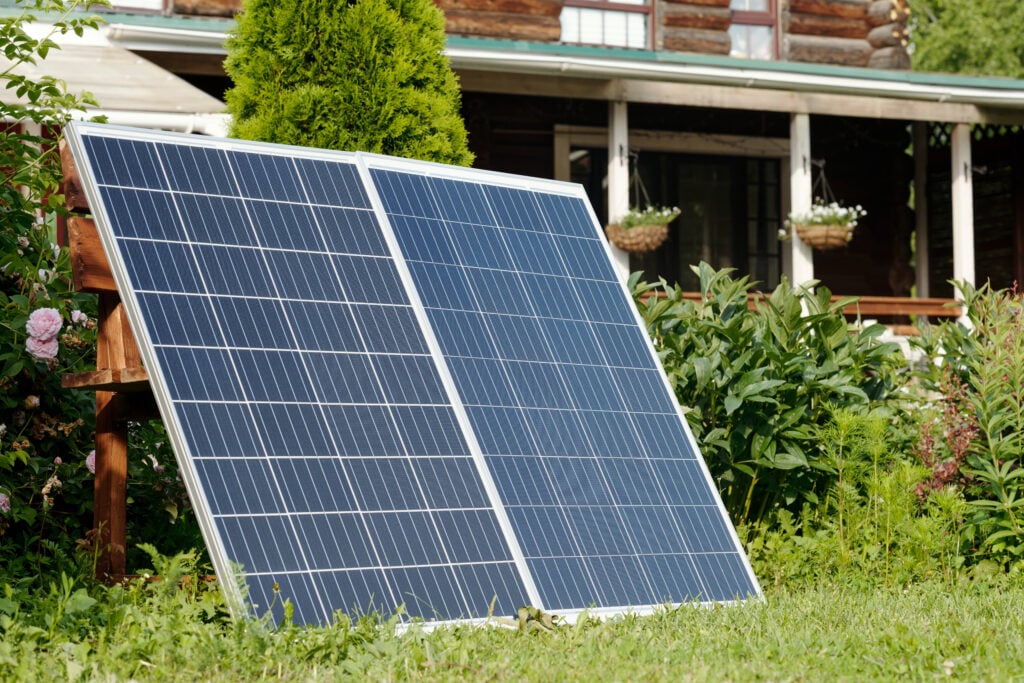
The fixed off-grid buyer has one clock the weekend camper never faces: the panel has to still be working in year three. Weight is irrelevant. Portability is irrelevant. The only questions are whether the panel is built to last, whether it actually delivers the watts it promises over time, and whether it can scale from a single small-cabin panel to a homestead-sized array without switching products.
No other panel in this catalog matches its durability credentials: a 30-year-to-90%-output lifespan claim, a 5-year warranty, tempered glass set in an anti-corrosive aluminum frame, and IP68 sealing. Those are the specs that matter for a ground array cycling every day indefinitely — and crucially, the output holds up in the field to back them. Independent testing of a four-panel 500W set measured 525–537W under good sun and peaked at 556W, meaning this panel meets or exceeds its rating rather than quietly underperforming it, which is rarer than the spec sheets suggest. The TOPCon cells also hold their output better than older folding-panel chemistry as clouds roll in — a meaningful edge when there’s no grid to fall back on.
The modular design means one product covers the entire population: a single 9.26-lb panel for a small cabin, up to eight panels in parallel for 1,000W on a homestead. At $169 per panel it also carries the best dollar-per-watt figure of any panel on this page.
Two limits to respect before loading up the array. First, the panel is genuinely light for tempered glass, and that means wind will tip it — the legs must be anchored with sandbags, stakes, or ground screws. No mounting feet are included. One owner cracked a panel in a roughly 1.5-foot drop during setup; it still produced output afterward, but handle it deliberately. Second, the 50V Voc is parallel-native for EcoFlow stations but exceeds the input ceiling of several smaller and non-EcoFlow units — confirm your charge controller’s or station’s accepted voltage window before wiring, and keep strings in parallel rather than series (three in series approaches a DELTA Pro 3‘s 150V ceiling). The bifacial rear-face gain is real, but only over reflective ground: measured ~278W from a two-panel set over snow or white surface, versus a modest ~52% of the spec over grass.
Skip it if: you want a single large panel feeding a big Anker station through one MC4 connection — the Anker SOLIX PS400 below is the better fit for that setup.
Its best-fit profile is the off-grid cabin array buyer who sets the angle once and leaves it. It ranked at the top of an independent six-panel build-quality comparison, confirmed IP67 through heavy rain and sustained daily exposure, and delivers the output of two smaller panels through a single MC4 connection — useful when your station has limited solar ports. Real output runs 275–345W in good direct sun, with one owner recording a 421W peak on a strong summer day.
It’s the runner-up rather than the pick because real output runs 60–85% of rated, the 35.3-lb weight is heavier per watt than the modular panels, and no warranty period is stated. The snap-button stand that fails under repeated adjustment is a minor issue at a fixed site where you set the angle once — but it remains a latent problem if you ever need to readjust. Choose it over the pick when you want a single high-output panel feeding an Anker SOLIX F2000, F2600, or F3800. One wiring note: cap series strings at 7 panels — eight in series reaches 460.8V, which exceeds an Anker SOLIX E10‘s 450V ceiling.
IP68, a 5-year warranty, 600V series capability for arrays, and the easiest high-output panel to handle at 22 lbs. Tilt-mounted at a fixed site it delivers around 400W. It’s a solid choice for a Jackery off-gridder who tilt-mounts permanently; the modular pick beats it on value and the PS400 on single-connection output. One wiring note: it needs at least 4 panels in series into a 135V-floor high-PV input (3 in series at Vmp 41.7V = 125.1V, which falls below that floor).
the cracking pattern that makes it a poor choice for repeated folding largely spares the owner who handles it once during install and leaves it. Its real-world output ratio in the 220W class is among the best available (180–210W), and at $299 / $1.36/W it’s a defensible budget fixed-array panel — provided you handle it once, accept the 12-month warranty, and acknowledge that a tempered-glass foldable is not purpose-built for permanent installation the way the modular pick is.
A membrane roof, a metal shed, a curved outbuilding surface — the usual solar mounting answer doesn’t apply when you can’t drill. The constraint here is absolute: the panel has to adhere or eyelet-mount flush without any penetrations, and then survive years of roof heat and weather exposure without anyone coming to check on it.
That constraint narrows the field to one product type: a flexible adhesive panel. Two are in this catalog, and for a continuous off-grid roof install, the evidence behind them is what separates them.
It’s the better-documented panel for what this segment actually demands. Owners running it on shed and trailer roofs confirm 70–90W per panel in direct sun — strong output for the flexible category — and its IP68 sealing has survived documented hail and long-term outdoor exposure in real installs. The 20.3V Voc fits safely within every EcoFlow station’s charge window, so there’s no overload risk on the receiving end. It conforms to curved and membrane surfaces with silicone, VHB adhesive, or pre-cut eyelets, at 5.1 lbs, and once it’s mounted there’s nothing mechanical to fail.
The honest cost of this category for off-grid duty: flexible panels mounted flush against a hot surface run hotter than ground-deployed rigid panels, and they degrade faster as a result. A realistic lifespan for a flush-mounted flexible panel under continuous heat is 2–5 years — shorter in harsh climates — and one failure has been documented at 15 months. For a no-drill off-grid roof, that’s the real calculus: weigh the no-penetration convenience against the likelihood of replacing the panel sooner than you would a rigid setup. Plan for it rather than being surprised by it.
Two operational notes. Shade sensitivity is severe — a hand shadow drops output to roughly one-third or less, and light cloud alone can cut it near zero. Site the panel where it will see clean, unobstructed sun. The solar-to-XT60 cable ships with EcoFlow stations, not with the panel itself — order it explicitly if buying the panel standalone.
Skip it if: you have a flat (non-curved) roof and a ground-frame option is feasible — the EcoFlow 125W Bifacial Modular on a ground frame will outlast this panel significantly and produce more per dollar over a multi-year horizon.
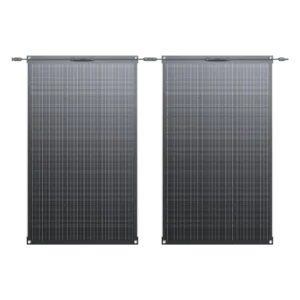
It’s lighter (4.85 lbs), cheaper per panel at $164.50, carries a slightly higher rated efficiency at 23.4%, and has a stated 1-year warranty — an advantage over the pick’s undisclosed warranty period. The flexible-mount capability is identical: it adheres or eyelet-mounts to the same surfaces.
The reasons it sits second matter particularly for off-grid use. No independent real-world output measurement exists for it — plan below nameplate, with the caveat that the gap is unknown. There is also no long-term durability data, which is a real concern when endurance is the primary off-grid question. Its IP67 rating is lower than the pick’s IP68, and Bluetti explicitly says not to leave it in standing rain — a meaningful demerit for a panel you plan to leave mounted on a roof indefinitely. Its 41.4V Voc also exceeds the input ceiling of smaller Bluetti stations, so confirm your station accepts that voltage before purchasing. Right for a no-drill roof feeding an AC180, AC200, or Apex-class Bluetti when you’ve verified the voltage compatibility.
A note on scale: both flexible panels top out at 100W each. For meaningful daily off-grid harvest you’ll run several in series or parallel — verify your charge controller’s voltage window before committing to a multi-panel string.
Living off-grid and mobile is the hardest brief in this category: the panel has to endure daily cycling like a permanent install and take repeated handling, repositioning, and transport like a portable. Most high-output panels do one or the other convincingly. Very few survive both.
Among the high-output panels, the SolarSaga 500X has the endurance profile built for daily use. A 5-year warranty is the longest in the class, IP68 sealing means it can sit through active rain without being brought in, and the operating range — rated to −40°F through 185°F — is the widest in Jackery’s panel line. Those specs matter for a buyer who can’t always babysit the weather.
Weight settles the relocate-and-reposition question. At 22 lbs it’s the lightest high-output panel available, against 30–35 lbs for the competition. A reviewer who tested competing panels called it the lightest 500W he’d handled. When you’re moving the panel between sites and adjusting its angle regularly, that difference accumulates quickly. The bifacial TOPCon sub-panels add a practical advantage at partial-shade sites: independent testing measured 330W with one of the six sub-panels fully shaded, where a conventional panel would drop much harder.
Tilt is not optional — it’s where the output lives. Laid flat on the ground the panel produces around 250W, roughly half its rating. Angled 20–30° toward the sun and oriented east-to-west it reaches ~400W, and near-optimal conditions push close to 495W. The full-timer who builds a tilt mount or leans it against a fence unlocks the panel; the one who lays it flat will spend months wondering why their station isn’t charging. The panel ships with no orientation guidance, so that knowledge doesn’t come in the box.
A few practical limits. The 10-foot DC cable is a real siting constraint — Jackery says a third-party extension voids the panel warranty. You can’t mix the 500X with a smaller SolarSaga on a shared-MPPT station. Scaling up means buying more identical 500X panels. And at $799 it carries the highest price of any panel on this page.
Skip it if: you manage your panel’s exposure carefully and bring it in for weather — the Bluetti PV350 below delivers a higher real-world output ratio at a lower price, and the harvest advantage is real for a buyer who can babysit it.
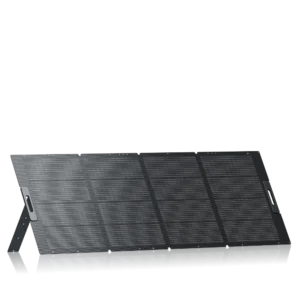
The strongest real-world output ratio in the high-output class: owners and independent testing consistently put it at 280–330W, which is 80–90% of rated — where competing panels land at 60–75%. It was measured out-producing a 400W glass array in shade (240W vs. 207W), and its low-light behavior is notably strong. A continuously adjustable stand makes sun-chasing across a day practical, and at $599 it’s the lowest price of the high-output options.
For a full-timer who needs the panel to ride out exposure unattended, its endurance profile is the honest weakness. IP65 means splash resistance only — Bluetti’s own manual says not to leave it in rain or snow. The warranty is 1 year. Two owner reports describe ETFE surface softening or bubbling after sustained summer heat. For the off-gridder who brings the panel in for weather and manages its exposure, that harvest advantage and lower price are a genuinely good trade; for one who needs it to live outside unattended, the pick’s IP68 and 5-year warranty are the right choice. Hard voltage gate: the 46.5V Voc is incompatible with smaller Bluetti stations (EB3A, AC2A, AC50B, AC60, EB70) — verify your station accepts that voltage. One model-identity note: confirm the spec sticker reads 46.5V Voc, as a separate regional ‘PV350D’ variant with different voltage characteristics can be misidentified.
the Segment 1 pick also serves the EcoFlow nomad well. Its 30-year lifespan claim, 5-year warranty, IP68, and output that beats rated translate directly to relocatable daily use; at 9.26 lbs per panel it packs flat and handles easily. Deploy one panel on a light day, add more for heavier loads, anchor the legs at each site against wind. At $169/panel it’s the most cost-effective way to build a scalable nomadic array. The Segment 1 write-up carries the full detail.
top build quality and IP67 weatherproofing make it a strong panel for a stationary setup, and its best-fit use case is exactly the fixed off-grid array in Segment 1. For a nomad who repositions regularly, the snap-button stand failure is a real liability with no reliable workaround, and the 35.3-lb weight makes solo daily handling genuinely burdensome. Better suited to set-once use.