

Federal aviation rules settle this segment before any other spec matters. The FAA and TSA place lithium-ion batteries into three bands: 0–100 Wh flies unrestricted in carry-on; 101–160 Wh requires prior airline approval (up to two per passenger); anything over 160 Wh is forbidden on passenger aircraft — carry-on and checked both. Weight, output, price — all of it is noise until a unit clears that threshold. No power station in this class sits at or under 100 Wh, so there is no zero-paperwork pick; if you need approval-free, you are shopping power banks. Exactly one unit in this comparison sits inside the 101–160 Wh approval window. Do not gamble on anything bigger — owners have had 288 Wh units confiscated at JFK.
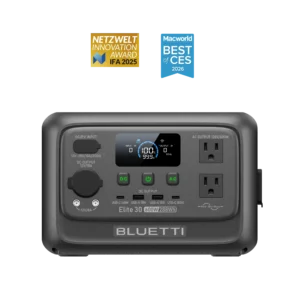
The Elite 10’s 128 Wh capacity is deliberately built into the FAA’s approval window — flight-approved with prior airline sign-off, up to two units per passenger — and at 3.97 lb it is the only power station here you would actually want in a backpack through a terminal. The travel case is confirmed: a roughly 70-minute wall recharge (enable Turbo mode in the app — the default is far slower), a bench-confirmed 10 ms UPS switchover that handles hotel-room router or laptop duty cleanly, and a useful built-in LED. At 60–100 W device-charging draws, efficiency lands in the high-80s percent — plan on roughly 110 Wh delivered. A worst-case bench figure taken at a sustained ~170 W draw pulled closer to 100 Wh; don’t apply that number to phone-and-laptop duty.
Two limits before you pack it. The 200 W AC ceiling is a hard wall — no kettles, no hair dryers. The headline 100 W USB-C port has documented trouble sustaining rated output on high-draw devices: a Starlink Mini measured 96 W and reboot-cycled on one owner’s unit, even while other Bluetti gear on the same outlet ran fine. For bedside charging, route devices over USB-C rather than AC — the fan can run in UPS mode even under tiny AC loads. The warranty is three years, shorter than Bluetti’s usual five, and there is no DC car socket; 12V accessories need an adapter for the barrel port.
No runner-up exists for this segment. Every other unit in this comparison exceeds 160 Wh. Always confirm approval with your specific airline before flying — carriers, particularly international ones, can be stricter than the FAA floor.
Skip it if: your destination loads include a kettle, hair dryer, or anything above 200 W — the right answer there is to buy or rent power at the destination, not to pack a larger unit that cannot legally board the flight.
When you are back at a wall outlet most nights, a fast refill beats a bigger tank you have to haul. The practical ceiling for a day-bag power station is somewhere under 10 lb; the practical floor for anything beyond phone duty is around 230 Wh. Four credible units cluster at 230–290 Wh and 7.9–10.4 lb, all LiFePO4, all roughly an hour to recharge. The spec sheet cannot separate them — the deciding factors are USB-C delivery, verified recharge speed, and price per watt-hour, measured rather than claimed.
On paper it is one of a crowd. What separates it is what bench testing actually found: 260 Wh delivered through the AC outlets and 274 Wh over DC — unusually efficient for the class — and a full wall recharge in 51–70 minutes in Turbo mode, with 80% in 40–45. The travel-defining feature is the dual USB-C: 140 W and 100 W ports running simultaneously at a measured 240 W combined, enough to fast-charge a MacBook Pro and a second device at once. Nothing else at this size and price matches that. At $199 it is also the value play of the segment.
One habit to form before bed: with eco mode off, the inverter idles at a measured 11–19 W — enough to empty the unit overnight. Toggle eco mode on or power it down between uses. For a nightly-recharge traveler that is a habit, not a flaw. Two other limits: it will not charge below 32 °F, and the solar cable is not in the standard box. The 1,500 W ‘Power Lifting’ figure is a resistive-loads-only voltage-drop mode, not real headroom for motors or compressors.
Skip it if: the last 1.3 lb matters more than dual USB-C and $70 in savings — that is the Jackery Explorer 300 v2.
The lightest LiFePO4 station in this group at 8.16 lb, with a ~76-minute full wall recharge and a ‘traveler and content creator’ profile — carry-on-friendly size, 100 W USB-C, a top-up over a lunch break — that fits this segment well. It earned the only Strong Buy in this class. Choose it over the Elite 30 V2 if carry weight is your tiebreaker. One note on confidence: most of its performance figures trace to manufacturer specifications and spec-based analysis rather than independent bench measurement of this exact unit — the numbers are consistent and plausible, but the Elite 30 V2’s are verified.
At 7.8 lb it is the lightest option here, and independent testing measured 213 Wh delivered of 245 rated, a 58-minute warm recharge, and library-quiet operation. It earns a mention for the noise-sensitive or ultralight traveler. The reasons it isn’t higher: the smallest tank in the group and only two AC outlets spaced too tightly for bulky plugs.
One unit was considered and set aside: the Bluetti AC2P ($129, 230 Wh) offers the best price in the class, but its review documents a recurring, unresolved pattern of units refusing to power on after idle storage — E113/E116 error codes with troubleshooting-first support. That is exactly the failure a traveler far from home cannot absorb.
A 12V cooler running around the clock changes the calculus completely. You need a pack large enough to handle real overnight duty on the DC port, enough solar ceiling to top up while driving, and output headroom for whatever else shares the campsite — lights, fans, devices. Two to four days between wall charges is normal; the car covers the gap.
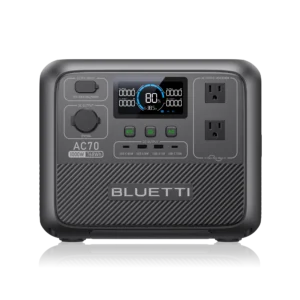
The AC70 and the EcoFlow RIVER 2 Pro match almost exactly on paper — same 768 Wh capacity, within $10 of each other — but their reviews tell opposite stories, and that is what settles it. The AC70’s case: a 12V fridge runs ‘the better part of a day’ in eco mode on the DC port, Turbo charging measured 0–80% in 43–47 minutes from the wall with no external brick needed (full in roughly 90 minutes), and the pure sine wave is bench-confirmed clean. At 22.5 lb it is still a one-hand carry from trunk to table. The 500 W solar-input ceiling — high for a unit this size — and the durable XT60 connector give it real replenishment headroom on days you don’t reach a wall.
The DC-port story matters for this buyer specifically. The review’s ‘plan around 450–500 Wh usable’ figure reflects AC duty, where inverter overhead taxes every hour the unit runs. The cooler lives on the DC port, which bypasses that overhead entirely — the energy reaching it sits far closer to the pack’s full delivery. Budget the AC-side conservatively; the cooler handles itself.
Three things to know before loading it up. A Keurig-class coffee maker trips the unit even in Power Lifting mode — under-1,000 W drip makers and kettles are fine, 1,500 W appliances are not. Its wall charger pulls a 400–500 W minimum that overloads small vehicle inverters, so charge from the 12V socket instead (roughly 6.5 hours, cable included). There is a documented first-year hardware-failure cluster involving DC-port E065 errors, acknowledged by Bluetti — register it, test it on arrival, and lean on the 5-year warranty, which owners report is honored.
Skip it if: the weight difference is the deciding factor — the Jackery Explorer 600 Plus at 16.1 lb carries you through a long weekend at a 6-lb savings.
At 16.1 lb it is the lightest unit on this page that still carries multi-day capacity, and its review calls it the ‘sweet spot’ for two-to-three-day trips — owners ended a three-day run at 25% remaining while powering phones, fans, and pumps. A ~1.5-hour brick-free wall recharge is owner-confirmed, and CPAP users get two-plus nights off the 12V DC adapter. The trade-offs: 632 Wh versus 768, an 800 W ceiling, and a new DC8020 connector that requires an adapter for older Jackery car and solar cables not included in the box. Keep outputs switched off in storage — one tester measured 23% drain over 12 hours with outputs enabled and nothing connected; a single-source figure, but the underlying drain is owner-corroborated.
The EcoFlow RIVER 2 Pro ($339, 768 Wh, 18.2 lb) was the natural contender here — lighter than the AC70, cheaper, identical capacity, and its DC credentials are real (a 12V fridge ran 57 hours in testing). Its review is what ruled it out. A measured ~40% self-discharge per 24 hours whenever the inverter is left on, an erratic fan peaking around 61–62 dB, a 30 ms switchover, and a documented tail of inverter and charging hardware failures with slow refurb-replacement service make it a unit to work around rather than rely on. When an even spec fight comes down to one review saying ‘buy if’ and the other saying ‘skip unless,’ the choice is clear.
This is the segment where the power station stops being a gadget and becomes infrastructure. Laptop and monitor through the day, Starlink, a 12V fridge, cameras — cycled and recharged every single day at cafés, campgrounds, and off the car, with you sleeping and working a few feet from it. Three things decide this field: recharge speed (your charging windows are short stops, not afternoons), noise (it runs next to your head), and endurance under sustained daily cycling. Three 1,024 Wh LiFePO4 units land within 3 lb and $200 of each other, all with 1,800–2,000 W inverters, and those three axes separate them.
The single most-cited reason owners choose the C1000 Gen 2 fits this segment exactly: top off at a library, coffee shop, or off a small generator in under an hour and you are set for the day. Independent bench testing measured a full 0–100% recharge in 46–47 minutes — fastest on this page — and a dead battery becoming a coffee-break errand changes how you travel. It is the lightest unit independent testers weighed in the 1 kWh class at 24.9 lb, runs under 20 dB below 200 W loads (it disappears during work and sleep), and carries a bench-confirmed sub-10 ms UPS that rode desktops and NAS gear through outages without a blink. Its 4,000-cycle LFP rating is built for exactly the daily cycling this buyer runs.
Bench testing measured 850–907 Wh delivered through the AC inverter at a 1,000 W load; at the gentler 100–300 W mixed working draw this segment runs, expect that band or better — and meaningfully more on anything shifted to the DC side, where the fridge belongs.
Five setup and use notes before you depend on it. It is not expandable — Gen 2 deleted the Gen 1 expansion port, and any listing pairing it with an expansion battery refers to the old model. SurgePad cannot be disabled, so high-inrush motor loads like some microwaves and power tools can stall — test yours before a remote trip. The 600 W solar ceiling is only reachable with 29–60 V panels; common low-voltage panels cap near 200 W. UltraFast charging needs cell temps above 68 °F and runs the fan noticeably louder (~42 dB) while it works. Complete the initial app pairing at home — owners report the outlets may not turn on off-grid without it.
Skip it if: your primary recharge is solar and you can’t carry high-voltage panels — the BLUETTI Elite 100 V2‘s 1,000 W solar input is a different league for off-grid refueling.
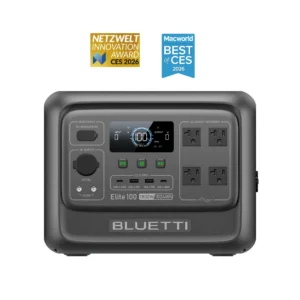
The value-and-solar pick: the best dollars per watt-hour on this page, and a 1,000 W solar input that its review’s testers called one of the fastest solar refills they had seen at this size — a 1:1 solar-to-capacity ratio that matters when café stops are scarce. Bench delivery measured 869–880 Wh usable, and the 25 lb flat-top body is repeatedly praised for clean vehicle stacking. It is demoted from the win by two things: a recurring early-failure cluster (DOA units and unprompted failures inside one to six months — warranty honored, but with real return-logistics friction) and setup traps that must be cleared on day one. ECO mode ships on and can cut outlets under low idle draw; the high-current solar mode is off by default, capping panels near 130 W until you toggle it in the app. Clear those settings before you leave the driveway.
The expansion path. Its review’s closing read — ‘buy it for the road, not the closet’ — names this buyer directly, with a measured ~55-minute recharge, dual 500 W solar ports, an 8 ms measured switchover, and compatibility with EcoFlow expansion batteries up to 5 kWh. Its weaknesses cluster around stationary use: a heavy 32–40 W idle draw and an erratic fan under sustained high load — neither matters much to someone cycling the unit daily. It earns the mention for anyone who expects their power needs to grow; it simply costs more than the C1000 Gen 2 without beating it on recharge speed or noise, so it starts as the expansion pick rather than the outright winner.
The Jackery Explorer 1000 v2 ($499, 1,070 Wh, 23.8 lb) was considered and set aside. It is the lightest of the four and charges fast, but its review’s reliability record at exactly this duty ruled it out: documented silent AC-output cutoffs while indicators stay lit, no configurable low-battery cutoff, a proprietary solar connector that rejects most third-party panels, app Bluetooth that times out (a real problem in a vehicle), and independent AC rundowns across multiple units averaging around 61% of rated capacity at the sustained draw this segment runs.