When you purchase through links on our site, we may earn an affiliate commission. Learn more.

Bluetti AC70vsAC70P (2026)

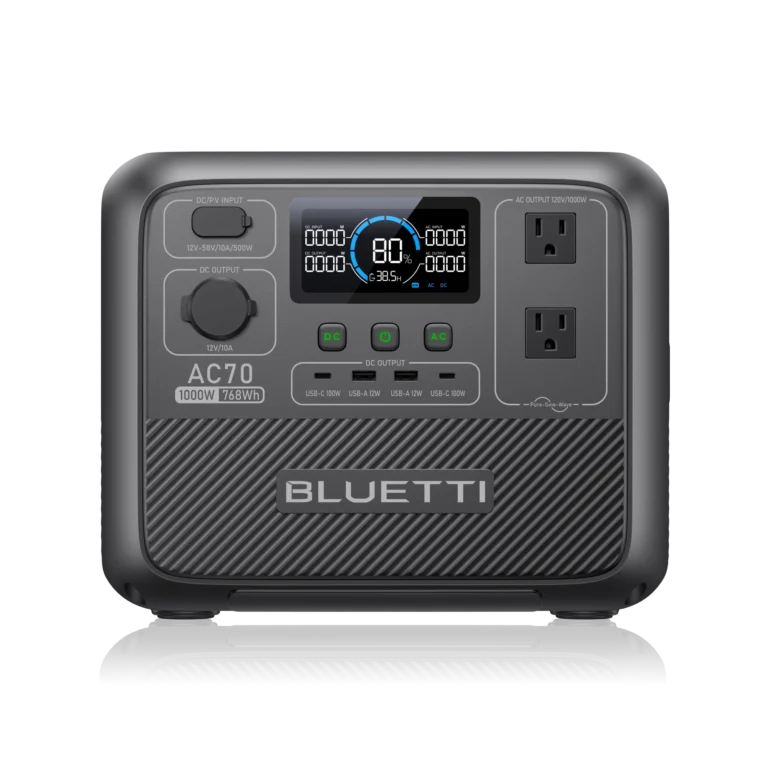
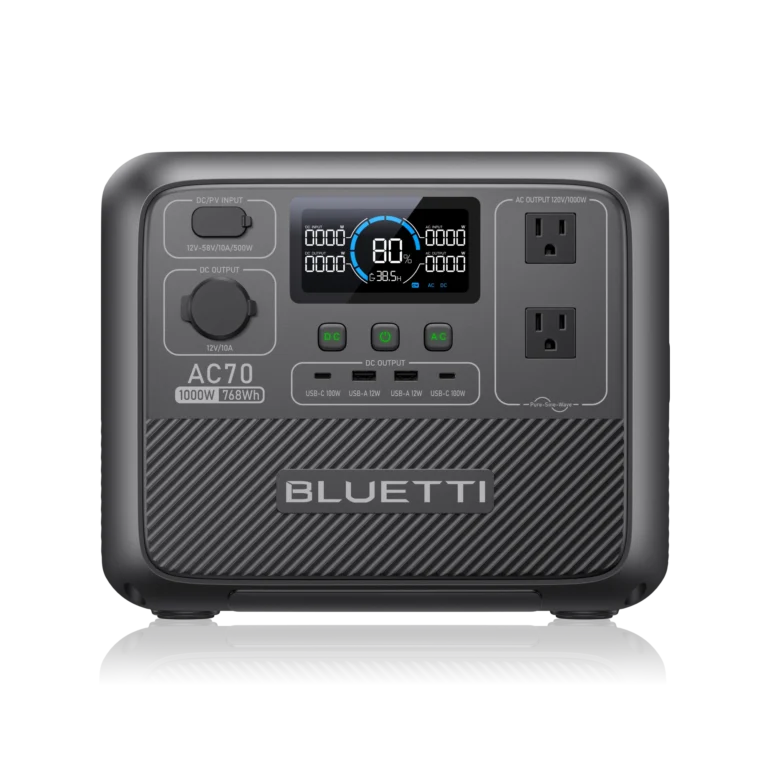
The Bluetti AC70 and AC70P share the same 22.5 lb chassis, 1,000 W inverter, 500 W solar input, 1.5-hour recharge, and 5-year warranty. The difference is price and three features: the AC70P adds 96 Wh of capacity (768 to 864 Wh, a 12.5% gain), a second USB-C port, and a working wireless charging pad. At the current street prices — AC70 $349, AC70P $699 — the AC70P costs double for those modest extras. Both units’ own reviews say the same thing: buy on the price gap. When the gap is wide, the AC70 delivers the same core capability for half the cost. The AC70P only justifies its premium when the price difference is narrow and you specifically want the extra runtime and ports in this exact footprint.

Check price
Prices and availability change frequently
Check price
Prices and availability change frequently
Spec Bluetti AC70 Bluetti AC70P
Capacity 768 Wh 864 Wh
Rated output 1,000 W 1,000 W
Surge 2,000 W Power Lifting* 2,000 W Power Lifting*
Weight 22.5 lbs 22.5 lbs
Dimensions 12.4 × 8.2 × 10.1 in 12.4 × 8.2 × 10.1 in
Chemistry LiFePO4 (3,000+ cycles to 80%) LiFePO4 (3,000+ cycles to 80%)
AC recharge ~1.5 hr (80% in ~45 min, 950 W turbo) ~1.5 hr (80% in ~45 min, 950 W turbo)
Solar input 500 W (12–58V VOC) 500 W (12–58V VOC)
AC outlets 2× 120V 2× 120V
USB-C 1× 100 W 2× 100 W
USB-A
12V car port 1× 10A
Wireless charging None** 15 W
UPS switchover 20 ms*** 20 ms***
Idle draw ~6 W (network mode) / ~10–15 W (inverter on) ~6 W (network mode) / ~10–15 W (inverter on)
Expandable Power Bank Mode only Yes, to 3,936 Wh (Power Bank Mode + B300)
Warranty 5 years 5 years
Price $349 $699
Price per Wh $0.454 $0.809

Value-first essentials, camping, and CPAP backup

  • Who it’s for: A compact one-hand-carry unit for car camping, van trips, CPAP or essential-device overnight backup, or network-UPS duty — and you want the most capability for the least money.
  • Why the AC70: At half the price, it does the same core job. Same inverter, same charging, same UPS behavior for network gear, same form factor. Both reviews independently steer this buyer to the AC70 — the 96 Wh bump and extra ports are not worth doubling the cost. Usable energy is load-conditioned: plan on roughly 450–500 Wh at low AC loads like a 40 W CPAP (where the 10–15 W inverter idle takes a proportional bite), rising to 650–700 Wh at mid and high AC loads of 200 W and above (where idle is proportionally negligible), and higher still on the DC port, which bypasses the inverter. Our review confirms a CPAP runs a full night (7.5–8.5 hours with humidifier and heated tube, waking with over 30% left), a mini-fridge over 7 hours, a 65 W laptop over 10 hours. As a network UPS for routers, modems, NAS, and Starlink, the 20 ms switchover holds seamlessly at roughly 6 W idle — far cheaper to leave running than a legacy lead-acid UPS. Charging is the standout: roughly 930 W from the wall, 80% in 43–47 minutes, measured. At $349, it is one of the better-value compact stations Bluetti makes.
  • Why not the AC70P: It delivers the identical job for $350 more; its extras — the additional 96 Wh, second USB-C, and wireless pad — are not worth doubling the price for this buyer.
  • Honest limits (size your expectations): Appliances over 300 W and motors are out. Power Lifting’s 2,000 W rating caps near 1,000 W and drops voltage (measured 62–96 V under heavy load) — fine for some resistive loads, unsafe for motors, and it trips on a Keurig even in Power Lifting mode (the larger AC180 handles it). AC charging needs 400–500 W minimum in Standard mode, which overloads a 400 W vehicle inverter — charge from the 12V port or a larger inverter or generator. One AC70-specific risk to register: a documented first-year hardware-failure cluster (DC-port E065 error, acknowledged by Bluetti, plus dead screens, charging failures, and isolated smoke events). Warranty service is responsive, so the 5-year coverage earns its keep — register and test the unit, including outlet polarity, on arrival.

Maximum runtime and ports in this footprint

  • Who it’s for: You like this exact compact 22.5 lb form factor, but want the most runtime it can hold, a second USB-C, and a wireless pad — and you can get the price gap down through sale stacking, a bundle, or a narrower spread than today’s street prices.
  • Why the AC70P, with caveats: It carries 864 Wh versus 768 Wh, which translates to roughly 12.5% more usable energy at every matched load regime (idle and efficiency are identical, so the gain is proportional): roughly 510–565 Wh at a CPAP-class load and 735–790 Wh at mid and high loads, versus the AC70’s roughly 450–500 Wh and 650–700 Wh. Our review corroborates strong real delivery — a full breakfast (grill, kettle, coffee) costs roughly 20% of capacity, a 60 W TV runs 8–10 hours, a car fridge roughly 9 hours. It also adds a second USB-C 100 W port and a working 15 W wireless pad (the AC70’s spec lists a pad, but our review confirms there is none). Here is the honest problem: at the current $349 versus $699, the gap is double, and both reviews say a wide gap favors the cheaper sibling. Worse, at $699 the AC70P is shopping against roughly 1,000–1,070 Wh units with 1,500–2,000 W inverters and faster 10 ms UPS (Anker SOLIX C1000, EcoFlow DELTA 3, Jackery Explorer 1000 v2) — more capacity and more output for similar money. The AC70P only makes sense if you specifically want this footprint with the extra ports and the real price gap is small (near the roughly $100 struck-list spread, not the doubled street price). If the gap is wide, buy the AC70; if you want real capability headroom, step to a 1 kWh-class unit.
  • Why not the AC70: It has 96 Wh less capacity and fewer ports — but those modest extras are only worth it if the price gap is narrow.
  • Availability caveat: The AC70P is flagged as out of stock and possibly end-of-life, so long-term support and stock are open questions, and field data on it is thin.

Server or sensitive-computer UPS

  • Who it’s for: You want to put a home server, workstation, or other transfer-sensitive computer behind it and walk away, confident it will never see a power blip.
  • Why neither: Both units carry the identical UPS limitation. The 20 ms switchover is a best case that degrades when the unit sits at full charge — precisely the state a UPS idles in. On the AC70P, an owner running a Plex server saw a detectable blip on roughly 20% of outages, and the manufacturer’s own documentation explicitly warns against using it for servers, workstations, and medical equipment. On the AC70, desktop owners with 300 W and higher loads report reboots despite the 20 ms spec, including a state-dependent failure where the handoff works while charging but fails at 100% and idle. The fix on either is the same and self-defeating: cascade a real traditional UPS downstream — at which point the Bluetti is not doing the set-and-forget job you bought it for. Both do handle routers, modems, NAS, Starlink, TVs, and fridges as UPS — consumer electronics ride through cleanly. And both run a CPAP fine as a power source (a CPAP tolerates a brief blip and restarts; it is not transfer-critical like a server). The warning about medical UPS is about instant-transfer-critical equipment, not overnight CPAP runtime.

True of both units — Both units cap solar input at 500 W and 12–58 V open-circuit, so panel string open-circuit voltage must stay under 58 V (account for cold-morning rise). Our review of the AC70P gives useful in-unit guidance: with two 200 W panels, wire them in series, not parallel — below 32 V the controller caps current at 8 A, leaving output on the table in parallel; in series you stay inside the voltage window and recover it. Standby draw is low but real — roughly 6 W in network or low-power mode, roughly 10–15 W with the inverter actively on. Long-press to fully power down for storage; ECO-mode thresholds are app-configurable.

Common questions

The bottom line

The Bluetti AC70 wins for value-first essentials, camping, CPAP backup, and network-UPS duty — it does the same core job as the AC70P for half the price, as long as you size to its honest load-conditioned capacity (roughly 450–500 Wh at low loads, roughly 650–700 Wh at mid and high loads) and skip appliances over 300 W and motors. The AC70P wins the narrow case where you want the extra 12.5% runtime, a second USB-C, and a wireless pad in this exact footprint — but only when the price gap is small, and at the current $349 versus $699 the gap is double, so even that niche tilts back to the AC70 or up to a more capable 1 kWh-class unit for similar money. Neither unit is suitable for server or workstation UPS duty — the 20 ms switchover degrades when the unit sits at full charge, exactly the state a backup device idles in, and both fail reliably enough that the manufacturer warns against it. Price sensitivity is the dominant caveat: the AC70’s headline value rests on sale pricing, the AC70P may be end-of-life, and at struck-list pricing the gap narrows to roughly $100, which changes the value calculus toward the AC70P for the runtime-and-ports buyer. Confirm both the live prices and stock before you let the spec sheet decide.