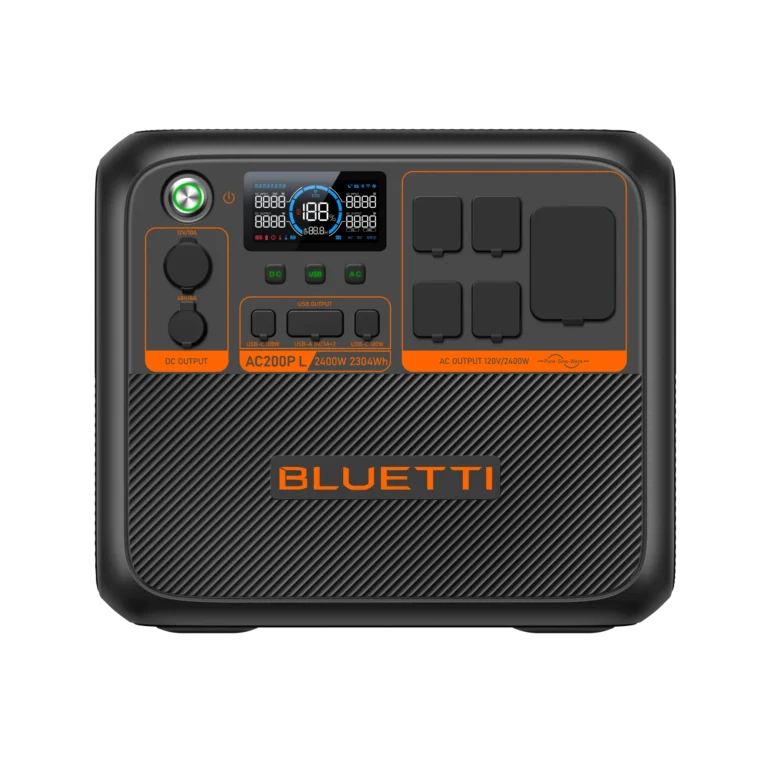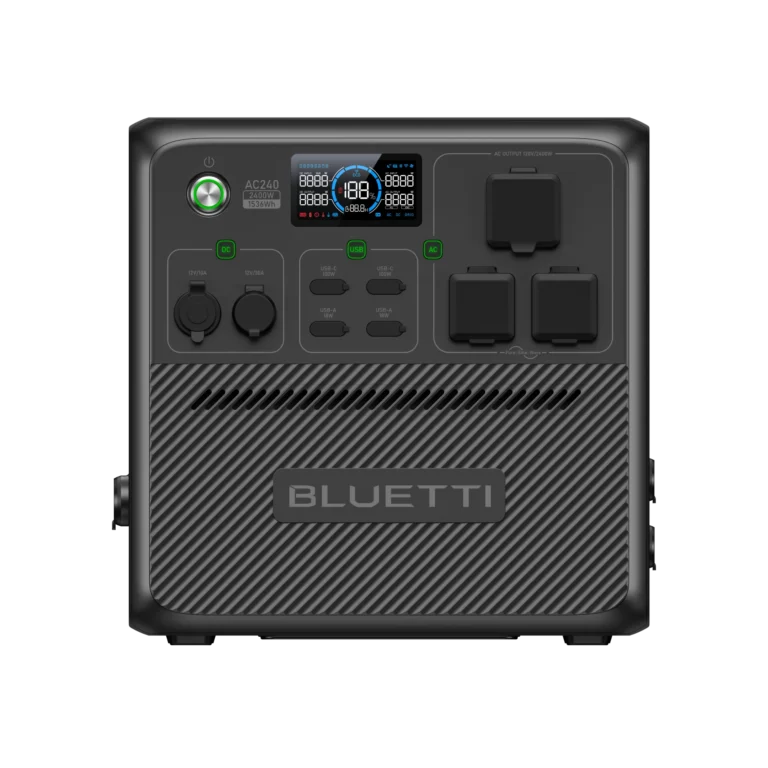
These two Bluettis cost the same — both $1,999 — and push the same 2,400W continuous output. Both are LiFePO4, both are 120V-only, and both publish a 1,200W solar ceiling. So the spec race is a tie. The decision is a single trade: the AC240P buys you an IP65 weatherproof shell and pays for it by giving up roughly a quarter of the base battery (1,843Wh vs 2,304Wh), a flexible solar-voltage window, 8.5 lbs, and about $0.22 of value per watt-hour. The AC200P L spends the same money on more usable energy, a much wider solar input window, less weight, and an expansion path that is actually in stock. Which trade is worth making depends entirely on where you will use the unit.
| Specification | Bluetti AC200P L | Bluetti AC240P |
|---|---|---|
| Capacity | 2,304Wh | 1,843Wh |
| Rated output | 2,400W continuous | 2,400W continuous |
| Surge | 3,600W Power Lifting (resistive-heating-only)* | 3,600W published (Power Lifting, resistive-heating-only)* |
| Weight | 63.5 lbs | 72 lbs |
| Chemistry | LiFePO4 (3,000+ cycles to 80%, 5-yr warranty) | LiFePO4 (3,500+ cycles to 80% in Silent Mode only, 6-yr warranty) |
| AC recharge | ~1.5 hrs to full (0–80% ≈1 hr) | ~1.2 hrs to full claimed (turbo needs accessory cable, sold separately) |
| Solar recharge | ~2 hrs claimed | |
| Ports | 11 total — 4× 120V AC (2,400W), 1× NEMA TT-30, 2× 100W USB-C, 2× 15W USB-A, 1× 12V car, 1× 48V/8A DC aviation | 9 total — 2× 120V/20A AC, 1× NEMA TT-30, 2× 100W USB-C, 2× 18W USB-A, 1× 12V/30A RV port (360W), 1× 12V/10A cigarette |
| Solar input | 1,200W max, 12–145V window | 1,200W max, 11–60V window |
| Weather rating | IP65 | |
| Price | $1,999 ($0.87/Wh) | $1,999 ($1.08/Wh) |
* Power Lifting Mode is a voltage-trimming feature for resistive heating loads only (heaters, hairdryers, irons), not for motor-start loads, and is disabled in parallel on the AC240P. Neither unit offers conventional motor-start surge headroom; both cap continuous at 2,400W. Blank cells indicate a figure was not recorded in our research, not that the feature is absent.
The same two units rank differently across segments. That is not a contradiction — it is the single trade (weatherproofing vs. capacity/flexibility/value) resolving differently as the situation reweights the axes. The AC200P L wins sheltered home backup (flipping axis: low-load efficiency plus 25% larger battery), solar-fed off-grid (flipping axis: 12–145V solar input window vs the AC240P‘s 11–60V ceiling), and RV & trailer when the install is enclosed (flipping axis: capacity, weight, value, D40 12V charging). It is demoted in weatherproof field and adventure (flipping axis: no IP rating, a hardware gate it cannot clear). The AC240P wins weatherproof field and adventure (flipping axis: IP65 weather sealing), and RV & trailer when the install is weather-exposed (flipping axis: IP65). It is demoted in sheltered home backup (flipping axis: low-load inefficiency — 65W drew the battery from 84% to 15% overnight — plus smaller battery) and solar-fed off-grid (flipping axis: narrow 11–60V solar window chokes higher-voltage arrays). The pattern in one line: the AC240P wins exactly when the unit gets wet or dusty, and loses everywhere it stays dry. At an identical $1,999, the IP65 shell is the only thing you are buying that the AC200P L cannot match — and it costs you a quarter of the battery, the solar flexibility, and the value.