
On this page
The number stamped on a solar panel is a lab result, not a promise. It was measured under conditions you will essentially never recreate on a van roof — perfect angle, perfect temperature, perfect irradiance. The real-world gap isn’t rounding error. One full-timer who logged a year of data found their 400W array averaged around 250W in summer and fell to roughly 75W in winter, hitting anywhere near its rated output exactly once. Summer produced about three times what winter did. That single dataset reframes the whole question: you’re not really asking how many watts you need — you’re asking how many watts you need in your worst month, at your latitude, for your actual load.
This guide works through that question honestly. It starts with what the numbers actually mean, moves through how much is genuinely enough for different kinds of van life, and ends with what to do when the answer is “more panels won’t fix it.”
The Rule of Thumb — What It Gets Right and What It Silently Assumes
The sizing formula you’ll find on almost every van build blog is consistent enough to be worth knowing. It runs like this: figure on roughly 200W of solar for every 100Ah of usable lithium capacity you carry. As a daily harvest estimate, the same sources suggest panels collect roughly four times their rated wattage per day. A 400W array, then, is expected to gather around 1,600Wh on an average day.
The formula is arithmetically sound — it’s an energy-balance calculation, not a marketing claim, which is why it keeps showing up across sources that have no reason to agree. The problem is the invisible asterisk: “average day” in that formula means peak-summer, close-to-ideal conditions. The same bloggers who publish the rule also document, in their own data, that it dissolves in winter. Copying the number off a chart without its season attached is how people end up chronically undercharged from October onward.
The more honest working band, once you account for clouds and short days, is somewhere between 200W and 400W of solar per 100Ah of usable capacity — and where you land in that band depends almost entirely on when and where you travel.
What Your Panels Will Actually Produce
This is the part the spec sheet doesn’t tell you, and it matters more than any formula.
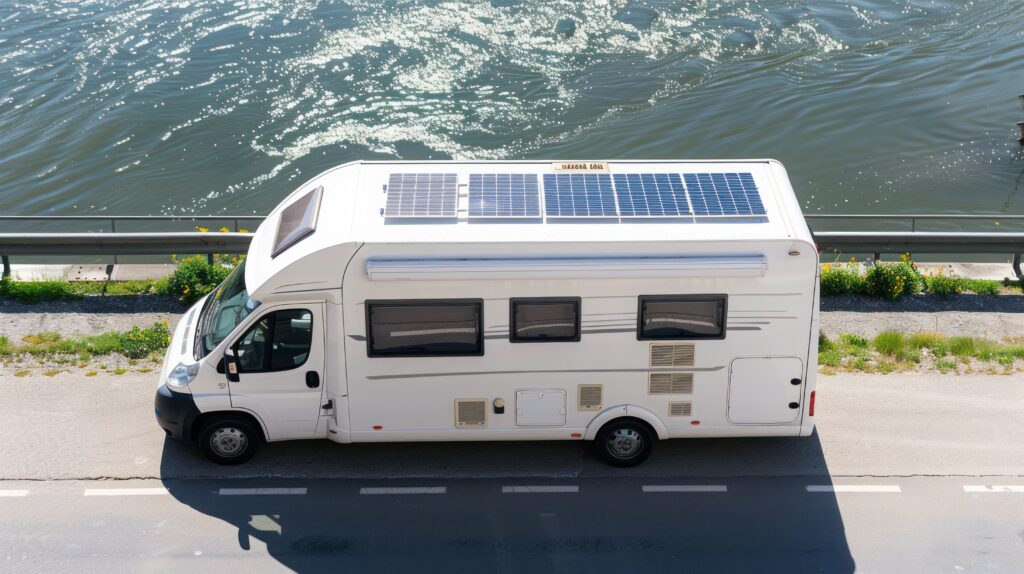
The logged data tells a clear story. A 400W array, flat-mounted on a van roof, averaged around 250W during summer months — already a significant haircut from the nameplate. In winter that fell to roughly 75W. The rated 390W peak was hit once over a full year of measurement. The seasonal swing was nearly threefold.
Several factors stack to create that gap:
- Flat mounting loses 20–30% compared to a tilted array. A roof-mounted panel is almost never at the optimal angle for the sun, especially outside of summer. Hands-on testers with liftable mounts report that tilting or lifting the array recovers 20–30% of output, with even larger gains in winter when the sun sits low.
- Clouds cut output to roughly 20–30% of full-sun production. Not zero, but a severe reduction — and in the Pacific Northwest, northern Europe, or a rainy week anywhere, “cloudy” is the default, not the exception.
- High latitudes compress the picture from both ends. Short winter days combined with a low sun angle mean the productive window shrinks at exactly the time each hour of sun is already underperforming.
The practical takeaway: treat rated wattage as a theoretical ceiling you rarely approach. Size your system for what it will actually produce during your worst expected stretch, not for what the label says on a perfect July afternoon.
How Much Is Enough — Full-Time Van Life Without AC
Two different sources with logged or extended field experience converge on a useful pair of benchmarks. They’re worth treating as real reference points because neither was selling a specific panel or kit.
400W is the practical floor for a full-timer running a fridge. Below this and you’re either rationing constantly or relying on alternator charging and shore power to fill the gap. The important caveat: the same tester who named 400W as the minimum also documented 75W winter output from a 400W array. At that yield, 400W is only a real minimum if you have backup charging. Solo solar at 400W won’t sustain a full-time rig through a cloudy northern winter.
600W is the comfort point. At 600W, field reports describe reaching a full battery by early afternoon on sunny days and managing reasonably well through summer and mild winters. It provides enough margin to absorb a cloudy day without immediately rationing. For a full-timer with a 12V fridge, lights, fans, and regular laptop use, this is the target worth building toward.
At the high end, builders running Starlink or heavy remote-work setups alongside their fridge and accessories report that around 1kW of solar paired with a substantial battery bank makes energy feel genuinely effortless — no mental overhead, no rationing, no chasing the sun.
Your actual load matters too. Here’s where common full-time setups tend to fall:
- Minimal (weekend or occasional use): 200–300W with 100Ah lithium — runs a 12V fridge and charges devices in decent conditions
- Comfortable full-time, no AC: 400–600W with 200–300Ah lithium — the range where most full-timers without heavy power draws land
- Full-time with heavy work loads or Starlink: 600W–1kW with 300–500Ah lithium — buys independence and margin for cloudy stretches
Battery Chemistry Changes the Math More Than Most Charts Show
Panel count is only half the equation. Your battery bank determines how much of what your panels collect you can actually use — and how many sunless days you can survive.
The key variable is usable depth of discharge. Lithium batteries can be drawn down to roughly 20% remaining charge, giving you about 80% of their rated capacity as usable energy. AGM batteries should only be taken to 50% discharge to preserve their lifespan — meaning you get roughly 50% usable. In practice, that means AGM needs about twice the rated capacity to store the same usable energy as lithium.
To make that concrete: if you need 300Ah of usable capacity for three days of autonomy at 100Ah per day, you need roughly 375Ah of lithium or roughly 600Ah of AGM to get there.
What the depth-of-discharge math doesn’t mention is cold weather. Lithium loses usable capacity as temperatures drop, and — critically — lithium cells must not be charged below freezing without a heated battery or a low-temperature charging cutoff. A perfectly sized battery bank is still useless as a solar sink on a frozen morning if the chemistry shuts down charging. Winter van life in cold climates means either a lithium battery with built-in heating, or planning around this limitation.
Inverter Size Is About Peak Load, Not Total Energy
The inverter question is simpler than people make it, once you frame it correctly. Inverter size is set by your highest simultaneous AC draw, not by how much energy you use in a day.
For a modest van build — two laptops, a blender, some phone charging, maybe a small fan — a 1,000W inverter covers simultaneous loads comfortably and reportedly gets “barely used” at capacity in setups without a microwave or AC. If you want to run an induction cooktop and a microwave at the same time, the load stacks to 3,000W or more, and your inverter needs to match that peak.
The common mistake is sizing the inverter to daily energy use. A rig that uses 2,000Wh per day doesn’t need a 2,000W inverter — it needs an inverter that can handle whatever load spikes occur simultaneously. Oversize slightly to handle motor surges and compressor startups; don’t size to daily totals.
Air Conditioning Is a Different Problem Entirely
If AC is on your list, the panel-count question largely dissolves into “as much as physically fits on the roof, plus backup charging.” This is consistent advice across experienced builders, and it reflects a real physical limit: solar panels alone cannot reliably sustain air conditioning through clouds, overnight, or during prolonged overcast stretches.
Realistic AC-capable builds cluster around 1kW of solar paired with a very large battery bank — one cited example runs roughly 12kWh of battery storage, representing about half of a complete build budget. A mini-split with around 1kW of solar is the most efficient AC approach, but even there, the battery bank is doing the heavy lifting when the sun isn’t cooperating.
The mental model that helps: size your batteries for roughly 24 hours of autonomy without any charging input, then target solar plus alternator charging to replace a meaningful fraction of consumption per hour when conditions allow. Adding a generator or shore power connection as backup removes the anxiety that clouds and long overnight AC runs would otherwise create. More panels help, but they can’t cover the problem that cloudy runs and nighttime cooling create — storage and charging redundancy solve that.
The One Number Worth Keeping
If you leave with one thing, let it be this: size for your worst month, not your best. The tester who logged a full year on a 400W array wasn’t in an unusual situation — they were in a typical one. Summer looks like plenty. Winter looks like barely enough. Design your system so that “barely enough” in December still keeps the fridge running and the batteries above their floor, and everything else is margin you’ll enjoy in July.