
On this page
Everyone shopping flexible solar panels zeroes in on one number: efficiency. Rigid panels are a few percentage points more efficient, the comparison charts say, and buyers spend hours deciding whether that gap matters. It doesn’t — or rather, it’s so far down the list of things that matter that fixating on it is a distraction. The real problem with flexible panels is that they can cook themselves to death in a few years, and no datasheet will tell you that.
The failure isn’t from bending. It’s from heat. A flexible panel laminated flush to a roof or deck with no air gap behind it has nowhere to shed thermal energy — one measurement put a panel’s surface at over 160°F on a 90°F day. That sustained heat, compounded by UV, breaks down the plastic encapsulation and eventually kills the cells. Field reports from hot, high-UV climates describe panels going from healthy to dead in three or four summers, while the spec sheet promises five to fifteen years. The warranty asymmetry tells you everything: manufacturers will stand behind a rigid panel for 25 years, but they cap flexible panel warranties at around five — because they know what happens.
Understanding all three form factors — rigid, flexible, and portable — means understanding what each one actually trades away, and why the trade looks different in a catalog than in real life.
What You’re Actually Choosing Between
The three panel types share the same job but solve it differently, and the differences run deeper than shape.
Rigid monocrystalline panels are the glass-and-aluminum workhorses that cover most rooftops. They run 20–23% efficiency under ideal conditions, weigh 30–50 lbs apiece, and last 25–40 years — routinely warrantied to 25. They need a solid mounting structure and don’t fit curved surfaces, but when the question is “how long will this keep making power,” nothing else in this comparison comes close.
Flexible panels use ultra-thin silicon cells — a fraction of the thickness of standard monocrystalline cells — encapsulated in plastic (usually PET or ETFE) or bonded to a metallic backing. That thinness is what makes them bendable, and it’s also what makes them vulnerable. Most are rated around 30 degrees of flex, with some specialty units going further. They run 15–18% efficiency under ideal conditions, weigh 4–6 lbs, and are marketed at a 5–15 year lifespan. What they actually deliver in harsh sun is the subject of the next section.
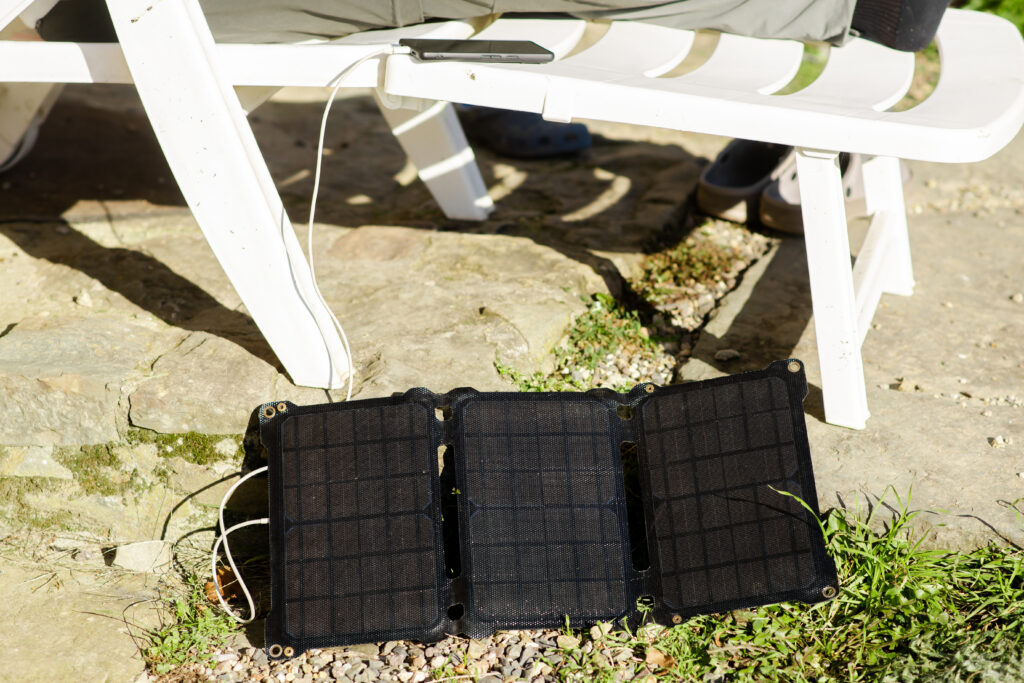
Portable panels — suitcase-style folding units — are their own category. They travel, they deploy on-demand, and they don’t mount permanently anywhere. They sidestep the flush-mounting heat problem entirely because you unfold them, prop them up with a kickstand, and fold them away when you’re done. For anyone powering a portable power station on a trip, they’re the most pragmatic choice in this lineup.
The Real Weight Advantage — and Why It’s Legitimate
Before getting into what flexible panels get wrong, it’s worth being clear about what they genuinely get right: weight. Sources across the board agree on the numbers here — 4–6 lbs for flexible panels against 30–50 lbs for a standard rigid panel. That’s not a rounding difference; it’s a different category of object entirely.
For an RV roof, a sailboat deck, or a van conversion where every pound matters and the surface curves, flexible panels offer something rigid panels simply can’t provide. They can conform to a curved roof skin. They won’t put structural stress on a fiberglass hull. They won’t blow off a vehicle at highway speed the way an improperly mounted rigid panel might. These are real, legitimate reasons to choose flexible — and the durability problems don’t erase them. They just mean you’re making a trade, and you should make it with open eyes.
Why Flexible Panels Die Young
The failure story is almost always the same, and it isn’t about bending.
When a flexible panel is laminated directly to a surface — flush to the roof skin, no gap, no airflow — it traps heat between itself and whatever it’s stuck to. One measurement captured a panel surface exceeding 161°F on a 90°F ambient day in direct sun. That’s not a brief spike; it’s the sustained operating temperature for every sunny afternoon. The plastic encapsulation can’t handle years of that, especially with intense UV on top. The cells degrade, the encapsulant yellows and delaminates, and output collapses.
People who’ve actually run flexible panels in hot, high-UV climates report outcomes well short of the marketed lifespan. Individual accounts describe panels going to zero output in 18 months in northern Australia, dying after three summers in New Zealand, and — in one direct comparison — a 130W flexible panel going dead in four years while a smaller 100W rigid panel was still producing meaningfully a decade in. Another report described a bank of four 100W flexible panels down to roughly a quarter of their rated output by year two. These are individual user reports from harsh conditions, not controlled studies, so treat them as the realistic bad-case end rather than a universal guarantee. But the pattern is consistent, and the warranty gap corroborates it.
The rated efficiency difference — flexible panels running 15–18% versus 20–23% for rigid — sounds like the main story. It isn’t. A higher-wattage flexible panel can actually out-produce a smaller rigid one on day one. One real-world comparison showed a flex panel producing meaningfully more power than a rigid unit with a lower rating — right up until it died years early. Efficiency without lifespan is a trap metric.
There’s also a separate, temporary effect worth knowing: hot panels lose output while they’re hot, independent of any permanent damage. That’s a real derate on hot days, layered on top of the long-term degradation problem.
Construction Details That Actually Matter
Not all flexible panels are equally fragile. Two construction choices make a real difference to how long a panel survives.
- Encapsulation material: ETFE plastic holds up under UV significantly better than PET. If you’re choosing a flexible panel, ETFE on the surface is worth paying for.
- Backing material: Metallic-backed cells outlast plastic-backed ones. PET plastic backing degrades under UV and heat; a metallic substrate handles it better.
The thinness that makes flexible panels flexible — cells measured in a few micrometers versus up to around 200 micrometers in a standard rigid cell — is the same property that limits how much protective material surrounds them. The feature and the fragility share a root. That’s not a flaw in the design so much as an honest constraint of the physics.
Bend ratings — typically around 30 degrees, with some specialty panels rated to higher angles — are fresh-out-of-box specs from single manufacturer sources, and they describe what the panel tolerates on installation day. Repeated thermal cycling creates micro-cracks over time that compound whatever heat damage is already accumulating. The bend number is not a long-term operating spec.
How to Use Flexible Panels Without Getting Burned
If the weight and conformability advantages make flexible panels the right choice for your application, two practices meaningfully improve the outcome.
- Leave an air gap. Even a small gap between the panel and the mounting surface allows airflow and dramatically reduces operating temperature. The 161°F measurement is a flush-mounted result; panels with ventilation behind them run cooler, and cooler means longer.
- Choose ETFE encapsulation and metallic backing over PET plastic where the option exists. In hot or high-UV environments, this is the single most durable construction choice available.
Portable folding panels are worth a serious look if your use case is mobile power rather than a permanent installation. They don’t have a flush-mounting heat problem because they aren’t flush-mounted — you deploy them, angle them toward the sun, and pack them away. For pairing with a portable power station on a camping trip or in a vehicle that moves, a well-made portable panel may simply be the better tool.
Matching Form Factor to Use Case
| Use case | Best fit | Why |
|---|---|---|
| Permanent home or cabin installation | Rigid | 25–40 year lifespan, highest efficiency, lowest long-term cost |
| RV, boat, or curved roof — permanent | Flexible (ETFE, air gap) | Weight and conformability win; mitigate heat risk with gap and good materials |
| Camping, van travel, portable power station | Portable folding | No flush-mounting heat problem; deploys and packs away; purpose-built for mobility |
| Weight-critical permanent install (sailboat, lightweight van) | Flexible (ETFE, metallic-backed, air gap) | Best available durability within the flexible category; accept shorter lifespan knowingly |
The honest summary: rigid panels win on lifespan by a factor that makes every other comparison secondary. Flexible panels win on weight — genuinely and decisively — and that win is real for the applications that need it. The efficiency gap between them is modest and largely beside the point. If you choose flexible, the two things that most determine whether you get three years or closer to the rated lifespan are whether you leave an air gap and which encapsulation material you buy. Everything else is secondary to those two decisions.