
On this page
The spec sheet says a power station holds, say, 1,000 watt-hours. Most buyers translate that directly into runtime — an hour at 1,000 watts, two hours at 500 watts, and so on. That math is roughly right for a light laptop load and wildly wrong for the appliances people actually need when the lights go out. The real question isn’t which device produces more power; it’s the difference between a fixed energy budget and an unlimited one. Once you see that structural divide, everything else about this decision falls into place.
The Fixed Budget vs. the Open Tab
A portable power station is, at its core, a very large rechargeable battery — lithium-ion or LiFePO4 chemistry — with a built-in inverter and a cluster of AC, DC, and USB outlets on the face. Silent, emission-free, no fuel to store, no exhaust to vent. You charge it from a wall outlet, solar panels, or your car, and then you draw from it until it’s empty.
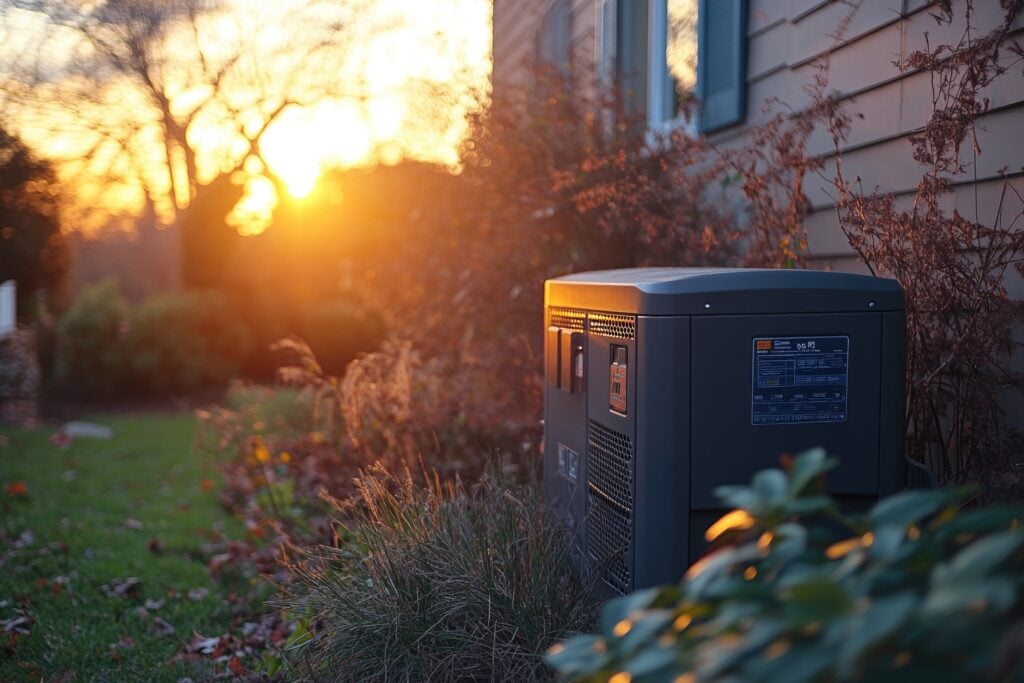
A home standby generator is the opposite in almost every relevant way. It lives permanently outside your home, wired directly into your electrical panel through a transfer switch. When grid power drops, it detects the outage within seconds and starts itself automatically — no intervention required. It runs on natural gas piped to your house or a large propane tank, which means as long as fuel flows, it runs. There is no energy ceiling.
That last sentence is the whole comparison in miniature. A power station has an energy ceiling. A standby generator doesn’t. Everything downstream — runtime, use cases, cost, expandability — is a consequence of that one structural fact.
What You Actually Get Out of the Listed Capacity
The nameplate watt-hour figure isn’t quite what reaches your devices. Inverter conversion losses shave a few percent off the top, and the gap grows under heavy or surge-heavy loads. Hands-on bench testing by Popular Mechanics found one unit delivering 92% of its listed 2,073.6 Wh, another delivering 97% of its listed figure. Not catastrophic — but not 100%, and the discrepancy gets worse precisely when you’re drawing hardest.
The practical takeaway: budget for something closer to 90–97% of the listed capacity, and know that the high end of that range assumes moderate, steady loads. The missing percentage isn’t a flaw — it’s physics — but the marketing never mentions it.
How Long Will It Actually Run Your Stuff?
This is where the “capacity equals runtime” fantasy collapses. All the following figures come from measured testing under stated conditions — they’re real, but they’re also specific. Your numbers will vary with your appliances and habits.
The starkest illustration comes from a single test on the Jackery Explorer 1000 V2, a 1,070 Wh unit. Running a refrigerator — which cycles its compressor on and off — it lasted 18 hours and 22 minutes. Running a constant 475-watt load, the same unit lasted 1 hour and 57 minutes. Same device, same battery, a factor-of-nine difference in runtime. The 18-hour figure is real; it just assumes the fridge’s compressor isn’t running continuously. A constant load of the same average wattage tells a completely different story.
The pattern holds across the range of tested units:
- A 268 Wh unit (EcoFlow River 3 Plus) ran a fridge for 3 hours and 45 minutes — useful for a power blip, not a day-long outage.
- A large 8,096 Wh configuration (EcoFlow Delta Pro 3 with expansion) ran a 1,300-watt space heater for roughly 6 hours. Eight kilowatt-hours, gone in a workday, because resistive heating draws constantly at full wattage.
- A 1,505 Wh unit (Goal Zero Yeti 1500) running light electronics — router, lamp, laptop — stretched past two full days.
The lesson isn’t that any of these numbers is good or bad. It’s that load type determines everything. Heating and cooling loads eat watt-hours aggressively and continuously. Electronics are miserly. The “runtime” figure on the box is usually derived from something closer to the electronics scenario, not the fridge or heater scenario.
Surge Watts: The Number That Decides Whether Your Appliance Even Starts
Every power station carries two wattage ratings: a continuous output ceiling and a higher surge — or startup — rating. The surge number is the one that matters for anything with a motor or compressor, because those devices demand a brief but intense current spike to get moving that can be well above what they draw once running. If the startup spike exceeds the surge ceiling, the appliance simply won’t start, regardless of whether the running wattage fits the continuous rating.
Tested surge figures from current units to give a sense of the range:
| Unit | Continuous | Surge / Boost |
|---|---|---|
| Bluetti Elite 200 V2 | 2,600 W | 3,900 W |
| Bluetti Apex 300 | 3,840 W | 7,680 W |
| EcoFlow Delta Pro 3 | 4,000 W | 6,000 W (X-Boost mode) |
| EcoFlow River 3 Plus | 600 W | 1,200 W (X-Boost) |
A note on “boost” or “X-Boost” modes: they raise apparent output by reducing voltage, which works fine for many appliances but can cause problems with sensitive electronics. They’re not a free upgrade to the surge ceiling — they’re a workaround with trade-offs.
One more wrinkle: if you’re running multiple appliances and two happen to start their compressors at the same moment, those startup spikes stack against the same continuous ceiling. Shopping by running wattage alone is how people end up frustrated on day one of an outage.
Battery Life and Recharge: What the Datasheet Won’t Tell You
LiFePO4 chemistry stations are commonly rated to around 6,000 charge cycles before dropping to 80% of original capacity. That figure appears on spec sheets and in nearly every roundup. What it doesn’t say is that no reviewer — and no buyer — can verify it in a realistic time window. It’s a manufacturer datasheet number, full stop. Treat it as directional: LiFePO4 is legitimately long-lived chemistry, but the specific cycle count is an unverifiable claim.
Two things the cycle-life headline quietly omits matter more in practice:
- Temperature accelerates degradation. That 6,000-cycle figure assumes room-temperature conditions. Heat cycling and cold storage both cut real-world longevity.
- Lithium chemistry must not charge below freezing. Charging a lithium battery — LiFePO4 or Li-ion — in below-freezing temperatures plates lithium metal onto the anode and causes permanent damage. If you’re storing a station in an unheated garage or vehicle through winter and plugging it in on a cold morning, this matters.
Recharge speed, on the other hand, is well-tested. From a wall outlet, modern units in the 1–2 kWh range charge fast: one tested unit (Bluetti Elite 200 V2) reached 80% in 81 minutes and completed the cycle in 107 minutes. A Jackery Explorer 1000 V2 came in under two hours from the wall. Vehicle charging is a different story — the same Jackery unit takes up to 12 hours from a car’s 12V outlet. For outage preparedness, wall charging is the only practical quick top-up; solar is slower still and depends entirely on conditions.
Can You Stack More Batteries and Compete with a Standby?
Higher-end stations accept expansion battery packs and can run in parallel pairs, which means the energy ceiling is movable. The EcoFlow Delta Pro 3 can reportedly scale to 48 kWh with expansion packs and a second unit. The Bluetti Apex 300 can reach roughly 19,353 Wh with six added batteries and two units in parallel. These are verified specs from a single testing source, reported as model-specific numbers, not universal claims.
That’s a genuinely large energy store — enough to run a typical home through a day-plus outage comfortably if you’re managing loads. But two catches come with it that marketing tends to understate.
First, weight. A base EcoFlow Delta Pro 3 weighs roughly 113 pounds. Add an expansion pack and you’re approaching 200 pounds. This is no longer a device you move around; it’s a semi-permanent fixture that happens to not require a permit.
Second — and this is the catch that makes the comparison with a standby generator more honest — when that 48 kWh empties during a multi-day grid outage, you recharge it from the grid or from solar. During a grid outage, the grid path doesn’t exist. Solar recharge depends on weather and takes time. A standby generator on a gas line never faces this problem. Expandable capacity narrows the gap; it doesn’t close it.
Which One Is Actually Right for Your Situation
The use-case guidance circulating in most sources comes largely from Generac, which manufactures and sells both standby generators and portable units. Their framing is directionally sound but serves their product segmentation — take the tidy category boundaries with appropriate skepticism.
With that caveat, the genuine distinctions are real:
- A power station fits: apartments, condos, and smaller homes where noise and emissions are prohibitive; outages measured in hours, not days; powering a handful of essentials (fridge, phone, medical device, router); RV use and remote work; anyone who needs portability or wants zero installation.
- A home standby generator fits: whole-home coverage; multi-day or indefinite outages; houses with natural gas or large propane supplies; households that want fully automatic, hands-off restoration with nothing to charge, calculate, or manage.
No source quantified what a standby installation actually costs — unit, transfer switch, gas line work, and professional installation together. That number runs well into the thousands and is a meaningful part of the decision that the comparison guides skip over. Likewise, no source put hard numbers on the portable fuel generator middle option (cheaper upfront than standby, a couple of 120V outlets, not intended to power a whole house) beyond that general framing.
The Decision, Distilled
Power stations are remarkable for what they are: silent, portable, zero-emission, and increasingly capable. But they hold a finite charge, and the moment you plug in a space heater or keep a fridge running through a summer outage, that budget drains faster than the box implies. A standby generator doesn’t care how long the outage runs — it only stops when the fuel does. If the outage scenario you’re actually planning for is measured in days, not hours, no amount of battery stacking fully replaces an open-ended fuel supply. Know your expected outage duration first; everything else — capacity, watts, cycle life — is detail work.