
On this page
The question everyone asks — “how many batteries do I need for a 300W solar panel?” — is backwards, and answering it straight sets you up to fail. A 300W panel doesn’t reliably produce 300W. It hits that number only under laboratory conditions almost never seen in the field, and only for an instant. The nameplate is a ceiling, not a promise. Size your batteries to that ceiling and you’ll spend most days undercharged.
The real question is how much energy your panel actually harvests on a typical day in your location — and that number changes everything. Get it wrong in either direction: too little battery and you run out of stored power before sunrise; too much and the panel can never fill it.
Before you can answer “how many batteries,” you need to lock down three other variables: your realistic daily sun-hours, your battery chemistry, and what you’re actually planning to run. Everything below is about those three.
What a 300W Panel Actually Produces in a Day
The honest starting figure for daily energy production is: multiply your local peak sun-hours by the panel’s wattage, then expect somewhat less than that in real conditions. For a decent US location averaging around 4.5–5 peak sun-hours, a 300W panel yields roughly 0.9–1.5 kWh on a good day — with a California-style calculation landing around 1.35 kWh. That’s before derating for heat, wiring losses, and less-than-perfect angle.
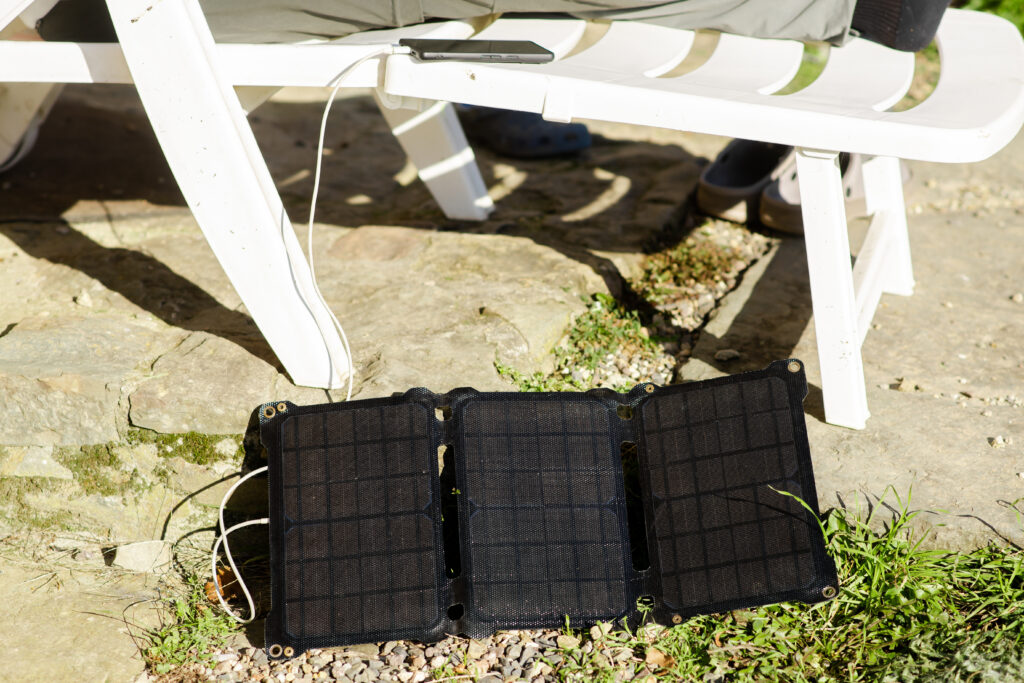
But the daily average hides just how variable the panel’s output is hour to hour. Even in strong, direct sun — the closest you get to ideal outdoors — you’re looking at around 240W, roughly 80% of the rated number. Cloud over and you’re down to 50–80W. A heavily overcast sky drops you to somewhere between 15–25W. Rain or night: zero. The 300W on the box is a lab ceiling you essentially never reach outdoors, because the rating requires both peak irradiance and a cool panel — and strong sun heats the panel well above that test temperature, eating into output even on your best days.
This has a practical implication for sizing: if your use case is in a cloudy climate, or at high latitude in winter, the daily yield that drives your battery calculation isn’t the California figure — it could be a fraction of that. The number to find for your situation is your local peak sun-hours, not the panel’s nameplate.
The other thing this means: charge-time estimates you see quoted online almost always assume favorable, full-sun conditions. Keep that in mind as you plan.
Battery Chemistry Is Where You Actually Size
The most counterintuitive thing in battery sizing is this: two banks with the same Wh label on the box can deliver radically different amounts of usable energy depending on chemistry.
With lead-acid and gel batteries, you can only draw down about 50% of the rated capacity before you start causing permanent damage. A bank labeled 6,000Wh gives you roughly 3,000Wh you can actually use. LiFePO4 (lithium iron phosphate) changes the math entirely — it’s routinely usable to about 80% depth of discharge to preserve cycle life, and capable of going to 100% when you need it. So a 3,000Wh LiFePO4 bank delivers as much or more usable energy as a 6,000Wh lead-acid bank, at half the nameplate size.
The sources that establish this are a hobbyist forum and a kit vendor — not a single seller pushing one chemistry — which makes the 50%/80–100% split fairly credible. It’s also consistent with how these chemistries behave at the cell level.
| Chemistry | Nameplate example | Usable energy | Notes |
|---|---|---|---|
| Lead-acid / Gel | 6,000 Wh | ~3,000 Wh | Discharge past 50% causes permanent capacity loss |
| LiFePO4 | 3,000 Wh | ~2,400–3,000 Wh | 80% recommended for longevity; 100% capable for occasional use |
The practical takeaway: never compare batteries across chemistries by their Wh sticker. Size by usable energy, not nameplate. And if you’re choosing between the two, the same usable capacity requires you to buy roughly twice the lead-acid nameplate to match a LiFePO4 bank — which matters for cost, weight, and space.
How Long Will One 300W Panel Take to Charge a Battery?
Every charge-time figure you’ll find online has a hidden assumption baked in, and that assumption is almost always optimistic. The honest answer is: it depends entirely on how big the battery is, how depleted it is, and how much sun you actually get that day.
Here’s what the range of worked examples looks like across different sources:
- A roughly 600Wh LiFePO4 unit charged from 20% to full takes around 4–7 hours on one 300W panel under London irradiance — the spread coming from whether the panel is rigid or folding.
- A 3 kWh battery takes approximately 10 hours under “perfect” conditions on a single 300W panel. Realistically, with two panels and actual weather, one source estimates just under two days.
- A 12V, 300Ah (roughly 3,600Wh) lead-acid bank would need multiple panels to achieve a same-day charge.
Notice that none of these numbers travel well to your situation — each one encodes a specific battery size, depth of discharge, panel type, and sun assumption. The “10 hours under perfect conditions” figure is exactly that: an idealized floor that real conditions will extend. Treat any charge-time estimate you see as best-case unless the source explicitly shows its sun-hour assumption.
There’s also a bottleneck most sizing guides skip entirely: your charge controller. A 12V/20A PWM controller, for example, caps the power intake regardless of what the panel can produce. The panel wattage is often not the limiting factor — the controller and the battery’s own charge acceptance rate are. If you’re building a system around a single panel and a modest battery, check the controller’s current ceiling before assuming the panel’s full output is making it through.
If You’re Using LiFePO4: The Cold-Charging Trap
Lithium batteries have a specific hazard that isn’t obvious from the spec sheet: discharging in cold weather is generally tolerated, but charging below freezing causes irreversible lithium plating inside the cells. It can be both a longevity and safety issue. Vendor specs place the safe charging window at 0–45°C. If your setup is in a van, shed, or outdoor enclosure in a cold climate, this isn’t a minor footnote.
For operation and storage, the optimal band is around 20–30°C. For longer-term storage, keep the battery cool — one vendor spec gives −5 to +35°C as the storage window and flags not going below −10°C or above 45°C for extended periods. Store at roughly 50% state of charge, not full and not empty.
These are vendor-sourced numbers from a single spec sheet, so treat them as a planning guide rather than a hard engineering spec. The directional rule is clear regardless: in cold weather, make sure your battery is above freezing before you put charge into it.
A Note on Cycle Life Claims
LiFePO4 batteries are typically marketed with figures like “>2,000 cycles” or “10+ years.” Both numbers come from cell datasheets and are structurally unverifiable — no third-party reviewer can independently cycle a battery 2,000 times inside a product review window. The “10 years” figure assumes one full cycle per day, which is itself an assumption.
More importantly, a naked cycle count means nothing without knowing what end-of-life capacity it’s measured to (80% remaining? 70%?), at what depth of discharge, and at what temperature. A cycle figure without those anchors can’t be compared to anything. File “>2,000 cycles” as a datasheet claim, acknowledge it’s directionally better than lead-acid’s cycle life, and don’t treat it as a measured outcome.
So How Do You Actually Size the Battery Bank?
Work the problem in this order:
- Find your realistic daily load. Add up what you’re running and for how long. This is your daily Wh target.
- Find your local peak sun-hours. This varies considerably by region and season. A California summer installation and a winter install in the Pacific Northwest are completely different problems.
- Estimate realistic daily yield. Peak sun-hours × 300W, then expect something below that once you account for heat, angle, and wiring losses. The ~0.9–1.5 kWh range is a reasonable US reference band for a good location, not a guarantee.
- Size for your chemistry. Determine the usable Wh you need from your load target, then work back to nameplate: divide by 0.5 for lead-acid, divide by 0.8 for LiFePO4 at the recommended limit.
- Build in buffer for bad weather. If you want two cloudy days of autonomy, multiply your daily load by two before sizing the bank. A single 300W panel topping up the bank each day works well in consistent sun; it falls short fast when cloud cover stretches across multiple days.
The 300W panel doesn’t tell you how many batteries you need. Your load, your sun, and your chemistry tell you that — and the panel’s job is to refill the bank you’ve sized to those three things. Start there, and the nameplate becomes what it always was: one input among several, not the answer.