When you purchase through links on our site, we may earn an affiliate commission. Learn more.

Jackery SolarSaga 100 PrimevsBluetti SP100L

Two 100W solar panels at the same canonical price — $199 each — built for opposite jobs. Both Reviews say the same thing: the form factor forks the audience cleanly. This is not a close fight on a shared axis; it’s a fork in the road, and which one is better depends entirely on how the panel will live.

Check price
Prices and availability change frequently
Check price
Prices and availability change frequently
Spec Jackery SolarSaga 100 Prime Bluetti SP100L
Rated watts 100W (108W BNPI bifacial best-case) 100W (90W ideal-conditions ceiling per Bluetti — unverified)
Panel type IBC monocrystalline, bifacial monocrystalline
Efficiency Not published by manufacturer 23.4% (manufacturer claim)
Connector Anderson (DC8020 adapter in-box for current Explorers; DC7909 separate for older; extra adapters for multi-panel parallel) MC4 (universal; compatible with all Bluetti stations and most solar generators)
Weight 13.23 lbs 10.9 lbs
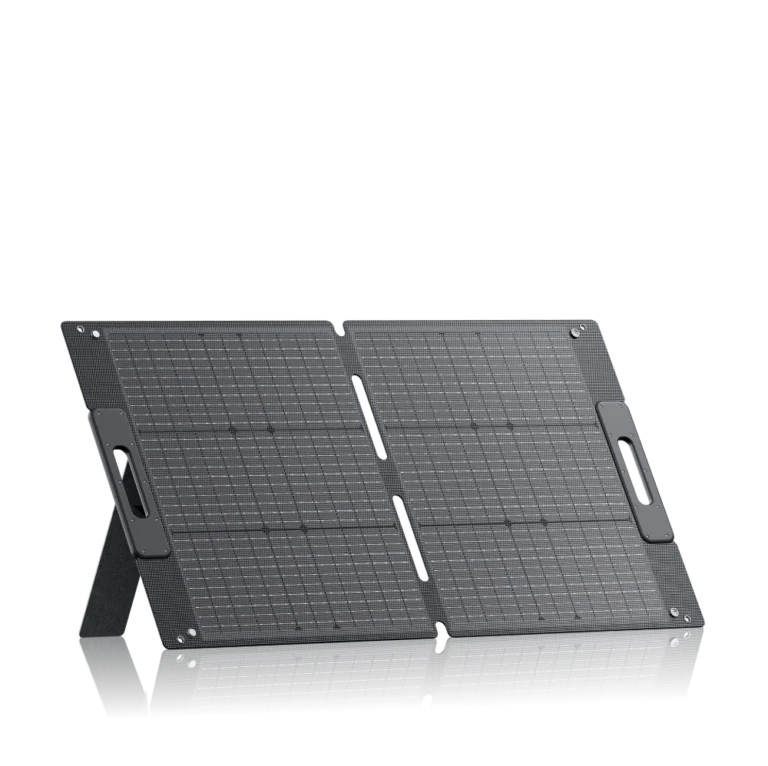
Form factor Rigid, glass + aluminum, Z-bracket mount — does NOT fold Foldable bifold, built-in adjustable kickstands, ETFE — portable-only; manufacturer says NOT for permanent mounting
IP rating IP68 IP67 (splash-resistant, not submersible)
Warranty 5 years 1 year
Electrical (STC) Voc 22.7V / Vmp 18.7V / Imp 5.30A / Isc 5.53A; 600V DC max system voltage (series-capable) Voc 24.62V / Isc 5.13A (Vmp ≈19.5V, Imp ≈5.13A)
Price $199 $199
$/W $1.99 $1.99
Measured output ~93W at optimized roof angle, mid-afternoon (1 owner); 45–93W real-world band by angle/sky/host (our review) 56.6 Wh in 1 hr direct sun, mid-pack vs 14 rivals, one independent bench test (our review)

Mounting it and leaving it outside

  • For anyone bolting a panel down once — to a vehicle roof, a rooftop tent, a truck roof, or a shed or balcony — and leaving it out through driving, rain, sun, and seasons. Portability is irrelevant; weatherproofing and a durable mount are everything.
  • IP68 weather rating, owner-confirmed. Jackery positions it as their most waterproof panel yet, and owners run it roof-mounted on Jeep rooftop tents, truck and Gladiator roofs, and shed roofs without reported water failure (our review). The only weak point owners flag is keeping the Anderson connector interface clean and dry — not the panel face.
  • Rigid, mountable construction. Tempered-glass face and aluminum-alloy frame with a Z-bracket kit and 12 pre-drilled holes; rated –40°F to 185°F and to 600V DC for series strings. This is hardware built to bolt down.
  • 5-year warranty — the longer endurance commitment of the pair, and consistent with a panel meant to live outdoors for years.
  • Real roof output reaches ~93W at an optimized angle in mid-afternoon sun per one owner; plan for a real-world band of roughly 45–93W depending on angle, sky, and the host battery (our review). The low end of that band (~45W into an Explorer 1000v2 over three days) is partly the host’s ~20W idle draw eating the harvest — a panel-plus-station interaction, not a panel defect.
  • The Prime uses an Anderson connector — plug-and-play on current-gen Jackery Explorers via the included DC8020 adapter, but older Explorers need a separately purchased DC7909 adapter (not obvious at checkout), and multi-panel parallel strings need extra Jackery adapters (our review). If your fixed-mount host is a non-Jackery station expecting MC4, that’s added friction — but it doesn’t change the verdict, because the alternative here can’t be permanently mounted at all.
  • The SP100L is excluded here: Bluetti explicitly states the SP100L is not recommended for permanent mounting on a roof or car — it’s a portable, deploy-and-stow panel. On top of that hard gate, its IP67 rating is splash-resistant but not submersible, and its warranty is 1 year — both weaker for an always-on outdoor install than the Prime’s IP68 and 5 years. This isn’t a demotion based on our review; it’s a form-factor disqualification the hardware and the maker both confirm.

Setting it up and packing it away

  • For anyone who sets the panel up at a campsite, on a boat deck, or in the yard to top up a small power station, then folds it and packs it away. You carry it between uses. Foldability and setup are the point; nothing gets bolted down.
  • It’s the only one of the two you can actually fold and carry, and the single axis that has been measured (output) checks out. But its verdict in our review is Watching, not a confident buy — so the pick is eligibility-driven, not proof-driven, and you should know exactly what’s unverified before you spend.
  • Foldable bifold, 10.9 lbs, built-in adjustable kickstands. This is the deploy-and-stow form factor — set it up, angle it, fold it away. The Prime simply cannot do this.
  • MC4 connector — the universal standard, compatible with all Bluetti stations and most solar generators (manufacturer claim). For a portable panel that might feed different hosts, MC4 is more flexible than the Prime’s Anderson.
  • Measured output: 56.6 Wh in one hour of direct sun, mid-pack against 14 rival panels in an independent side-by-side bench test with sound methodology (identical batteries, same place and time, repeated and averaged). It does not reach Bluetti’s 90W ideal-conditions ceiling — plan around the real number, not the marketing one — but it’s competent for topping a small station (our review).
  • The certainty caveat (read this): The SP100L’s verdict in our review is Watching for a reason — that single bench test is the entire independent record. There are no durability reports, no weatherproofing confirmation of the IP67 claim, no independent assessment of the kickstands, and no long-term owner accounts of the series and parallel pairing with Bluetti’s other 100W panels. The one firsthand owner account was a pre-deployment first impression that promised follow-up and never delivered (our review). The panel is the right form factor and its one measured axis is fine, but you’re buying the durability and the kickstands largely on Bluetti’s spec sheet. If you need proof before you spend, this one isn’t there yet.
  • The SolarSaga 100 Prime is excluded here: The Prime does not fold. At 13.23 lbs of rigid glass and aluminum, owners who expected a foldable suitcase panel were genuinely caught out, and there’s no accessory or workaround that turns it into a carry-and-stow panel — our review calls it the wrong product for setup-and-pack-away use. Hard form-factor gate; not reviewable.
The bottom line

At $199 and $1.99 per watt apiece, price and rated watts are a dead heat — they decide nothing. Pick on the one question that actually matters: Will the panel live bolted down and exposed to the weather, or do you set it up and pack it away each time?

Mounting it and leaving it outside? Buy the Jackery SolarSaga 100 Prime. It’s the rigid, IP68, weather-rated, 5-year, Z-bracket panel built for exactly that, and our review backs the weatherproofing with real roof-mounted owners. Buy it on a sale (retail struck-through is $299) and confirm your station’s connector — Anderson is plug-and-play only on current Jackery Explorers.

Setting it up and packing it away? The Bluetti SP100L is the only one of the two that fits — foldable, kickstands, MC4, and a measured output that holds its own mid-pack. Just go in clear-eyed: its verdict in our review is Watching, and the durability, the IP67 rating, and the kickstands are unproven beyond Bluetti’s spec sheet. Fine if you accept that trade; wait for a second independent test if you don’t.

Buying either panel for the other segment’s job is the one real mistake on the table — and it’s the mistake both our reviews warn about most loudly.