When you purchase through links on our site, we may earn an affiliate commission. Learn more.

EcoFlow RIVER 3vsBluetti AC2A (2026)

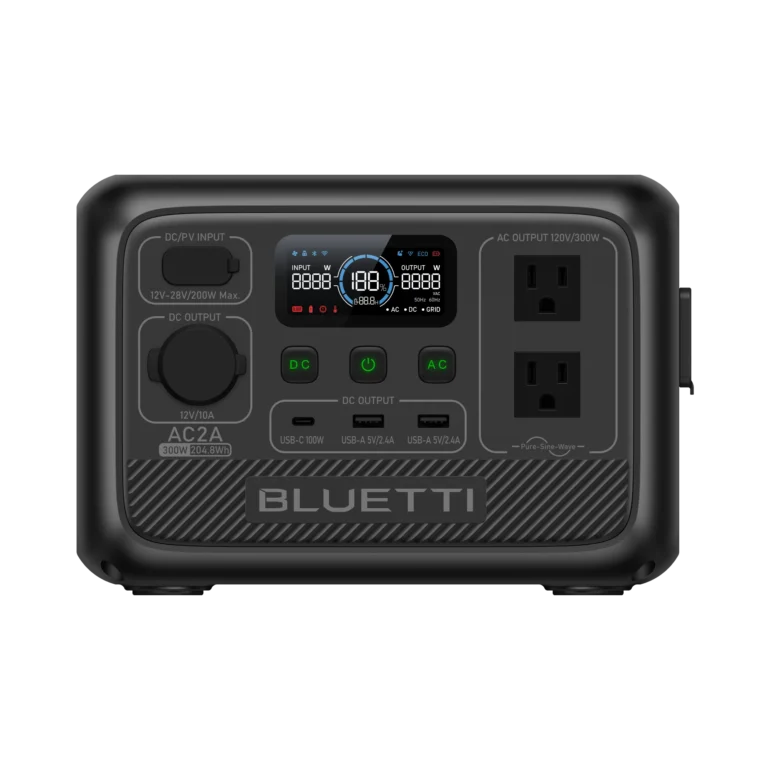
These two are near-twins on paper: both are ~7.8 lb LiFePO4 stations rated at 300W continuous, both list a 600W surge, both are 120V-only, non-expandable, and both carry a sub-20ms UPS and a 5-year warranty. Which one is right comes down to one of four jobs — and three of them go one way, one goes the other.

Check price
Prices and availability change frequently
Check price
Prices and availability change frequently
Spec EcoFlow RIVER 3 Bluetti AC2A
Capacity 245Wh 204.8Wh
Rated output 300W 300W
Surge 600W* 600W*
Weight 7.8 lb 7.9 lb
Chemistry LiFePO4 LiFePO4
AC recharge ~1.0 hr (58 min warm) ~1.2 hr (0–80% in 45 min)
Solar recharge ~2.6 hr ~1.2 hr
AC outlets 2× 120V (one 2-prong) 2× 120V
USB-C 1× 100W PD output
USB-A 2× 12W
Car output 1× 126W
Solar input 110W 200W
Price $199 $219
$/Wh $0.812 $1.069

*600W surge on both is a voltage-reduction mode (X-Boost / Power Lifting) that works only on purely resistive loads and fails on motors, compressors, and electronics. Treat both as honest 300W units.
AC2A solar recharge at 200W input; ships in a quieter charge mode capped near 78W until Turbo mode is set once in the app.
Blank cells indicate figures not recorded in our research, not that the feature is absent.

Always-on home / network UPS

  • Who it’s for: You keep it plugged in 24/7 behind a router, cable modem, Starlink, or a small NAS/home server, and you want the load to ride through outages without a reboot. Stationary, cycling daily for months, light continuous draw (~20–70W).
  • Why it wins: Both units deliver a true sub-20ms UPS switchover — bench testing measured faster than spec, holding across networking gear with no reboots. When the deciding spec ties, the RIVER 3 wins the tie-break on four axes at once: lower price ($199 vs $219), more capacity headroom for when the load creeps up (245Wh vs 204.8Wh, and ~210–215Wh usable through the AC outlet), a lower idle inverter draw (~5W, which matters on a unit powered on 24/7), and the best-in-class app — live draw display, custom charge limits, even Home Assistant integration for scripted server shutdowns. At a ~70W stack our review estimates 3+ hours of runtime; the AC2A runs a 20W router-class load ~6–7 hours. At the same low load the two overlap on runtime, so this is genuinely decided on price, headroom, and idle efficiency.
  • Runner-up — Bluetti AC2A: Its UPS switchover is bench-verified under spec, and unlike Bluetti’s own AC50B (which disclaims UPS), the AC2A delivers it. Reasons it loses the tie: $20 more for ~40Wh less, a higher idle penalty (its AC inverter path runs ~70% efficient), and a louder spec (45dB vs 30dB) that you’ll notice on a desk. One latent risk is mostly dormant in this exact use: the deep-discharge lockout (see store-and-forget segment) rarely bites a unit that stays plugged in and cycling — the AC2A’s own review confirms the always-on buyer is the one who escapes it.
  • Catch: Neither unit runs a kettle, toaster, microwave, hair dryer, fridge, or AC. The 600W surge figure is the same trick on both (X-Boost / Power Lifting) — a voltage-reduction mode that works only on a narrow band of purely resistive loads and fails on motors, compressors, and electronics. Our review documents the RIVER 3’s fridge tripping it on startup surge and a 350W load shutting it off in ~10 seconds; the AC2A review documents a 600W kettle tripping the unit at 243W. Treat both as honest 300W units.

Solar-leaning off-grid / camp charging

  • Who it’s for: You’re away from the wall and replenishing from panels — van life, basecamp, a remote cabin day — topping up phones, laptops, lights, and a small device or two, and you need the unit to actually refill from the sun in a day, not just discharge.
  • Why it wins: Its 200W solar input is nearly double the RIVER 3’s 110W — the single axis on which the AC2A clearly wins. Our review confirms ~170W real from two 100W panels, refilling its 204.8Wh pack in a bit over an hour of good sun. For a solar-primary buyer, that gap is the ballgame.
  • One setup caveat: The AC2A ships in a quieter charge mode that caps solar near 78W; you must switch to Turbo (in the app) once to unlock the full ~170W. It’s a one-time toggle, not a defect — but if you skip it you’ll wrongly blame the panels.
  • Pairing note: Our review names the Bluetti PV200 (200W) as the matched panel for hitting its input ceiling. Treat that as a recommendation only — no panel is read into the AC2A’s price.
  • Runner-up — EcoFlow RIVER 3: With a 100W+ third-party panel (kept under its voltage limit) it charges fine for top-ups, and it’s still the cheaper, larger-battery unit (245Wh vs 204.8Wh). But in a solar-dominant profile it loses on the one axis that’s weighted highest: 110W solar input against the AC2A’s 200W. The base RIVER 3’s bundled 45W panel is described in our review as near-useless (6+ hours in perfect sun, near-zero in winter).
  • Catch: Same surge ceiling as Segment 1 — neither unit runs a kettle, toaster, microwave, hair dryer, fridge, or AC. The 600W surge works only on purely resistive loads.

Store-and-forget emergency insurance

  • Who it’s for: You want to buy it, charge it, put it in a closet, and trust it to work on demand at the next storm or outage — months later, untouched.
  • Why it wins — by veto of the alternative: The AC2A’s review documents a strong, recurring deep-discharge BMS lockout: units left at low charge enter a fault state and refuse to wake from AC, with a recovery procedure that is not in the manual and needs a car cable not in the US box. Its own review calls store-and-forget the riskiest way to use it and cites owners who bought for CPAP, recovery, and wildfire prep and found bricked units at the moment of need. That is a direct collision with this segment’s entire premise. The RIVER 3 carries no comparable documented lockout; it stores and wakes normally.
  • Honest certainty note: The RIVER 3 wins here on the absence of a documented failure, not on a confirmed multi-month retention test — our review measures ~85 hours of idle coast from full but doesn’t characterize months-long standby. Directionally clear, lower certainty. Keep either unit topped up if you can.
  • Scope note: Both are tiny (204.8 / 245Wh). Emergency insurance here means small-load coverage — a CPAP for a night, phones for days, a router for hours — never appliances or whole-home.
  • Catch: Same surge ceiling as Segments 1 and 2 — neither unit runs a kettle, toaster, microwave, hair dryer, fridge, or AC.

CPAP / quiet overnight medical backup

  • Who it’s for: A low-draw therapy device (CPAP) you want to ride through a single night’s outage, sitting on the nightstand where noise matters and reliability matters more.
  • Why it wins: Three things stack for it. Capacity: our review confirms an AirSense 11 (humidifier off) plus a phone and watch running 2+ days on a charge — the longest, most explicitly validated CPAP runtime of the pair, helped by running the device on the 12V/DC output to skip the ~5W inverter idle. Noise: 30dB, review-confirmed silent enough to sleep beside, against the AC2A’s 45dB spec — a real difference at the bedside. Reliability: no storage lockout, so a unit kept ready for outages wakes when you need it.
  • The AC2A is competent here but loses on all three: ~8 hours on DC with the humidifier off (a single night, not multiple), 4–6 hours once the humidifier and heated tube are on, a louder spec (45dB), and the storage-lockout risk that specifically worries a medical-backup buyer. If you keep it plugged in and cycling it’s fine for one night — but the RIVER 3 is the safer, longer, quieter pick.
  • Catch: Same surge ceiling as prior segments — neither unit runs a kettle, toaster, microwave, hair dryer, fridge, or AC. The 600W surge works only on purely resistive loads.

True of both units — The 600W figure is the same trick on both: EcoFlow calls it X-Boost, Bluetti calls it Power Lifting, and on both it is a voltage-reduction mode that works only on a narrow band of purely resistive loads and fails on motors, compressors, and electronics. Our review documents the RIVER 3’s fridge tripping it on startup surge and a 350W load shutting it off in ~10 seconds; the AC2A review documents a 600W kettle tripping the unit at 243W. Neither runs a kettle, toaster, microwave, hair dryer, fridge, or AC. Treat both as honest 300W units. This is a hard hardware wall on both.

The bottom line

The same two units flip verdicts segment to segment. The EcoFlow RIVER 3 wins always-on UPS (the tie-break stack: price + capacity headroom + idle efficiency), loses solar off-grid (its 110W solar input against the AC2A‘s 200W), wins store-and-forget (no documented storage lockout), and wins CPAP overnight (overnight usable Wh + bedside noise at 30dB). The Bluetti AC2A is runner-up on always-on UPS ($20 more for ~40Wh less + higher idle), wins solar off-grid decisively (200W solar input is nearly double the RIVER 3’s 110W), is demoted on store-and-forget (deep-discharge BMS lockout documented in our review), and is demoted on CPAP overnight (less capacity + lockout risk + higher noise). The one-line takeaway: buy the AC2A if and only if solar replenishment is your priority axis; otherwise buy the RIVER 3.