When you purchase through links on our site, we may earn an affiliate commission. Learn more.

Bluetti Elite 400vsAnker SOLIX F3800 (2026)

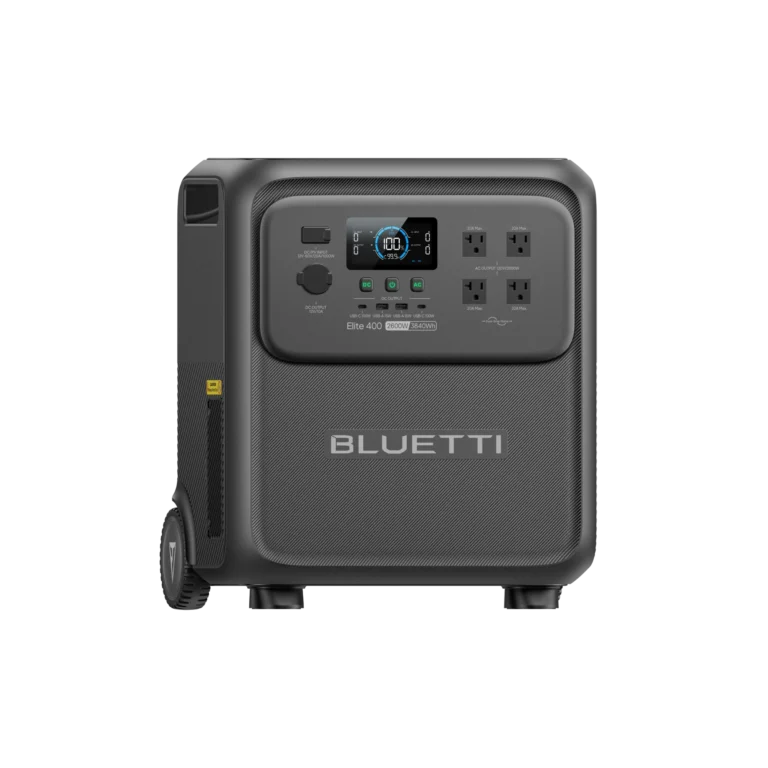
Two big LiFePO4 boxes with the exact same 3,840 Wh nameplate — and almost nothing else in common. The F3800 spends its size budget on a 6,000 W, 120V/240V split-phase inverter that ties straight into a subpanel and scales to around 27 kWh. The Elite 400 spends it on a sealed, 120V-only pack you can roll across the house one-handed, that sips around 12 W at idle and costs $500 less. The capacity tie is a red herring; what you’re actually choosing between is capability and scaling versus livability and value. Below, which one wins depends entirely on which buyer you are.

Check price
Prices and availability change frequently
Check price
Prices and availability change frequently
Spec Bluetti Elite 400 Anker SOLIX F3800
Capacity 3,840 Wh 3,840 Wh
Rated output 2,600 W 6,000 W
Surge 5,200 W*
Weight 86 lb 132 lb
Chemistry LiFePO4 LiFePO4
AC recharge ~2.5 hr ~2.5 hr
Solar recharge
Ports 4× AC (2,600 W total), 2× USB-C 100 W, 2× USB-A 15 W, 1× car 120 W (9 total) 6× AC (incl. NEMA 14-50 + NEMA L14-30R), 3× USB-C 100 W
Solar input 1,000 W max (12–60 V / 20 A) 2,400 W max nominal
Price $1,299 $1,799
$/Wh $0.338 $0.468
Voltage 120V only 120V/240V split-phase
Expandable No (sealed) Yes, to ~26,880 Wh single-unit
UPS Yes, 15 ms switchover Yes

*Elite 400 surge 5,200 W is the startup-transient peak; its separate 3,900 W Power Lifting figure is resistive-only and is not counted as motor-start headroom. F3800 solar input ceiling caps real input around 1,200 W with third-party panels due to 60 V / 25 A-per-port limits. Blank cells indicate a figure was not recorded in our research, not that the feature is absent.

Whole-house essentials with 240V

  • You want backup that wires into a transfer panel and runs 240V loads — a well pump, an electric dryer, a deep freezer on a 240V circuit — from a single box, not a paired pair of units.
  • The Elite 400 is eliminated at the gate — it’s 120V only, with no split-phase, no transfer-switch support, and no TT-30R. It cannot power central AC, an electric range, and a well pump together. The F3800 delivers 6,000 W at 120V/240V from one box with built-in NEMA 14-50 and L14-30, and our review confirms owners ran 240V electric dryers and tied directly into transfer-switch panels, and ran whole houses minus HVAC. Central AC still needs a soft-start or a second unit even on the F3800 — so whole-house essentials, not literally everything.
  • Delivers around 3,400–3,500 Wh per cycle at moderate household draw (measured around 90% out in full-cycle testing), base unit alone. For true whole-house-essentials duration you’ll want at least one expansion battery.
  • The F3800’s most-cited flaw bites hardest exactly here: when you recharge through the 120V AC input (e.g. from a gas generator), the 240V output shuts off, plus three of six 120V outlets. In a multi-day outage you can’t recharge from a generator while a 240V well pump or freezer keeps running — you alternate. The documented workaround is feeding DC through the solar port from a 48V battery or a chargeverter.

Multi-day and expandable off-grid

Roll-anywhere essentials backup, on a budget

  • You want to keep a fridge, lights, router, phones and a few small loads alive through outages, move the unit to wherever the trouble is, and not overpay. No 240V, no transfer panel.
  • At this light 120V load the F3800’s 6,000 W and 240V are dead weight you’re paying for. The Elite 400 is $500 cheaper ($1,299 vs $1,799) for the same 3,840 Wh, which is also the cleaner $/Wh ($0.338 vs $0.468). And it’s genuinely movable: 86 lb on a telescoping handle and wheels that reviewers compare to rolling luggage, with owners reporting one person repositioning it solo.
  • The F3800 is 132 lb — it rolls on level ground but is a two-person job for stairs, vehicle loading, or uneven terrain, and one owner’s unit rolled off a walkway and cracked.
  • The Elite 400’s 2,600 W is a real ceiling, not a footnote — testing tripped overload at 3,000 W after around 2 minutes, and a 2,000 W base load tripped instantly when a kettle was added. Fine for sequential essentials; not for piling simultaneous heavy loads. The vertical-mobility caveat also stands: wheels solve horizontal movement, but Bluetti recommends three people for a lift, so a stairs-only basement is a consideration.

Set-and-forget stored reserve

CPAP and sensitive-electronics overnight backup

  • Medical or near-critical: a CPAP overnight, a desktop/NAS, networking gear — loads that must ride through a grid drop without a reset.
  • The Elite 400’s 15 ms UPS switchover is published and review-validated as comfortably under the around 20 ms a desktop/NAS needs, and our review frames it directly as a strong CPAP backup, with the wheels letting you roll it bedside.
  • The F3800’s UPS switchover time is not published — our review calls grid handover seamless but only via the add-on Home Power Panel and gives no figure, so for a glitch-sensitive medical load its continuity is a spec unknown, not a confirmed number. Add that the 132 lb F3800 is not a unit you move to a bedroom, and the Elite 400 is the clear medical pick.
  • Turn off Eco mode on the Elite 400 for medical-device UPS duty — the default low-load shutoff can cut power to an intermittent or low draw (a CPAP during low-breath periods could fall under the threshold). The fix is one setting; the 15 ms handoff otherwise makes this a strong choice. Note also the UL 2743 label advising against use in a sleeping room (an industry-wide compliance requirement above 1 kWh, not a defect) — practical reading: keep it out of the room you sleep in if you can.
The bottom line

The 3,840 Wh tie means the real question is what the rest of the box is for. Buy the Anker SOLIX F3800 ($1,799) if you need 240V split-phase from one unit (whole-house essentials with 240V) or the ability to scale past a single battery (multi-day and expandable off-grid) — and only if you’ll plan its recharge, because its solar and charge-while-outputting story is its documented weak point. Buy the Bluetti Elite 400 ($1,299) for everything 120V and essentials-scale: it’s cheaper per Wh, half-again lighter and actually rollable (roll-anywhere essentials backup, on a budget), sips far less at idle for stored readiness (set-and-forget stored reserve), and has the confirmed clean UPS handoff for medical loads (CPAP and sensitive-electronics overnight backup). The F3800 is the more capable machine; the Elite 400 is the more livable one. Match the box to the job, not to the matching capacity number.