When you purchase through links on our site, we may earn an affiliate commission. Learn more.

Bluetti Elite 100 V2vsEcoFlow DELTA 3 Classic (2026)

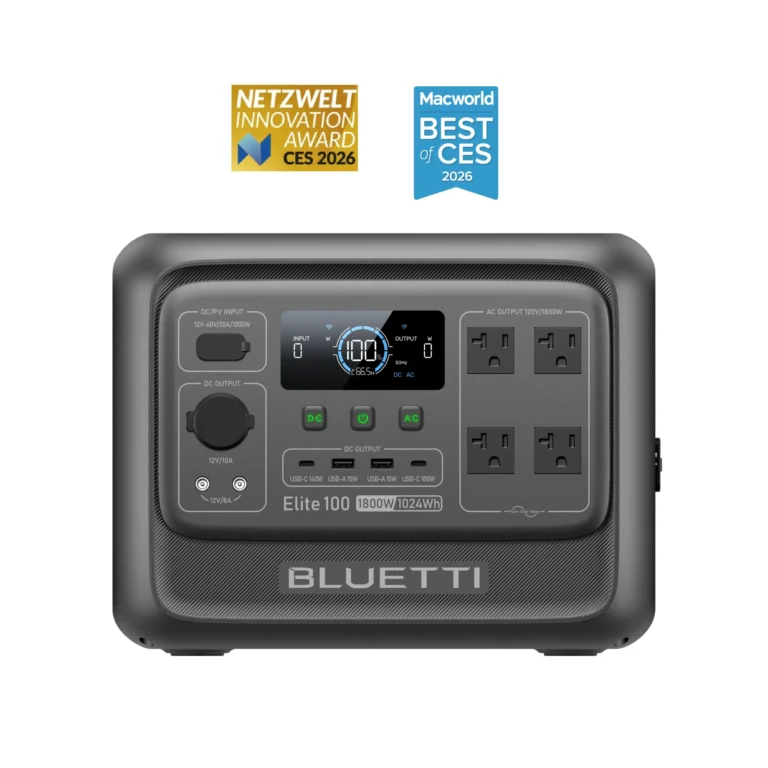
Two 1,024Wh LiFePO4 power stations rated at 1,800W continuous and 3,600W surge — the Bluetti Elite 100 V2 and the EcoFlow DELTA 3 Classic look identical on the spec sheet. Both offer the same capacity, the same output ceiling, the same 10ms UPS switchover, and the same 5-year warranty. Neither is expandable, and both share the same core chemistry and form factor. On paper there is almost nothing to separate them. The difference appears in independent testing, and it is clean: the Bluetti wins the moment you pick it up and carry it somewhere; the EcoFlow wins the moment you bolt it to a wall and ask it to start a motor-driven appliance. Your use case determines the pick.

Check price
Prices and availability change frequently
Check price
Prices and availability change frequently
Specification Bluetti Elite 100 V2 EcoFlow DELTA 3 Classic
Capacity 1,024Wh 1,024Wh
Rated output 1,800W 1,800W
Surge 3,600W peak1 3,600W peak2
Weight 25 lbs 27.3 lbs
Chemistry LiFePO4 LiFePO4
AC recharge ≈1.17 hr (80% in ~45 min) ≈1 hr (80% in ~45 min)
Solar input 1,000W (12–60V, 20A)3 500W (single port)
AC outlets 4 (1,800W total) 2 (1,800W total)
USB-C 1× 140W, 1× 100W 1× 100W, 1× 30W
USB-A 2× 15W 1× 18W
12V car port 1× 12V/10A None
12V DC5521 2× 12V/5A
Price $399 $449
Price per Wh $0.39 $0.438
UPS switchover 10ms 10ms
Noise 30dB at ≤600W 30dB at ≤600W
Warranty 5 years 5 years
Expandable No No

1 Power Lifting mode boosts to 2,700W for resistive loads only (heaters, kettles) — does not handle motor or compressor starting loads.

Solar-first off-grid

  • For buyers who live off the unit for days at a time in remote locations, RV boondocking, or anywhere without shore power, and recharge from solar panels or an alternator while driving. Capacity tolerance is loose because you top up daily; replenishment speed is everything.
  • Solar input ceiling decides this. The Elite takes in 1,000W versus the DELTA’s 500W — a one-hour top-up window versus two to three hours when the sun is your only refill. Independent testing calls this one of the fastest solar refills seen at this size, and the explicit reason it supersedes Bluetti’s own AC180.
  • The 1,000W figure is real but conditional. Full intake requires 48–60V panel strings and enabling the high-current PV mode in the app (it ships off; until toggled, input caps at ~130W). At 24V you pull ~460W, at 12V ~230W. Wired and configured correctly, it delivers — this is a setup step you must take, not a limitation that sinks the advantage.
  • Alternator top-ups while driving via the Charger 1 or Charger 2 (sold separately) unlock what testing calls an effectively unlimited off-grid configuration — a path the DELTA’s independent testing does not claim.
  • The DELTA is the runner-up, with solar topping out at 500W through a single port and reaching full in roughly 1.5 hours under a 500W array. Fine for occasional use, but half the intake — and in a sun-replenished life that is the axis that decides.

Weekend camping and portable use

  • For buyers who carry the unit from the car to the campsite or tailgate, run a 12V cooler, phones, lights, a fan, maybe a grill or small tool, for a day or a weekend. The default throw-it-in-the-trunk scenario.
  • The units tie on headline specs — same capacity, output, surge, and charge speed — so this comes down to weight, the 12V DC port, and price.
  • The Elite is lighter at 25 lbs versus 27.3 lbs, and independent testing notes the flat, handle-hidden top carries one-handed and stacks in a vehicle.
  • It keeps the 12V DC bank the DELTA deletes entirely: one 12V/10A car outlet plus two 12V/5A ports — the connections a 12V cooler, tire inflator, or diesel heater actually plug into. The DELTA 3 Classic has no 12V car port at all, so a cooler buyer is pushed onto the AC inverter, paying the idle tax all weekend instead of bypassing it. For the typical camper running a 12V load, this is the deciding gap.
  • It is cheaper at $399 versus $449 and offers better value per watt-hour at $0.39 versus $0.438.
  • Bonus: dual high-wattage USB-C (140W plus 100W) versus the DELTA’s 100W plus 30W, so a laptop charges at full speed.
  • The DELTA is genuinely close — same capacity, slightly better measured efficiency, quieter under sustained AC load, and explicitly endorsed for weekend camping and tailgating in independent testing. But for the buyer running a 12V cooler, the missing DC port combined with the weight and price gap hand it to the Elite.
  • Both units show an early-failure cluster in independent testing (Elite: dead on arrival or within one to six months; DELTA: weeks to four months). For a once-a-month weekender neither is disqualifying, but it is symmetric and worth awareness.

Always-on home and electronics UPS

  • For buyers who leave the unit plugged in at home to silently guard a fridge, router, NAS, Starlink, a home office, or a CPAP — and wait, often idle, until the grid drops. Standby readiness and idle efficiency matter as much as raw capacity.
  • Idle draw is 13W, top-tier for this class, and the explicit reason independent testing calls it credible as an always-on UPS rather than just an emergency box. The Elite’s standby self-discharge runs roughly 140Wh per 24 hours over DC and roughly 262Wh per 24 hours with the inverter on, so a unit left waiting for an outage quietly drains itself — testing names this a maintenance chore for emergency-prep buyers.
  • Better usable efficiencyroughly 940Wh (91.7% of rated capacity) versus the Elite’s roughly 880Wh (around 86%), measured at comparable AC and high loads so the comparison is like-for-like.
  • Independent testing points here directly: home UPS for sensitive electronics is called the Classic’s strongest case, with owners running Starlink 12-plus hours and the 10ms switchover keeping NAS, routers, and PCs alive through grid drops. The Elite’s testing, by contrast, documents a basement flood when default ECO mode cut the AC outlets during a sump pump’s between-cycle idle — despite correct UPS mode — which is the failing side of its UPS case.
  • CPAP and medical backup fold in here. The DELTA runs a roughly 30W CPAP for 30-plus hours; the Elite gets two to three nights with heating off. Both work, but the DELTA’s lower idle and quieter charging make it the steadier bedside-standby unit.
  • Both units ship with a default that defeats unattended backup until you change it. The DELTA’s two-hour inactivity auto-shutoff cuts power to intermittent loads like a fridge — set it to never. The Elite’s ECO mode does the same and caused the flood above — disable it. Neither is set-and-forget out of the box, and both independent test reports warn against making either your only line of defense for truly critical loads given the early-failure clusters. The DELTA wins this segment, but a medical-critical buyer should keep a second backup behind whichever they choose.
  • The Elite is the runner-up. Once ECO mode is off and System Switch Recovery is on, its hardware does this job well (sub-10ms, owner-proven on server racks). It loses on the standby self-discharge, the lower usable efficiency, and testing that records the failure mode rather than the success.
  • One longevity question remains open for the DELTA: cycle life is unpublished — the manufacturer states only 10 years, with no cycle count anywhere, while the Elite carries a stated 4,000 cycles to 80 percent. For a unit cycled daily this is the one endurance question the DELTA leaves unanswered, slightly lowering certainty on hard daily-deep-cycle backup duty.

Running motor and compressor appliances

  • For buyers who specifically need the unit to start a reactive load — a window air conditioner, a compressor freezer, a motor-driven tool — not just run resistive heaters and kettles.
  • The spec sheets tie at 3,600W surge, so on paper these units are equal. Independent testing says they are not — one starts a window AC, the other refuses, and that is the entire segment.
  • X-Boost (claimed at 2,600W) ran an 8,000 BTU air conditioner in owner testing, and in a head-to-head comparison an EcoFlow DELTA-platform unit started a 1,275W window AC the Elite could not — that exact comparison appears in the Elite’s own independent test report.
  • The Elite’s Power Lifting (2,700W) is resistive-only — kettles, hairdryers, heaters — and testing is explicit: it will not start a window AC compressor or some larger freezers, even in Power Lifting mode. Same brand-wide Bluetti limitation that governs the AC70: resistive boost is not motor-start.
  • Neither unit is a motor monster. Both fail a half-horsepower well pump — the DELTA’s testing records an owner who could not start one, and submersible-pump inrush routinely exceeds what a 3,600W surge spec implies. The DELTA wins the window-AC-and-similar band; nobody here wins the well-pump band. If your load is a deep-well pump, the answer is neither — you need more inverter.
  • The Elite is demoted, not ranked as runner-up, because it lacks the capability this segment asks for. It is excellent at what it does; what it does not include is starting the motor loads this buyer needs.
The bottom line

The same two units recur across every segment; what changes is which axis decides. The Bluetti Elite 100 V2 wins on mobility and replenishment — it takes in double the solar (1,000W versus 500W), weighs less (25 lbs versus 27.3 lbs), keeps a full 12V DC port bank the DELTA deletes entirely, and costs $50 less at current pricing. Those advantages hand it the solar-off-grid segment and the weekend-camping segment, where portability and sun-based recharge are the whole game. The EcoFlow DELTA 3 Classic wins on stationary load-handling — it idles at 13W (versus the Elite’s standby self-discharge), delivers better measured efficiency (roughly 940Wh versus roughly 880Wh), and its X-Boost starts a window air conditioner the Elite’s resistive-only Power Lifting refuses. Those advantages take the always-on home UPS segment and the motor-appliance segment, where readiness and reactive-load capability decide. Match your situation to the axis family — carry-and-recharge or plug-in-and-run — and the pick follows directly.