
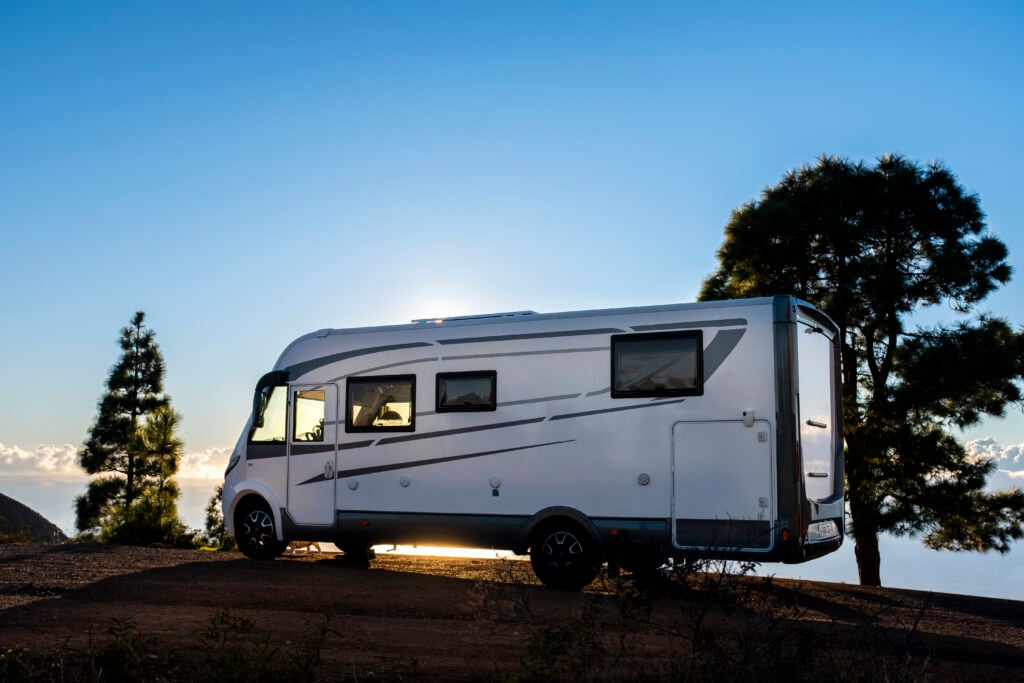
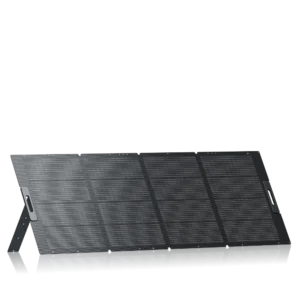
A curved fiberglass or cathedral trailer roof has exactly one panel type that can serve it: a flexible adhesive panel that conforms to the surface, adds negligible roof load, and mounts without the standoff brackets that rigid panels require — brackets that add wind drag and require roof penetrations. That narrows the whole available field to two units. Between them, the specs are close enough that the deciding question isn’t what’s on paper — it’s what’s confirmed working on an actual roof, outdoors, through real weather.
The EcoFlow Flexible is built for exactly this job. At 5.1 lbs and 258° of flex, it conforms to a curved or cathedral roof without standoff brackets, and it mounts via adhesive or pre-cut eyelets with no roof penetrations required. Those are the table-stakes requirements for this segment — what separates it from its only real rival is the evidence that it actually performs on a roof over time.
Independent testing confirms 70–90W per panel in direct unobstructed sun, which is strong output for a flexible panel class that often falls short of even that. Run two in series and they deliver ~158–159W even under slight haze. IP68 weatherproofing has held up in practice: owners report hailstorm survival on trailer roofs, which is the kind of confirmation that matters when a panel lives outside year-round. The 20.3V Voc fits every EcoFlow station’s 11–30V solar input window cleanly, so there’s no voltage-ceiling question across the lineup.
Two things to plan around before you mount it. First, shade sensitivity is real: a hand shadow drops output to a third or less, and light cloud can push it near zero. If your roof gets afternoon tree shade, plan around significantly reduced harvest during those windows — this is a flexible-panel characteristic, not a defect, but it’s the thing that matters most for sizing. Second, the warranty situation is genuinely unclear. EcoFlow does not publicly state a warranty term for this SKU. The roughly 12-month figure circulating in owner reports is not a confirmed specification — verify it at checkout, because one documented panel failure at 15 months exists in the field and long-term durability under sustained roof heat is an open question. If you’re buying the panel standalone rather than as part of an EcoFlow station bundle, note that the solar-to-XT60 cable ships with EcoFlow stations, not with this panel — order it separately.
Skip it if: your roof gets heavy afternoon shade (you’d need to size for 30% output during those hours, which may not be worth the install) — or if your station isn’t an EcoFlow and you want to confirm voltage compatibility first.
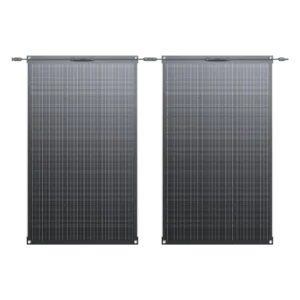
The Bluetti PV100 FX is genuinely attractive on paper: lighter at 4.85 lbs, cheaper at $164.50 per panel, rated at a slightly higher 23.4% efficiency, and it carries a stated 1-year warranty. For a curved roof feeding a mid-to-large Bluetti station — an AC180, AC200-class, or Apex — it’s worth considering once you’ve confirmed your station accepts its 41.4V open-circuit voltage.
That voltage point is the hard stop: 41.4V Voc exceeds the solar input ceiling on Bluetti’s smaller current stations (the AC2A being the clearest example), where the panel simply won’t charge. Beyond the voltage gate, there’s no independent real-world output measurement for this panel — plan below nameplate rather than against it. And its IP67 rating covers splash and brief exposure; Bluetti explicitly advises against leaving it in standing rain, which is a real limitation for a panel intended to live on a roof. Until long-term roof-mounted durability data exists, the EcoFlow’s confirmed hail survival and IP68 rating carry more weight than the PV100 FX’s numbers on paper.
The test an RV folding panel actually faces isn’t a sunny afternoon at a level campsite. It’s a hundred fold-and-stuff cycles into a cargo bay, a few hours bouncing over washboard roads, three thunderstorms at sites where you couldn’t get back in time to bring it in, and then another unfolding on a Tuesday like none of that happened. Output matters. But a panel that outputs well on day one and cracks at the hinge by month four has already failed at the job.
The SolarSaga 200W is the one panel in this tier that a long-term test confirmed takes the abuse RV travel actually delivers: 90 days of rough rocky-terrain handling with no cell damage and no measured performance loss. That’s the fact this segment turns on. The 5-year warranty — the longest in the class — backs it up. For a panel that gets folded and unfolded at every site, those two things together are worth more than a tenth of a watt of efficiency advantage.
The output story is also better than most of this class. Owners consistently measure 198–200W in aligned strong sun using the built-in SolarTarget shadow sight, which is unusual — most comparable panels undershoot their ratings by 15–20% even in good conditions. At lighter loads and partial cloud you’re looking at 100–160W with repositioning, which is honest planning territory for an average camp day. The IP68 rating has held up in the field too: owners report thunderstorms, rain, and morning dew over extended use without issues. Built-in USB-A (5V/2.4A) and USB-C (5V/3A) ports let you charge phones and cameras directly at camp without running through the station.
There are two handling notes worth taking seriously. A small cluster of connector reports — one burn-out, one loose seat — points to a specific habit: seat the DC8020 connector fully and support the cable weight rather than letting it hang free from the panel port. The two-kickstand design also lets the inner panel sag when open, and the whole thing can blow over in a gust — weight the legs on exposed sites.
The proprietary DC8020 connector is also the pick’s clearest limit: it locks this panel to Jackery stations. For an RVer running a different brand, this is the most expensive path to 200W in the segment — and the runner-up makes a strong case at $80 less.
Skip it if: you’re not running a Jackery station — the proprietary connector makes it the wrong choice for any other ecosystem, and the runner-up offers better value there.
The NextGen 220W is the output-and-value argument in this tier. At $299 it’s the cheapest panel here, and it’s also the one that most consistently meets or beats its rating: owners regularly see 180–210W front-side in strong aligned sun, with 215–240W possible in cool temperatures. An integrated kickstand and working angle guide make deployment straightforward. For an RVer who sets up at a single site for the trip and handles the panel deliberately, it’s an excellent piece of gear.
The reason it’s the runner-up rather than the pick is specific and worth quoting directly from the field evidence: the panel has a documented recurring cracking pattern at the hinge and edges under repeated folding and transport. That failure mode is exactly what an RVer who moves between sites regularly inflicts on a panel every weekend. The 12-month warranty is too short to provide a real backstop against it. At 15.4 lbs with no carry handles it also requires two hands. For the RVer whose pattern is set-up-once-per-trip and careful handling, it’s a strong buy on output and value — just go in knowing what it can’t absorb. One note on the bifacial design: the back-side gain is real on reflective surfaces like sand, concrete, or snow (15–25%), but drops to 5–10% on natural grass — don’t pay for the back side if that’s where you camp.
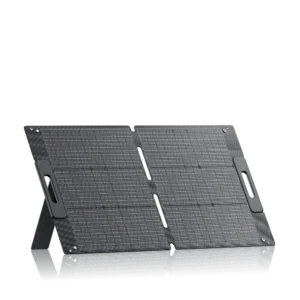
The broadest-compatibility panel in the tier and the best option when partial shade is a regular camp condition. Its four sections are wired in parallel, so shading one drops output proportionally rather than collapsing the whole panel — a genuine advantage over series-wired competitors. It’s also the cheapest at $349. The limits are real: the carry handle is a systematic failure point (self-tapping screws into thin plastic that often breaks on first use — handle it with care), the IP67 rating means it should come in for rain, and the field record shows real output decay under daily continuous use. Best for a Bluetti-station RVer who values the shade tolerance and compatibility and camps occasionally rather than full-time. Not the right call for anyone who’ll depend on it every day or run it in consistent weather exposure.
The clean drop-in for an Anker SOLIX station, and that’s the only reason to consider it. At full retail it’s the worst value in the tier, real output runs 156–160W in full sun and collapses to around 25W under cloud, the legs are flimsy, and no warranty is stated. Buy it if your station is already a SOLIX and ecosystem compatibility is the priority; otherwise the pick or runner-up is the better spend.
A strong scalable alternative for the EcoFlow-station RVer who doesn’t always need a full 200W panel. At 9.26 lbs per panel you can deploy one on a light day and add more as needed. See the boondocking segment for the full treatment; the relevant note here is that it’s a deploy-and-stow panel, not a roof fixture, and its per-watt value is the best of any panel in this guide.
Dry-camping for days puts a different demand on a panel than a weekend top-up trip. You’re repositioning through the day to chase the sun, leaving it out in variable weather, and asking it to put back enough energy into a large station to run a fridge and real loads overnight. Rated wattage on the box is nearly irrelevant — what matters is how much of it actually arrives in the battery by end of day, under mixed sun conditions, from a panel and stand that still work after the fifth adjustment.
The boondocking panel’s job is maximum real harvest, day after day, in conditions that won’t always be optimal. The PV350 is the panel whose real-world numbers most clearly confirm it wins that axis: independent testing puts peak output at 280–330W — 80 to 90% of rated — where the rest of the high-output class typically delivers 60–75%. In a direct comparison, it held 315W in full sun and out-produced a 400W glass panel in shade (240W versus 207W). That shade performance is particularly relevant to multi-day boondocking, where at least some of your harvest hours will be under diffuse or partly cloudy sky. Even under full cloud cover it keeps producing meaningful watts at around 150W, rather than collapsing toward zero the way lower-efficiency panels do.
The continuously adjustable kickstands — a seatbelt-strap mechanism — let you track the sun through the day without committing to a fixed angle, which is the mechanical feature this segment needs. At $599, it’s also the least expensive of the serious high-output panels while delivering the most confirmed harvest. For a mid-to-large Bluetti station, it’s a cleaner solution than juggling multiple smaller panels.
The voltage gate is the first thing to check before buying: at 46.5V Voc, the PV350 exceeds the solar input ceiling of Bluetti’s smaller stations — the EB3A, AC2A, AC50B, AC60, and EB70 will either throw an overload warning or simply not charge. It’s correct only for AC180, AC200-class, and larger Bluetti stations. Verify your station accepts 46.5V before ordering.
The weather situation is the main operational tradeoff. IP65 means splash-resistant, not weatherproof — the manual explicitly says not to expose it to rain or snow. This is a deploy-and-retrieve panel; you bring it in when weather rolls in, unlike the IP68 runner-up that can sit through a storm. No corner grommets or tie-down points, combined with mid-panel handles, means a gust can flip it on an exposed site — anchor it. One purchasing note: a regional variant called the PV350D exists with a much lower Voc (around 33V, with some reports as low as 27.6V) that can cause compatibility mismatches with certain station MPPTs. When you receive the panel, verify the spec sticker reads 46.5V Voc before relying on it.
Skip it if: your station is a small Bluetti (EB3A, AC2A, AC60, or similar) — the voltage mismatch is a hard stop — or if you need a panel you can leave out through rain, in which case the IP68 runner-up is the right choice.
The SolarSaga 500X earns its runner-up slot on one specific profile: the Jackery-ecosystem boondocker who repositions several times a day, needs a panel that can sit through active rain, and will commit to tilt-mounting it at 20–30° toward the sun rather than laying it flat. That commitment is non-negotiable — laid out in the accordion pose Jackery’s own marketing often shows, it produces around 250W, roughly half its rating. Tilted properly, it delivers around 400W, and near-optimal angles in clear sky push close to 495W. Jackery’s own support puts the realistic ceiling at 70–80% of rated, and that number is only achievable if you do the tilting.
The reasons to choose it over the pick: at 22 lbs it’s significantly lighter than the PV350’s 30.6 lbs — a real ergonomic difference when you’re repositioning multiple times a day. It’s IP68, so it stays out through storms. The 5-year warranty is the best in the high-output class. Its bifacial sub-panels keep producing when one section is partially shaded. If repositioning weight and all-weather capability matter more to you than harvest-per-dollar, and you’ll reliably do the tilt-mounting, it’s the right panel. One wiring note: into a high-PV-input station with a 135V minimum floor (such as the Explorer 5000 Plus), a minimum of four panels in series is required — three panels at 41.7V Vmp falls 10V short of that floor.
The EcoFlow-ecosystem boondocker’s match, and the review’s own stated sweet spot is exactly this deployment: set up at a campsite for days, stored between seasons. IP68, MC4, Voc 48V. Real output runs 70–75% of rated — 300–360W peak — and at $599 it’s the best dollar-per-rated-watt of the high-output options. The catches are real: at 35.3 lbs it’s a two-person setup, the case-kickstand design causes the outer panels to sag rather than face the sun squarely (owners build DIY stands to fix this), and the polymer surface degrades under long-term permanent mounting. Worth it for the EcoFlow boondocker who accepts the weight and stand workaround.
Best build quality and IP67 protection in the class, and genuinely right for a set-and-leave Anker array where one connection delivers the output of two PS200s. Not the right panel for active daily sun-chasing: its snap-button angle stand has a documented design failure — it tears out, sometimes on first setup — that has no reliable workaround, and only three of four sections have kickstands. At 35.3 lbs, daily solo repositioning becomes its own problem; Anker’s own recommendation for that use case is two PS200s instead. Wiring note: Voc is 57.6V — cap series strings at seven panels (eight would hit 460.8V and exceed the Anker E10‘s 450V ceiling). No warranty is publicly stated. $699.99 · $1.75/W.
The scalable route for an EcoFlow boondocker who doesn’t want to commit to a single large panel. Deploy one 9.26-lb panel on a light day and add panels in parallel up to eight (1,000W) on a heavy one. Real output meets or beats rated — a four-panel 500W set measured 525–537W in testing. IP68, 5-year warranty, and at $169 per panel ($1.35/W) it’s the best value-per-watt of any panel in this guide. Caveats: the light build tips in wind and the tempered glass can crack if it falls, so anchor it on exposed sites. Its 50V Voc exceeds the solar input ceiling of several non-EcoFlow stations — confirm compatibility before mixing ecosystems. This is parallel-native wiring: three panels in series would hit 150V and reach a DELTA Pro 3‘s ceiling, so keep strings in parallel.