
The homestead segment has one requirement that clears most of the field before anything else is weighed: native 240V split-phase output, wired through a transfer switch, for days at a time. The well pump, furnace, and kitchen circuits are all in play, and solar is the only recharge source that doesn’t burn fuel.
The Explorer 5000 Plus wins on the axis that matters most to a solar-primary prepper: verified solar delivery. Rated solar input numbers are claims; what independent testing measured here is 3,600–3,900W intake in clear conditions, refilling the pack in roughly 1.9 hours. That is the highest confirmed solar throughput of any unit reviewed for this guide — not the biggest rating, the biggest confirmed number. The two candidates with higher ratings couldn’t back them up: the EcoFlow DELTA Pro Ultra‘s solar peaks at 3–3.7kW against its 5.6kW rating and throttles to 500–1,000W in heat, and its own review calls it the wrong unit for a solar-primary plan. The Anker SOLIX E10‘s 9,000W rating has a single real-world data point, measured under overcast — it’s an unverified claim against a confirmed figure.
The 240V case is equally well-documented. Independent testing put a 2,400W well pump, dual RV air conditioners, and full kitchen loads through the 7,200W split-phase inverter cleanly, at 2.2–2.6% THD — numbers that say the inverter can handle motor-start events without complaint. Runtime anchors at this segment’s loads: a 21 cubic foot refrigerator runs about 28 hours, a home office about 18 hours, central AC about 2.8 hours on the base pack. Expansion reaches 60kWh per unit. It operates at 35–40dB below 3,000W, livable indoors.
Three constraints, all real, all plannable. First: AC charging disables 240V output entirely — but DC and solar input do not. For a solar-first prepper that’s actually the right trade: the array keeps recharging while the 240V circuits stay live. Second: the high-voltage solar input requires a minimum 135V at the port, which means panel strings must be wired in series — three or more SolarSaga 500X panels at 48.5V open-circuit each clear that threshold. Third: the 14,400W surge is overstated in testing; the unit could not start a 10,000W-surge AC load, so plan a soft-start capacitor for central air. The app is the weakest component by a significant margin; the hardware runs correctly from the physical controls without it.
The IP20 enclosure is the planning boundary that shouldn’t be skipped: this station must live indoors. Its fans pull ambient air, and humidity is the enemy.
The panel pairing: Jackery SolarSaga 500X
500W rated · TOPCon bifacial · 25% efficiency · 22.05 lbs · IP68 · $799
The review for this panel is blunt about the accordion-pose default: flat on the ground, it delivers roughly 250W. Tilt-mounted 20–30°, it reaches about 400W, and Jackery’s own support puts the realistic ceiling at 70–80% of rating. The review’s verdict is ‘Skip Unless’ — and this is precisely the unless scenario: a Jackery station owner who will mount panels at an angle on a fence post, pole, or ground stand. Build your array around 350–400W per tilted panel, wired in series strings to meet the 135V input floor.
Skip it if: your recharge plan is genuinely solar-only and you won’t tilt-mount the panels — the SolarSaga 500X’s rated input is only reachable at an angle, and a flat array halves your replenishment speed; the runner-up E10 or a grid/generator-primary plan deserves a second look.
The E10 is the permanently installed path — NEMA 4 outdoor-rated, passively cooled and completely silent, modular from 6.1kWh to 92kWh. Its review confirms 5-ton central-AC startup, transparent 20ms transfers through real outages, and tri-fuel generator integration for effectively indefinite runtime. The 30–450V MPPT window takes nearly any array you could build. What keeps it at runner-up is exactly the axis that decides this segment: the 9,000W solar figure is not field-verified, and for a solar-primary plan that matters. Also weigh the documented order and support failure cluster, app-only control, and the fact that the companion Smart Generator cannot ship to California. The PS400 (400W rated · 23% efficiency · IP67 · $699.99, with independent testing confirming 275–345W in good sun) is the matched portable input for the E10; larger permanent arrays are the natural next step for serious builds.
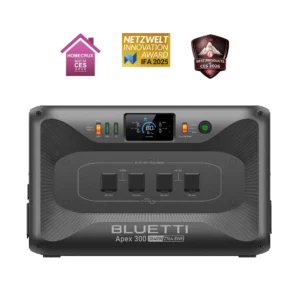
The cheapest split-phase station in the catalog, with two findings worth noting for preppers specifically: independent testing measured 18–24.7W standby draw — the lowest of any split-phase unit reviewed here — and confirmed operation at −15°C. It’s behind the pick on the solar axis: independent testing measured roughly 790W per solar port and only 1,000–1,100W optimal against a 2,400W rating, and the 60V MPPT ceiling can’t take standard 400W panels in series. A 60–150V dead zone sits between the built-in controller and the SolarX 4K accessory. If the Apex 300 is the budget path, plan the array around Bluetti’s own low-voltage panels — the PV350, at 46.5V open-circuit, fits.
One portable panel or two in the yard, a fridge and router staying alive through a long weekend without power, no transfer switch beyond a manual essentials circuit — this is the most common prepper setup, and the 3–3.6kWh, 120V band is crowded with units that look interchangeable on a spec sheet.
They’re not. At this segment’s loads and solar constraints, the field separates on a single axis: how much sun actually enters the battery when the grid is down.
The F3000’s 2,400W dual-MPPT solar input is more than double anything else in this class, and the number isn’t just a rating — independent testing took real panel setups to roughly 1,900W combined through those two ports. No other unit in the 3kWh band came close under test conditions. Full 3,600W passthrough means loads keep running while the battery refills at full speed, and a measured idle draw of 20–35W protects the runtime you actually have.
Usable capacity in this segment’s regime: roughly 2,760Wh at the wall under light discharge, around 2,650Wh through a heavier draw, and about 2,490Wh at a 200W continuous load. A cycling fridge plus electronics sits between those figures — plan around 2,500–2,750Wh. The unit runs at around 35dB under moderate loads, pairs cleanly with a manual transfer switch for essential circuits, and expands to 24kWh.
One catch that belongs in every emergency kit conversation: the AC charging cable is a proprietary twist-lock with no standard substitute. A single damaged or lost cable takes AC charging off the table. Keep a spare before you need it. Also know that independent testing put the real AC-on idle runtime closer to 88 hours than the five-day marketing figure — meaningful for multi-day outage planning.
The panel pairing: Anker SOLIX PS400
400W rated · monocrystalline · 23% efficiency · MC4 native · 35.3 lbs · IP67 · $699.99
Independent testing measured 275–345W in good sun. The review profile matches this buyer precisely: the set-it-and-leave emergency deployer. Two PS400s carried a household through a three-week post-hurricane outage. Its 57.6V open-circuit voltage lands squarely inside the F3000’s 11–165V high-voltage MPPT window. The snap-button kickstand is a documented failure point — handle it deliberately, not roughly. Treat 400W as a label and size the array around what testing shows.
Skip it if: your outage scenario runs more than two days and you can’t guarantee sun — the runner-up’s quieter operation and smart solar modes make more of a limited panel, and that gap grows when clouds cut the day short.
The quietest unit in the class — bench-measured at 25dB or below under 600W — with a genuinely useful prepper feature in Self-Powered Mode: it runs the house on solar between configurable thresholds, and Storm Guard pre-charges ahead of weather alerts. Independent testing measured roughly 2,690Wh usable in a full discharge. It loses the segment on solar input: 1,600W rated against the F3000’s 2,400W, with MPPT efficiency measured near 80% in testing. For multi-day outages when clouds cut into recharge time, that gap matters. Its review also flags 19–30W idle draw and sub-75% round-trip efficiency if left plugged in year-round. Pair with the EcoFlow 400W panel ($599 · IP68 · independent testing confirmed 300–360W peak) for occasional emergency deployment — the review is explicit that permanent outdoor mounting degrades the polymer surface.
The best closet-ready readiness profile in the band: independent testing confirmed zero-drain charge retention over storage, charging down to −4°F, and the highest cycle rating of any unit here. It’s behind the pick on solar — the review’s words are that the 1,000W solar input is ‘undersized for the battery, full stop,’ with a pair of 200W panels taking ten or more hours of perfect sun to refill it. It recurs as the runner-up in the medical segment below, where the load regime changes the solar calculus entirely.
The power rides in the truck. When it gets called on, there is no grid to fall back on, no generator in the driveway — just what solar puts in and what the battery holds. This is the segment where reliability isn’t a nice-to-have, it’s the whole point.
The spec sheet makes this look easy: two units at roughly 25 lbs with 1,024Wh of LFP and class-leading 1,000W solar input. The reviews do not agree that it’s easy.
It’s built for exactly this duty cycle. A dead battery is a 55-minute wall refill before departure or roughly an hour of strong sun through the dual ports mid-route; the 800W alternator-charger option tops it off while driving; expansion reaches 5kWh across compatible EcoFlow battery packs; and the Smart Generator 3000 auto-start covers a no-sun contingency. Independent testing and extended owner deployments both document a clean UPS record — a year of uninterrupted uptime in real use, bench-confirmed 8ms switchover. The Bluetti Elite 100 V2 matches it on paper and costs $200 less, but its review documents a recurring early-failure cluster — dead-on-arrival units and unprompted deaths within one to six months — plus a default ECO mode that has shut off outlets under a low cycling load. A bug-out unit is the last line of defense. That’s the wrong failure mode for the last line of defense.
Two limits to know before the first deployment: the DELTA 3 Plus idles at 32–40W when left switched on, which will drain the pack meaningfully over a parked day — switch it off between use cycles rather than leaving it live. The measured surge held around 2,600W in testing against the 3,600W rating, so large motor loads may not start; size loads accordingly.
Running a 12V fridge on the DC output bypasses the inverter idle entirely and stretches usable energy toward the high end of what the battery holds. A 300W-average fridge on AC runs about three hours; mixed light loads — fridge, Starlink Mini, laptops — drew the unit to about 70% over ten-plus hours of an owner deployment. DC is the right port for this segment’s primary load.
The panel pairing: EcoFlow NextGen 220W Bifacial
220W front / 175W rear · TOPCon · 25% efficiency · 15.4 lbs · IP68 · $299 · XT60i cable included
This is a rare panel: it actually hits its rating. Owners routinely measure 180–210W front-side in good sun, which is nearly unheard of at this size and price. The bifacial rear gain is real on reflective surfaces — 15–25% on concrete, sand, or snow; 5–10% on grass. One handling rule that matters for a kit that gets loaded and unloaded: the tempered glass cracks under careless folding. Pack it with padding and deploy it gently, the same occasional-use pattern this kit runs.
Skip it if: you’re running the unit unattended and can’t do the initial configuration — the runner-up’s ECO-mode default makes that a real risk; stick with the pick, or go directly to the next segment’s winner for the reliability record that unattended criticality demands.
The value case: the lightest body in the tier with the same 1,000W solar ceiling, at $399. For an attended user who configures it before deployment, its review calls it the best mobile unit in Bluetti’s lineup. Three setup steps before trusting it: disable ECO mode, enable the high-current PV setting (off by default — without it, solar input caps near 130W), and wire panels at 48V or higher to unlock the full input ceiling. The early-failure cluster is why it’s the runner-up; Bluetti honors its 5-year warranty, but a warranty RMA and a bug-out situation are not compatible timelines. The PV350 ($599 · 350W rated · 46.5V Voc · 30.6 lbs · IP65) is on Bluetti’s own compatibility list, delivers 280–330W in good sun per independent testing, and its voltage is precisely what unlocks the Elite’s full input. Accept the 30.6 lb weight and the bring-it-indoors-in-rain IP65 rating.

The fastest-recharging unit in the class — bench-confirmed 46–47 minutes to full — and the lightest at 24.9 lbs. It’s here instead of higher because its 600W solar ceiling requires 29–60V panels; common low-voltage portables cap its input near 200W, which undercuts the solar advantage this segment needs. It wins the next segment, where a 48V-class panel and a different load regime change those numbers entirely.
When an outage plan starts with a CPAP, the usual buying logic inverts. A bigger battery sounds safer, but a fixed 10–30W of inverter self-consumption can eat a quarter of the pack or more at a 40W overnight draw — nameplate Wh is the least useful number in this segment. What decides it is evidence at the actual load, through the actual port, for the actual device.
That evidence exists for exactly one unit reviewed for this guide.
The C1000 Gen 2 wins on the only evidence that actually counts here: owners measured four nights of CPAP per charge running the device DC-direct, bypassing the inverter and its idle tax entirely. No other candidate reviewed for this guide has a regime-matched, port-matched runtime figure. The sub-10ms UPS switchover is bench-confirmed across desktops, NAS units, and CPAPs riding through outages without interruption. Below 200W it operates under 20dB — quieter than most bedroom fans — which matters when the device runs all night next to a sleeping person.
Two setup rules that are non-negotiable for a device this critical. Complete the initial Bluetooth app pairing before you ever need it off-grid — outlets may not activate otherwise. And schedule firmware updates deliberately, not automatically: they cut power to outputs mid-process, which is not acceptable behavior for an emergency medical device. Both issues are documented in the review and both are fixable in advance.
The solar limitation is real and the panel pairing is the solution: the 600W input requires 29–60V panels, and common low-voltage portables cap the input near 200W. At a 40–60W nightly CPAP draw — roughly 250–350Wh — one panel-day of real sun outruns a night of use with margin.
The panel pairing: Anker SOLIX PS400
400W rated · 23% efficiency · MC4 native · 35.3 lbs · IP67 · $699.99
The PS400’s 48V working voltage and 57.6V open-circuit voltage land squarely in the C1000‘s 29–60V high-voltage window. Independent testing measured 275–345W in clear sun. At the medical segment’s draw rate, one PS400 and a clear day rebuilds more than a night of use. See the essentials segment for handling notes on the kickstand.
Skip it if: you need the CPAP covered and the fridge covered from one unit — the runner-up’s buffer handles both without math; the pick’s 1kWh is plenty for the medical device alone, but a second large load on AC means a shorter window between solar recharges.
For the household that wants the CPAP and the fridge on the same unit. The buffer is large enough that regime anxiety disappears: independent testing measured roughly 3,240–3,270Wh usable at the AC outlets (~90–91% of nameplate), 10ms UPS response, zero-drain charge retention confirmed over storage, and charging down to −4°F. The spec card is in the essentials segment above. Two notes before relying on it for medical loads: its review contains no CPAP-regime runtime measurement, so the exact number of nights it provides at 40W AC is genuinely unquantified (the margin is obviously large; the figure isn’t in evidence); and one owner reported erratic UPS fan behavior under light load. Wall-plugged bypass output caps at 1,440W — irrelevant for a CPAP, worth knowing before plugging in anything larger. The SolarSaga 200W pairing ($379 · 200W TOPCon bifacial · 14.33 lbs · IP68 · DC8020 native) is the rare panel whose review confirms it hits its rating when properly aligned via the SolarTarget sight. If you run two panels, use matched pairs per port — the two inputs share one charge controller, and mismatched panels risk overcurrent.